About Rachel

View all posts by Rachel
Further Adventures In The Abstract Garden
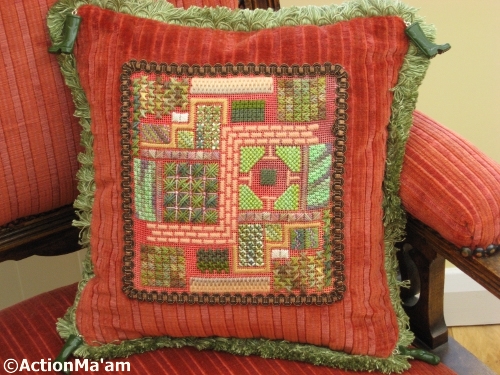
The Finished Cushion
You may recall that I worked an abstract piece of canvaswork inspired by a vegetable garden. When I’d finished it, I didn’t like it very much, and really didn’t know what to do with it. However, my cousin (who comments here occasionally as Action Ma’am) did not suffer from the same problem. Not only did she like it, she knew what to do with it. I’ve asked her to write up what she did, and here’s what she wrote:
Having commented how the abstract garden canvas reminded me of my veg garden, I was delighted when Rachel offered it to me. I knew exactly what to do – it had already told me it wanted to be on a cushion for the armchair in the conservatory. My guess that the red of the canvas was the same as the red of the upholstery was spot on.
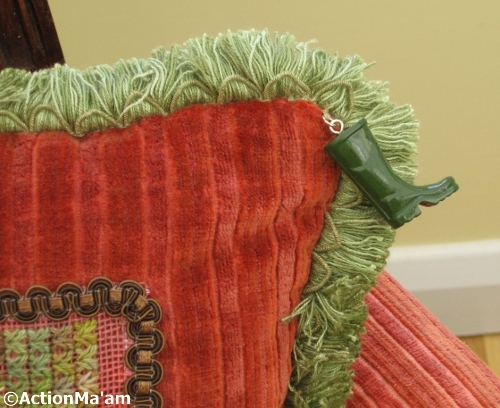
Close Up Of The Corner Trim
I don’t have a sewing machine, so Fiona my curtain-maker agreed to put the cover together for me. Not having done any needlework for many years, I was quite alarmed at the prospect of “getting it right”. Rachel and I had an email discussion about how to straighten the canvas and apply it to the velvet, handstitching it in place. To emphasize the garden theme, I had chosen some gimp braid to cover the edges of the canvas. The loops of the braid echo the hoops of the iron edging you sometimes find around borders in posh parks and gardens. I also chose some green fringe to define clearly where the cushion ended and the chair began.
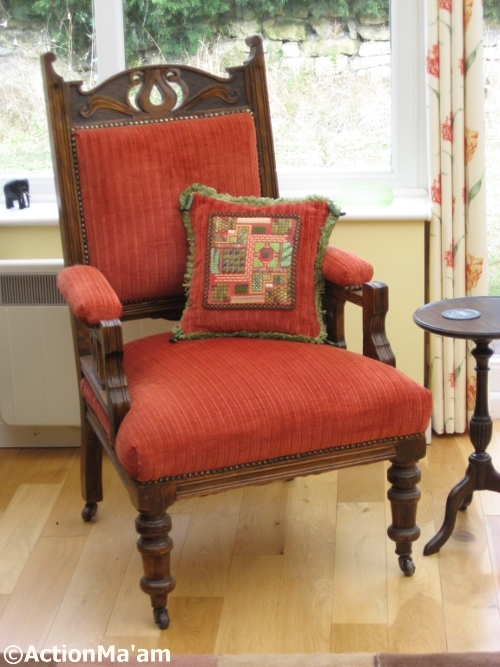
The Cushion On Its Chair
Whilst I was still thinking about getting started, Fiona phoned to say she could deliver a bedspread she had been making for me the next day. This was too good an opportunity to miss. I took the afternoon off work, a deep breath, gritted my teeth and leapt in. The stripes on the velvet helped in getting the canvas straight, the braid hid the edge of the canvas, and two hours later, it was ready for Fiona.
Whilst the cover was away being made up, I found a necklace in an accessories shop, with a green wellington boot charm on it. I bought four as a finishing touch.
The abstract garden canvas is now a happy cushion, nestling into the crook of the chair arm, and kicking its welly-booted heels in the air. I don’t think the chair intends letting go of it any time soon!
The Camberwell Panel – Fourteen
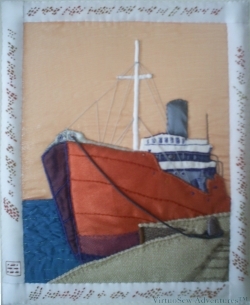
Final view
So at last, Finished!
By the time I had finished stitching it all I could nearly read Morse Code, even when it was running diagonally. The dedication runs from the bottom left anticlockwise around the picture – so the top border is upside down!
When I’d finished the whole dedication, and got to the left hand border I felt the end looked a little vague, so then I worked the little cartouche at the end of the left-hand border which contains my initials in Morse code. Somehow that provided me with the “full stop” the piece needed. The dedication itself already included the date, so I only had to sign it.
My cousin has had it beautifully mounted and framed in a box frame, and I gloat over it every time I visit her. Fortunately she loves it too, and she is going to write a guest post about framing and hanging the Camberwell in her house.
I also provided a booklet for her which documented all of the process of planning, designing, and working the piece, so there is a complete “provenance” attached to the piece as well.
Close-ups on the Elephant Doorstop
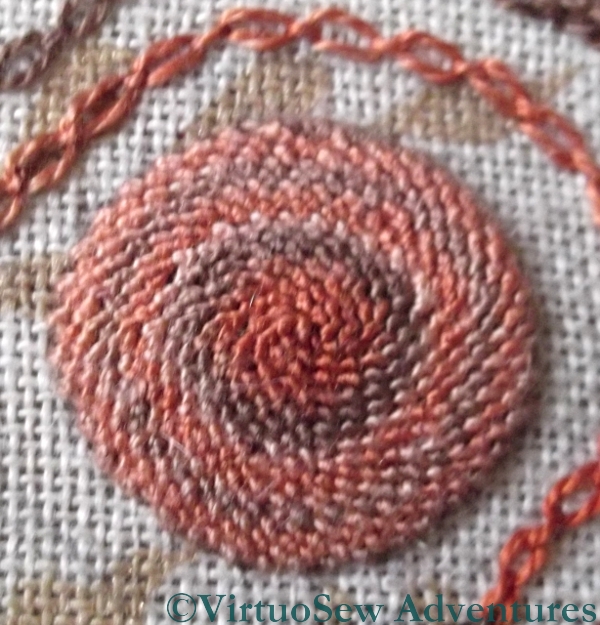
Close Up - Spiral Trellis Stitch
I’ve been asked to provide a few close ups from the Elephant Doorstop, so here goes.
This close-up shows the spiral trellis stitch medallion on the Elephant’s ear. I love this stitch – it creates a lovely nubbly texture! It’s about three quarters of an inch across.
The silk perlé I am using was in ready cut lengths, shading from orange to brown, and when I brought a new thread in, I started with the colour I’d just finished, so that the colour sections would be slightly longer and denser.
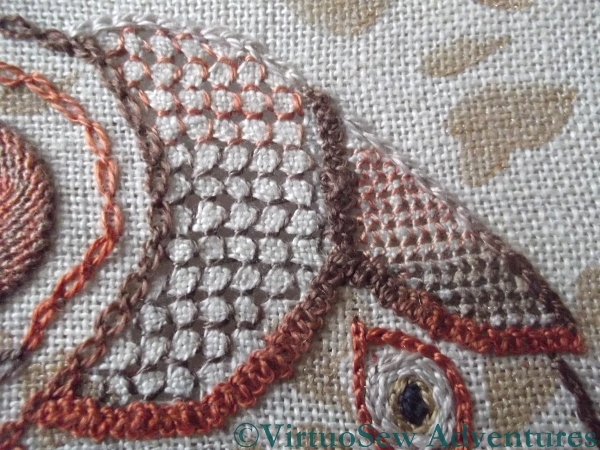
Close Up - Two Sizes of Four Sided Stitch
When I thought about working four-sided stitch on the Elephant’s headcloth, I was originally intending to work some other pattern over the top, so the background grid would modify the fabric and the pattern on the top would be the most visible thing. However, I couldn’t decide what size would be best and worked one section in each size, and now I’ve decided I like it just as it is. It recalls the Trellis Couching on the saddlecloth, but at a different orientation.
Tudor and Stuart Masterclass – Month Seventeen
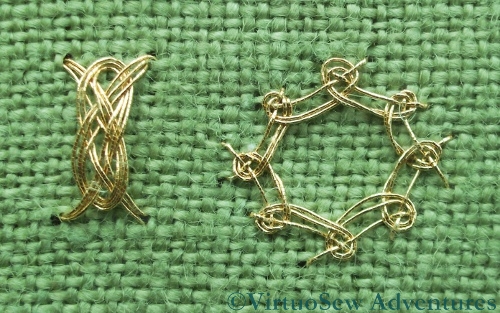
Eight Sided Interlacing And Josephina Knot
Month Seventeen’s stitches were Eight Sided Interlacing Stitch, and the Josephina Knot. I rather enjoyed them, too – they’re both very ornamental indeed!
The Eight Sided Stitch is less scary than you might expect on first sight, although I was slightly surprised to realise that the foundation layer interlaced in the direction contrary to the one I expected.
It will be more exciting at the smaller size on the real sampler, but I feel that I understand the structure, at least, and that is the important point, at this stage.
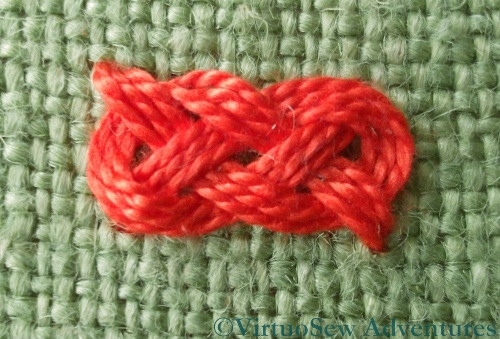
Josephina Knot in Pearl Cotton
However, if you look at the gold Josephina Knot in the top picture, you will see that I didn’t quite get the hang of that one…
This pearl cotton version shows what I was aiming for. It’s a really lovely ornamental spot stitch, with a slightly Celtic feel to it. However, if the interlacing goes wrong at any point during the working, it is very hard to recover – and not always easy to see before you’ve finished, either.
I made extensive use, for these stitches, of a belated birthday present from Elmsley Rose – a set of bone needlework awls/stilettos. I have a steel laying tool, but it’s so sharp that it’s not a good tool for coaxing threads into place. My birthday presents were just perfect – Thank You, Megan!
Elephant’s Anklets Identified!
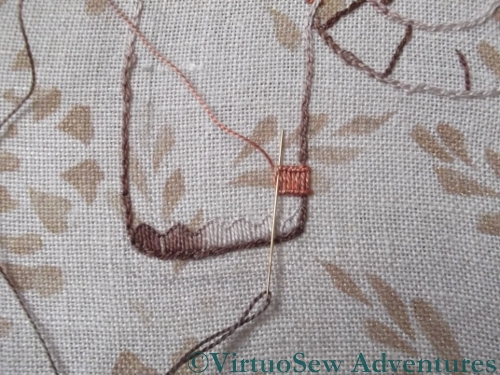
Ladder Stitch Foundation
I’ve been struggling to decide what to do with the anklets for the Elephant of Infinite Charm. When I look at the Elephant without anklets it’s clear the design needs more visual weight lower down in the design, but when I asked the Elephant what sort of anklets he wanted, he just humphed at me. For days!
Now, however, I think I’ve cracked it. And one of the really pleasing things about the idea is that it helps me to practice my Ladder Stitch, which I’ve been struggling with for the Tudor and Stuart Goldwork Masterclasss. It’s easier in silk, partly because I’m not quite as conscious of the expense of the thread (I can’t believe I just wrote that!), and partly because the thread slides over itself more easily.
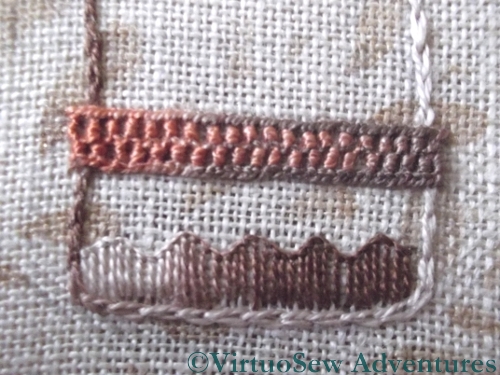
Zig Zag On LadderStitch Anklet
So here is my choice – ZigZag on Ladder Stitch. It adds a bit of patterning and structure , but it’s not out of scale with the Elephant or with his feet. The only slight difficulty is that because it it a complex stitch on top of a fairly complex foundation, it’s not exactly lightening-fast. Still, I’ve got one done, and the Elephant isn’t humphing anymore. When I’ve done both, I will need to decide whether to put a second anklet further up the leg. The original ceramic version does, but then in the ceramic version the anklet is smooth…
Tudor and Stuart Goldwork Masterclass – Bonus Instructions
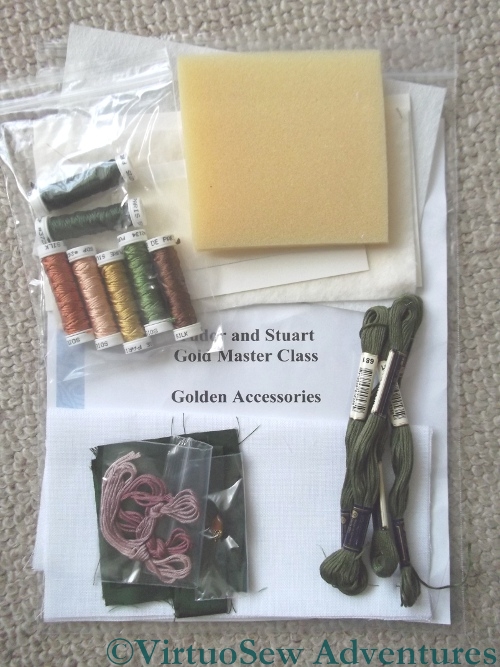
Golden Accessories Kit
There was a set of Bonus Instructions in the instructions for Month Fifteen, from a teaching project that Tricia had retired from use. She was asked whether she’d produce kits of the materials for those of us who don’t have easy (or even difficult!) access to a really good needlework shop. Yet again, apparently, demand outstripped her expectations (a good problem to have!), and here is my kit.
It includes finishing materials for the various accessories, as well as the fabric and the silk thread, but not the metal thread, since all of us already have large spools of that from doing the main Spot Sampler.
My intention is to finish these to add to that planned “winter decoration corner” I’ve mentioned a couple of times. I’ve found some masks which I’m going to decorate in silver and gold, and I will use some metallic gauze or something similar for the background. Already the two Needlework Nibbles, the Floral Glove Needlecase and the Tudor Pincushion look like they will create some wonderful reflective textures for a dark corner…
Tudor and Stuart Masterclass – Beginning the Petite Pincushion
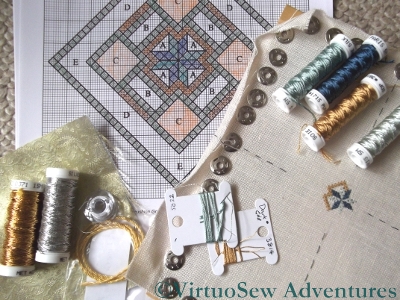
Starting The Petite Pincushion
There were two additional projects included in the Tudor and Stuart Goldwork Masterclass, to provide further opportunities to use some of the stitches we are learning. The Tudor Pincushion was one, and this “Petite Pincushion” is the second. The materials include a piece of silk brocade for the backing, some gold cord to provide an ornamental edge, and more spools of assorted metal threads for the goldwork stitches.
Whereas the silk stitchery for the Tudor Pincushion was in primarily in Tent Stitch, most of the silk work on the Petite Pincushion is in Queen Stitches. I’ve not done any since I finished the silkwork on the sampler, and I am finding that I am having to remind myself to pull them tight to create the openwork effect. I will have to remember to line the embroidered side of the pincushion or the stuffing will poke out through the gaps!
I stitched centre lines on the fabric, but as you can see, once I had the first stitch placed I snipped out the middle stitches and pulled them back out of the way.
I’ve already finished with two of the silk colours, which appear only in the central starburst. Now I just have to do rows of strapwork in the other two colours, as well as the four blocks of tent stitches that provide a basis for a rather intriguing-looking interwoven stitch which will probably be nearly the last element I add.
Christus Natus Est is Finished! (I think..)
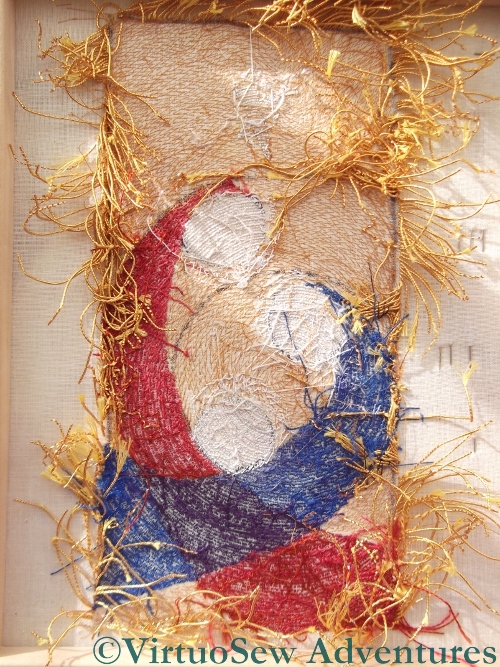
Back view of the finished panel
After considerable effort, and not a few significant struggles that I rather doubted I would win, I think I have finally finished the Christus Natus Est panel.
This back view shows a tangle of ends of the gold thread, caught down occasionally where the silk work has carried on over the top. If you look at the full size picture (click on the one on the left) you will see that in fact the central section is reasonably neat. What has made it untidy is that there were elements that I added to it – the halos that were done after the heads, the rust colour that I added into St Joseph’s robe, the additional light blue added to the Virgin’s robe. And of course there are all those wild gold threads which have a mind of their own!
The full size picture also gives you some idea how tiny all the coloured silk stitches are (we think on the order of 80 to 100 stitches per linear inch) – which will explain why I really didn’t want to have to unpick anything..
I’m going to put it away for a week and then look at it again to be sure it’s as finished as I can make it, before I mount it over padded acid-free card in preparation for framing.
Tudor Pincushion Finished
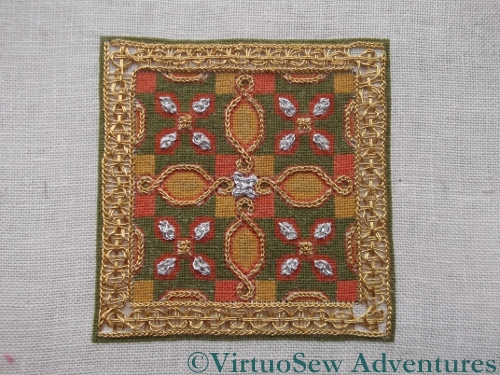
Tudor Pincushion Final Stitch In Place
The final stitch in the Tudor Pincushion was the central boss in Four Sided Interlacing Stitch, which slotted nicely into place after I received the instructions for Month 16.
I decided – after staring at it intermittently while I’ve waited for the stitch to turn up – that I was happy enough with the border and did not need to unpick it. So the next phase was to attach the silk backing and stuff the pincushion.
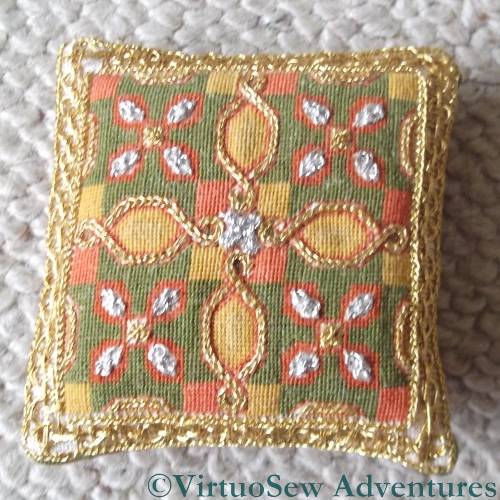
Finished Tudor Pincushion
I’ve tried not to over-stuff it, since I intend to use it as a decoration and not as a pincushion, but I still found myself pushing more stuffing in than I expected. Unlike the Tulip Slip Pincushion, where the velvet was so tough that I used a sewing machine, this one is finished entirely by hand, and stuffed enough to look plump and fat, but not so much that the fabric is strained.
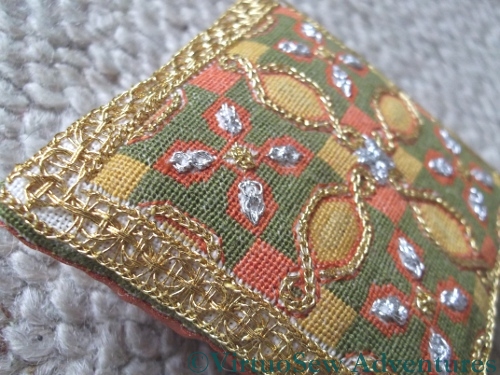
Close Up Of Pincushion
I’m finding with Tricia’s various pieces that photographing them from an angle sometimes produces a much clearer view of the stitching. There is certainly less likelihood of “glare” from the metal threads. Besides, after all that effort, I’m more than happy to show off a little…!
Cause for Alarm
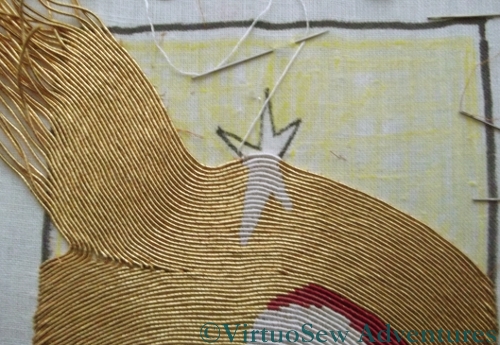
The Star That Rose In The East
I’m pleased with the progress I’m making on the panel now, but I’m becoming slightly anxious that I might run out of the gold thread before I finish the panel. I don’t know how thick the core is at the centre of the spool, and I’ve noticed that the kinks in the gold thread are getting tighter and more stubborn. If I do run out, that will put paid to the idea of photographing the finished piece for this year’s Christmas card.
You can see from this shot that the extra thickness of the silk thread forming the star is creating an extra curve in the lines of gold. If I were working a classical piece of or nué, with straight lines of gold, I would be trying to space the lines to reduce the effect, or I would have chosen a finer silk thread, with the same aim. In this case, however, I am quite happy to add an extra couple of curves to the gold lines, because it will add life and movement to the background.
If I have enough gold thread, I will rework the corner that is infilling that triangle on the left-hand side. I don’t think that the bends in the thread work as well as they might, and they are revealing the core more than I like. I need to finish the rest of the panel first, though.