Tag: Silk thread
More on Aethelflaed’s border
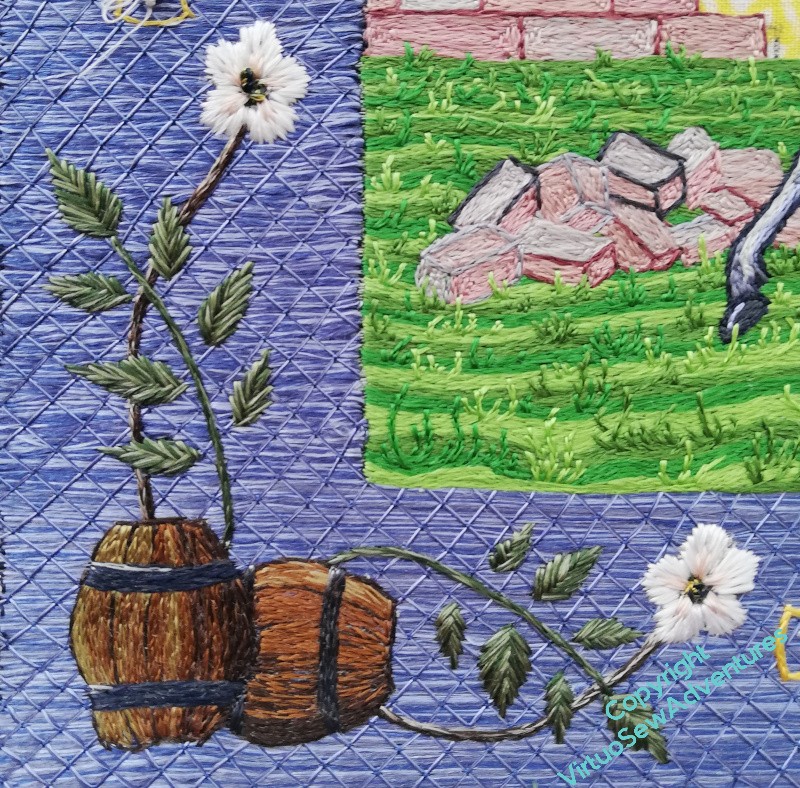
Aethelflaed’s border continues to make progress.
I’ve reversed the colours of the dog roses relative to William Marshall, making the outer edges of the petals white, with only a hint of pink towards the centre. The rose leaves have been heathered, pale and dark green in the needle together. I may decide they need a bit of the paler green around the edge to make the edges more obvious, but for now I think I’m content with them.

The next thing I wanted to do was to get the crosses in progress. I’m having quandaries about the skeps, and doing the crosses at East and West will give me some thinking time.
I remember with William that leaving the crosses until last left me a bit doubtful about them, and since I learned then that the crosses needed to be filled in, the only question, really, was How?
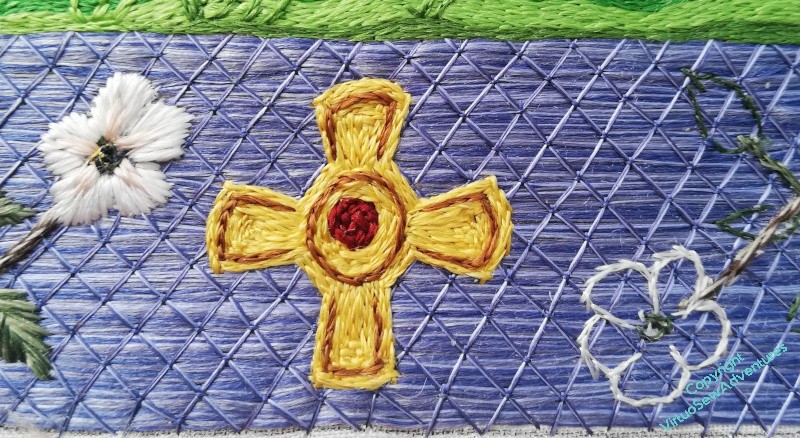
As I want to bring to mind the several crosses found in the Staffordshire Hoard, and some others of the period, they are obviously going to be gold and garnet – we got that far when I was doing the design work. However, How much detail of chasing (engraving) or embellishment with niello do I want to add? There’s the real gold of the background which is going to alter the balance of the whole piece, so I may need to add more, but for now, a single outline for each shape and a central garnet, and I think I have a reasonable version for my purposes.
Making a start on the border..
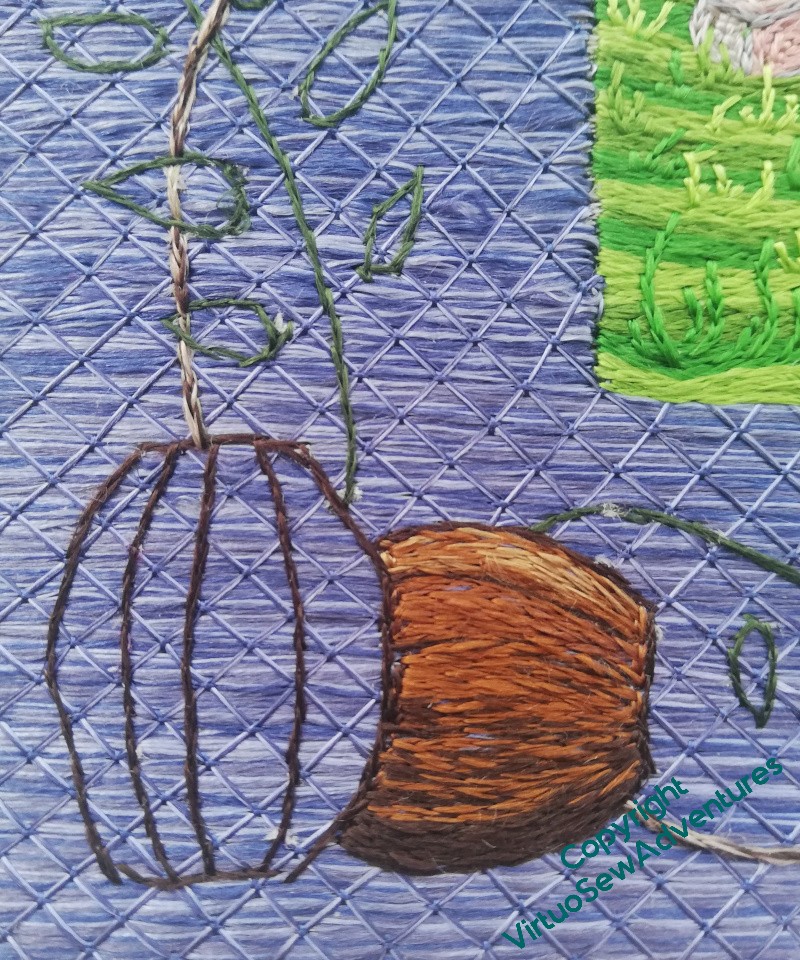
When last you saw Aethelflaed, I had split-stitch transferred the design onto the border, and made a start on the first barrel.
I am using memories of the barrels that figure so prominently in “Asterix in Britain” to give me an appropriate level of colouring, something not too subtle, but not too clunky either. If I can manage it, I want to have something fairly simple convey a greater level of detail than is really there.
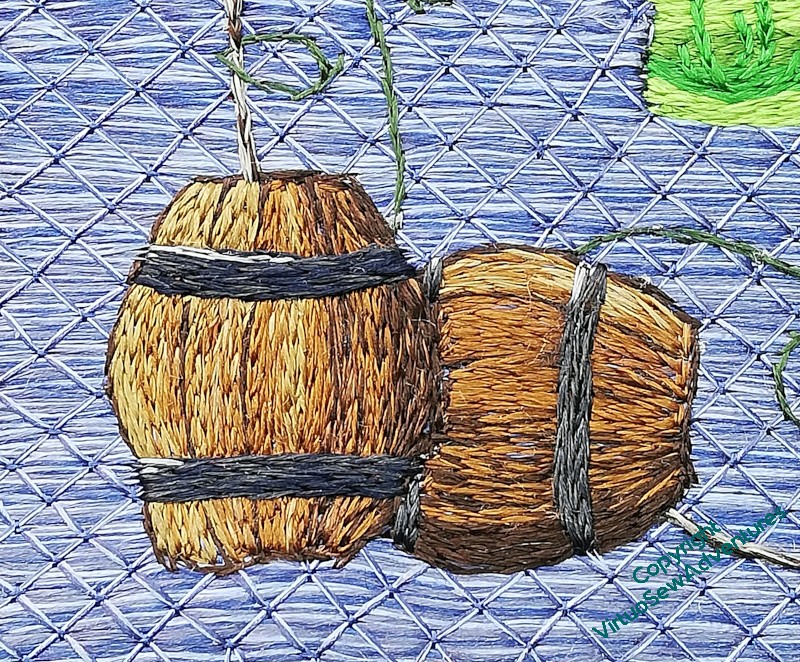
And honestly, I think I might be achieving that. Blending the silk threads stretches out the tones slightly, but the other thing it does is to create some impression of the grain of the wood. It might be a bit too much, too detailled when it’s seen up close, but at any sort of distance, I think it works.
And now, for some record keeping…
I have been slow to learn that I need to keep track of what I’m doing. At various points in the Dreams of Amarna, I had a very bad moment or two when I couldn’t track down the information about something I’d done so that I could do something similar somewhere else. One of the uses of a blog is to keep records!
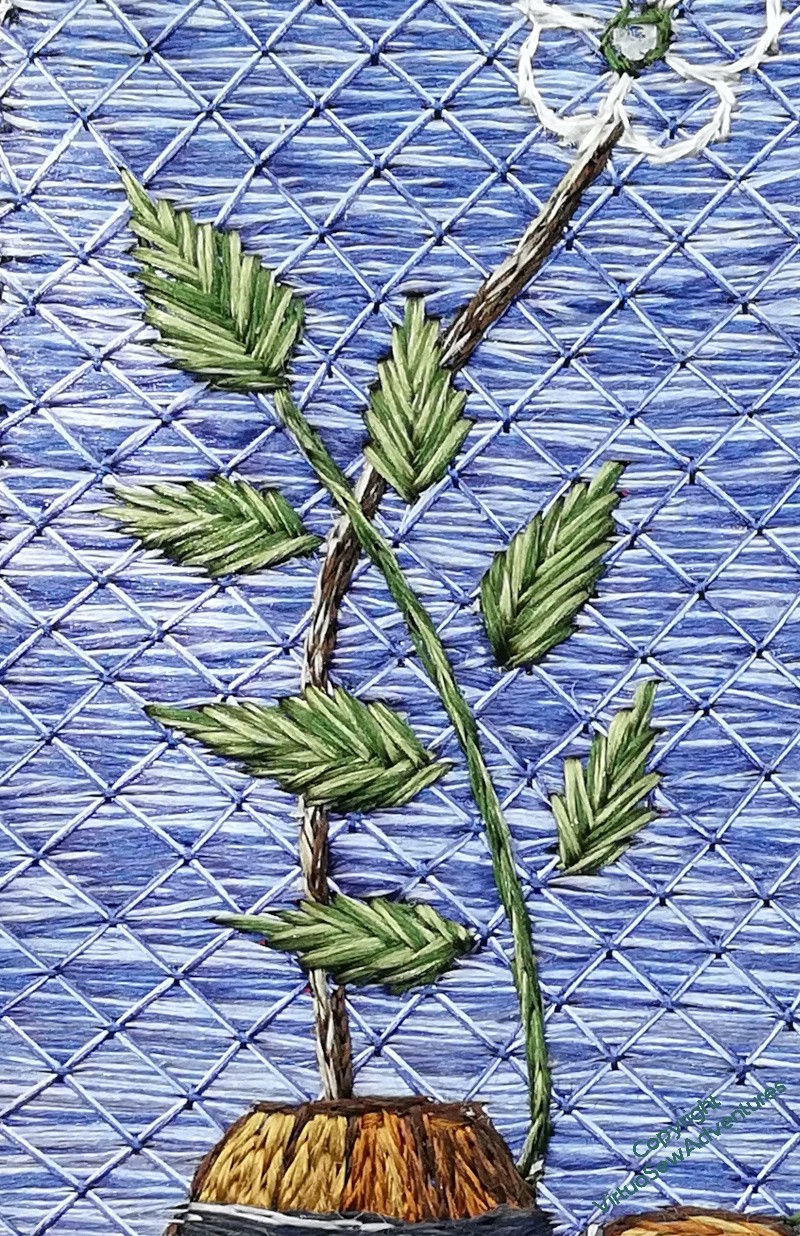
So far in the border, I have been using four strands of silk in my needle, just as I did in the rest of the piece. For the rose leaves, I’m using eight, four light and four dark. I want them raised over the stems without any sign of the stem behind them.
That seems to be working, too.
Finally getting on with it
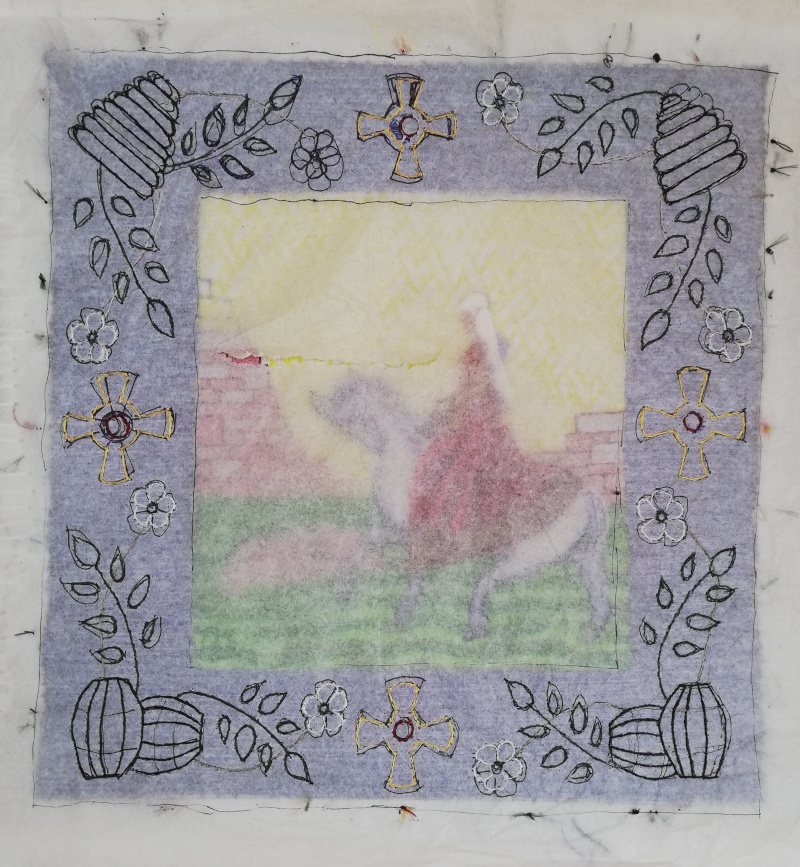
It has been quite the epic trial, getting Aethelflaed’s border designed, fiddly and full of repetition. I have learnt over the years that in fact that’s what I need to help me gain some surety in a design. And in turn, that is why I’m working so hard on being able to paint and draw. Improving those skills will make the iteration quicker and easier, so I may even be able to do more and gain greater surety. Rahere and Mother Julian are both going to offer significant challenges that I’ve not quite got the measure of yet!
However, one could write a substantial article on the various choices of design transfer method and when to use them. In fact, I’ve already written a blog post, many years ago during the Great Lady’s Magazine Stitch Off (happy days!), which described the methods I had experience with, and what that experience was. There are useful responses in the comments, too, describing other experiences and favourite tools.
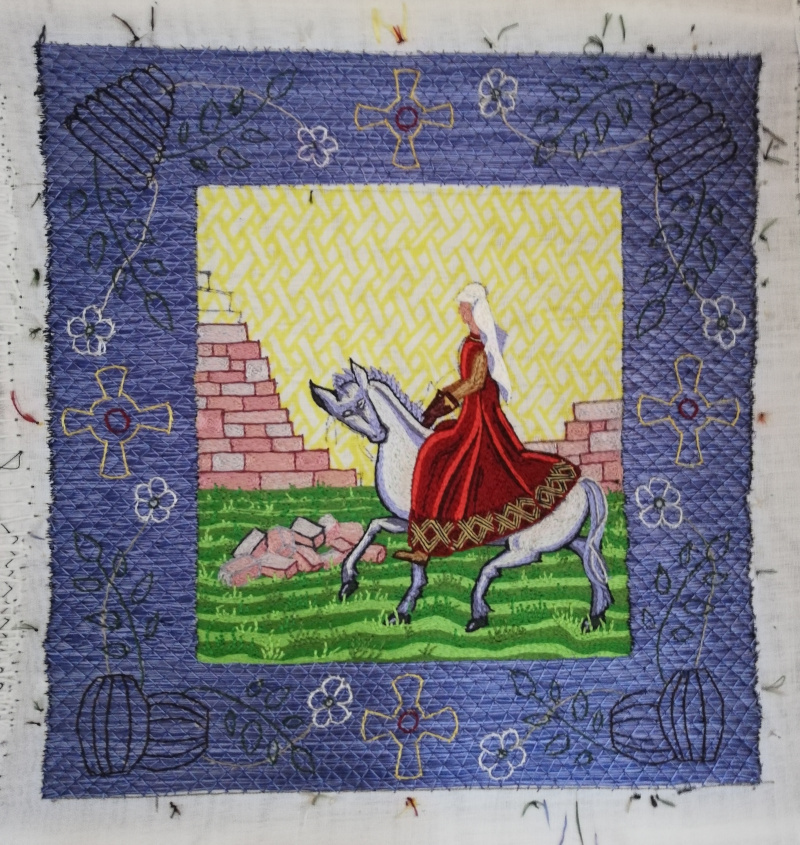
In the case of these Opus Anglicanum panels, there’s really only one sensible choice of design transfer method. Since I will be stitching over stitching, and what’s more, that stitching is in silk, I really can’t attempt to draw on it or transfer marks to it.
That leaves the running-stitch-through-tissue method, except that I discovered with William Marshall that that didn’t make the design clear enough to follow! Having learned from that, therefore, I went directly to split stitch through the tissue paper. It took several mornings of stitching, but I got there in the end.
And I have now managed to get started on it. I’m using blended strands in a couple of places – as I’ve said before, I’m not attempting to do something that looks as though it was done during the medieval period. This is a modern piece, by a modern embroiderer, exploring how the ancient and modern techniques can be in conversation with one another.
And yes, that does sound perilously like an artist statement in an exhibition, but it captures the sense I have of the techniques alternating the lead, as it were. It doesn’t really sound better if I say the techniques are dancing, does it?
Finally getting the border settled!
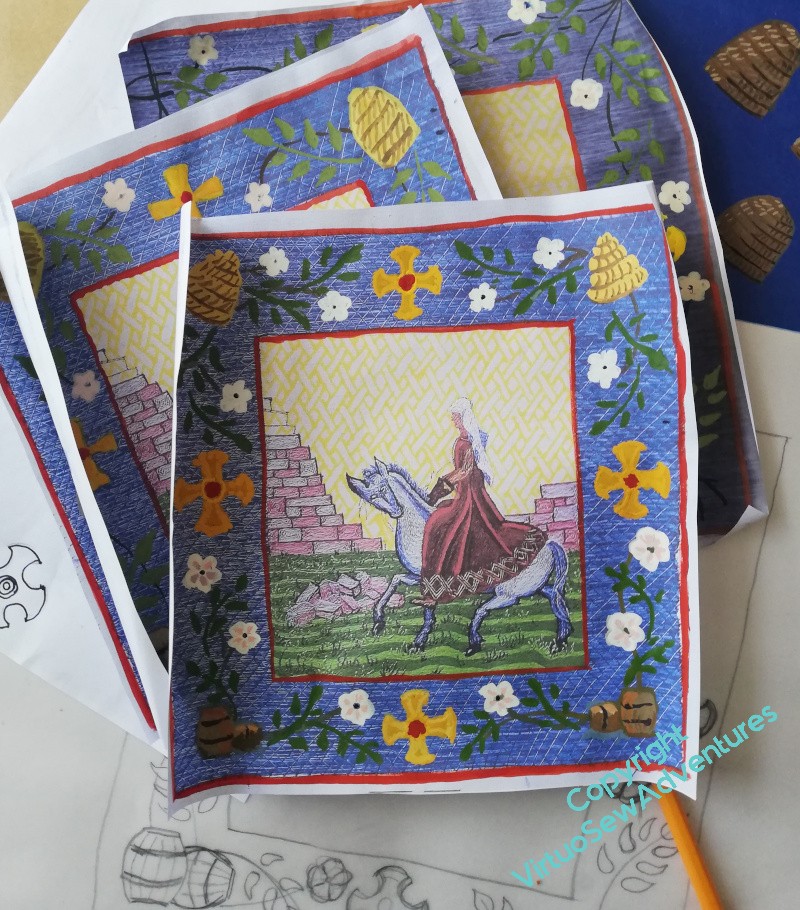
Aethelflaed’s border has been quite a trial, what with one thing and another. I became distracted from her by an assortment of non-embroidery things, which of course didn’t help, so having had that wonderful orgy of painting on printouts that resulted in a whole stack of variations, I found myself once more facing an undesired hiatus.
Still, I got back to it eventually. En avant!
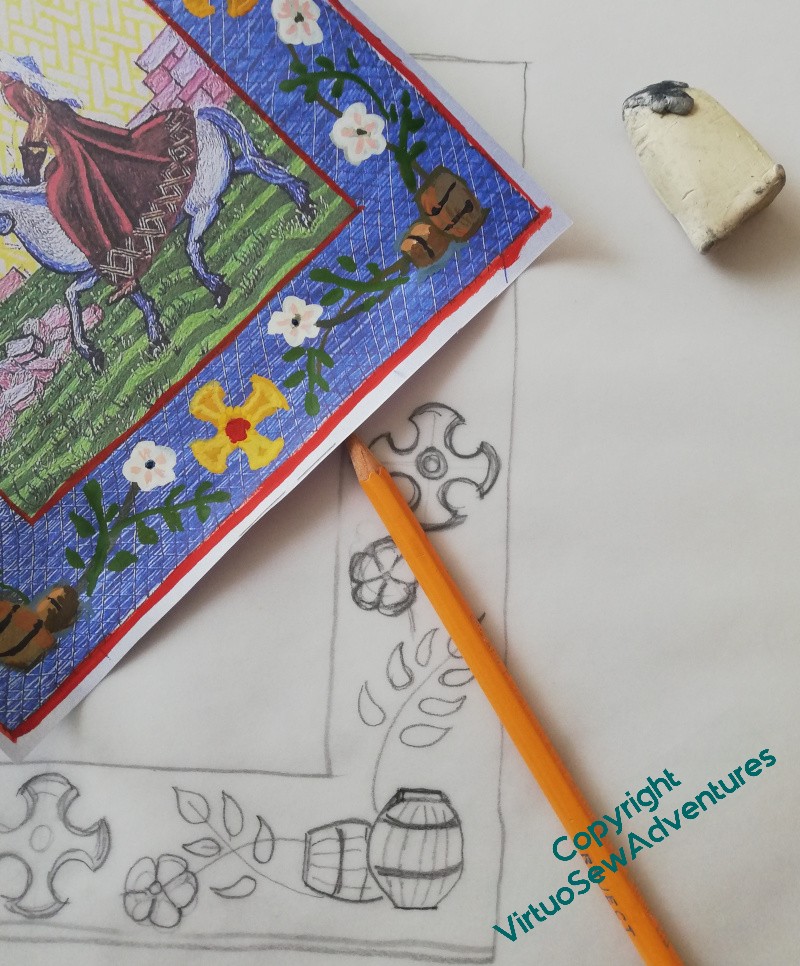
I’m very aware that the stitched version will project Personality in a way that paintings don’t (not even my paintings, which tend to be on the striking side). It’s one of the things that I mention in “Dreams of Amarna” because it was then that I became aware of it. So I felt that when I was developing the Aethelflaed design I was going to have to take that into account, and maybe give the elements of the design a bit of air around them, so as not to look too cluttered.
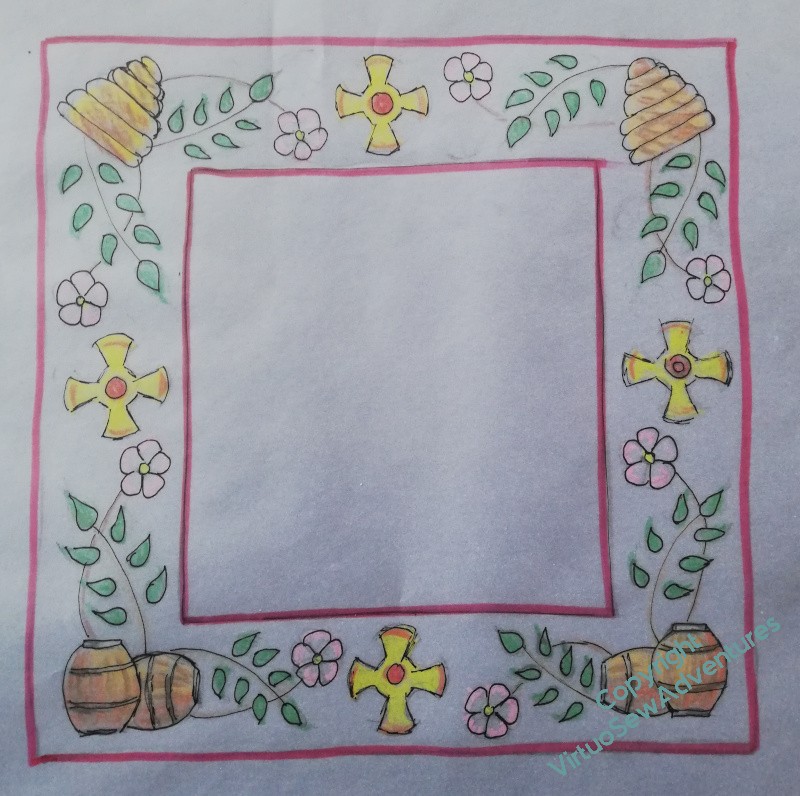
In the end, I did a bit of jiggery-pokery, and didn’t exactly translate any of the designs I originally came up with.
I drafted the design on a piece of tracing paper that I’d laid over the embroidery to get the dimensions of the actual border, and then put a bit of colour on the underside, rubbed out all the pencil lines on the top and reinstated them in pen so I could find them when I traced them onto tissue paper to get the lines in the right place on the actual piece.
And yes, it’s an almighty fuss and bother, going round and round and over the same ground over and over again. But it helps me to think through my plans, and gives me opportunities, sometimes, to come up with something entirely new and better.
Aethelflaed’s Border – much to consider
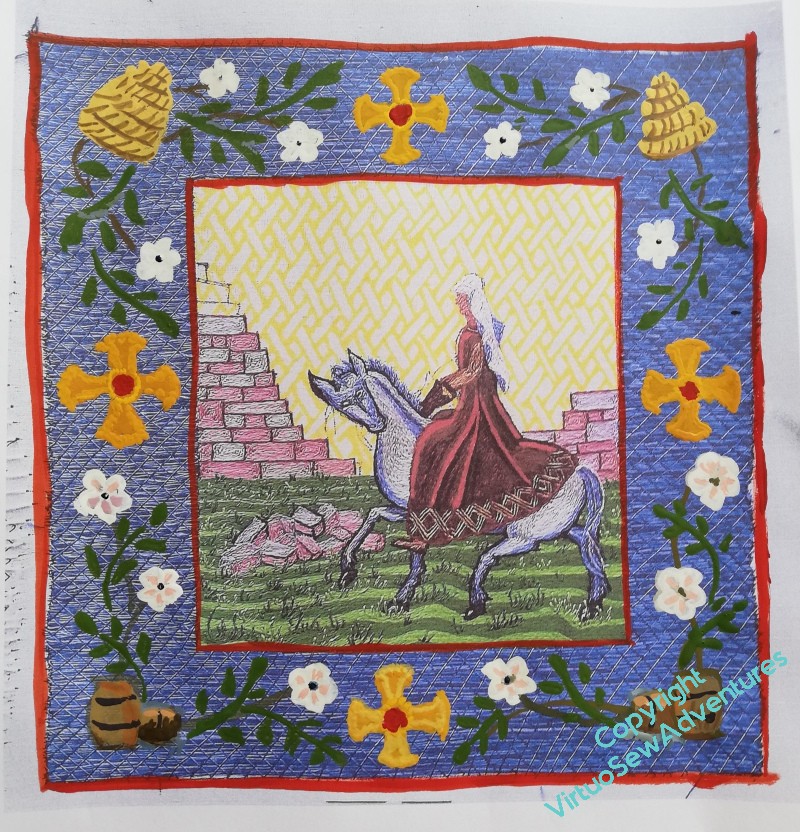
Well now. There’s quite a lot going on here!
When I worked on William, I did large gouaches of the design elements and then printed them small and played around with them to make them fit in.
I’ve already done some gouache explorations of the design elements – I wrote about it last November – so I tried something different this time. I photocopied the embroidery, as best as I could, got my paints out, and played with border designs directly on the photocopy.
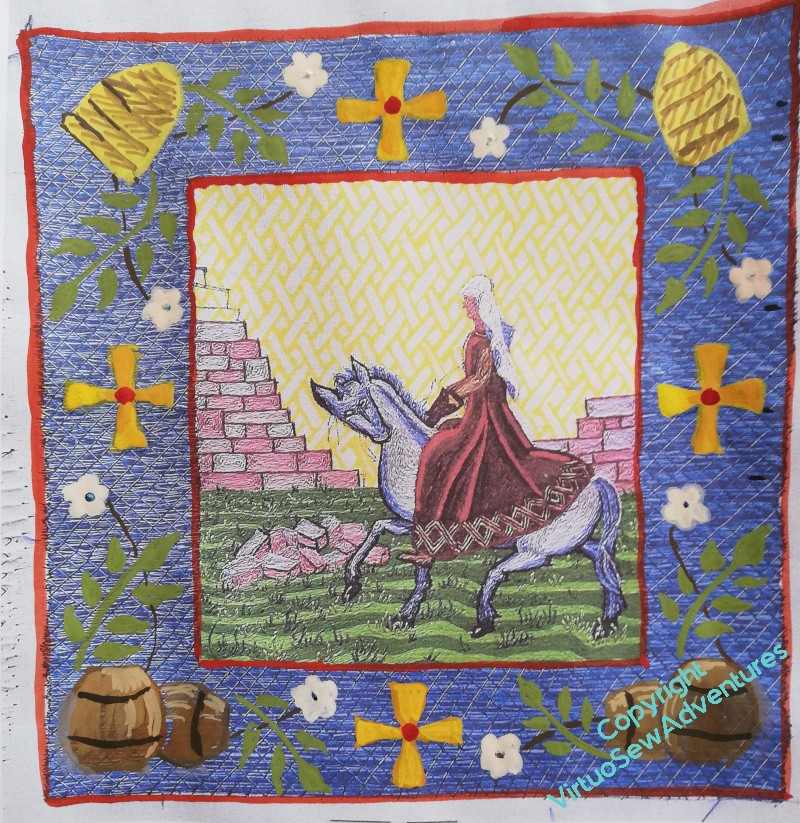
The first two designs are almost directly inspired by the design I did for William, but swap out the broom for the Plantagenets to put in the bee skeps and beer barrels associated with the defense of Chester. The crosses are still at the cardinal points – two different crosses, both inspired by my visit to the Staffordshire Hoard display – and there are still roses twining around and behind the other motifs.
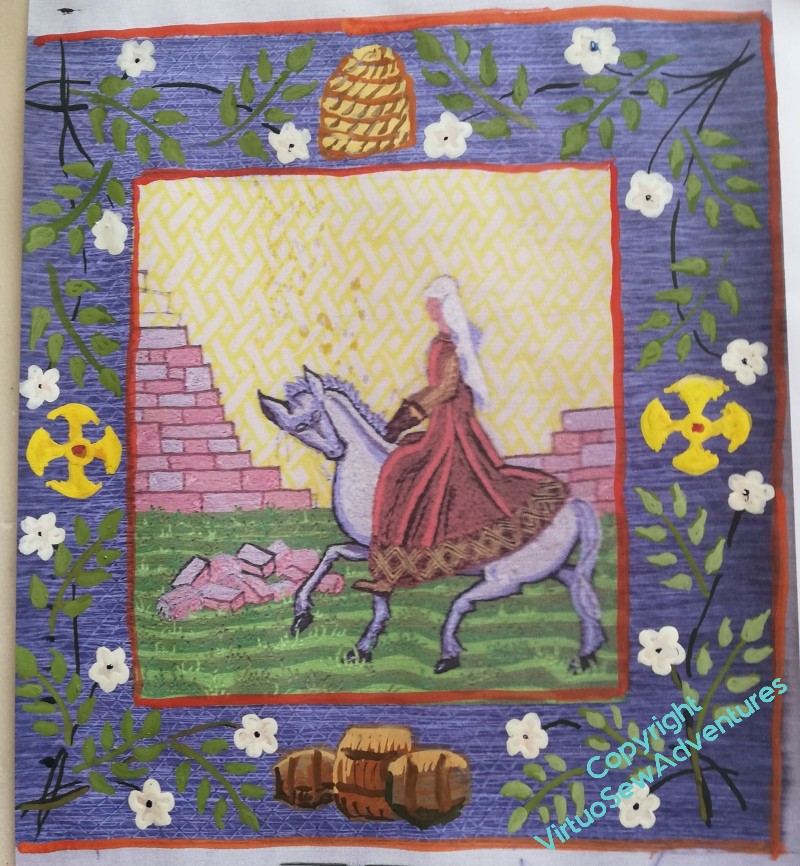
Then I decided it would be interesting to see whether I could create variations that would still be successful, still create the sense of a Book of Hours, but maybe broaden the space I get to operate in when I move on to Mother Julian and Prior Rahere.
So, this time, bee skep top centre, three barrels at bottom centre, and the crosses only at east and west. I think I got a bit carried away with the roses here – it’s looking a bit cluttered!
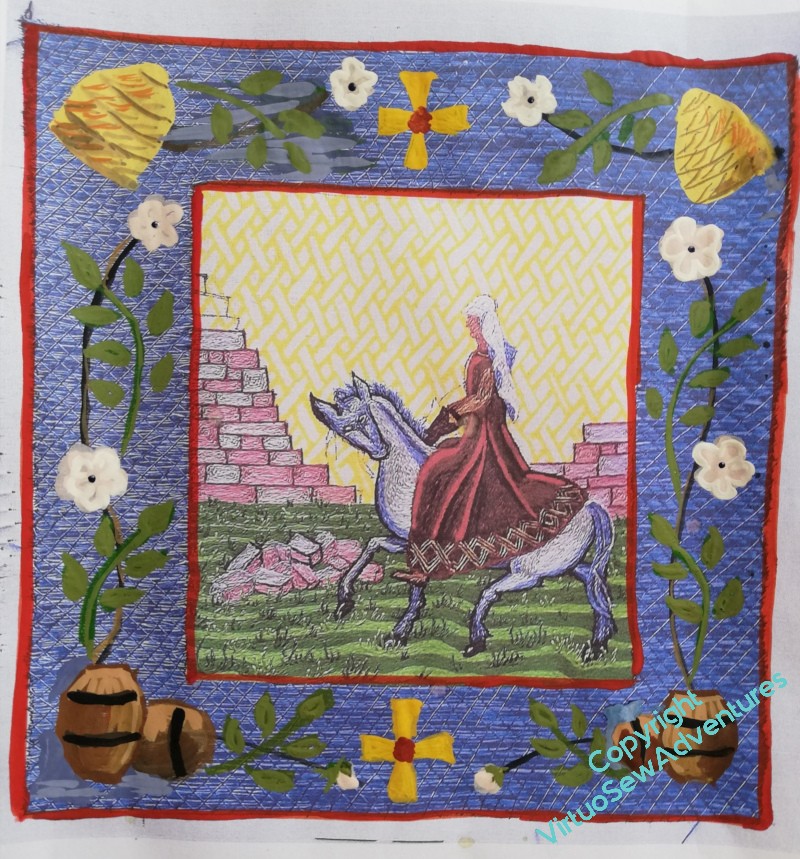
Then, back to the bee skeps and barrels in the corners, this time the crosses only at north and south, and roses in between.
Clutter aside, I think what I have here is actually a choice not about detail, but about the entire Medieval Movers and Shakers. Do I keep Aethelflaed’s border looking a little more like William’s, or do I use it to broaden the design choices I can make later? Do I need to do that? Or do the choices remain for Mother Julian and Prior Rahere, regardless of what I do here?
After all, of my four Medieval Movers and Shakers, Aethelflaed and William were war leaders, diplomats, peace weavers. Mother Julian and Prior Rahere represent the clerics and the religious aspect of medieval life. So the pairings are obvious as they stand. None of the four were contemporaries, and the worlds in which they operated were really very different as well.
Trellis Couching Complete
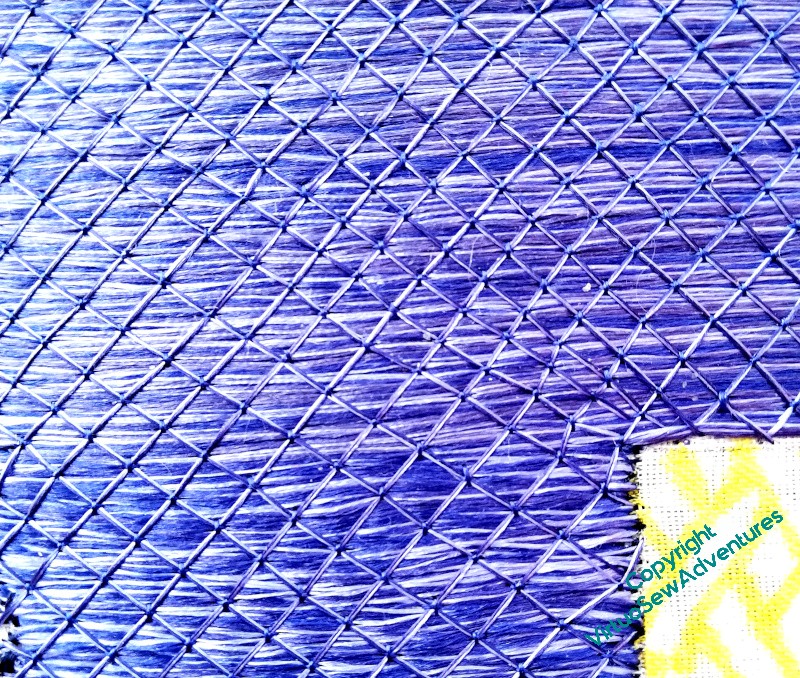
I am going to have to develop more careful and crafty ways to keep my trellis couching even. I’ve enhanced the contrast in the picture at left so you can see that there’s a section where I had to insert extra couching lines, which ended up radiating from the inner corner of the border.
It will barely show by the time the embellishment motifs have been added in, and it at least makes certain that the lower layer – the “colouring in” layer – is kept well under control.
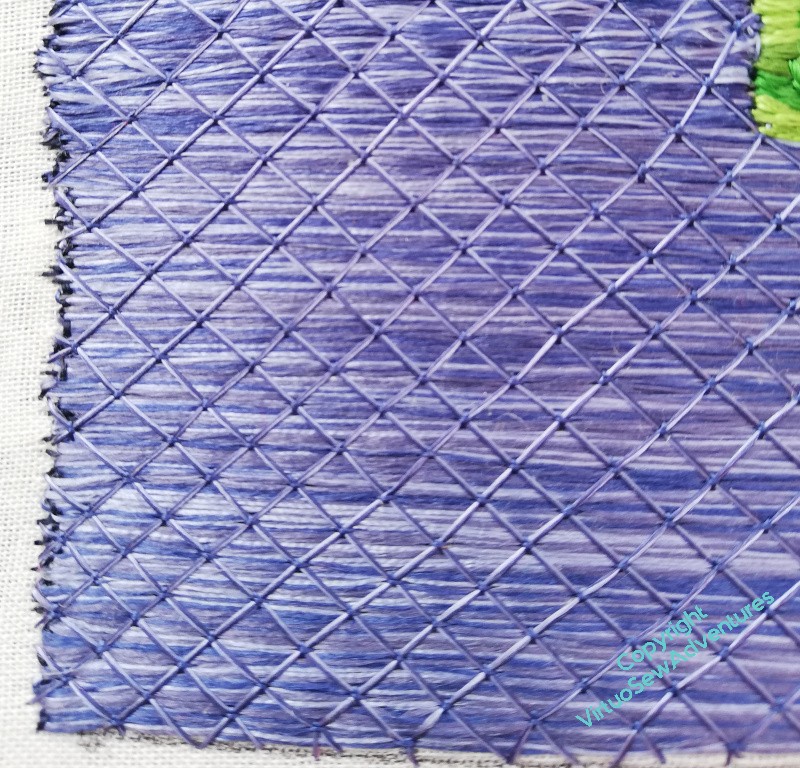
All that being said, if you look at the bottom left corner, I where I started the trellis, it’s much more even, although still wonky in places!
Never mind, it’s a background for something else – a Something Else I have yet to design, alas! – and as such I am happy that it produces that engaging “quilted” texture and allows me to move on to the next stage. You will see below the completed trellis couching.
Now I have to turn the tangle of roses, bees, skeps, barrels, crosses and numismatic motifs whirling in my head into something that looks pleasing within the border. Wish me luck!
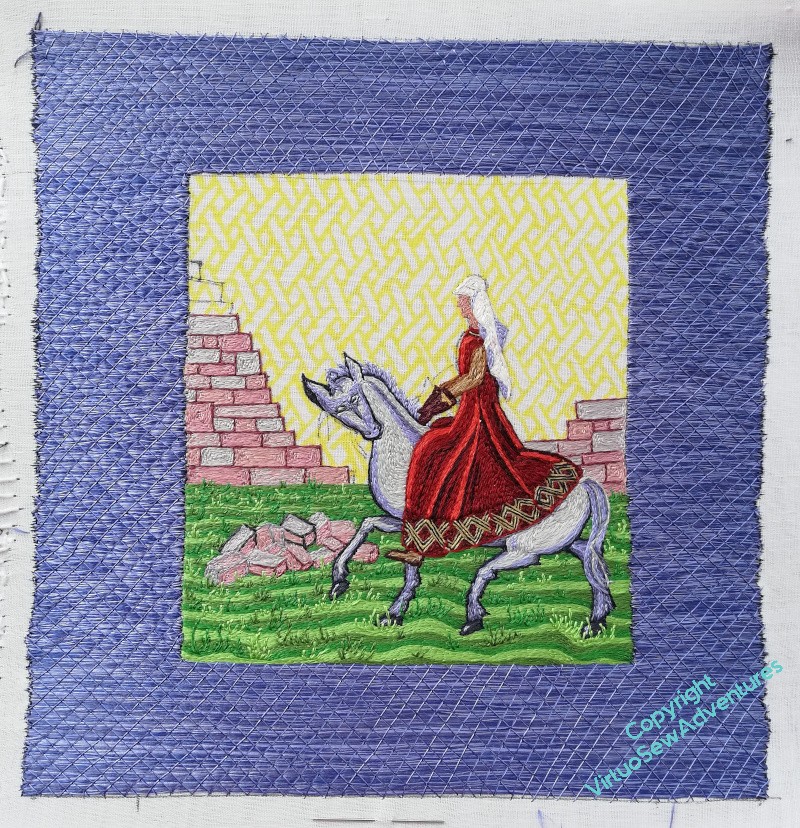
Aethelflaed’s Border Progresses
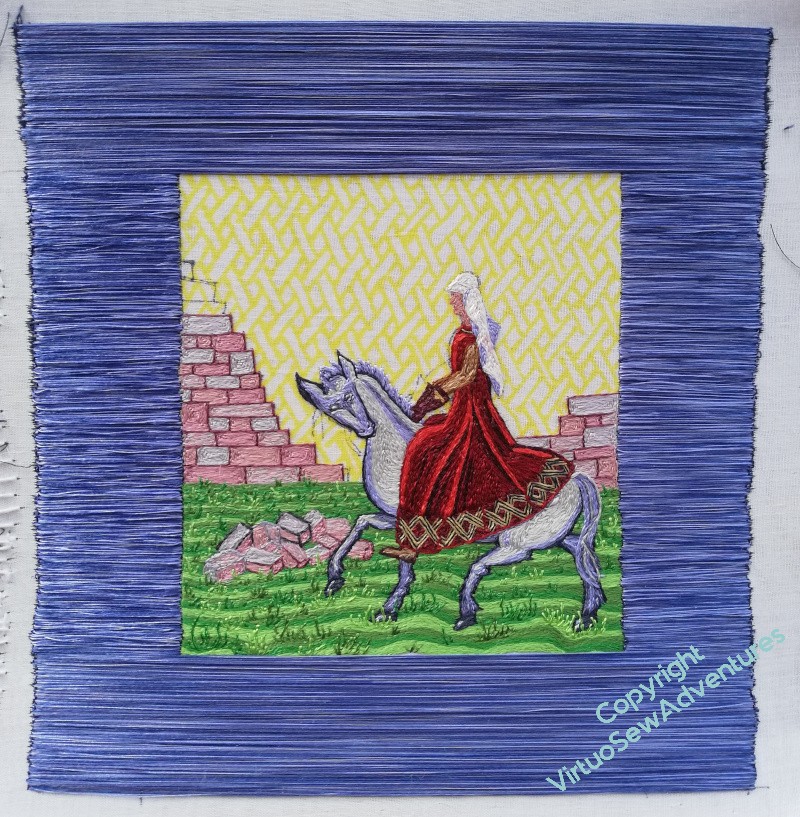
The border for the Medieval Movers And Shakers takes quite a lot of doing. The first layer is the broad “colouring in” – surface satin stitch, using the three colours of silk straight from the reels. I don’t enjoy this very much, because every time I sit down to it, I have to get re-attuned to balancing threads at either end, and it’s just difficult.
I do, however, like the effect.
It’s not stable enough to be left like that, though, and it’s not stable enough to be stitched over, as it stands. This is why the next stage is to do trellis couching over the top. If you look at the rightmost image in the gallery below, you will see the bit that remains unstitched of the diagonal stitches, and how much the couching settles everything down by comparison.
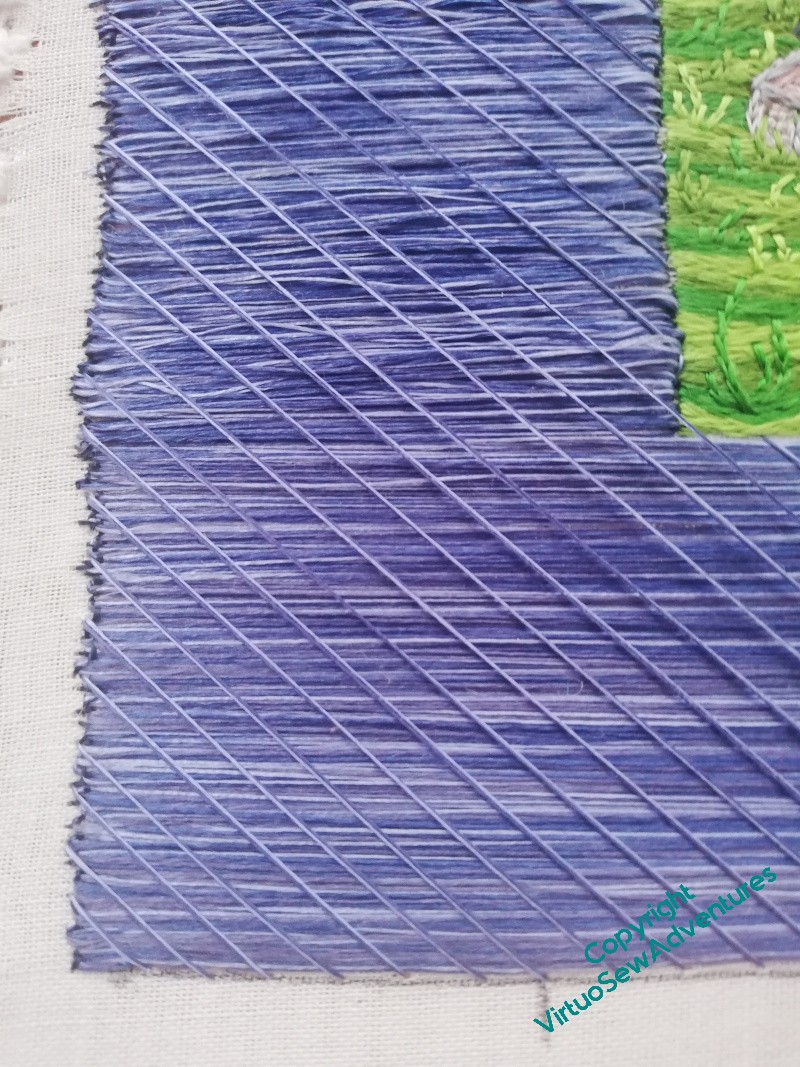
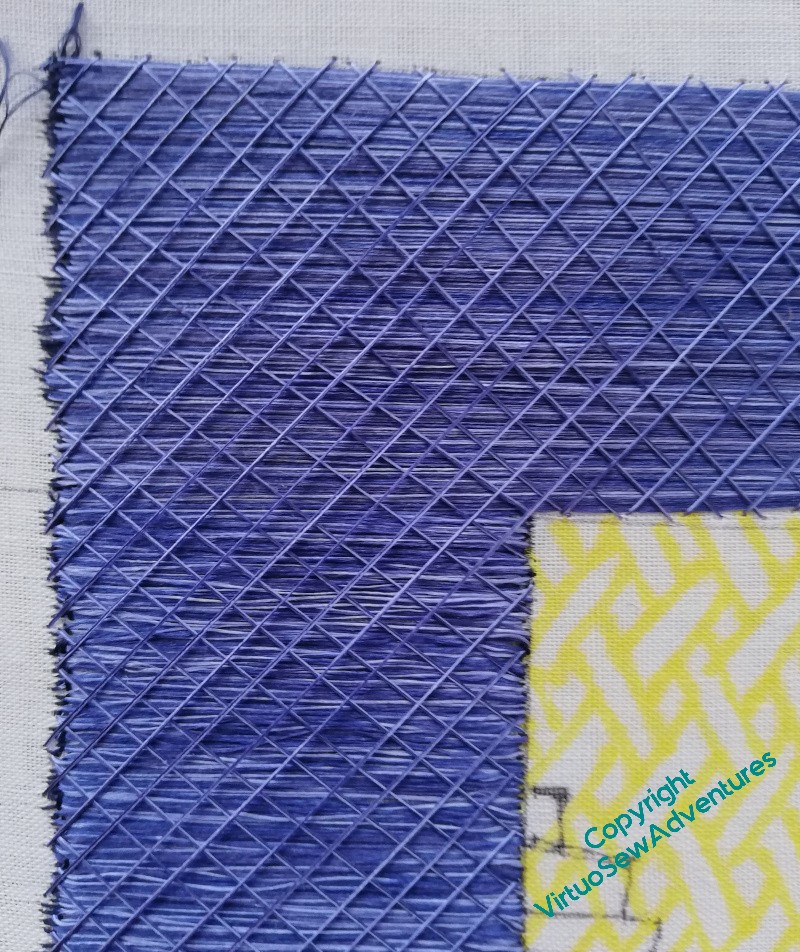
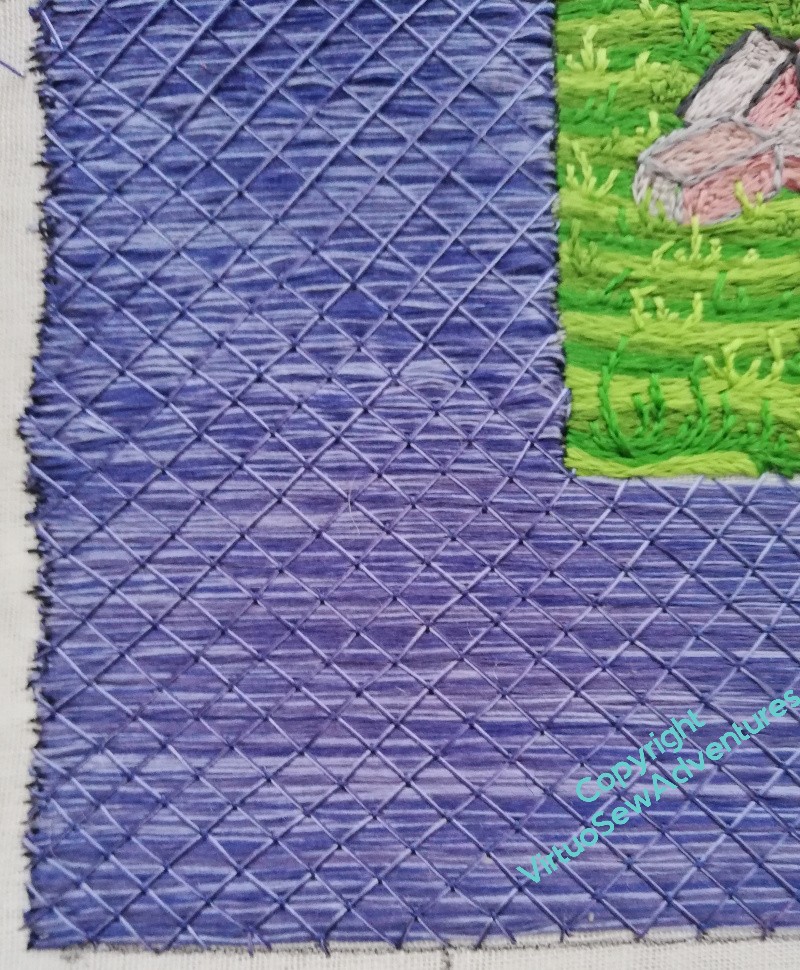
The diagonals are not as regular as I might have liked, but I’ve discovered that I can ease everything slightly one way or another with the couching, so the finished Trellis Couching looks more regular than just the diagonals. And of course, this is an intermediate stage, because I have yet to finish planning the roses, the beer barrels, and the bee skeps. And with William Marshall, I had an easy choice, framing the border with his heraldic colours.
All my questions to medievalists I’ve met concerning heraldry or symbology in Mercia and Wessex have met with apologetic looks. There probably was some, but they didn’t record it for us. So I will probably go for garnet and gold, because I would like to continue the structure I used for William Marshall, and have a suitable cross at the cardinal points. The borders framing the border can echo the crosses, and that will tied everything together.
Progress on the Lady of the Mercians
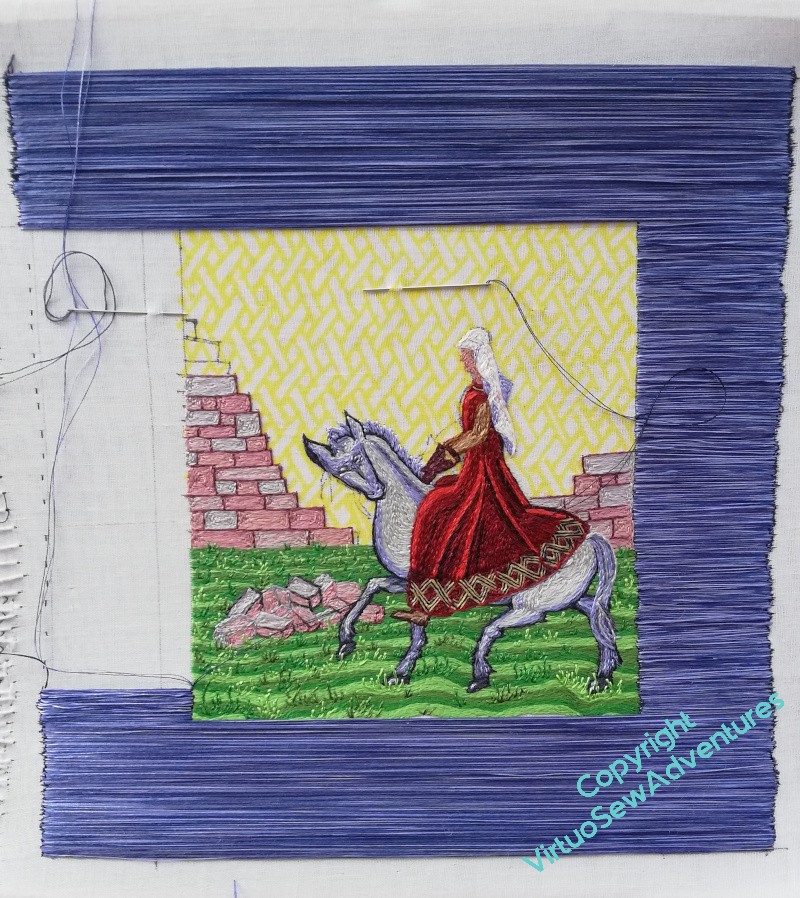
I realise that you’ve not heard about Aethelflaed for a while. In fact the period of silence is partly misleading and partly calendar related.
In terms of the calendar – my Serious Embroidery Frame sits beside a table in the bay window in the living room, and that is the table that the Christmas tree goes on. We don’t put the tree up early (I usually scoot in at the last moment on Christmas Eve, as was the family tradition when I was a child), but I do start clearing that space and thinking of other things.
In fact, however, before I put Aethelflaed away for that period, I had made considerable progress. Even with the pause for resupply, I had managed to finish the first layer of her border. It’s harder than it looks, because I couch the coloured silk at either end, straight off the reels, to avoid having too much wastage from starting up and ending off and misjudging lengths. I find every section I do requires me to rediscover my rhythm, and until I do, I feel clumsy and tied in knots. I think the result is worth it, however.
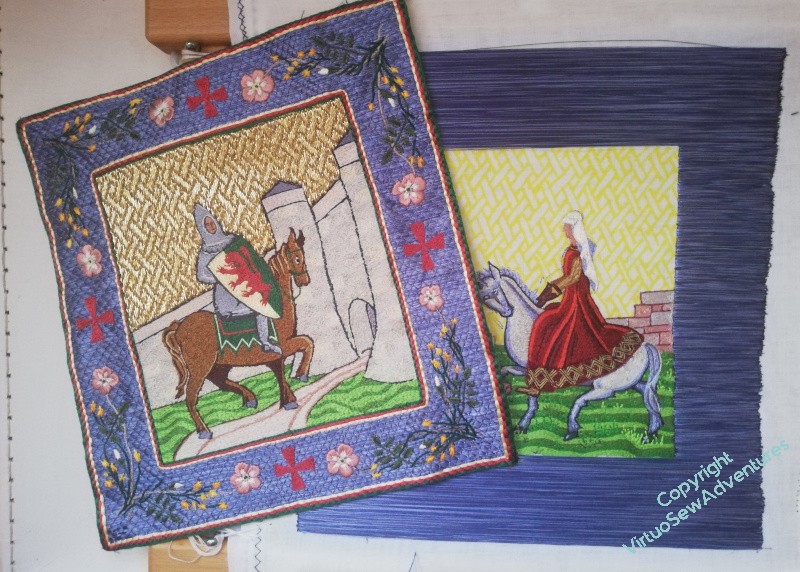
Comparing Aethelflaed thus far with William completed, you will see that I have to do the Trellis Couching (which goes alarmingly quickly once I get a run at it) and then finalise the design for, and then work, the embellishments.
Bee Skeps, Beer Barrels, and Roses, oh my!
Mus’ Renard, Mus’ Renard…
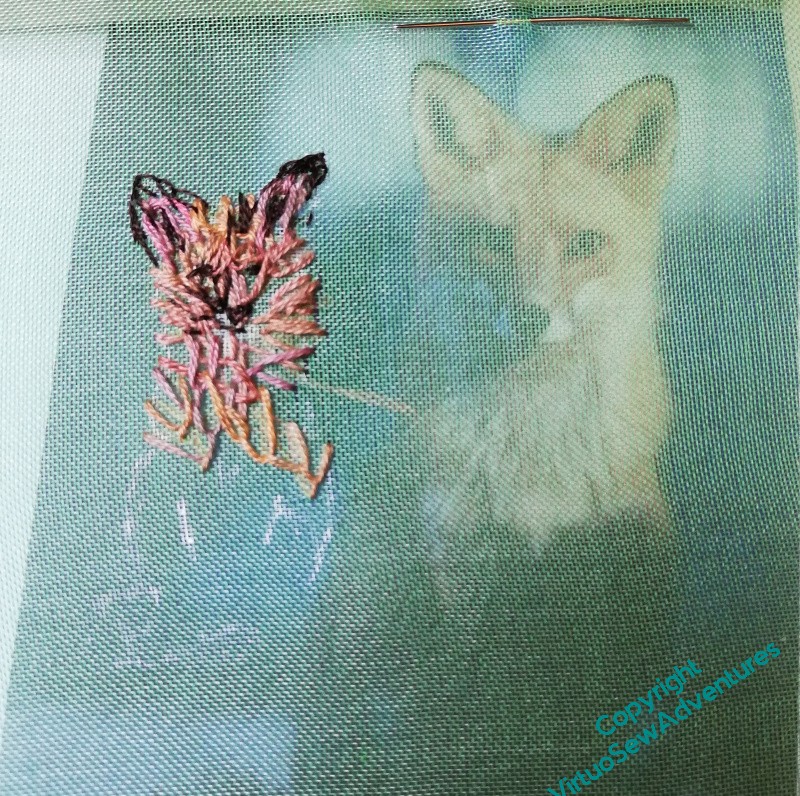
This getting started on the animal vignettes seems to be working, for the moment.
I found a lovely picture of a fox staring straight out of the picture, so I’ve gathered russets and browns for this one. He’s awkwardly sized – maybe too big, when I finally get to the assembly of the panel – and I kept changing from one to two strands of stranded cotton and not being happy with either.
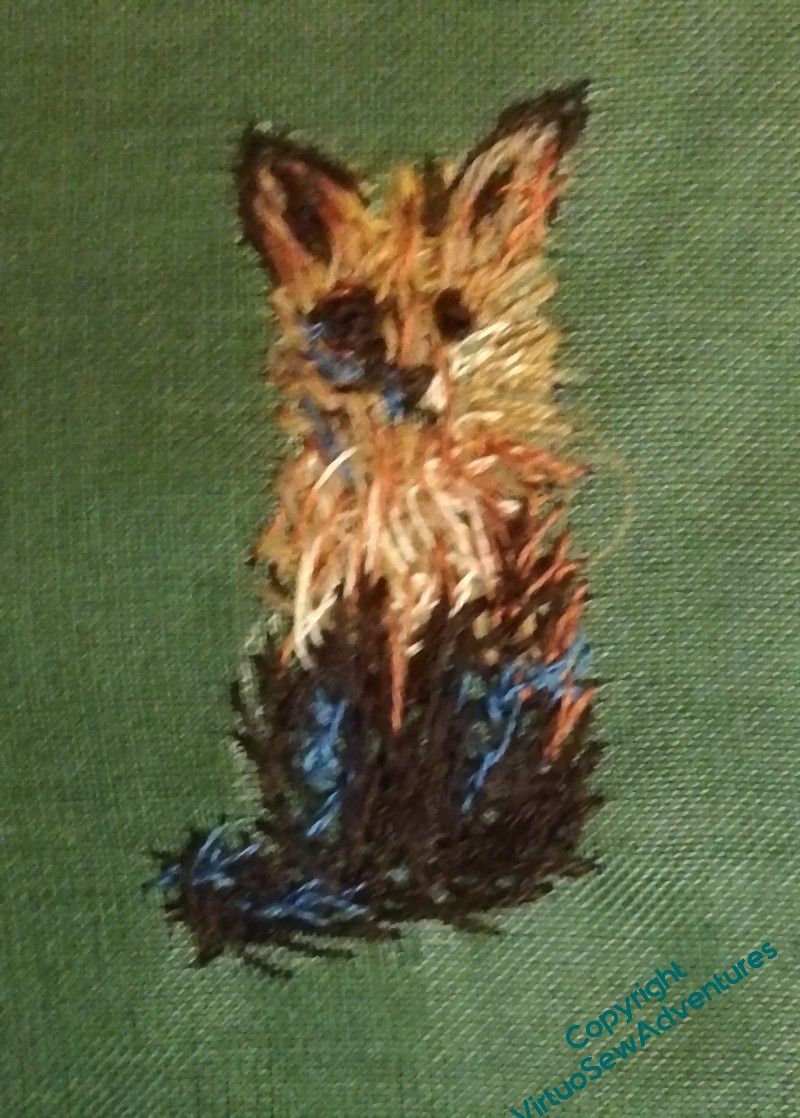
The half stage shows – rather blurrily, unfortunately – that I’ve used blue for the white-in-shadow. It’s amazing how often white does, genuinely, look blue or purple, but in any case, it helps to “lift” the general effect. When you’re mixing colours in painting, you can get lovely blacks and greys which have shades of other colours in them, and aren’t as deadening as straight lamp black would be. In embroidery, as I’ve said before, flat black has a tendency to unbalance a design, and in truth a lot of the greys aren’t much better. You might recall I turned Akhenaten’s black wig blue...!
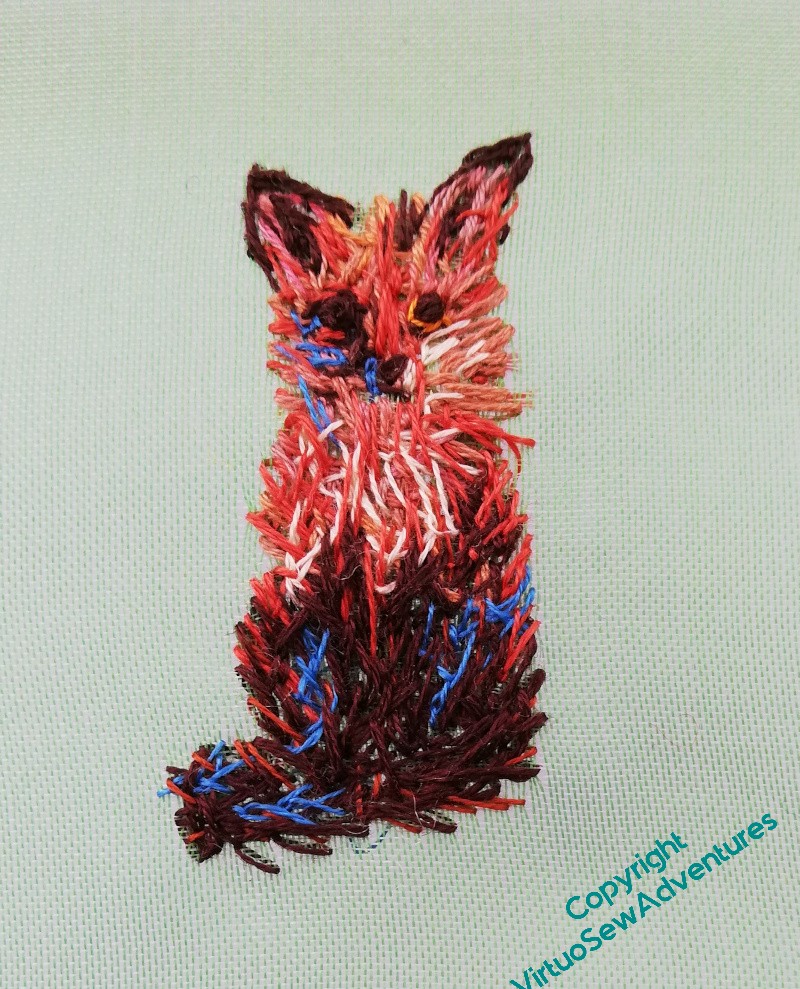
Well, the gauze really does vanish under light, doesn’t it!
Some of the stitches had to be woven into to shorten the length of the colour on display, and I’m not as happy with Mus’ Renard as I was with the Brockis. But he looks much better from the distance that he’ll be viewed from than he does in analytical close up, and I have to regard at least some of these as studies for the final piece, rather than necessarily parts of that finished piece.
We’ll just have to wait and see…
Working on the Brockis
You may or may not be able to see that there’s a drop-shadow effect in these photos – I learned from the mistake of the hawk, as I mentioned, and mounted the green gauze on a frame before I started. I rather like the result when I set it down for photography, and it gives you a much better sense of the view I got as I stitched.
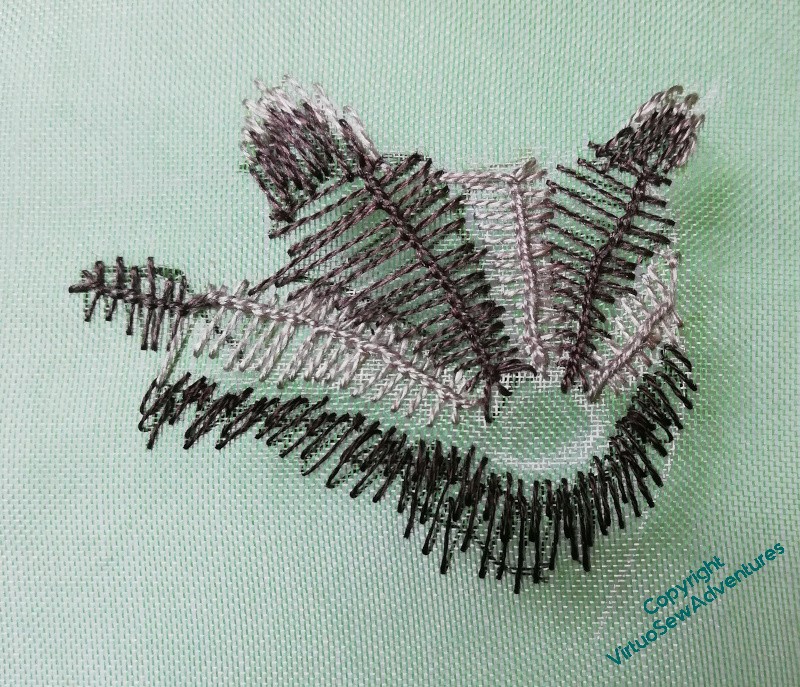
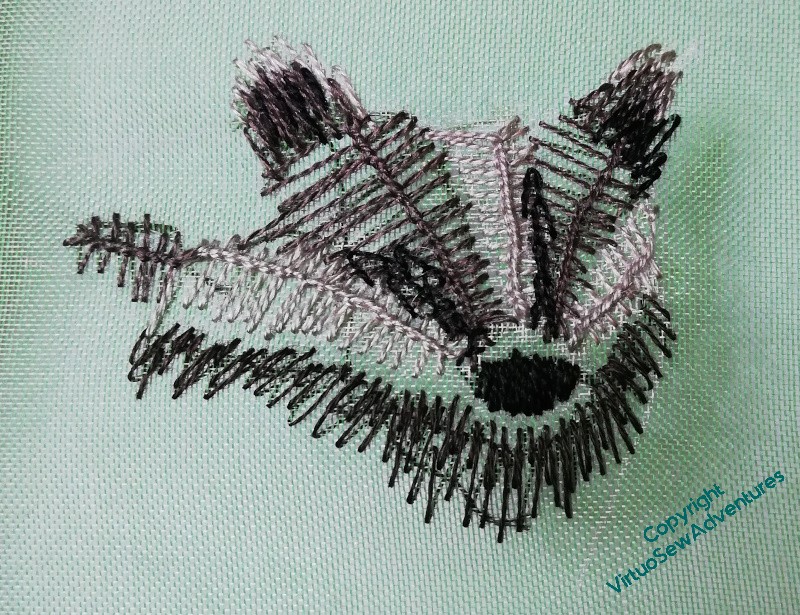
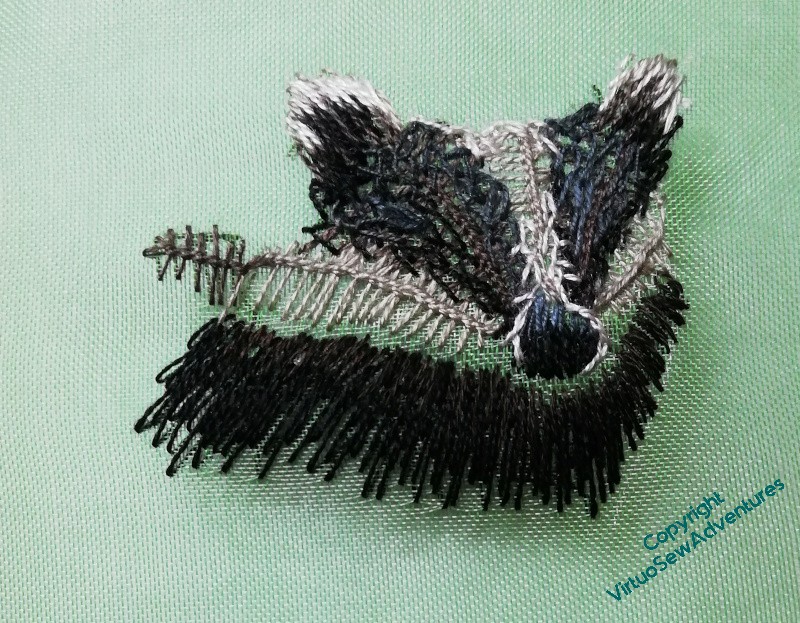
Ordinarily, I would be very concerned about working on gauze – the hawk is virtually satin stitch to ensure there’s nothing grinning through the gaps – but I have a feeling that this is going to evolve as I work on it. Regular readers will know by now that if I’ve convinced myself that something is necessary for the effect I want to achieve, I grit my teeth and do it, even if I don’t think I’ll enjoy it – although by the alchemy of Achieving What I Aimed For, it’s amazing how often I do in fact enjoy it!
My brockis is going to be peering out at the main scene from behind a tree, so he’s going to be on the ground, in amongst the undergrowth, and probably backed by darkish fabric and stitch. That being the case, gaps in the stitching might in fact enhance the sense of depth in the whole assembly. I want him to have rather rough fur, so he’s not going to be satin stitch, is he?
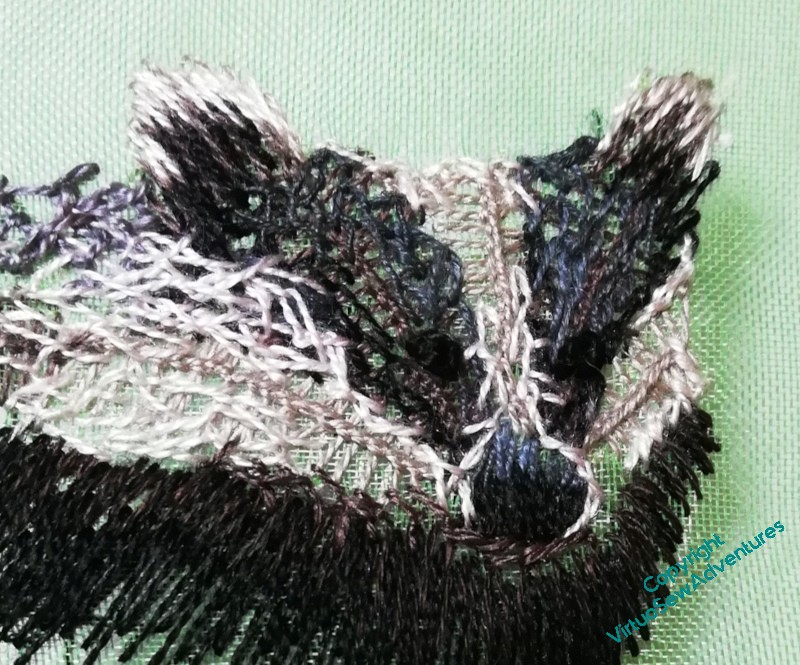
So my brockis is made, again, purely freehand, referring to the photo for guidance, but simply in layers of stitching. I’ve used silk, cotton, and linen threads, and a tangle of Vandyke stitch, Cretan Stitch, feather stitch and alternating twisted chain stitch. The silk came from the same stash as the silk I used for the hawk, the linen is a Stef Francis yarn I bought for the Dreams of Amarna that never quite worked in any of the projects, and the cotton is ordinary stranded cotton, but only single strands.
I’m rather pleased with him.