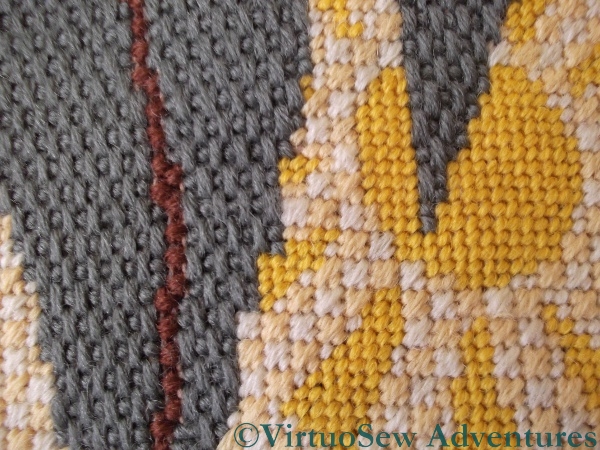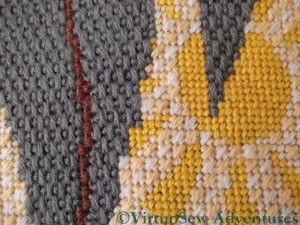
Close Up of the Sunburst
I believe I have mentioned before that our house is rather Arts & Crafts flavoured. I’ve been working on our dining room almost since we moved in. It’s north-facing, and our predecessors had painted it pale blue and papered the ceiling turquoise with gold stars. We felt we were dining inside an iceberg!
That may explain why when I repainted it, the ceiling turned white and the walls sunshine yellow. Above the picture rail, I stencilled a eucalyptus leaf frieze (in deference to my husband The Australian). When in due course I inherited my Grandmama’s dining room table and chairs, I decided to work needlepoint covers for the seats.
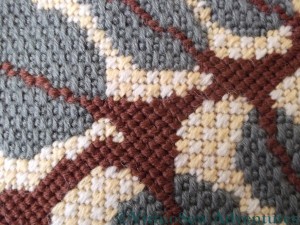
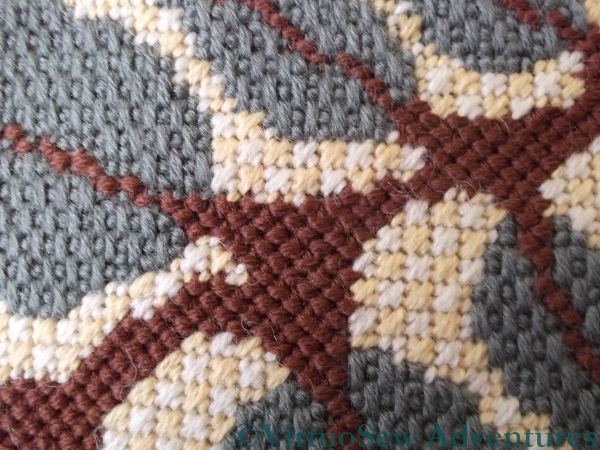
Close Up of the Leaf
Fortunately there are only four of them, but even so, I had to ask my mother to work on them as well, or they’d never have been finished. She helped with the stencilling as well – also an exciting challenge!
Unfortunately when they were finished I discovered some marks on some of the background. I was so dispirited that I couldn’t face unpicking them and so I stowed them away for several years. Now, however, I have fished them out, and I am tackling the replacement of some of the rows of stitching, one row at a time.
I would be nice to think I could get the chairs recovered for Easter…
Something Else In The Archive
My mother and I have been trying to make sense of the various boxes and bags that travelled from my grandparents’ attic to my parents’, and we’ve found all sorts of things.
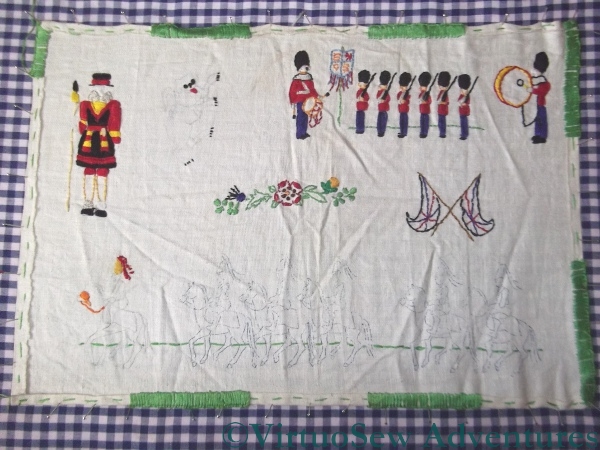
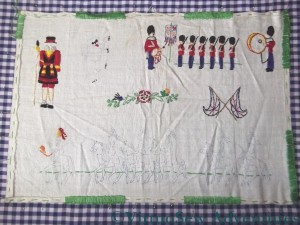
This traycloth must be something that Grandmama began to work quite late in life, when her eyesight was no longer what it had been, because it’s worked in four strands, and the back would not pass Miss Hunter‘s scrutiny. Judging by the subject matter – maybe she began it in 1977 for the Queen’s Silver Jubilee?
I suspect she intended to alternate the colours of the blanket stitch edging to create the same effect as the coloured blocks of fringing on a ceremonial trumpet’s banner.
I rather like the idea of tackling the parade of guardsmen at the bottom, so I’m planning to add this to my list of projects at some point. It would be the only project of which I would be able to say I had finished what Grandmama started!
I daren’t wash the piece or iron it, because the tracing has already begun to break up in some places. The unstitched motif in the top row is a heraldic lion, and most of his outline has rubbed off. It’s really just as well that I was keen on heraldry as a teenager and still have my books on the subject. I should be able to recreate him without too much trouble.
Spot Sampler - the Whole Thing Finished
Well, at last!
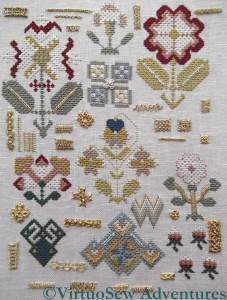
My first post on the Tudor and Stuart Goldwork Masterclass was dated 7 May 2010, so the course has taken me about 22 months, rather than the eighteen that Tricia planned it for. That’s not too bad – I thought it would have been much longer.
I’ve finished the spots and stitches as designed and laid down in the course, with a few small additions. I’ve done several sections of Plaited Braid using different metal threads, as well as having another go at Diagonal Half Guilloche stitch, down at the bottom. The picture is quite high resolution, if you want to zoom in and have a closer look..
I don’t usually practice stitches very much, but some of these stitches look and feel so different in the various different threads that it’s become clear to me that on future projects, I will have to test all my metal stitches with the thread and fabric I intend to use.
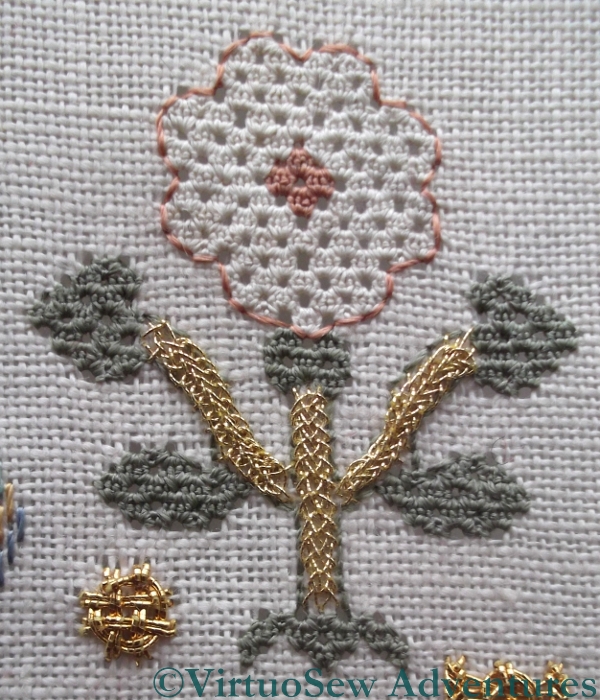
Curving Plaited Braid Stitch
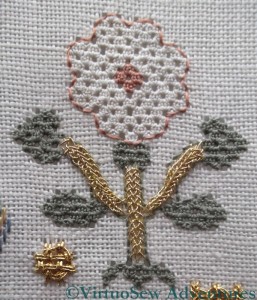
I also realised – at the last moment – that I hadn’t done possibly the hardest bit in the whole thing, that is, the curved stems of Plaited Braid Stitch for this flower. That was difficult for several reasons, but partly because I spent a lot of time trying to get the frame in the right position to allow me to work the stitch as I had practised it. I chose the very finest of the metal threads in the kit, and in the end I discovered that I could work the stitch quite effectively not only as I’ve practised (horizontally), but also at an angle, working away from me. It’s worked quite well, and I enjoyed wrestling it into some sort of sense, but I don’t yet feel that I can work Plaited Braid stitch with ease or grace. Maybe that will come in time. In truth, I think being able to work it at all is a considerable achievement!
Petite Pincushion - Embroidery Finished
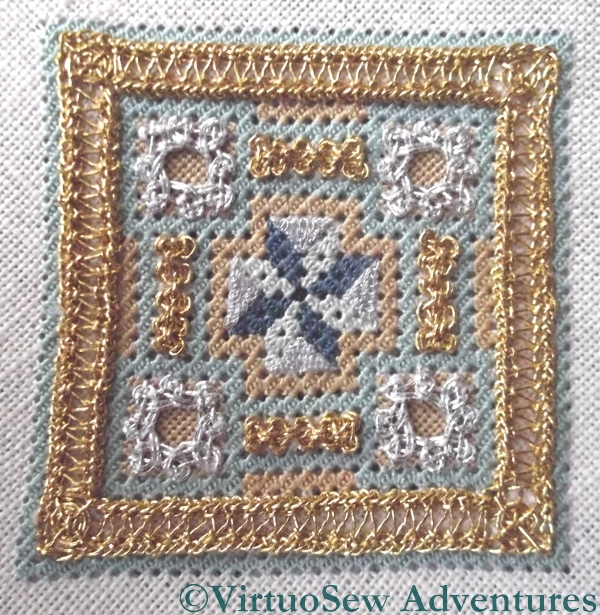
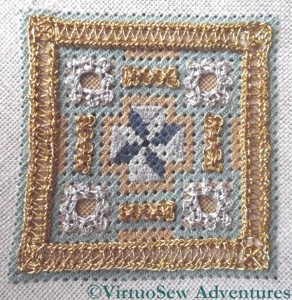
I said the Petite Pincushion had accelerated – it’s finished!
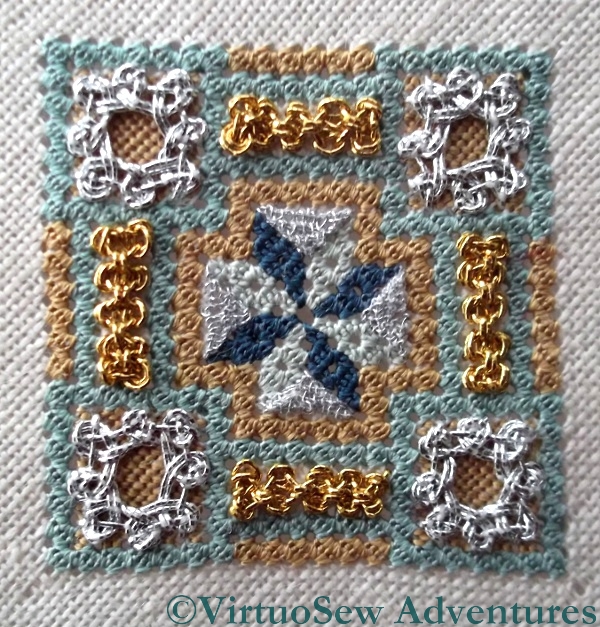
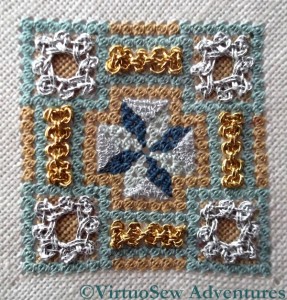
First here is a view of the finished embroidery, still stretched on the frame. You can see the zig zags of the the Hem Stitch on Ladder Stitch, the spirals of the Spider’s Webs, the intricate patterns of the Eight Sided Interlacing and the Figure Eight Interlacing, and the regular background texture of the Queen Stitches. Looks good, doesn’t it!
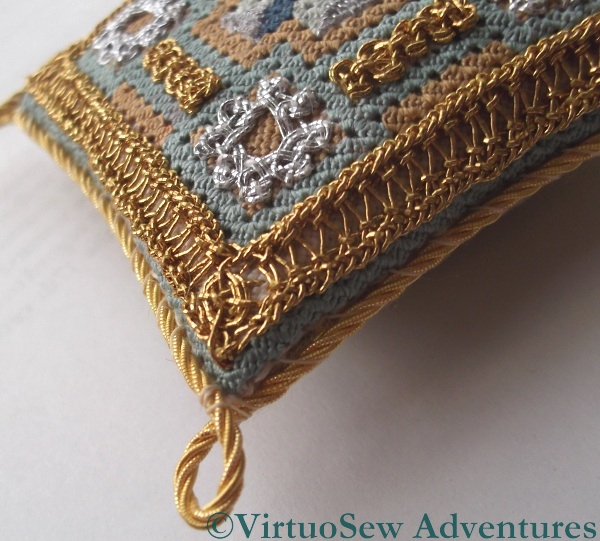
Making up the pincushion was relatively easy, especially after the Tulip Slip Pincushion and the Tudor Pincushion. The kit included a lovely piece of jacquard woven silk for the back, and Fine Grecian Twist to trim the pincushion. I backed the embroidered section with calico to keep the stuffing in – I couldn’t find silk in the right sort of colour (stash not big enough!) and the calico is unobtrusive. All the sewing was done by hand – I find it easier to do that than to get the sewing machine out!
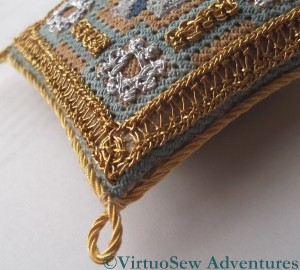
Petite Pincushion Finished
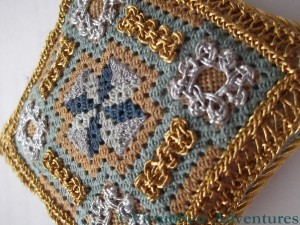
Petite Pincushion Again
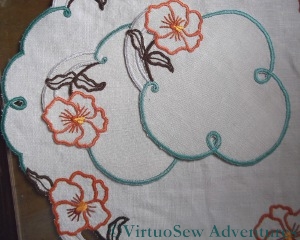
Dressing Table Set in Cutwork
When I first discovered eBay, I bought a lot of transfers and some threads, and this dressing table set in cutwork arrived in one of the parcels, already stamped and half-heartedly started.
You’ve probably already gathered that I’m not very enthusiastic about working a one-stitch project, so I eyed it askance for a little while, but then it occurred to me that my grandmother’s dressing table would be the better for a little embellishment, and that this might make a good travelling project.
(Translation: Travelling Project – a small, simple project that can be easily taken on visits. Sometimes I use a large project as a travelling project, if it is simple enough – for example, the initial stages of the Map of Amarna, when I had only one thread colour to use and no decisions to make)
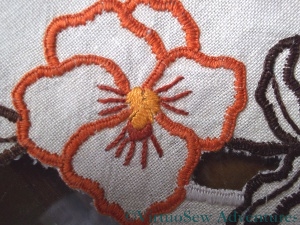
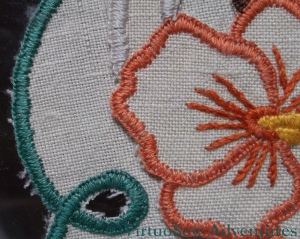
Flower On Dressing Table Set
More Edges on the Cutwork
I had to buy a special pair of supersharp, super narrow scissors to deal with the cutwork. Truly scary – have I made the edge strong enough or haven’t I? The close-ups show that there were a few threads that weren’t quite properly trimmed, but they don’t show as much in real life.
And, as it turned out, I rather enjoyed keeping the buttonhole stitch close and neat, and didn’t find the project half as tedious as I feared!
Petite Pincushion Eight Sided Interlacing
Somehow, progress on the Petite Pincushion accelerated hugely once the silkwork was finished. Each separate metal element (except the border!) proved to be fairly quick to do, and as I’ve already said, I enjoyed them immensely.
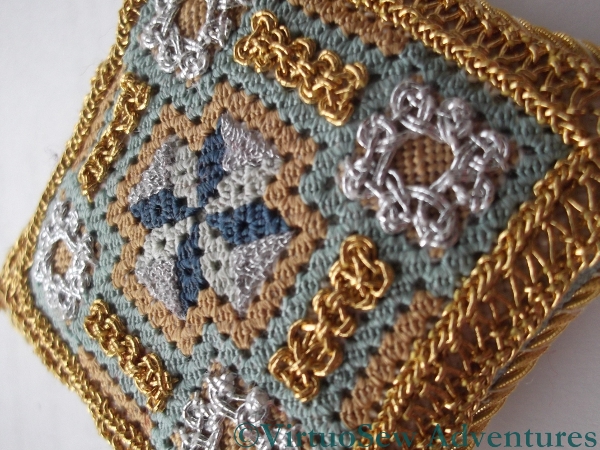
The next elements of the Petite Pincushion were the four spots of Eight Sided Interlacing in silver – so, yet another different metal thread to sample. Putting in the foundation stitches was made much easier because the foundation of tent stitches was square, and neatly segmented along each side by the Queen Stitches. Working these fairly zipped along, and I really enjoyed them.
Petite Pincushion - CloseUp
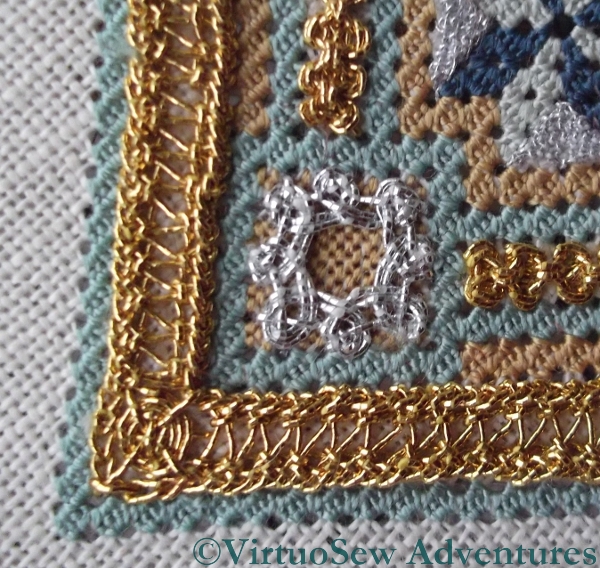
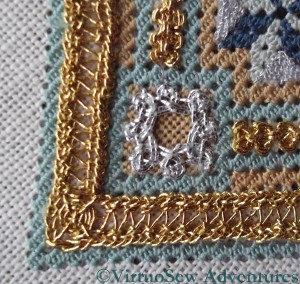
The final section was a border of hemstitch on Ladder Stitch, with Eight legged Spider’s Web stitch in each corner.
The Eight Legged Spiders Web stitches were easy and fun, filling in the otherwise blank corners beautifully. They’re more stable than the Four Legged variation, so if I were to be mad enough to use this as a pincushion when it’s finished, the spider’s webs would continue to look good under the strain!
I’ve been struggling with ladder stitch throughout the course – if you recall, when I first started working it on the Spot Sampler, I had serious problems with tension and with the thread breaking up. Practice makes perfect, I’m glad to say. By the time I’d worked Ladder Stitch all around the edge of the Petite Pincushion, it was going swimmingly – much to my relief.
The Hemstitches on either side of the Ladder Stitches increase the thickness of the edges, and create a zig zag effect with the horizontals, subtly altering the overall effect.
Fields Of Amarna
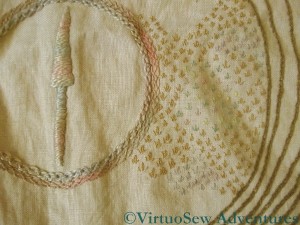
The cultivation on the Map of Amarna will take quite a while to do, but since I’m really quite happy with the progress it is making, I thought I would post a quick update on it.
The scatter of tête de boeuf stitches is as much as I have managed to do since I finally decided that that was the solution I was going to use. Granted, I’ve been working on a lot of other pieces at the same time, and sometimes I am simply not in the mood for single-stitch work, but it’s also more time consuming than you might expect. I’m trying very hard not to use a regular pattern of stitches – the scatter is as random as I can make it, given the human proclivity for pattern-making.
Since what remains to be done is about four times as much as I have done, I expect it will be quite some time before you see it again, but rest assured, I haven’t forgotten…
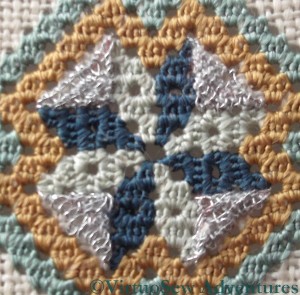
Petite Pincushion Detached Buttonhole
The diagram in the instructions listed the goldwork stitches from the centre outwards, so that is the order in which I decided to work them.
The detached buttonhole stitch at the centre was worked in a very fine silver thread. It was terrifyingly lively and had a will of its own, which made it hard to be sure of what I was doing. Yes, I had the magnifier, but looking at the closeup, the stitches are not especially consistent in size or shape.
I also caught down the detached fabric in the middle of the long side – not a step listed in the instructions, but one which seemed sensible at the time.
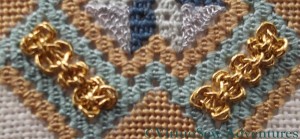
Petite Pincushion Figure Eight Interlacing
The Figure Eight Interlacing stitch filled in the strapwork in the middle of each side of the panel. I really enjoyed working this stitch, and this element of the Petite Pincushion seemed to be finished in no time at all! And believe me, I’m very glad I worked the detached buttonhole stitch first. I shudder to think how that whippy silver thread would have caught around edges of these panels, which stand proud of the surface to a considerable degree!

Liebster Blog Award
I’ve had a blog award passed on to me – thank you, Karen of Stitching Life.
When given this award:
1. Thank the giver and link back to their blog.
2. Reveal your 5 top picks and leave a comment on their blog.
3. Copy and paste the award onto your blog.
4. Have faith that your followers will spread the love too.
My picks:
- Susan of Plays With Needles, for providing thoughtful and thought provoking posts, and truly exquisite embroidery.
- Kathy of The Unbroken Thread, whose careful step-by-step descriptions of technique, and clear joy in creation make her blog a delight to read.
- Megan of Elmsley Rose, who is currently undergoing traumas of blog reorganisation, but whose embroidery posts always make me stop and think, and whose comments here are uniformly supportive and encouraging and frequently insightful as well.
- Alex of Under A Topaz Sky, whose embroidery I find wonderful to behold, although it isn’t a bit like mine.
- Hannah of Embrouderie, whose skills grow with every post as her blog develops.
Thank you, ladies, for hours of delight!
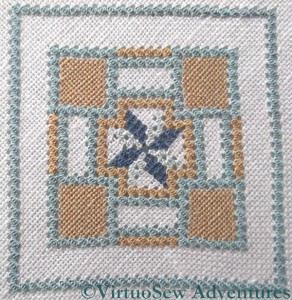
Petite Pincushion Silkwork Finished
Born teacher that she is, Tricia provided two additional projects with the Tudor and Stuart Goldwork Masterclass. After all, practice makes perfect, and practice is much more palatable when it produces something pretty at the end.
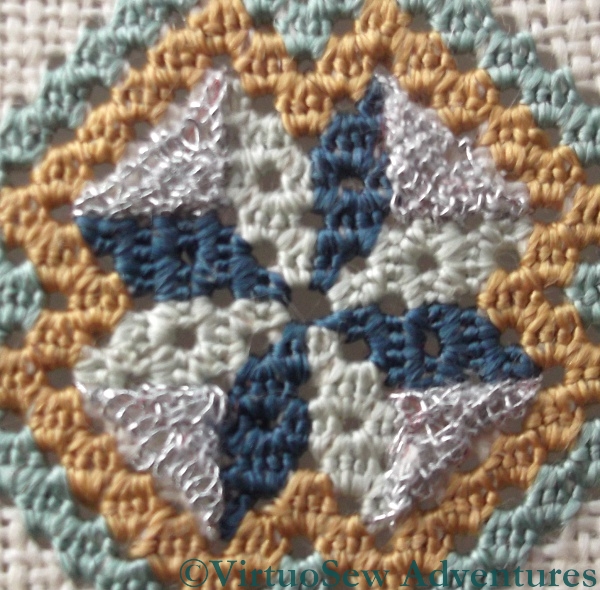
The silkwork of the Petite Pincushion is primarily worked in queen stitches. As you may have gathered, I’m not especially keen on counted work, regarding it as a salutary discipline rather than a pleasant pastime. I’ve been rather pleased that I’ve persisted with it in these cases, which is testament to the enjoyment I’ve been getting from learning the new stitches, and my desire to play with them even more.
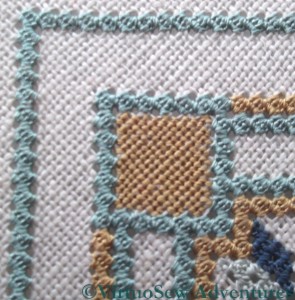
Petite Pincushion Quadrant CloseUp
Not that it has been entirely straightforward. The tent stitch corner panels were quite a strain – it’s astonishing how, even with a magnifier, I’ve managed to miss the odd stitch or set it crooked and have to unpick it and try again.
I never thought I would say this, but the queen stitches were easier! They interlock nicely, creating a textured, almost brocade-like surface which will make a good background for all the goldwork stitches that fill in the strapwork.