Tag: Silk thread
More progress on The Head of Nefertiti
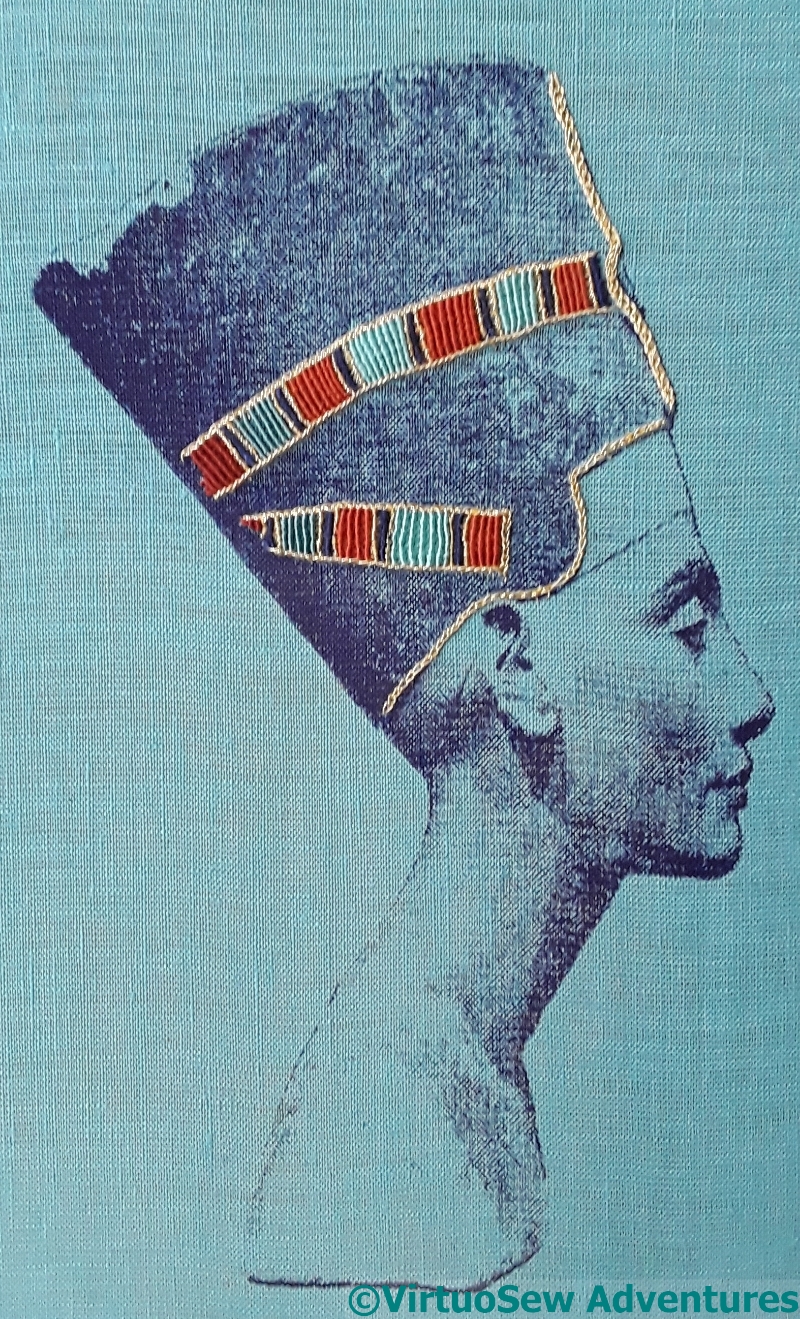
The polychrome band is finished
Once I had finished the polychrome bands, I sat back and looked at them. Using the darker shades of the colours in the darker part of the print helps to tie it all together and wrap the bands around the headdress.
I had a moment or two of concern, then decided that I would not, after all, ruin everything if I continued to add the other elements of the design that I had planned. There is always a moment or two of fear, especially when an early section has gone well!
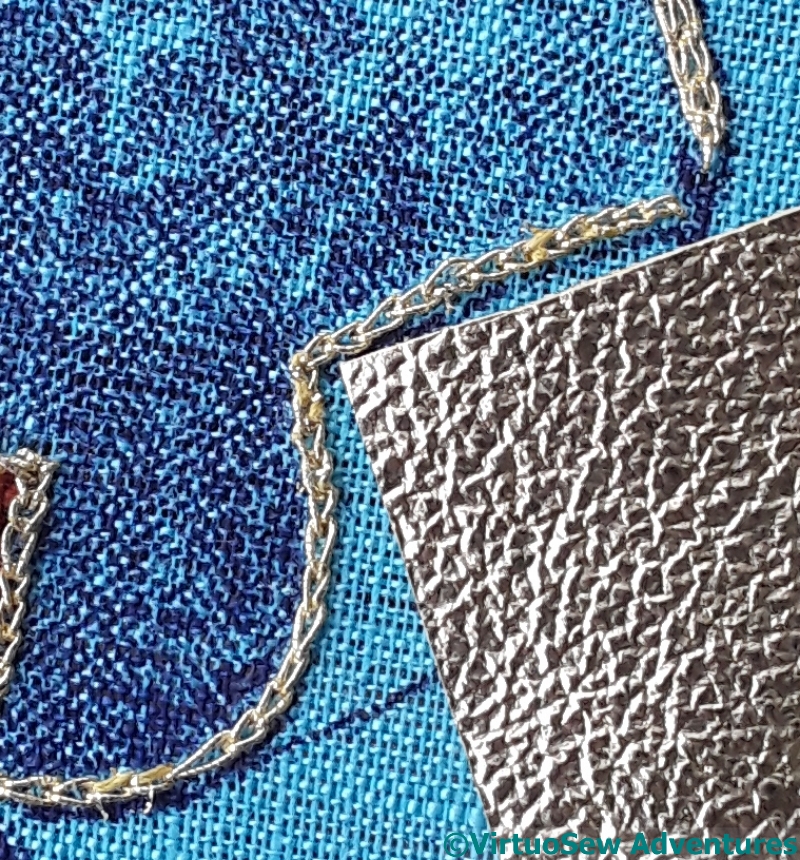
Trialling Leather
The original bust shows something that looks like a browband of gold, fairly plain and flat. I fished out a piece of gold kid, but although the photograph doesn’t show it very well, the kid is the wrong colour (too pale, and not yellow enough) for the gold thread, so I have to think of something else.
*Thinks hard*.
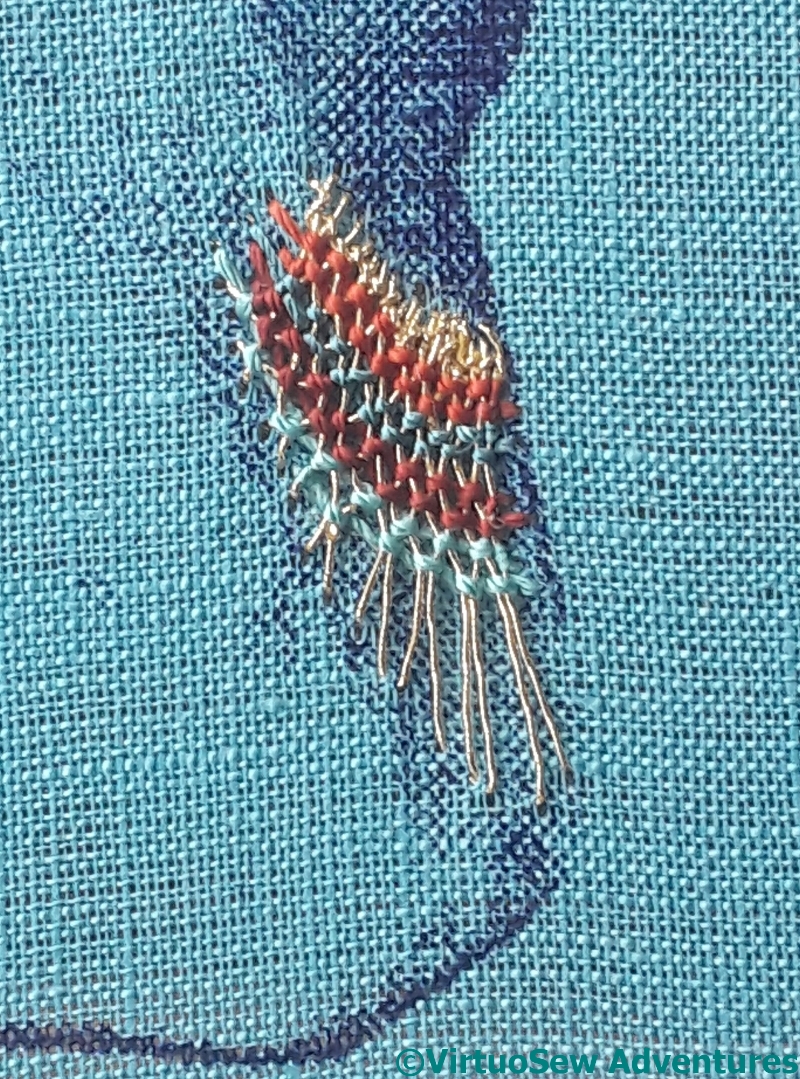
Necklace Trial
Meanwhile, I thought I would experiment with the necklace, or collar. My thought was that, rather than do the whole thing, I would do a small section of it, to make sure that I maintain the feeling of an embroidery, and not a portrait of a portrait.
What I have done here is to make radiating stitches of the gold thread, and then use the same whipped filling stitch I used on the polychrome bands, but alternating them so there is a hint of a gold net underlying the collar.
I like this, but maybe I do need to do an entire collar’s worth.
*Thinks hard*. Again.
The Head of Nefertiti – working with Silk
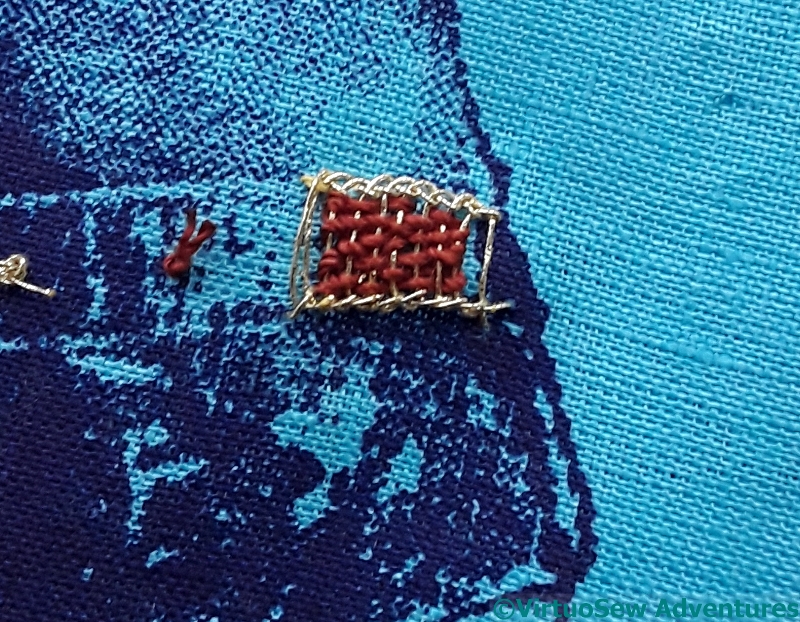
Trial Weaving
You will recall that I was rather underwhelmed by the effect of my first attempt at weaving the silk into the gold. Leaving the threads loosely packed to allow the gold to show through allows them to look untidy, and the colour is somehow a little flattened, not the rich, strong colour I wanted.
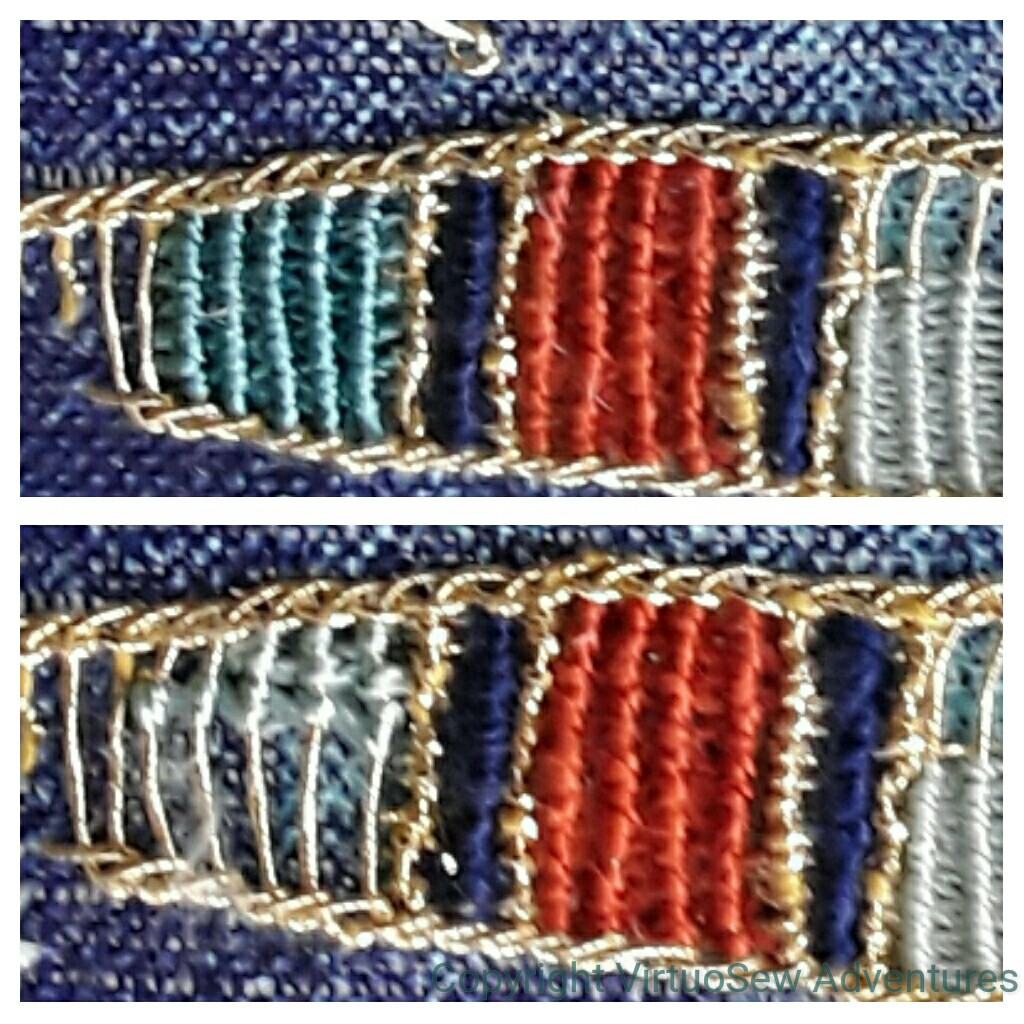
Different silk threads whipped in
So I decided to work the whipped style of filling stitch instead. It creates a strong colour, something like a grosgrain ribbon, in fact.
I’m using primarily colours from the Mulberry Silks “Nefertiti” colour range (appropriate, don’t you think!), and I’m happy with the rusty red. The navy is actually a heavy perle type and I’m not sure where it came from. That works too.
The lightest colour, however, on the far right, is too fine. It produces too retiring an effect, and weakens the whole effect. So I tried one of the stranded silks from Thistle Threads (lower example, left), and wasn’t convinced by that, either.
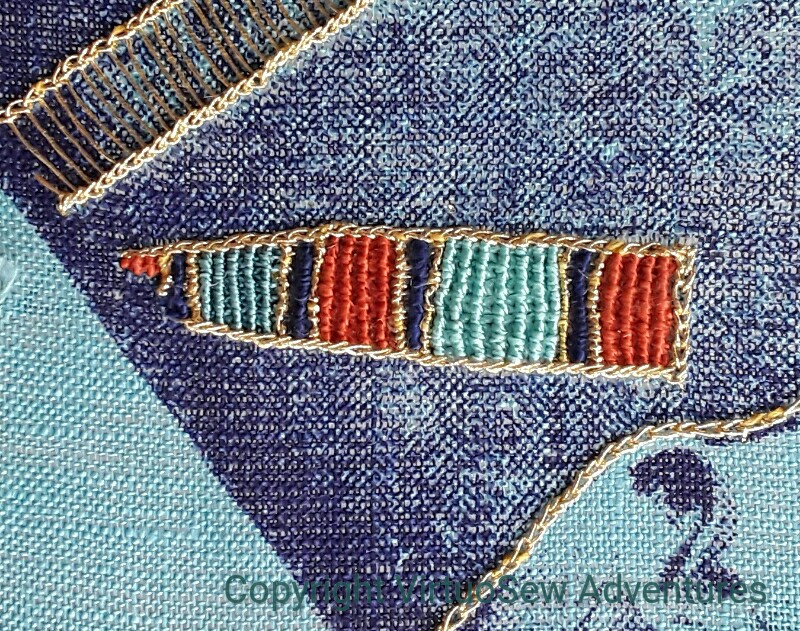
Third trial
This looks better. In fact the two light blue-greens are different, although that isn’t as clear in this photo as I might have liked. They aren’t as green as I would have liked, but I’m reasonably happy. If I decide to redo them, I may have to redo the whole thing, as the unpicking earlier on has left the Ladder Stitch a bit floppy.
Shadow Play
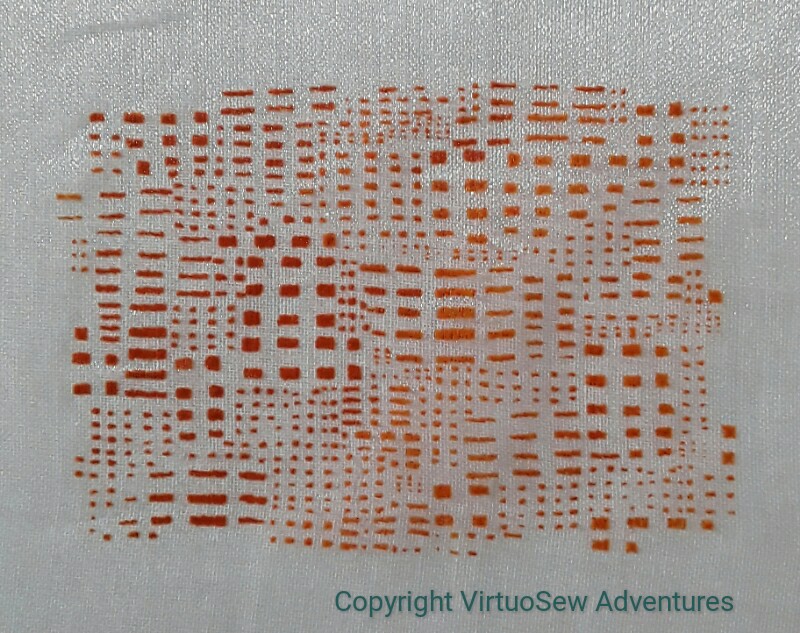
Printed on gauze
I decided, as I stared at the printing of this blocky pattern onto gauze, that I wanted to use the transparency of the gauze as part of the finished effect.
I don’t have a destination in mind for this piece which will give me a theme, so I decided that, in order to highlight that one quality, I would use a single thread (as it happened, a variegated silk), and design a fragment that would allow me to experiment with the effect of stitch cover and openness.
Sketching
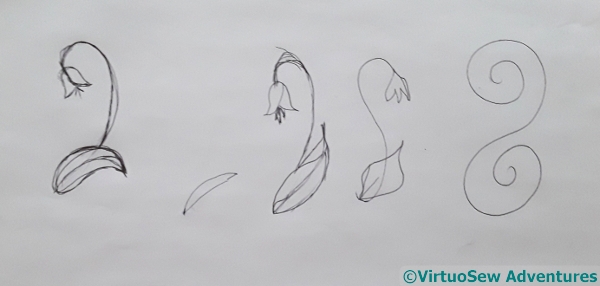
I leafed through books about pattern, saw nothing that gave me the combination I wanted, and then evolved the fragmentary organic sketch on the far left to give me the balance of line and form I was looking for. Incidentally, this is quite possibly the swiftest and shortest progression of any sketched design I’ve ever come up with!
Finished Fragment
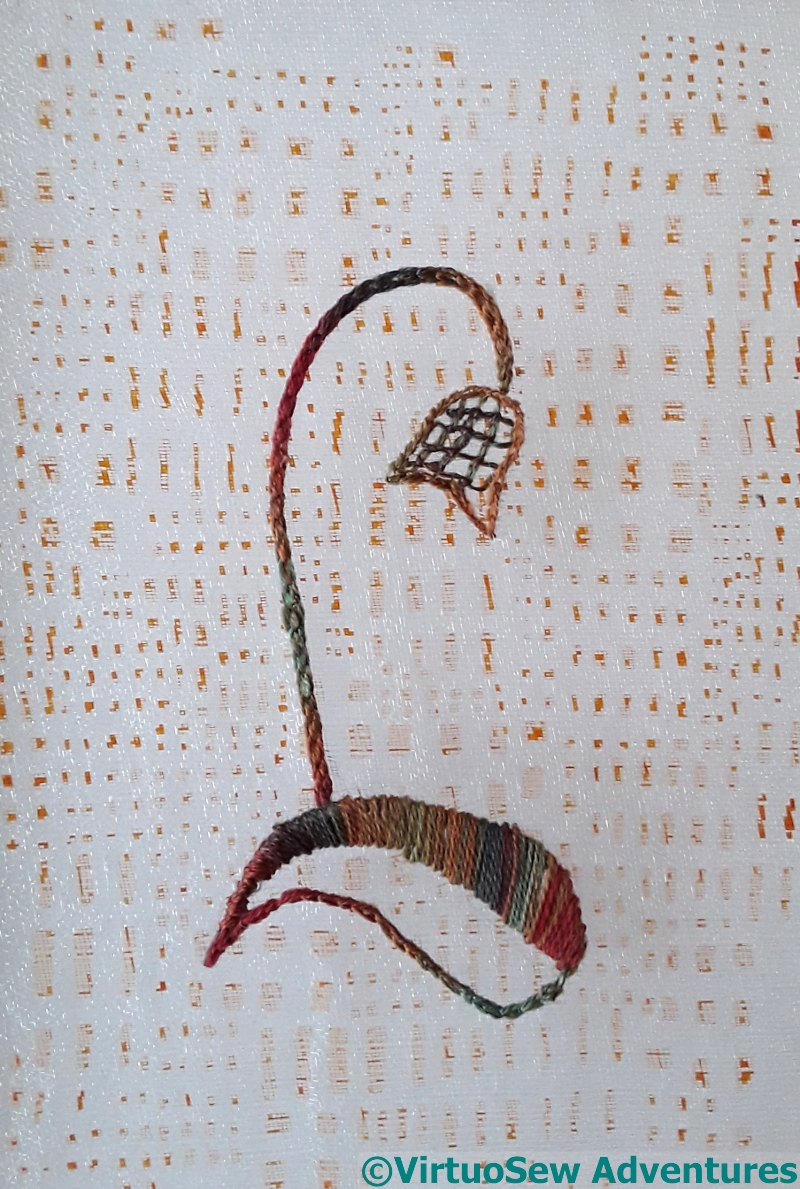
It’s astonishingly difficult to trace a design onto a fabric which is essentially invisible, and still harder, I might add, to follow the lines when you have finally put them there!
I used Hungarian Braided Chain Stitch for the stem, satin stitch for the solid side of the leaf, and Jacobean trellis for the flower-head. Clearly that gives me a solid coverage, and a firm line; I was hoping that the Jacobean trellis might offer a sort of half-shade.
Shadow Play
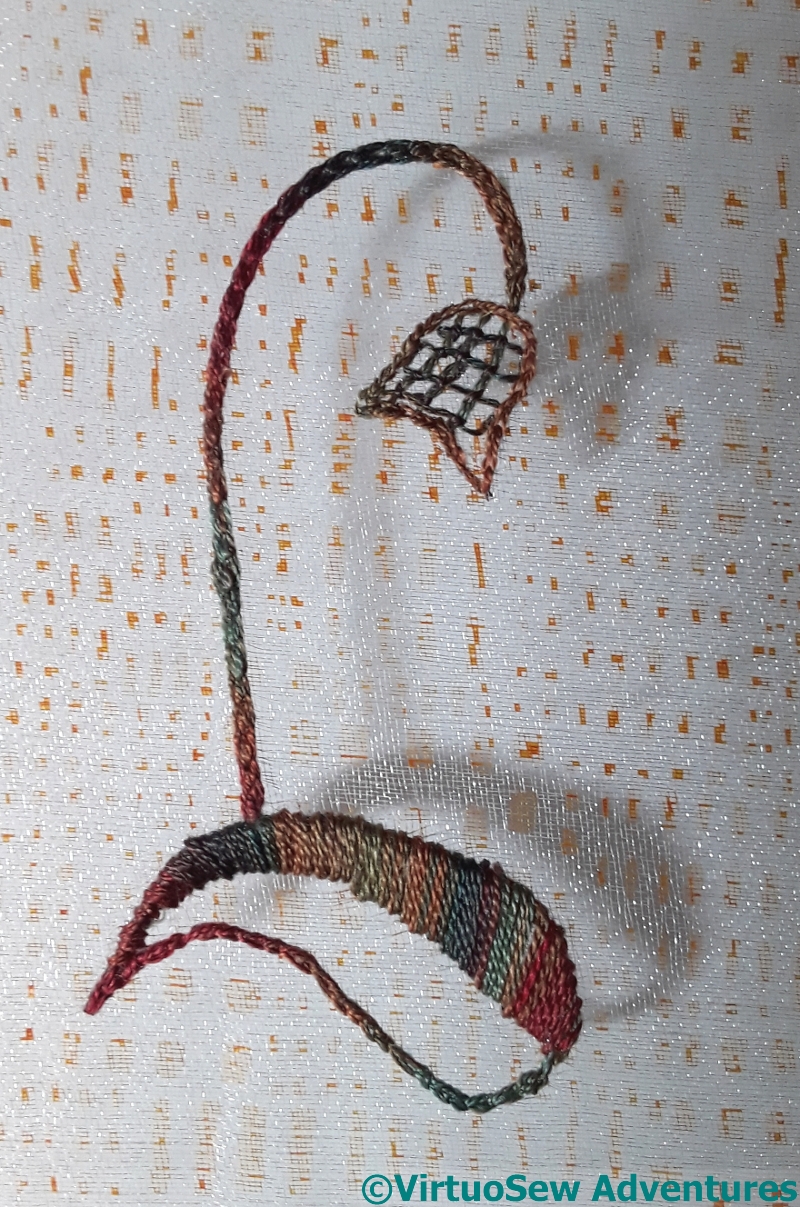
A qualified success, I’d say. The printed pattern doesn’t create a shadow, and the Jacobean trellis shadow isn’t a sort of half-depth.
But, my goodness, the shadow of the stem and the leaf work exactly as I hoped! The gauze itself almost disappears, leaving the printed pattern floating above the surface, and the leaf and flower thrown forward by their shadows.
The Head of Nefertiti, Embellished with Silk and Gold
Screenprint of the Head of Nefertiti
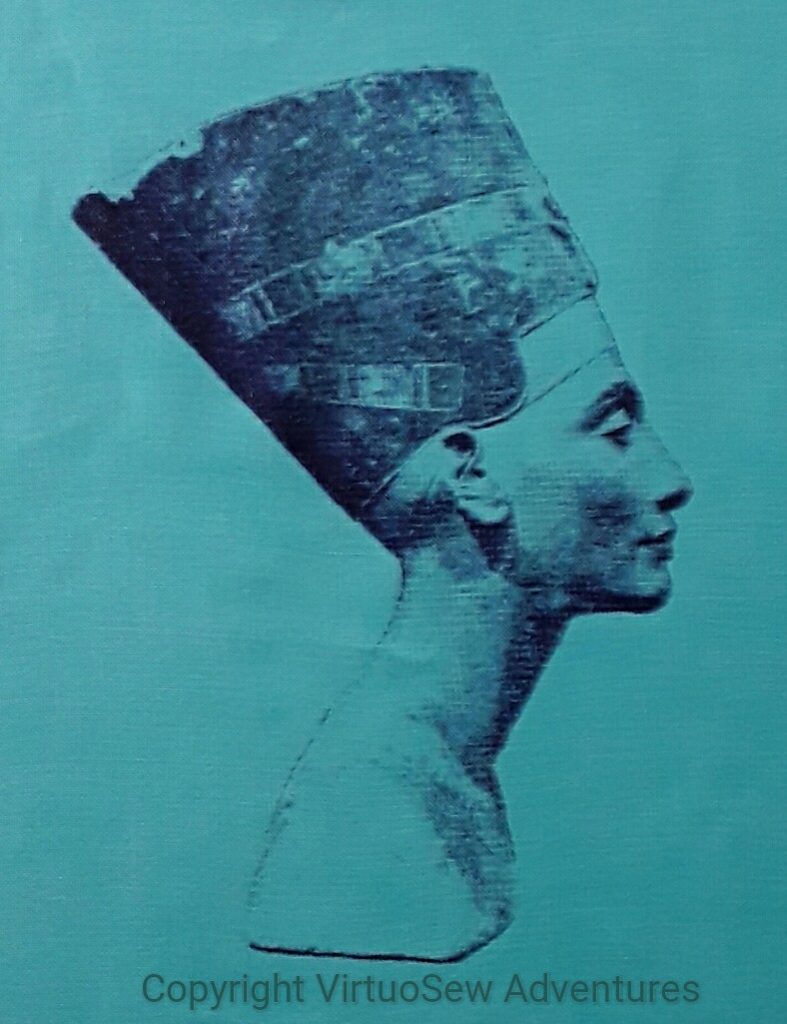
This is much the best print I’ve managed of Nefertiti, pressure, speed and amount of ink all working nicely, and very few really dark sections. What I want to do now is to highlight the coloured elements of the crown she wears – unique to her, apparently, no-one else in ancient Egypt has ever been depicted wearing it. I’ve got some gorgeous silk threads from Mulberry Silks which should do the job perfectly, but first they need a skeleton of gold. I had a lovely rummage in among the assorted wonders I’ve received from Thistle Threads (they have their own special box, of course), and after staring critically at the linen fabric, picked out the Special Tambour, and made a start.
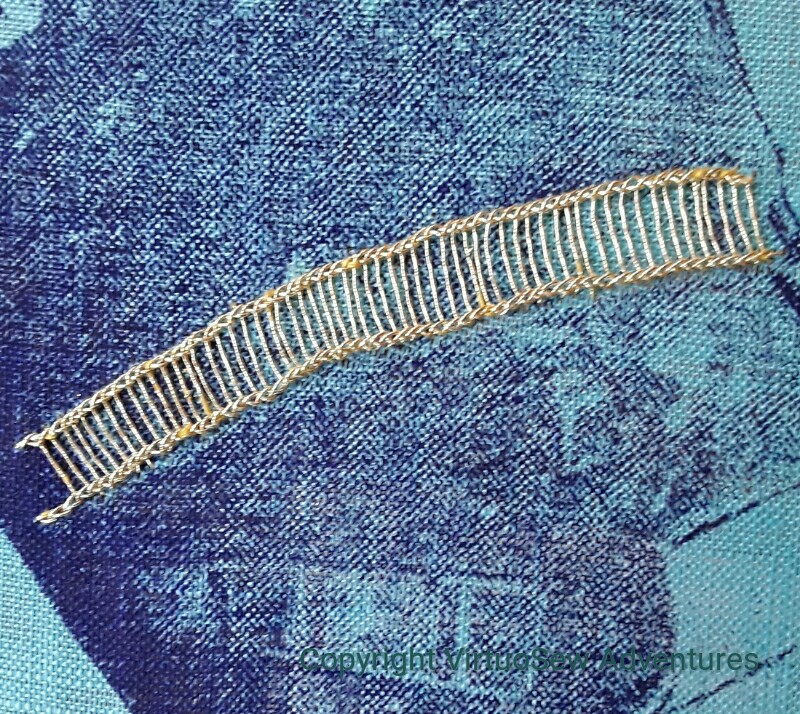 My idea is to create a framework of Ladder Stitch, and then add colour – as in the Tudor Rose project – using silk threads. Long term readers may recall that during the Tudor and Stuart Goldwork Masterclass, I had some trouble with Ladder stitch, so although I was fairly sure the idea would work, I sat down with some trepidation.
To be very pleasantly surprised. Something has happened in the intervening few years, and my ladder stitch wasn’t as trying as I expected, and moved fairly swiftly, too. I may yet decide to redo the stitches, because I re-tightened the fabric in the frame about halfway across, but that will depend upon how much better the second section looks when I have done it.
That’s a good start to a new project, isn’t it!
Finished – Tiny – Flame Stitch Pincushion
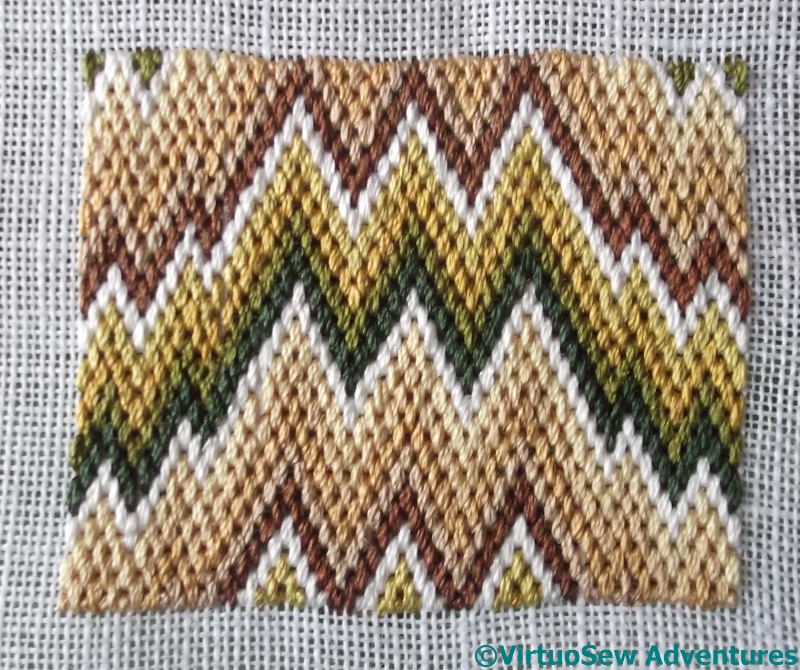
Flame Stitch Finished
There are in fact several errors in the stitching here. However, since I kept losing them and finding them and losing them again, I decided to let them stand. If even I can’t keep them in sight, no-one else will find them…
I enjoyed using the silk thread for the stitching – but then I keep saying that, don’t I? Silk seems alive somehow, in a way that cotton, linen, and even wool, don’t.
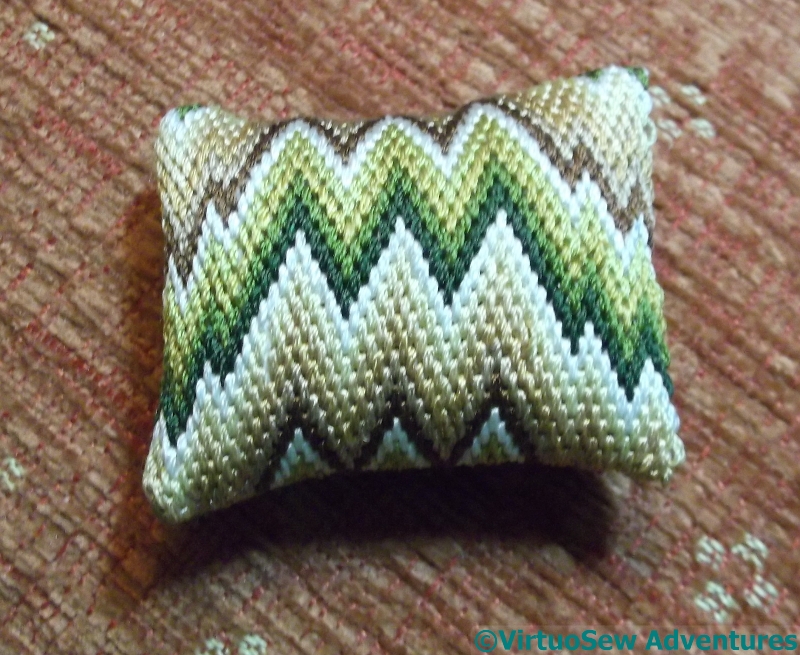
Finished Flame Stitch Pincushion
What really surprised me was just how small the pincushion was when I finished it, using a spare fragment of silk fabric for the back. It was really quite astonishingly fiddly when it came to turning it inside out and especially when it came to the corners.
Still, here it is, done, and stuffed, and the final side closed up neatly..

Isn’t It Tiny!
And then I put it in the palm of my hand and finally realised just how small it really is…
Another one for that eventual Winter Decoration Corner, I think – in my chaotic workspace, a pincushion this size would sink without trace!
Well, At Last!
Rejoice with me!
I have finished the polychrome tent stitch on Eve In The Garden Of Eden!
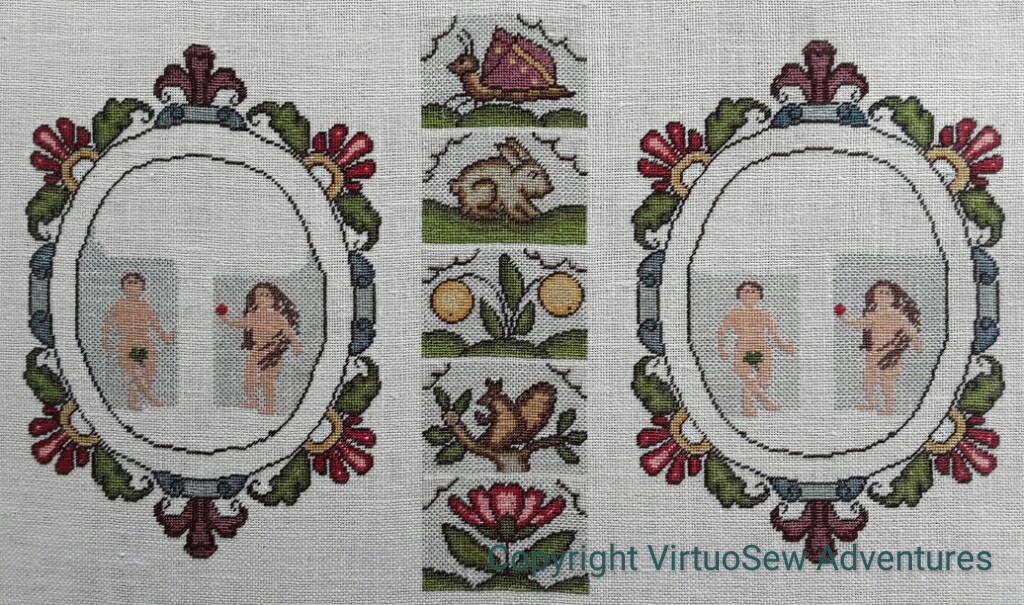
It has taken what felt like forever (although the post describing the start is less than a year old, as it happens), because firstly, I have to do counted work in short bursts or it drives me up the wall, secondly it is very fine and required a magnifier, and thirdly – there’s a lot of it!
In fact, to be strictly accurate, I haven’t quite finished, but that is because the skip tent backgrounds for the cartouches reach under the trees, and I want to decide how leafy I want to make them before I do miles of tent stitch that may all be covered. But I feel as though I’ve reached a milestone, so please don’t rain on my parade!
Flame Stitch Pin Cushion
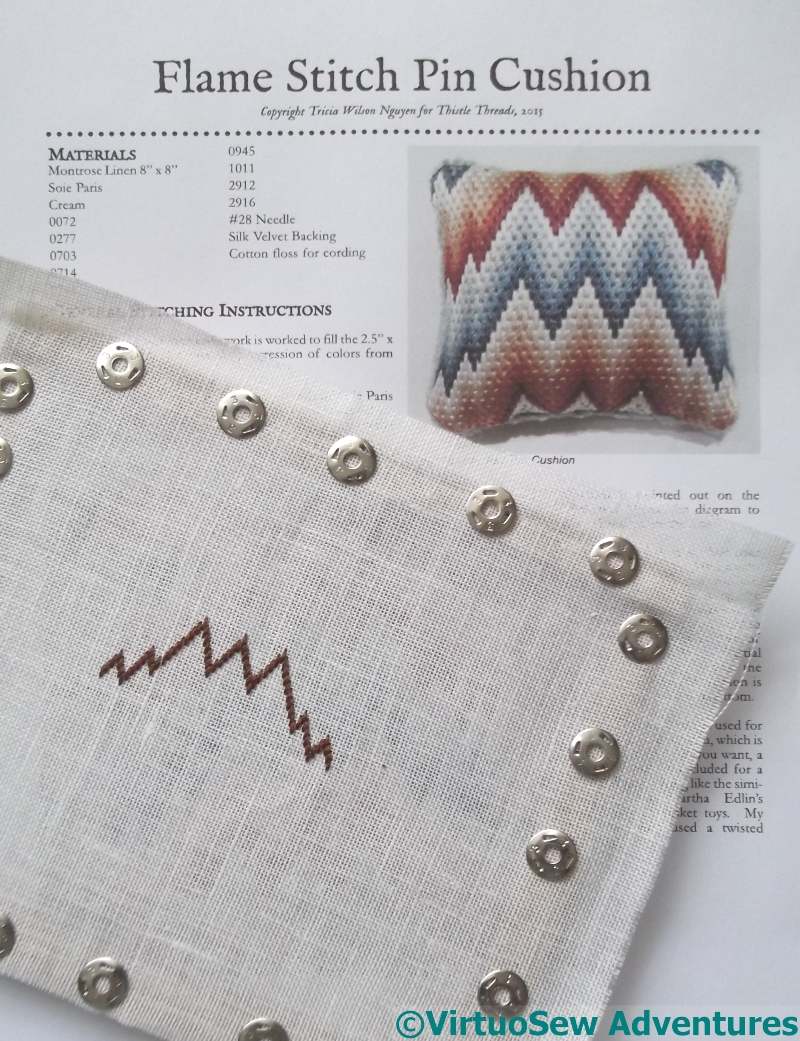
Pincushion Instructions
I hadn’t intended to do any of the Frostings Box designs, because I was intending to keep all the threads for my own purposes, but I’ve not been able to settle to anything this summer. I lost my “Dreams of Amarna” notebook (and found it again!), and although I have several pieces I want to do for it, I have no idea how I want to do them!
So I’ve been starting lots of little things to do in the intervals of the next major project.

Test Stitching
I’m determined not to buy anything for these projects, so I fished out a random piece of linen, and then the next thing was to discover how many threads to use. The instructions said four strands of Soie de Paris, but since I have no idea where the linen came from or what count it was, I thought the choice was worth testing. The left section is in two strands and the right is four.
Four it is, then!
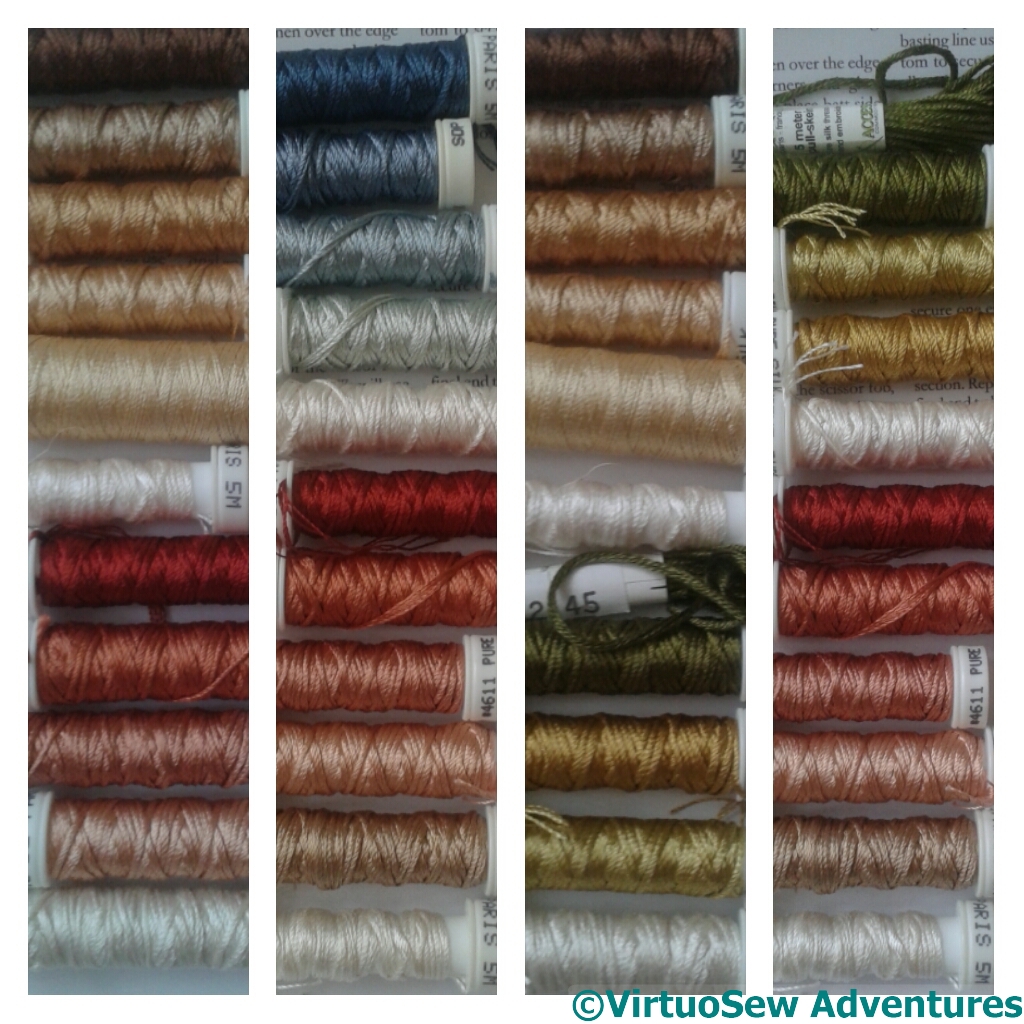
Colour Schemes
The next decision was colour scheme. As it happens, I don’t have the colours specified, so I decided to play around until I had something that looked interesting.
I’ve decided to go for green and brown.
Working on Nefertiti’s Cartouche – 2
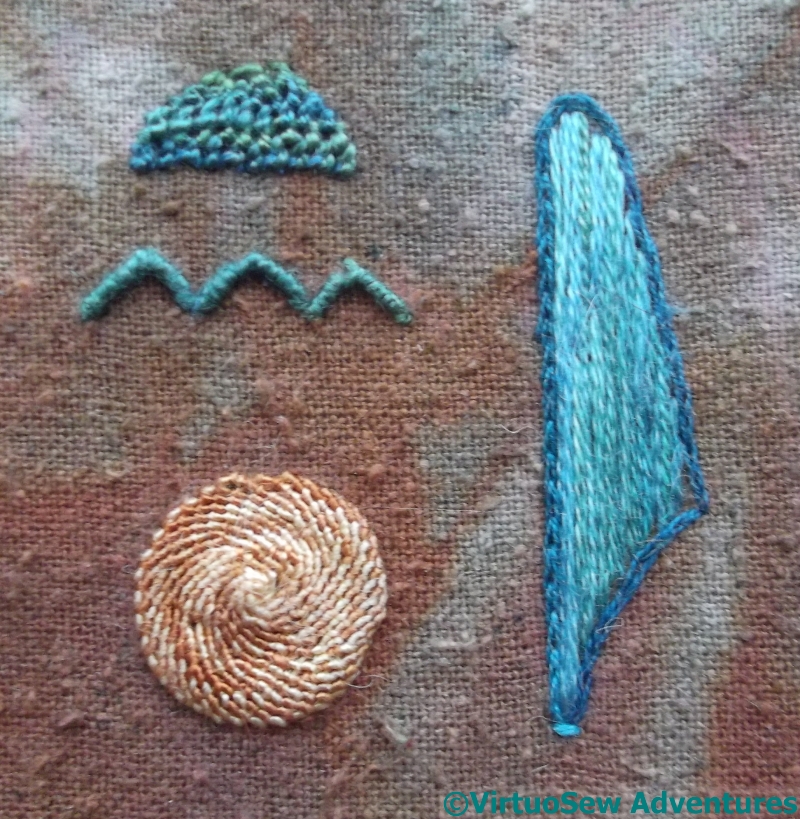
Top Block
After I’d finished the spiral trellis stitch circle, I had some doubts about it. Maybe it wasn’t strong enough, maybe the texture clouded the impression of the shape, maybe it even killed the colour. I’ve decided – with continuing reservations! – to keep it for now. I like the effect, and the knotted texture contrasts nicely with the long and short stitch beside it. If it can’t live with its companions when I’ve finished the piece, I will be in a better position to work out how to replace it.
The zigzag is about as simple as it could be – straight stitches, tightly whipped – and the half-circle, like the one in the lower section, is detached buttonhole stitch.
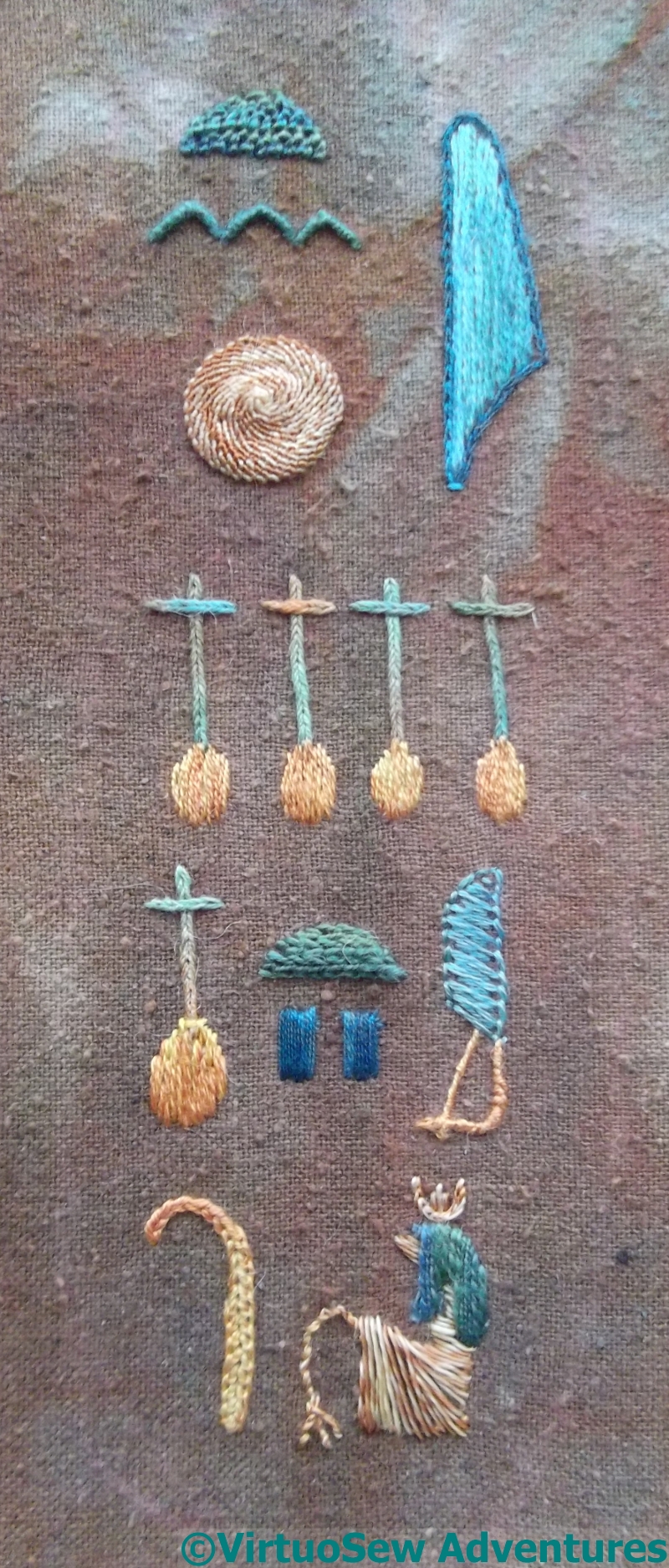
Needs A Border
So far, so good.
All the individual hieroglyphs have been worked, and I think the colour balance has turned out pretty well.
However, cartouches have borders, and the border is giving me a raging headache!
I had thought of working the border in Plaited Braid Stitch, in a copper or gold, or maybe couching down a knitted ribbon. Maybe a border in some other stitch, in blue-green?
So far, every thread I’ve tried has either disappeared into the background, or made itself altogether too obtrusive. I can see myself staring balefully at it for weeks, so in the meantime I am going to tack guidelines for the eventual border (in silk, what else?) and hope that inspiration dawns…
Working on Nefertiti’s Cartouche – 1
Lower Block
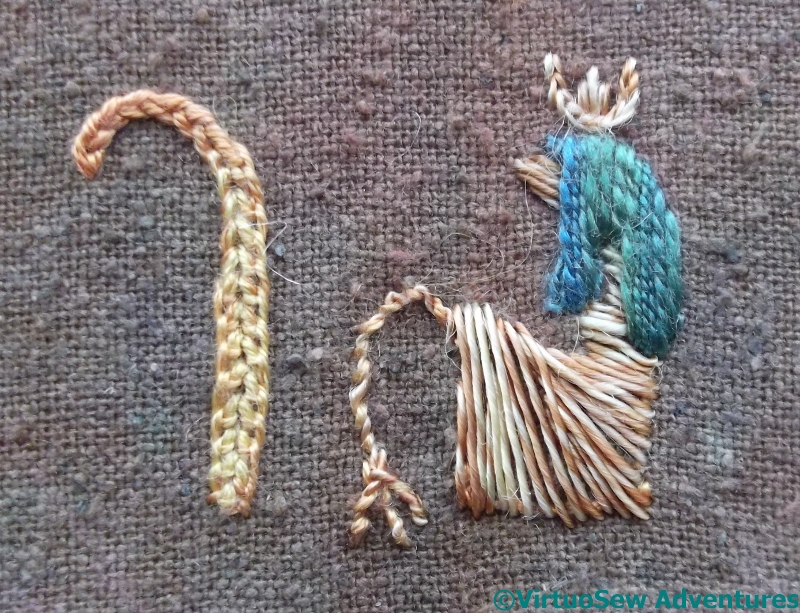
I need to learn to believe in myself more. As I was stitching this little seated figure, I was really very doubtful about it. I was twisting the sandy silk filament for every stitch, and it was being difficult, and looking rather odd and clunky.
Then I added the wig, in a variegated – and slightly slubby – silk perle, and suddenly I’m completely captivated!
The walking-stick like thing is a row of chain stitch with detached buttonhole stitch added to broaden the shaft. I think that works rather nicely, too.
Middle Block
False Start
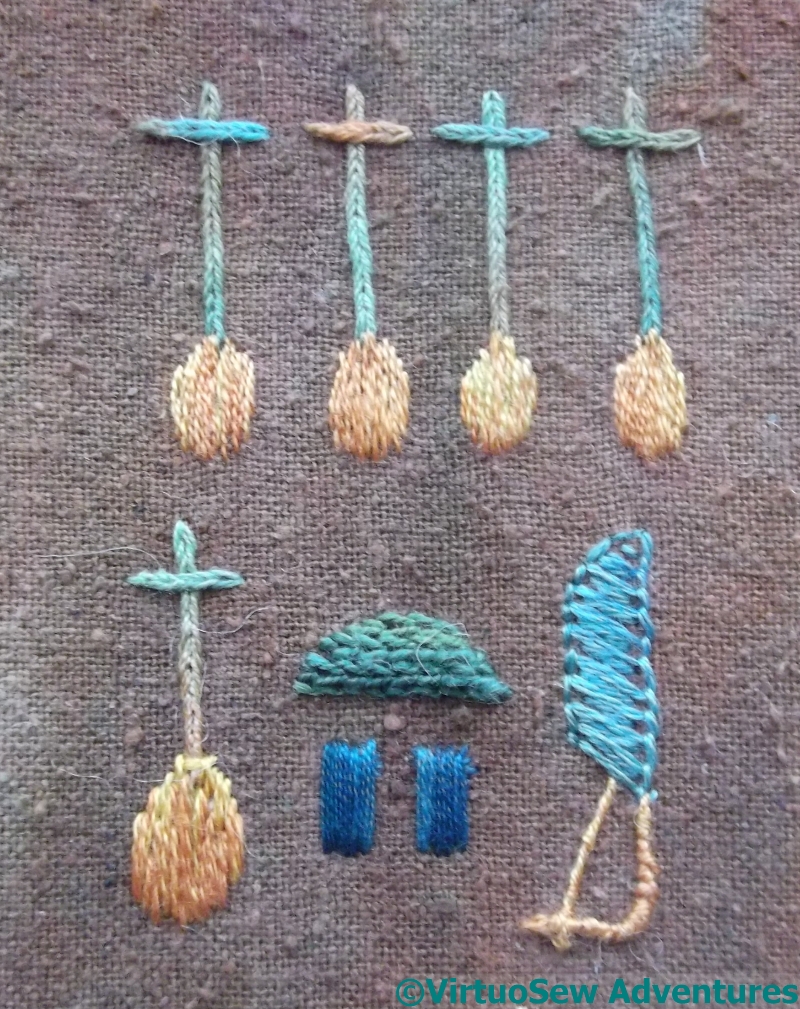
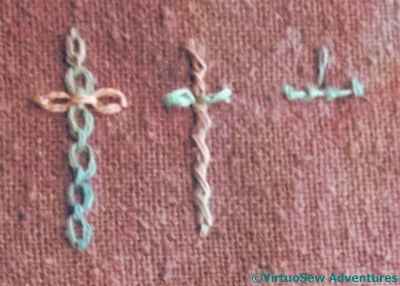
There was a slight false start with the row of spoon-like things. After I did the bottom row of this pair, ending with a crossed spoon in heavy chain stitch and long and short stitch, I wondered whether perhaps I should vary the stitches in the row above. An experiment in that direction soon proved me wrong, though!
The two little blocks started out as closed herringbone stitch, but that looked scrappy and a bit twisted. I left the closed herringbone stitch in place, and covered it with satin stitch, breathing a sigh of relief when it worked.
The fabric is the same as I used for the Faience Hippopotamus, and it’s frightfully difficult to photograph. No matter what I do, the colour careers around the spectrum, and the grey, overcast days aren’t helping, either.
Nor is it especially easy to stitch on. It doesn’t look like a loose weave, but it behaves like one, even though I’ve supported it with a piece of calico. Stitches that I like using are proving unsuccessful and behaving oddly. All in all, although I’m enjoying it, it feels most peculiar!
Progress on Eve In The Garden Of Eden
Progress on the spine
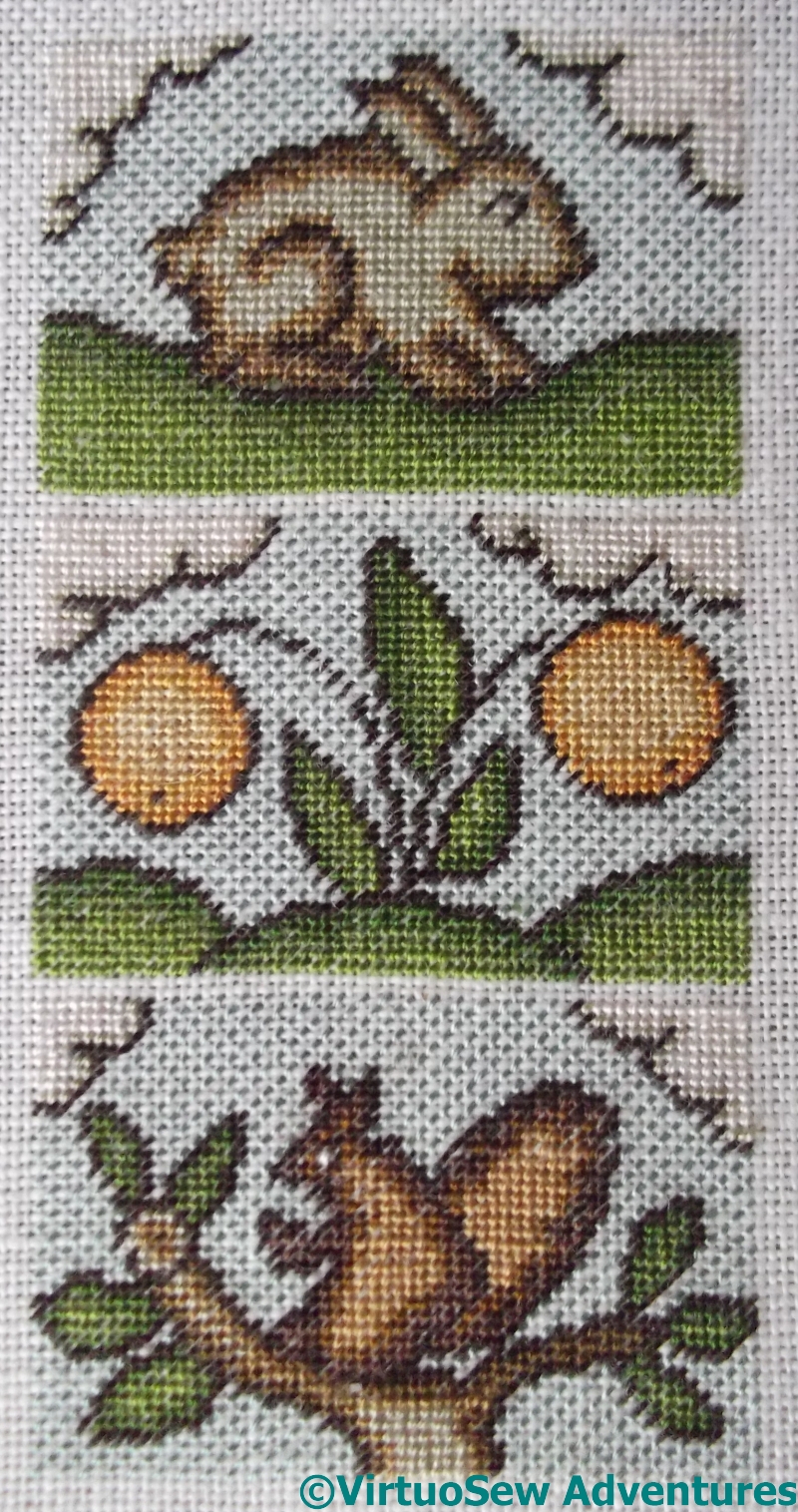
After all those good intentions, I’ve rather fallen behind with “Eve In The Garden Of Eden”. It’s not that it’s difficult – rather fine, requiring the use of the magnifier, but not especially difficult. Unfortunately I’ve only got as far as three of the five panels on the spine of the bookcover. There are two more little panels on the spine, and then two identical ornamental frames, back and front, showing Adam, Eve, the Tree Of Knowledge, and the Snake. And that’s before I start on the complicated bits!
Reasons/excuses for the delay? Well, I moved over to the Canvaswork Angel over Christmas (it seemed more appropriate somehow!), and then I was blindsided by the The Great Lady’s Magazine Stitch Off. Not that I am complaining, you understand – it’s been fascinating to begin finding out about the early days of periodicals and to see the designs provided for subscribers, especially as even more are beginning to come to light!
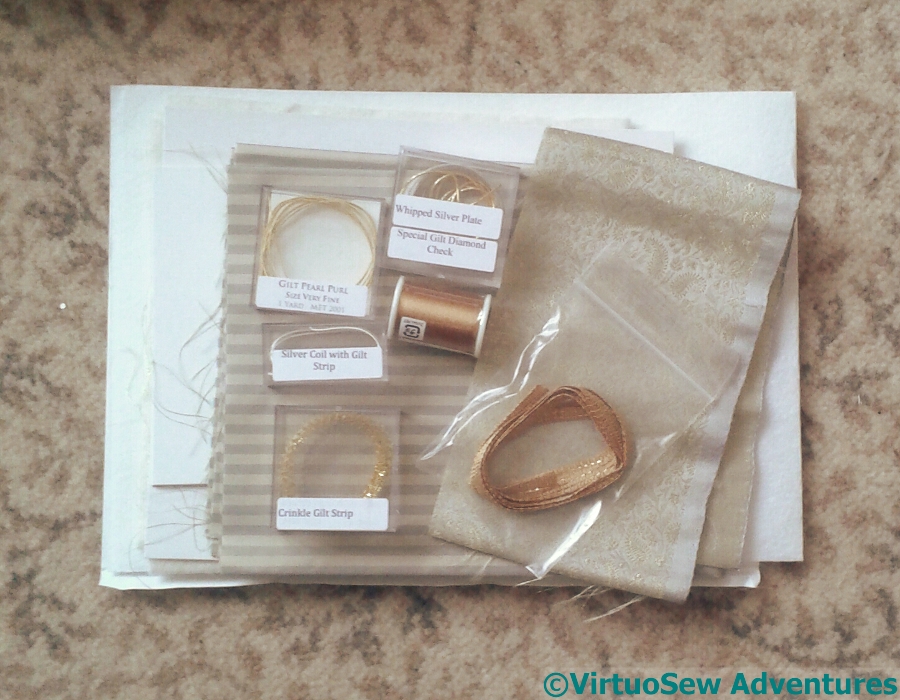
Another Parcel
And now I have been reminded that I really need to get on with it, because the finishing kit has arrived, including some rather lovely silk brocade, and some fancy threads I’ve not come across before.
Still, I need to finish that pashmina first…