About Rachel

View all posts by Rachel
Dreams of Amarna – The Antelope Panel
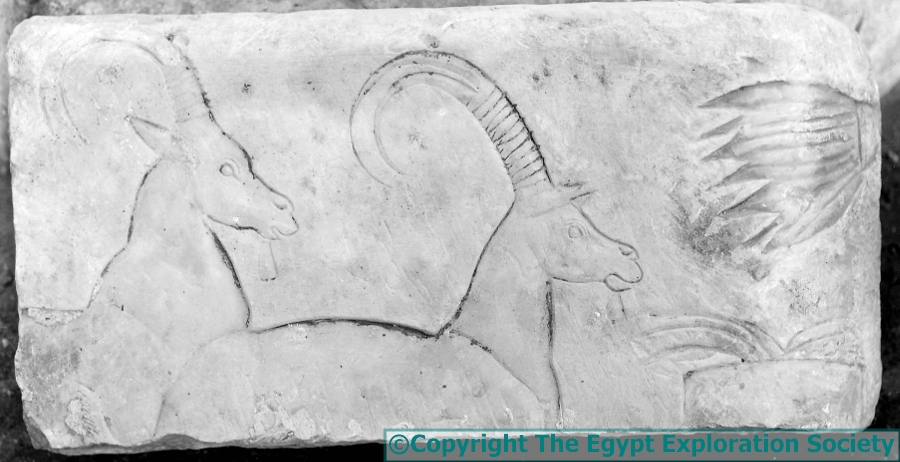
Antelope Carving – Photo copyright The Egypt Exploration Society
When I finished the Hittite Amulet, I didn’t have another piece ready to go, but feeling a little jaded with metal threads, I didn’t want to move straight back to the Tudor Rose… So I went rummaging in the wonderful selection of photographs that the Egypt Exploration Society allowed me to have copies of to use as reference, and found a photograph of a small piece of stone, carved with part of a frieze of antelope.
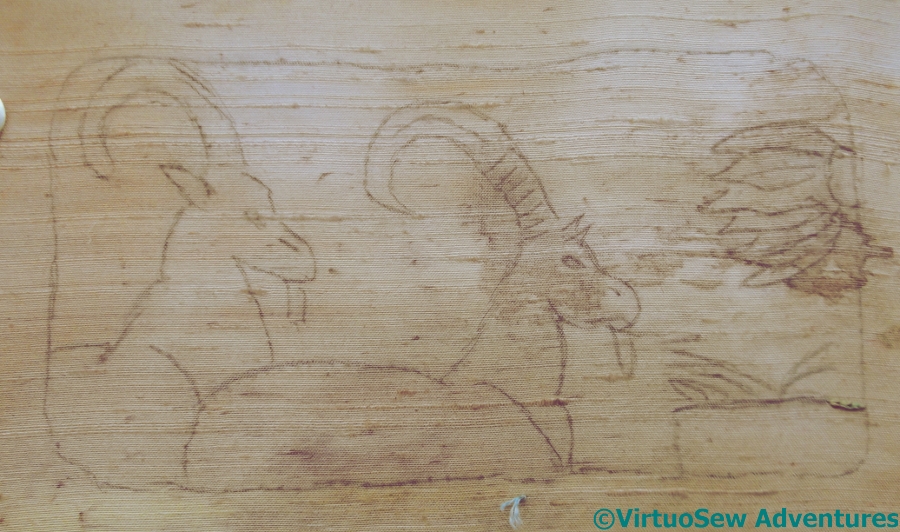
AntelopeFrieze
I transferred the design onto some handpainted silk using the prick-and-pounce method, and went over the lines with a pencil, then framed it up over a calico backing, picked out a skein of hand-dyed twelve strand silk and thought about stitches.
In the end I decided that what had attracted me to the photograph was the simplicity of the lines against the slightly uneven texture of the stone, and so I should make my version absolutely simple too.
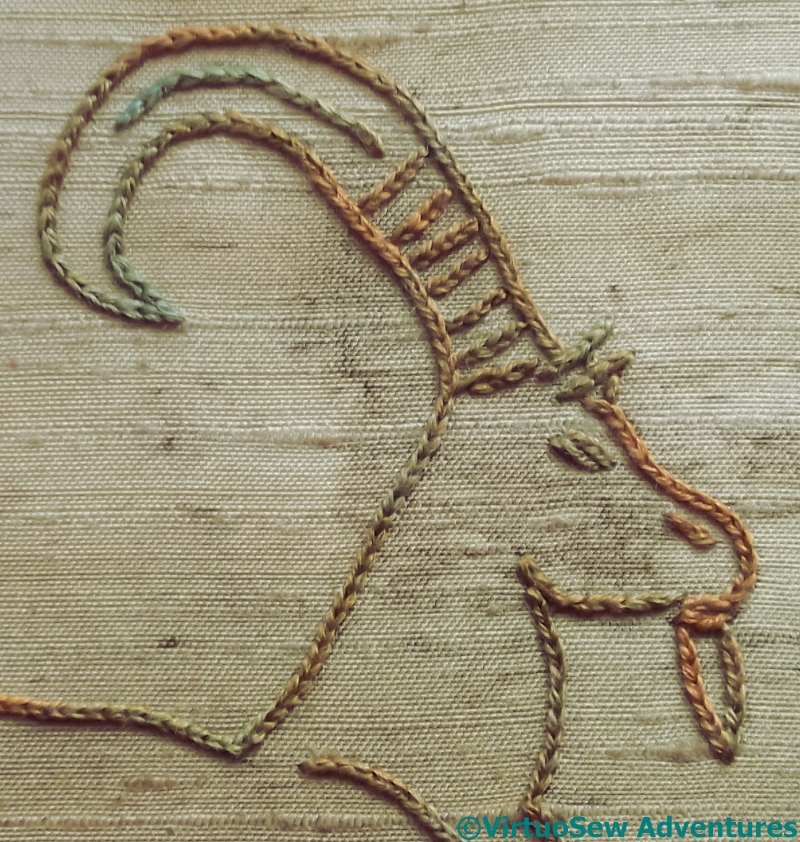
Antelope Close Up
With that in mind, all the lines will be in reverse chain stitch, worked as small and as evenly as I can manage without using a magnifier, for all the lines. Reverse chain stitch is so much easier than ordinary chain stitch when the fabric is in a frame!
I am thinking of using Hungarian Braided Chain, which I worked on the Crane Pot, for the edge, but I am also considering the possibility of not stitching a frame at all, but instead stretching the silk over a piece of skirtex cut to the shape of the stone.
This is a real contrast with the Glittering Nightcap – very simple and very “minimal”. Almost like a palate cleanser after a heavy meal!
Assembling the Glittering Gentleman’s Nightcap – Part One
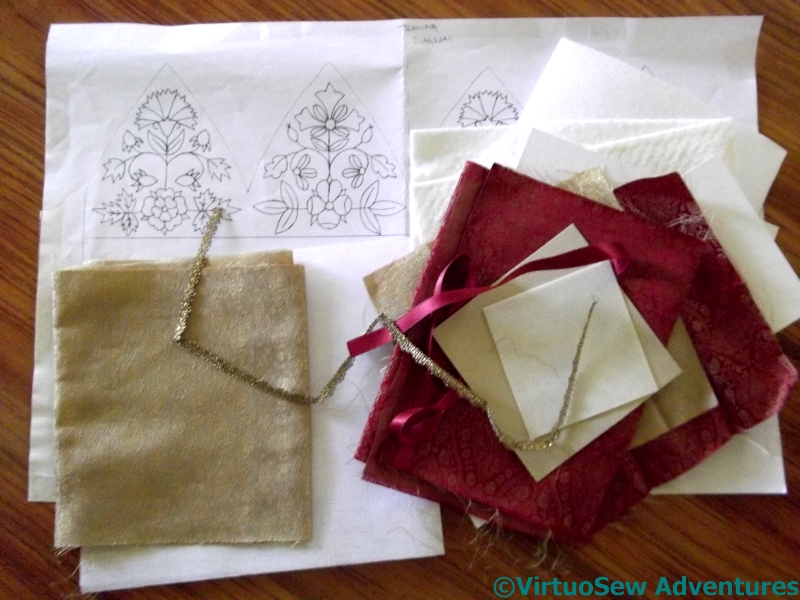
Materials To Finish The Nightcap
So now, having finished the embroidery, I need to assemble the Nightcap. In addition, Tricia has designed a stand for it, which is in the form of an étui. Consequently I have a rather distracting heap of brocaded silk, doctors flannel, ultrasuede, ribbon and gold lace. Not to mention batting and buckram…!
As I’ve said before, I am never entirely at ease finishing a piece into three dimensional form. So there was a slight hiatus while I gathered my courage to begin.
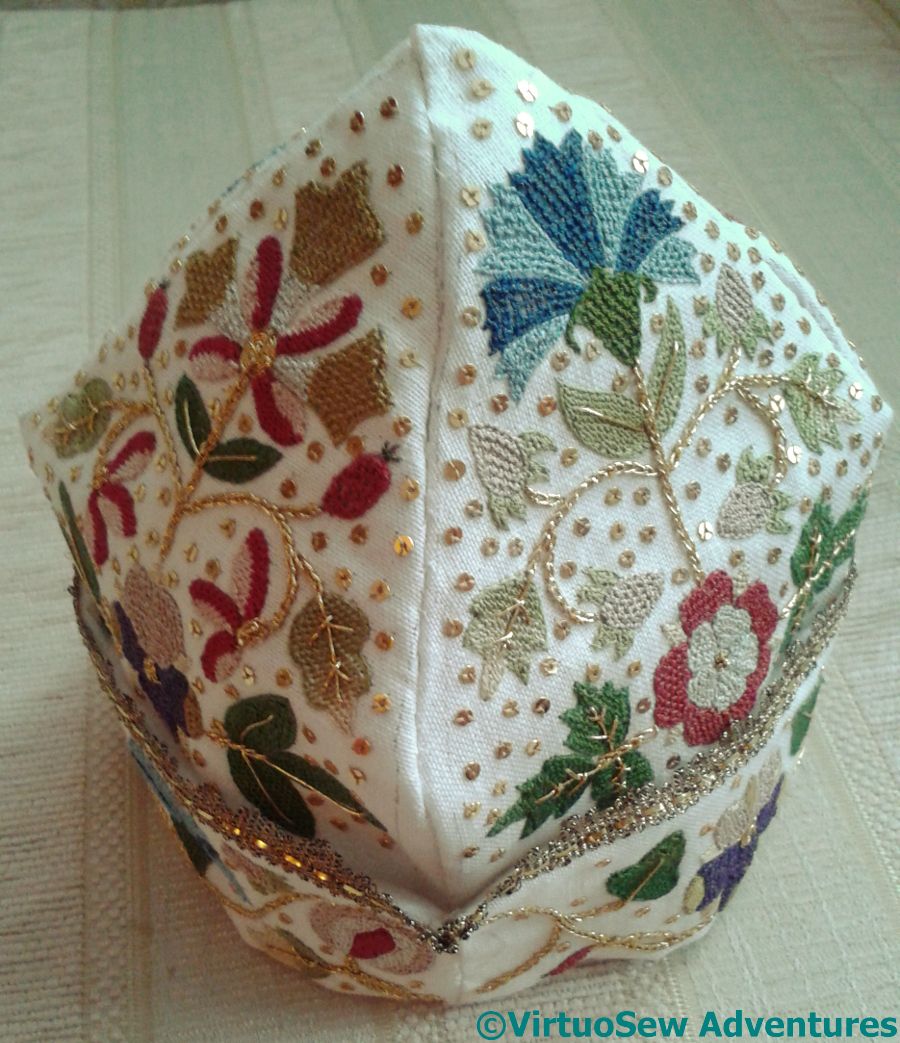
In Three Dimensions
I decided to finish the Nightcap itself first, as – not least – I was rather keen to see it!
The first stage was to add the lace to the top of the brim, and then create the shape by sewing up the seams on the crown. The lace was easy enough to apply, once the folds were in place, but sewing up the seams on the crown was surprisingly fiddly!
I had wondered, in looking at the instructions, why the seams were embellished with reverse chain stitch, and I think you can see why in this photo of the Nightcap finished (externally) apart from that detail.
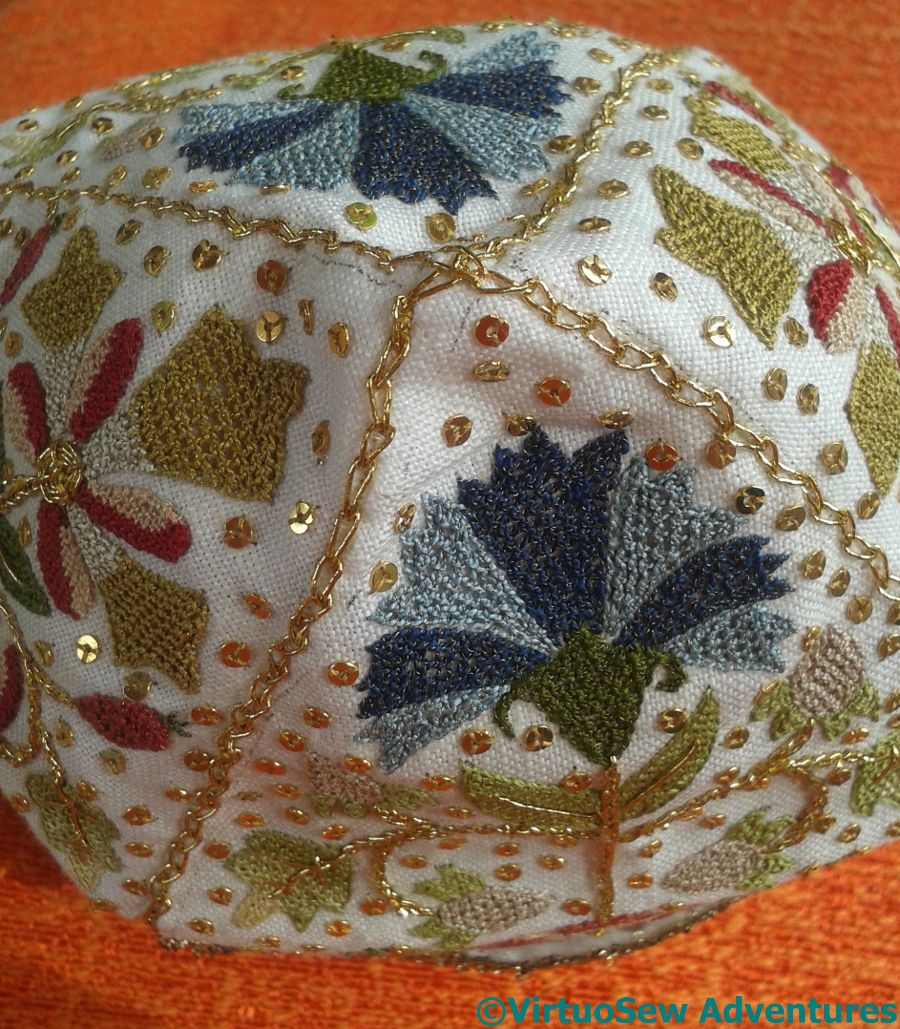
Aerial View With Gold
As this picture shows! Admittedly the orange background also helps to bring the Nightcap to life, but the reverse chain stitch in gold is another detail – like the pearl centres on the Floral Glove – that adds sparkle and polish to the piece.
The next stage was to line the Nightcap – using a lovely pale gold silk brocade. Again, simple enough to state, but slightly tricky in execution!
Lining completed, another deep breath and pause prepared me for the next stage…
Learning a new technique
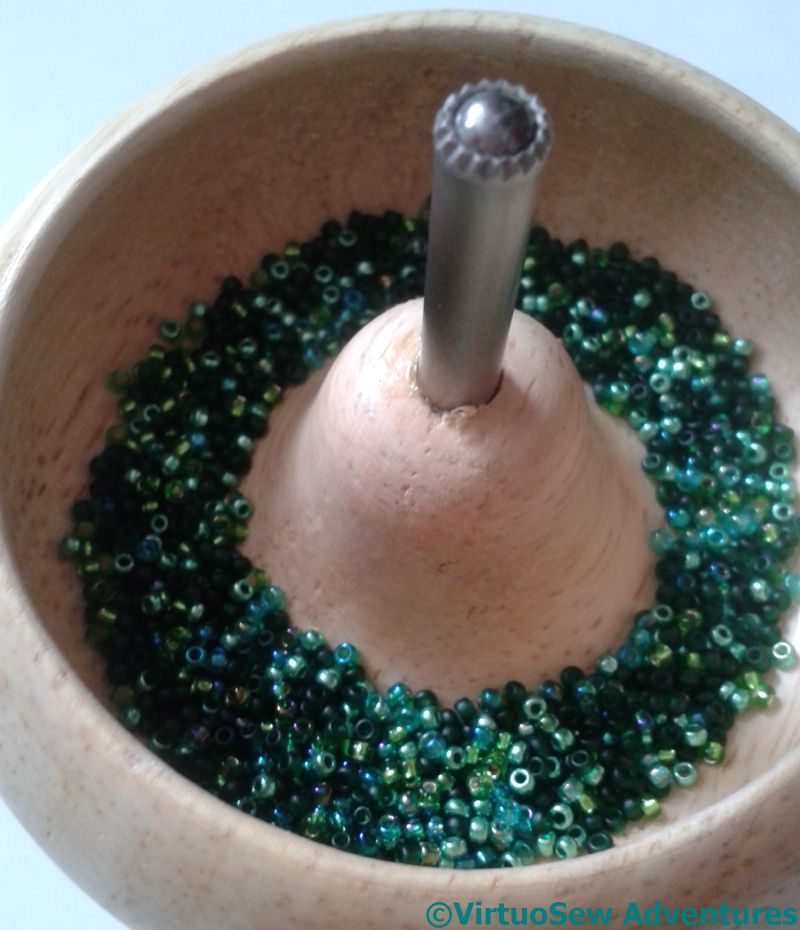
Beads Ready For Spinning
In “Nefertiti Lived Here” Mary Chubb describes excavating a necklace, and being reminded of a bead necklace she had as a child, partly by the delicacy of the necklace she was working on, and partly because the fact that she had no idea where it had gone gave some insight into how the excavated necklace could have been lost in antiquity.
Of course, she didn’t describe the necklace very much – she only said it had daisies on it – but I want to include some trails of daisy embellished lengths of beading, hanging off the edge of one of the Dreams of Amarna panels. Beadwork is not a technique I’m very familiar with, so it’s yet another adventure into the unknown!
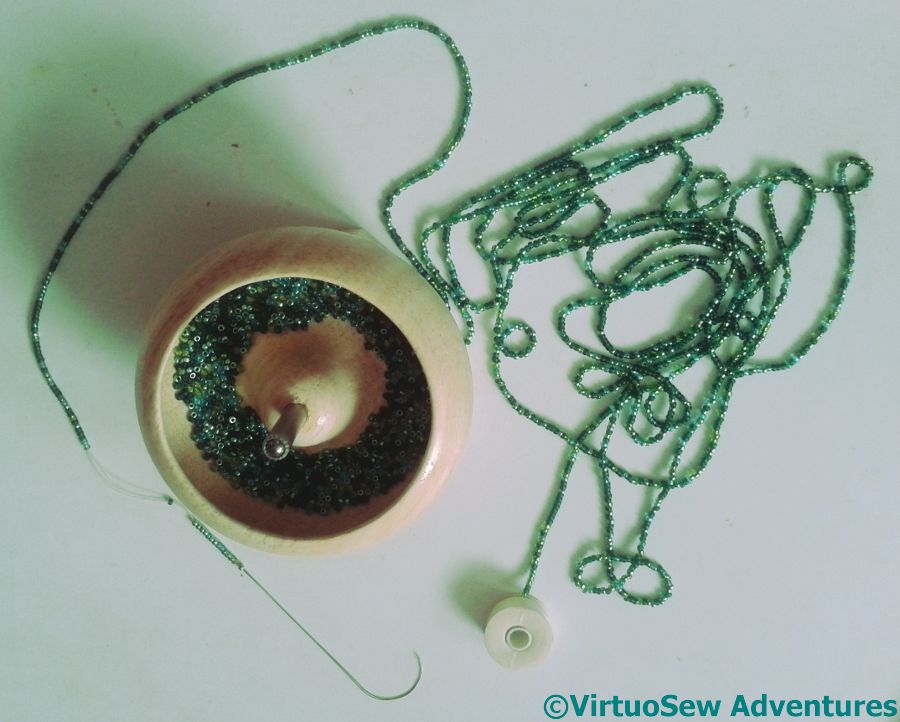
Bead Spinning
I wanted to make sure that there was some variety of colour in the green strands, and I used this “bead-spinning” pot to thread a random selection of green seed beads onto a strand. I got a little carried away here, because it took me some time to get used to the technique. I discovered that, strongly right handed though I am, it was more successful to hold the needle in my left hand, and turn the spindle with my right. In the end I had at least a couple of metres of bead strand waiting to be used, and I still have a metre left!
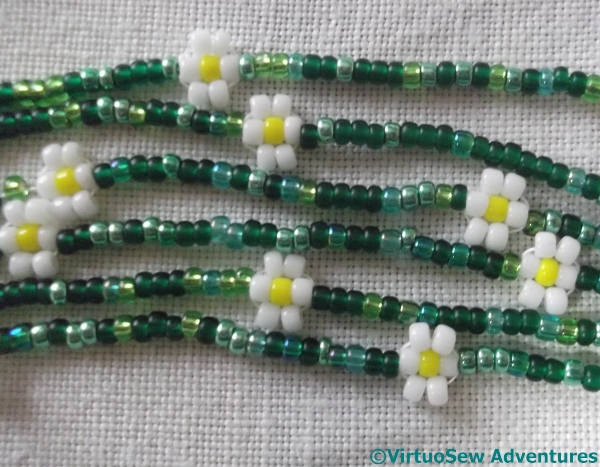
Close Up Of Strands
Here is a close up of the beaded strands I have created, with very simple bead daisies interspersed with lengths of the green beads. I’m rather pleased with it. It has the sort of delicacy that would have been considered suitable for a little girl in the early years of the twentieth century, and I can just imagine a small Mary gleefully rattling her beads and feeling very grown-up!
The Hittite Amulet Is Finished
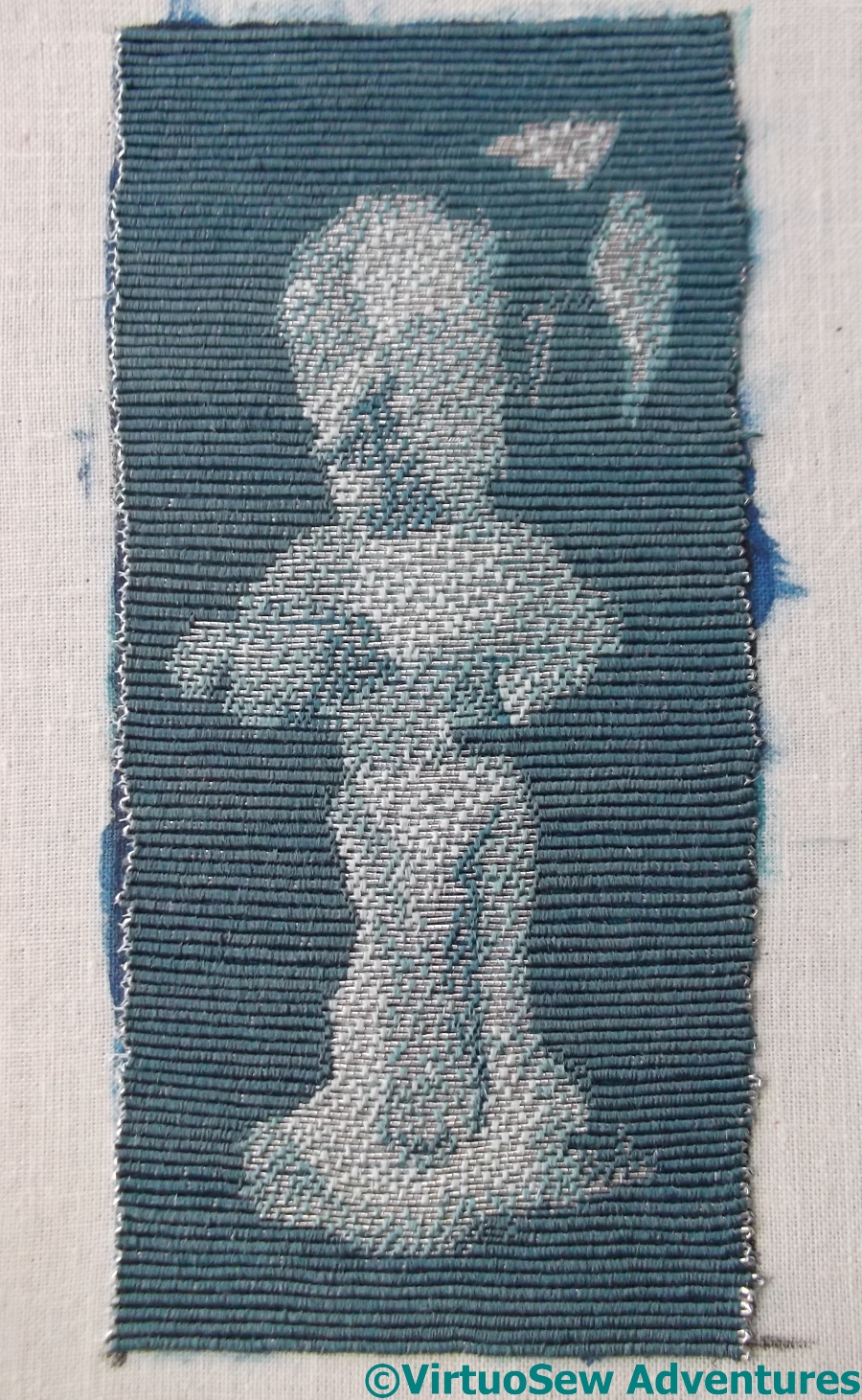
Hittite Amulet – Finished
Those who follow me on Twitter will have seen a Tweet full of rejoicings last week – I have finished the Hittite Amulet at last! He’s been quite a challenge, and required considerable stores of patience, but I’m very pleased with him. He’s looming out of the darkness very impressively!
I began working on him last July, and got rather less than halfway before I put him away in a boxfile before Christmas when I was getting ready for festive visitors. After Christmas, I decided to concentrate on the Glittering Nightcap, because I was beginning to fear that otherwise I would never finish it, and didn’t begin again on this fellow until May.
Since then I have simply persevered. I’ve not written about him, because in truth there is little to say. Or nué is a simple enough technique – in essence, satin stitch over a metal thread – it is just that there is a lot of stitching needed before any appreciable change is seen.
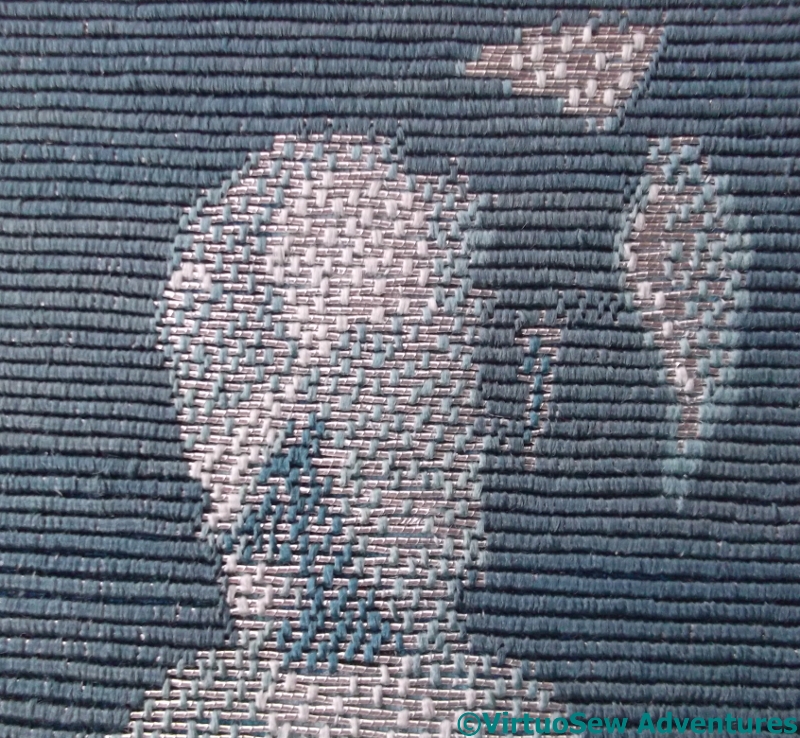
Detail Of The Head
Although it is a simple technique to describe, doing it well is less so. As you can see from the close up of the head, I’ve not managed to keep the rows perfectly even in their spacing or coverage. Perhaps, although I used pre-shrunk calico as the basis, I should have used two layers to make it sturdier (I hope not, it was tricky enough already!) or perhaps the waverings are owing to stitching over two rows at a time.
Now he can doze quietly in my Dreams of Amarna box while I continue with new pieces…
I had a skein and a half left of the dark silk, after all that panic buying last year. Getting quantities right is almost impossible.
Crazy Canvaswork Cushion – Part 6
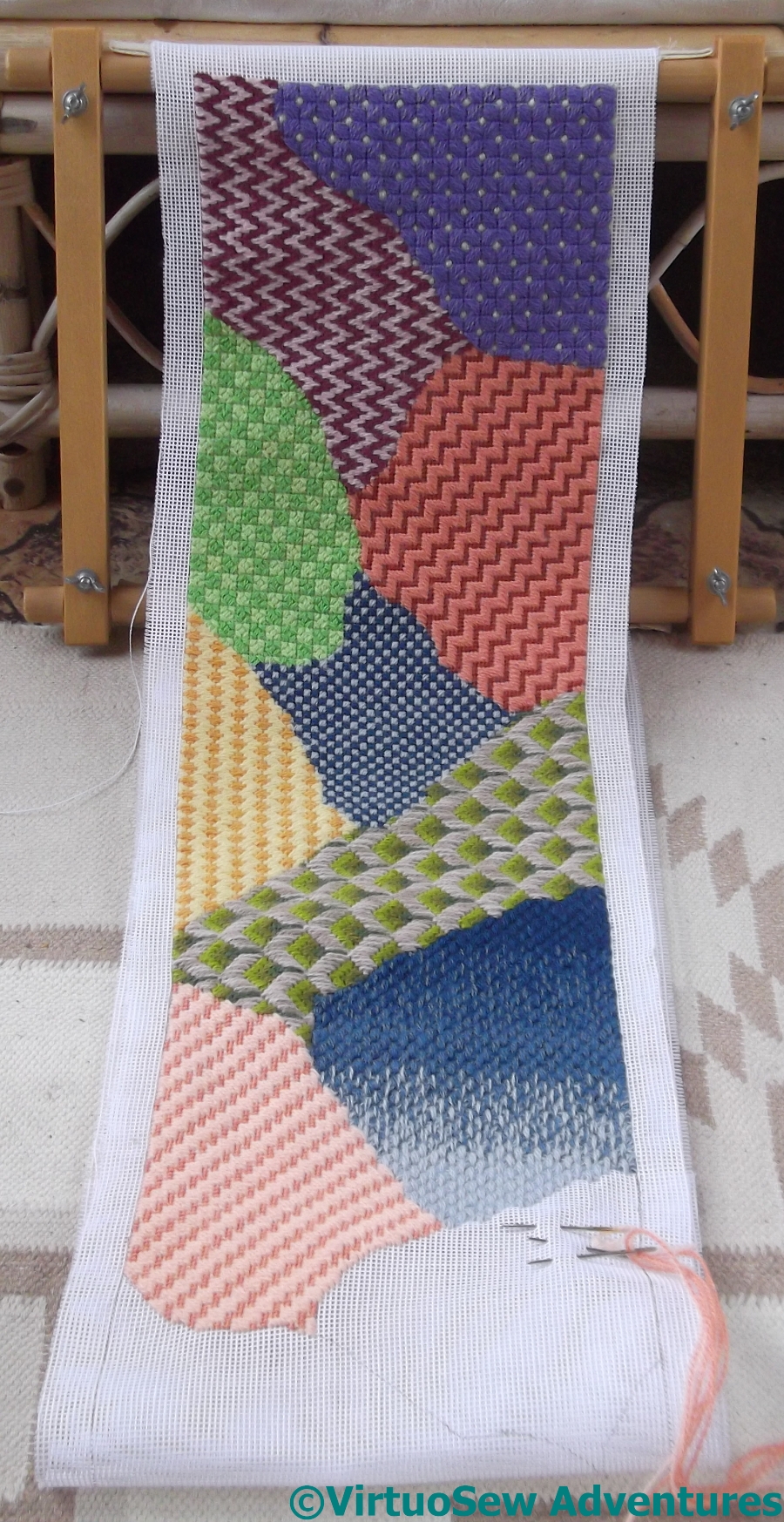
Two Thirds Done
We interrupt our normal programming…. to bring you your first sight of the whole Cushion.
Probably your only sight until I take it off the stretchers, too. As it turned out, getting the canvas rolled up neatly again, under sufficient tension, was really quite a task, involving two people and much changing of minds, as well as many rollings and unrollings. Furthermore, since the rollers are permanently set in their sockets, it won’t be possible to show the whole thing without taking it off the stretchers. I shan’t be doing that, because I really don’t enjoy the mounting process!
However, I can report that I am really very pleased with how it is going. I think I need another set of greens for the next section, since there seems to be a rhythm of sorts going on there. I certainly need something bright, with a bit of punch and impact. I like the last two sections — they work well together – but they are beginning to look a little too well behaved. It’s not quite as riotous as I was hoping…
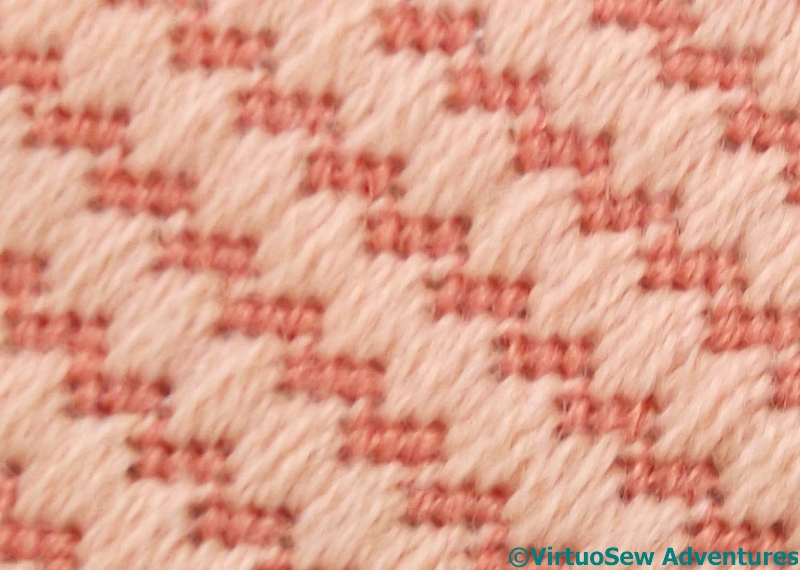
Moorish Stitch
Section Nine of the Crazy Canvaswork Cushion is worked in Moorish Stitch, a diagonal stitch to set against the crossed stitch of the previous patch.
There is one heathered thread in this pattern – the solitary tent stitch vertically separating the short dashes. That’s turned out a bit too subtle, but it does help to maintain the difference between Moorish Stitch and Jacquard Stitch, for example.
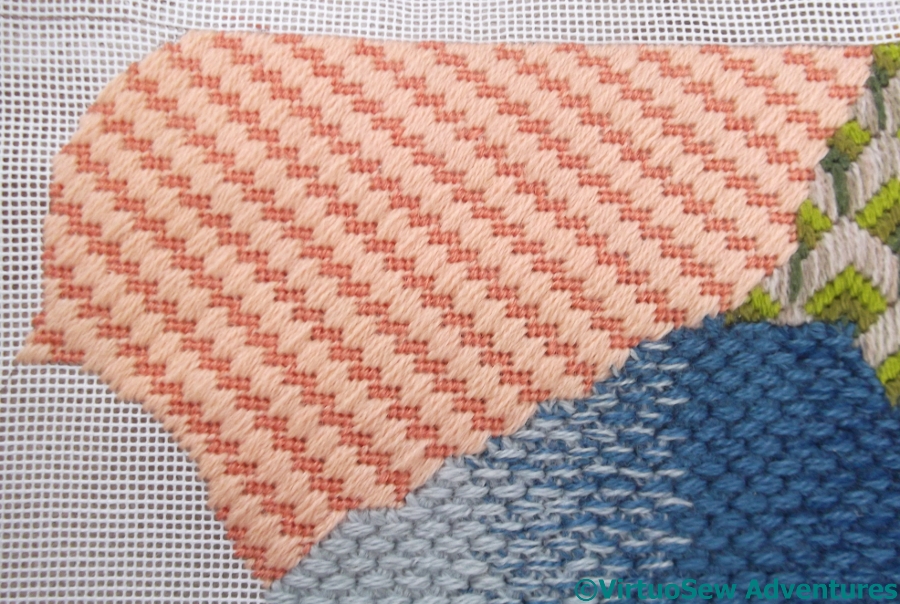
Section Nine
This patch took longer to do because as the weather warms up, wool becomes a less appealing material to work in. In addition, the main, peach wool proved to be rather harder to separate that I expected. It’s labelled Paterna, and should be exactly the same as all the other threads, but it was harder to strand, and has slightly less sheen.
Now I need to pick a stitch – I think it should be a straight stitch, with pattern that runs horizontally – and then pick the colours for Section Ten…
Tudor Rose Progress
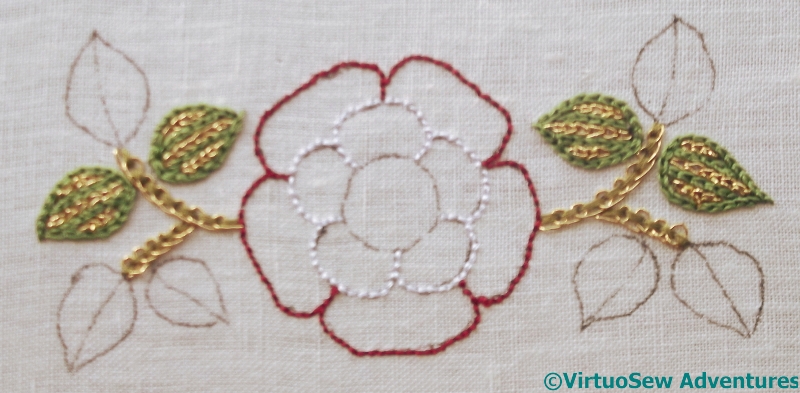
Rose Outlined
At this point, the challenges abruptly increased… The petals are to be filled with Up and Down Buttonhole Stitch With Return (which is one of the stitches from the Tudor and Stuart Goldwork Masterclass), but in a combination of metal and silk threads. The outer petals will be red and gold and the inner petals white and silver, and we are explicitly instructed to finish the back stitching (both white and red) before tackling the filling.

Detail Of Red Petal
The red silk is used for the return – the straight bar stitch – and the gold for the up and down buttonhole stitch. This means, of course, that there are long stitches on the back of the fabric, but it also creates a rather lovely chequerboard effect of gold and red. Up and down buttonhole stitch is one of my favourites, but as a detached stitch it offers a few challenges, especially in the gold thread. I was very glad to be working this in a frame resting on a stand, as there were times when both hands, and one of my bone stilettos, were needed to bring the gold thread under control.
I’ve noticed that in the metal thread, the stitch is squarer than in the silk, which compressed itself into a much denser fabric. I suppose this adds to the contrast in textures, but it will be interesting to see whether it becomes more even as I become more experienced with it!
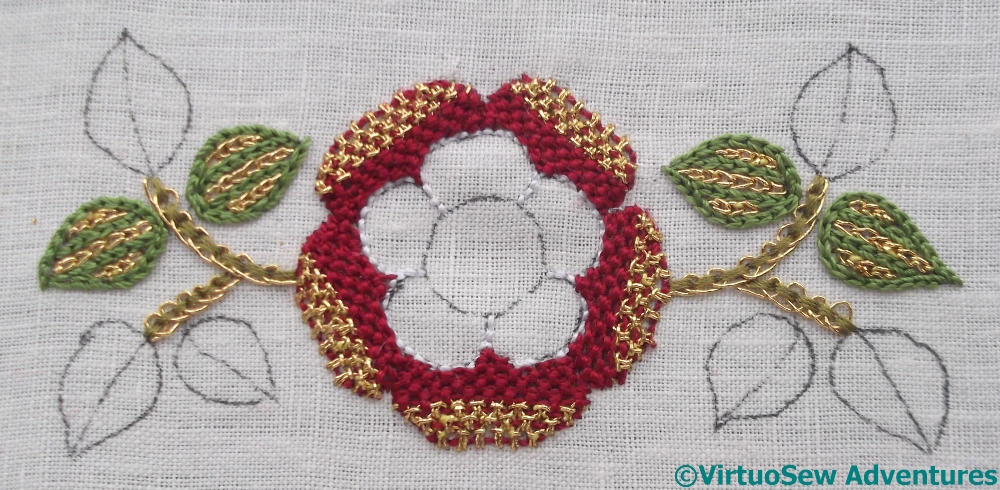
Red Petals Complete
I’m rather pleased with it so far. In a couple of the petals, the rows somehow are not as straight as they should be – I’m not quite sure how that happened – but, if you click on the image you will see the larger version, and I think it shows evidence of improvement in technique. Which, after all, is the whole point of my following these courses…!
The Circle Skirt Finished – Maybe!
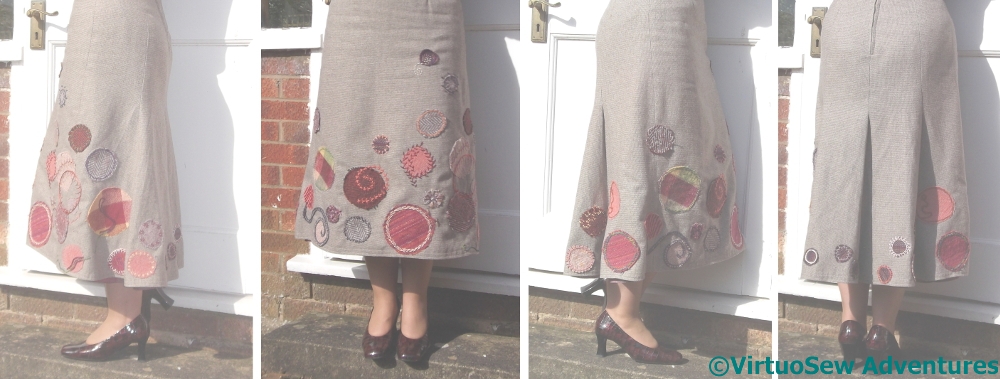
The Finished Circle Skirt – Perhaps!
This seems a good enough point at which to say the Circle Skirt is finished, although I may tweak and titivate further next winter.
Click on the picture to zoom in..
Some of the circles have been needlefelted, to greater and lesser extents, to help them to stay in place. Now I have my embellisher, I think that the next time I try this sort of thing, I will needlefelt very thoroughly, to try to help blend in the edges a little more. Once I have tried both ways I will feel that I am beginning to gain an understanding of how the embellisher affects the handle of the the fabric. I already know that it does, of course, but now I need to learn how to predict the effect and allow for it.
The skirt is now much more useful and wearable than it was. Unembellished, it was a strange light greyish colour that seemed just slightly “off” with everything I owned. Now, however, the burgundies, reds and greens tie in nicely with an assortment of tops, and the way the embellishment shrinks around the sides to the back helps to emphasize the kick-flare at the back.
In the right company, it’s a fabulous conversation starter, and it’s a wearable sampler as well. I’m rather looking forward to wearing it at the Knitting and Stitching Show in Harrogate in November!
Starting on the Tudor Rose
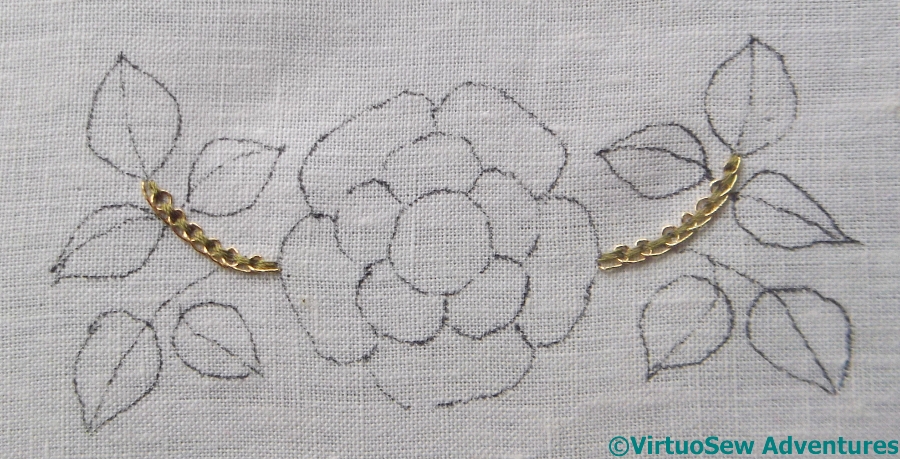
Tudor Rose – First Stage
Having finished the embroidery on the Glittering Nightcap – even if I haven’t assembled it yet – I decided that I would allow myself to begin on the Tudor Rose. The goal of this course is to introduce stitches and effects that combine silk and metal thread – in the same stitch, not in the same thread – and I am hoping that it will give me ideas for tackling representations of ancient Egyptian jewellery for the Dreams of Amarna.
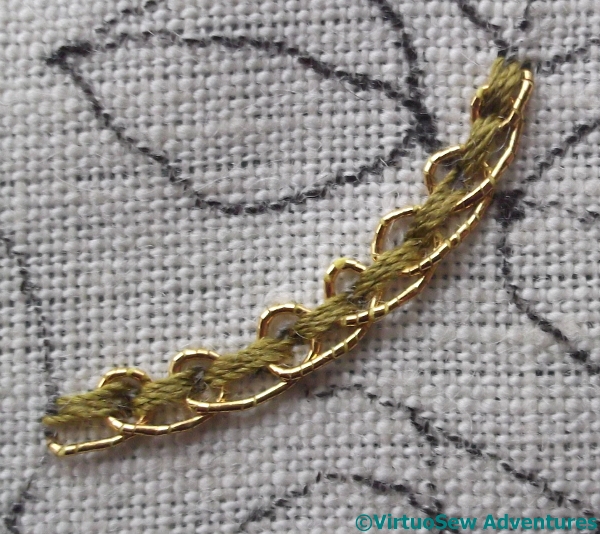
Interlaced Back Stitch
The first element is a fairly simple one, in effect a version of Pekinese Stitch, but with three rows of back stitch for the base, and a metal thread used for the interlacing. The challenge here is in making sure that the silk thread is sufficiently loosely stitched to make the interlacing possible, without being so loosely stitched that nothing stays in its’ place. Since the metal thread structure is of a core wrapped around with a fine film, when the thread is bent, the film sometimes stands away from the core, catching on the silk. Another key for Tricia in this course – as in fact in all her courses – is learning to be aware of the use to which a particular thread was intended to be put. We need not restrict ourselves to that use, but we do need to be aware of it!
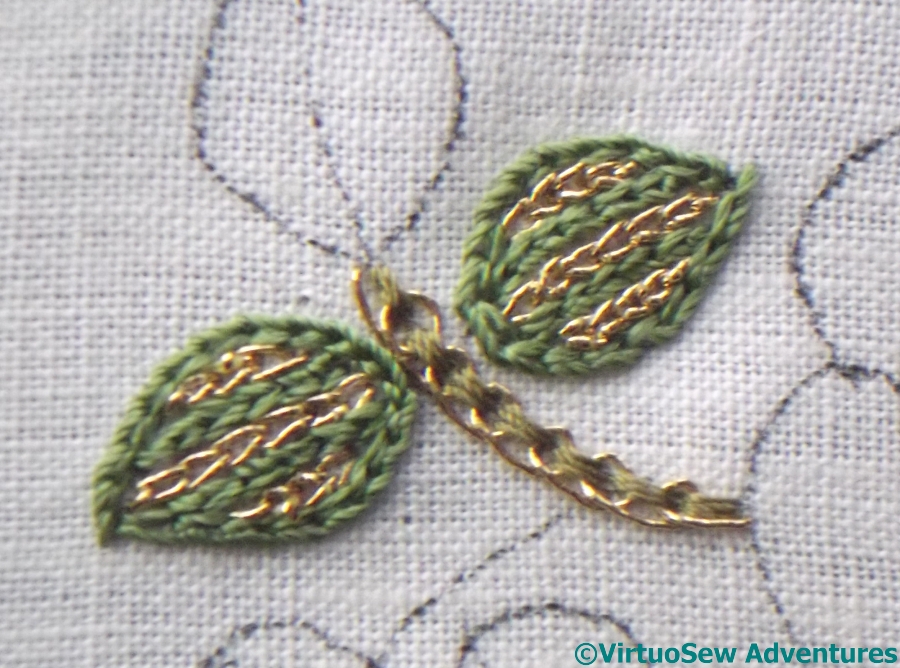
First Two Leaves
I rather suspect Tricia of letting us in gently, here, because the next element she describes is also fairly simple. The leaves are outlined in reverse chain stitch, in silk, and then filled using alternating rows of reverse chain in gold and in silk.
I hasten to add I have no objection to being let in gently – I’ve looked at the instructions for some of the later elements and rather expect a deal of unpicking to happen, so I’ve been able to enjoy handling the silk threads, which are quite heavy, but soft and “lofty” so they don’t punish the fabric unduly. If you look closely at this photo you will see that the olive green used for the stem is slightly thinner than the more emerald green thread used for the leaves. The weight matches nicely with the gold thread, so the more complicated elements that are coming up should look well balanced.
Embellishing the Circles Skirt – Part Six
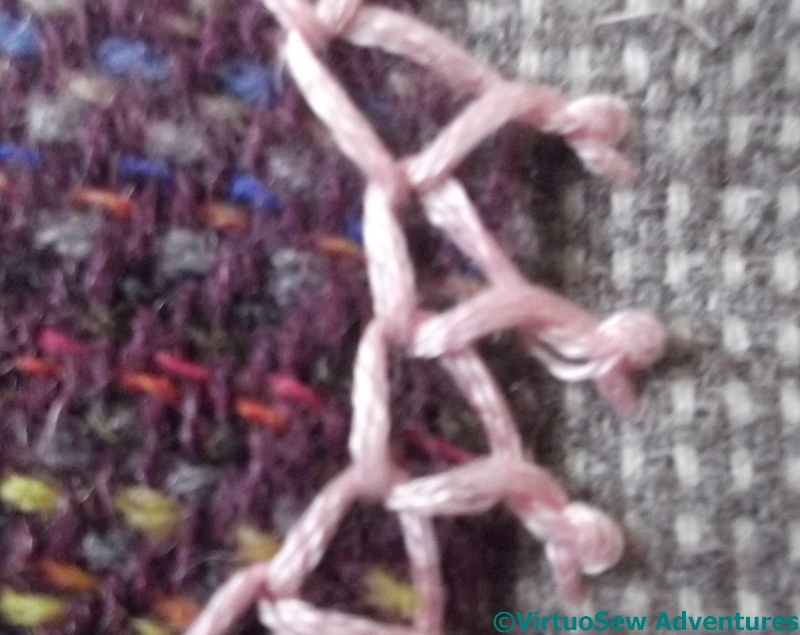
Crested Chain Stitch
I managed some really close close-ups here! This is the Crested Chain Stitch on one of the small circles on the back of the skirt, on the flaring panels.
The thread is a very ordinary stranded cotton, used straight off the skein – although as you can see, a couple of strands are making a bid for freedom, even so!
This picture also gives you a sight of the rainbow of colours involved in the tweed fabric I used for this particular circle – isn’t it lovely to see!
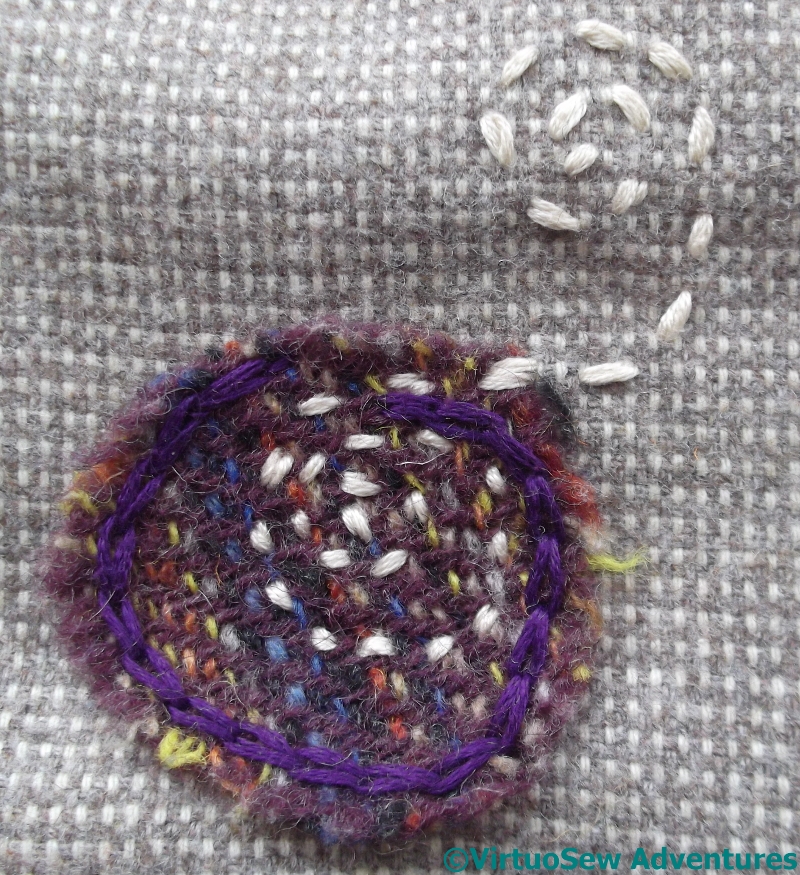
Trailing Spiral
The trailing spiral is high up on the front of the skirt, off to one side, and it was – in spite of the order of its appearance – one of the earliest elements which trailed off the circle and onto the fabric. I thought this would turn out to be quite important, to help link the various materials and create a cohesive whole. I had to work the spiral twice because the first time it barely showed at all. I’m all for the painter’s technique of “lost and found edges”, but there has to be something to find!
The purple chain stitch is there purely to make sure of the edges. If I had already bought the embellisher, I might have simply used that, very heavily, first.
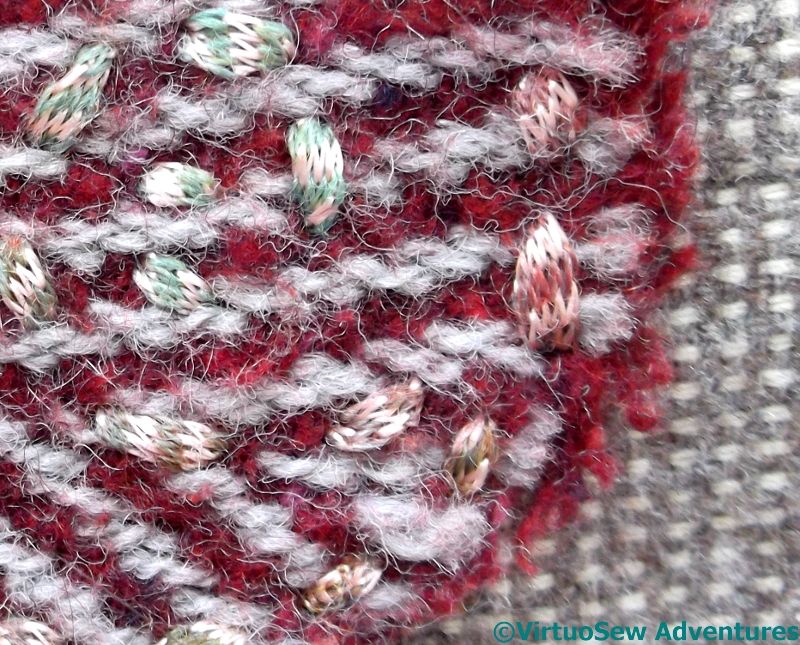
Chainette Spiral
I love using rayon chainettes in this sort of experimental embellishment. As a one-time specialist in the industrial production of “novelty” yarns, I have a sentimental attachment to chainettes, chenilles, and eyelash yarns.
This particular chainette was striped, which echoed the twill weave of the tweed very nicely. It was also a real trial to stitch with – hence the simple running stitch. I simply didn’t have the energy for anything else..
Restarting on the Hittite Amulet
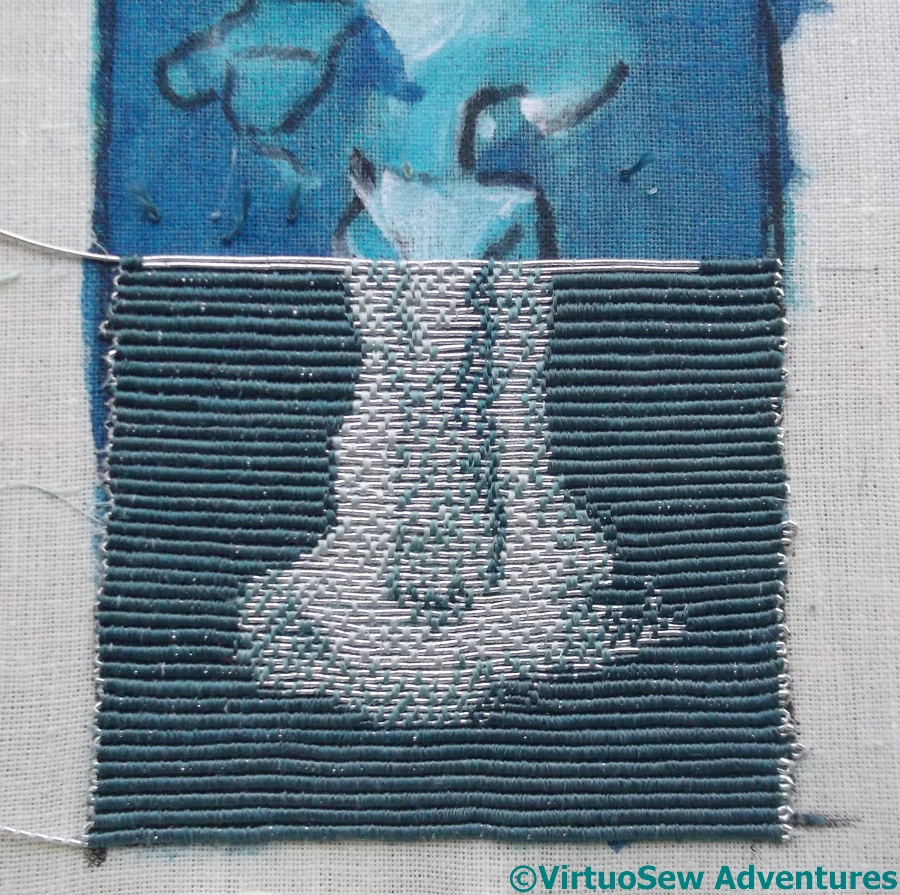
Progress On The Hittite Amulet
It is months since you last saw the Hittite Amulet. I put him away in a boxfile before Christmas and refused to get him out again until the embroidery on the Glittering Nightcap was finished.
Of course, it takes a while to gather ones’ wits, and restore the “flow” of a piece like thisl. Since there are two alternating tasks – laying the silver thread and then covering it with silk as appropriate – it is hard to develop a sense of momentum. If I succeed, I may find he gallops away with me – which would be gratifying, because I have a lot more ideas for Dreams of Amarna pieces that I want out of my head and onto fabric!
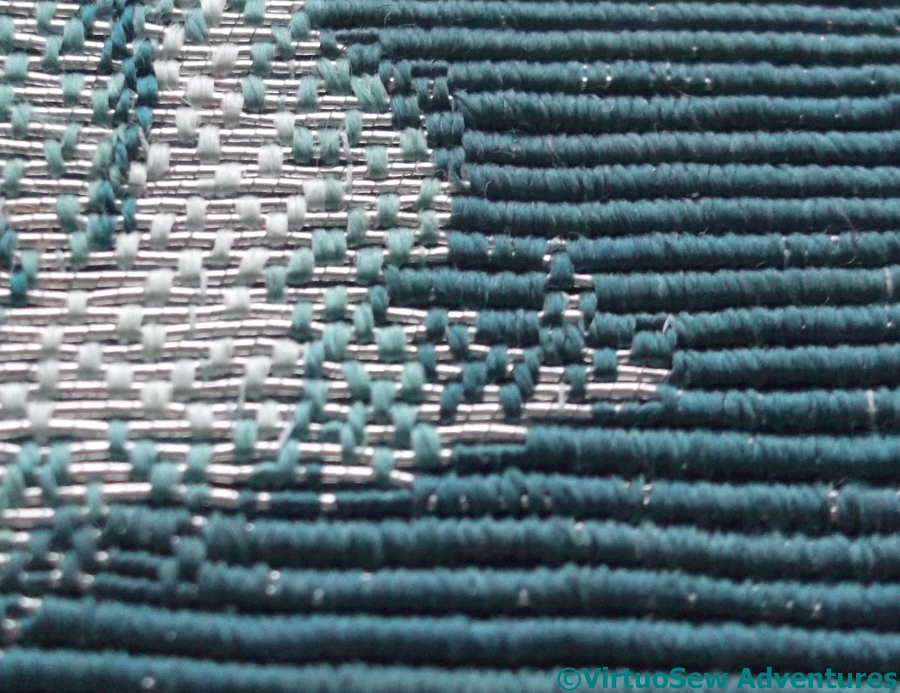
Oblique View
I’ve tautened the fabric again, and I am trying hard to remember not to let the lines of couching sag in the middle. Sometimes I forget and stitch too tightly, but usually only for one row, so the situation does not get out of hand!
This close-up, oblique view, gives you a sense of the ribbed, “grosgrain” type effect of the background, and the speckling of stitches across the Amulet himself that give the light and shade.
I really think it’s working!