Another Landmark on Christus Natus Est
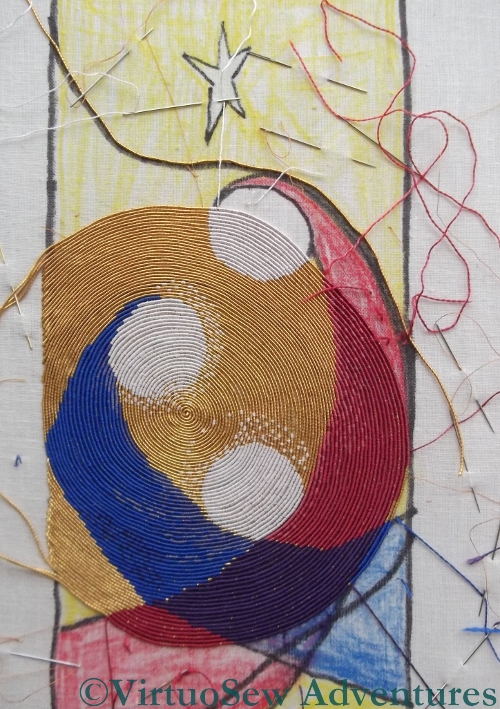
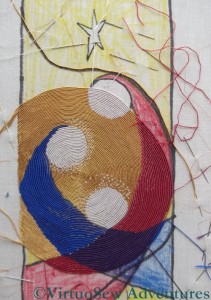
I’ve got to the point where the lower ends of the robes of Mary and Joseph have both been started, which also brings me very close to the other edge of the panel.
It’s been a little slow of late, partly because the weather has been frightful – grey and overcast. Stitching goldwork in bright sunshine is a recipe for eye fatigue (learn from my mistakes, Gentle Reader!) but at the same time the rich red of Joseph’s robe and the purple of the Christ Child both become quite difficult as the day turns darker. I’m finding that if I want to make progress, everything else has to come second to doing a row or two when the light is good. Sometimes I’m so busy doing other things that I only realise quite late that I’ve missed the best of the light. Very frustrating!
The other reason it has been slow is that I have so many needles in operation – ten of them! Every change of colour means putting one needle aside and picking up another, and while this is a tangible demonstration of progress, and therefore welcome, it does rather slow me down!
I’ve been talking recently with a friend who has been trained in icon painting, and it’s fascinating to hear about the layers of meaning and symbolism in the materials, preparations and even in the process. I’m working so hard on developing a technique here, that I’m not necessarily managing to turn my version into a spiritual exercise as well, although I do sometimes feel that I’m not a million miles away from stitching-as-meditation.
Well, St Benedict said “Laborare est orare” (“To work is to pray”). So maybe I’m onto something, after all.
You can tell that the Elephant’s inspiration was the right one – suddenly he’s taken off!
The Elephant Collared
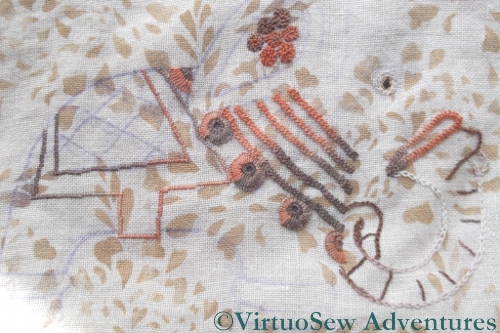
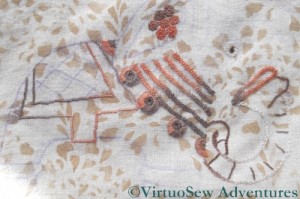
I’m using one set of variegated silk thread (shading from orange to brown) for the harness and headcloth and saddlecloth, and another (shading from cream to brown) for any small bits of the Elephant that show through all his finery. I shall have to redraw his head and headcloth – the transfer has rubbed off – but I’m pretty pleased with progress.
The collar is worked in six rows of braid stitch, which is a stitch that always looks better in a round yarn like this silk perlé. The roundels hanging from the collar are two rows of buttonhole stitch, and the roundels on the ear-covering are spiral trellis stitch – at the moment. I’m not quite sure that they are right. I first used Spiral Trellis on the Jacobean Work Panel, and really enjoyed stitching it, but I think these look too fussy. One big one might be better, and it would allow the colour change in the thread to show a little more.
I’m glad that I have worked out something to do next, as his anklets are giving me trouble.They are smooth and domed in the original model, but I think satin stitch might look a little ordinary.
I’ve used small satin stitches to outline the border of the saddlecloth, but only because I wanted something quiet to contain the excitement I intend to put inside it – I’m planning to use one of the complicated interlacings from the Tudor and Stuart Goldwork Masterclass for the saddlecloth, but extended to form an all-over pattern.
Watch this space…!
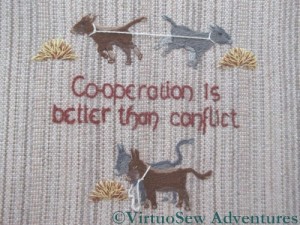
Cooperation is better than conflict
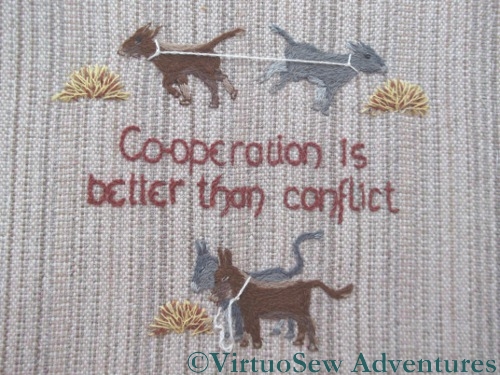
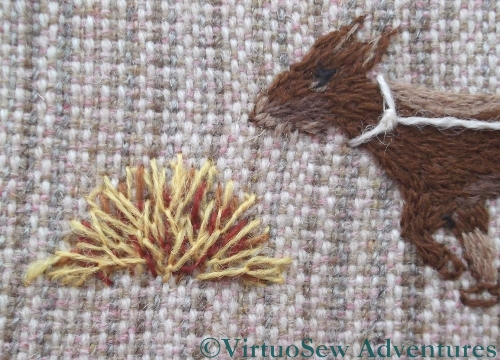
I suppose you could say I inherited this panel. A local embroideress died, and her daughter gave me (and I believe many others!) various bits of her stash. This was nearly, but not quite, finished. I’ve now finished it and haven’t the vaguest idea where to put it, as I’ve no wall space to spare!
It is based on one of the panels of the Quaker Tapestry, which is a fascinating piece of embroidery depicting the history and development of the Society of Friends. The woollen fabric was woven especially for the project, and the kit included not only the woollen fabric, but the cotton muslin backing that they recommend to stop the fabric puckering.
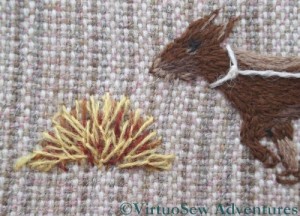
Fly Stitches For Hay
I was delighted that the lady was willing to give me this piece to finish, because we had seen the Tapestry (which, like the Bayeux Tapestry, is an embroidery!) during a visit to Kendal a few years ago, and I was fascinated by the variety of the stitches used, and very impressed by the general level of skill demonstrated, considering that it was embroidered by many groups of people.
In fact this kit doesn’t employ the whole variety of stitches used in the Tapestry, but I liked the use of Fly Stitches for the hay, and the use of the long taut straight stitch for the rope between the donkeys is just like my use of the same technique in the Camberwell’s rigging!
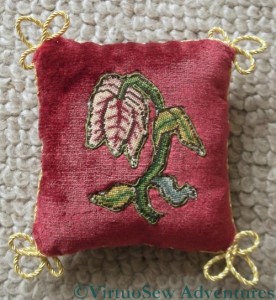
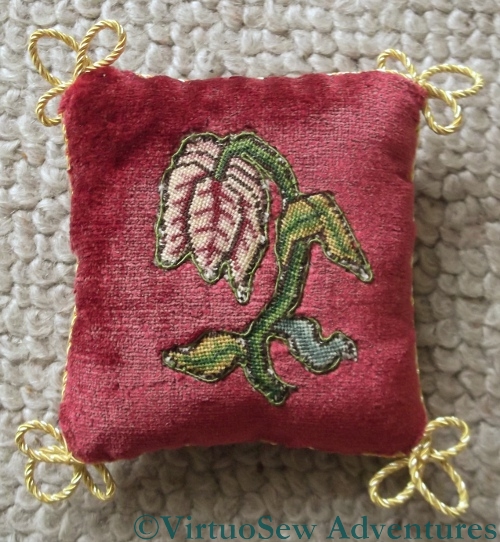
The Tulip Slip Pincushion Completed
I have finished the Tulip Slip Needlework Nibble. I used a sewing machine to attach the silk brocade backing to the silk velvet front, because my fingers were still shredded from finishing the Floral Glove Needlecase, and the velvet was very hard to stitch.
The amount of stuffing needed for even quite small items never ceases to astonish me. By the time I finally managed to finish stuffing this one I was wondering whether it opened into the Fourth Dimension!
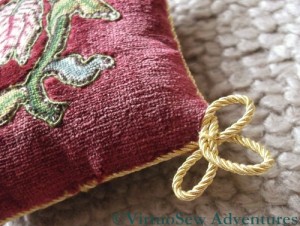
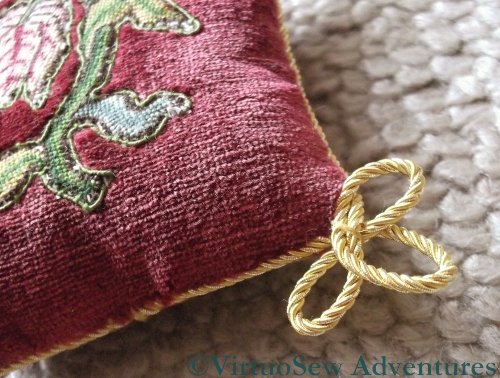
The Tulip Slip Pincushion - Corner Detail
The corner detail shows the trefoil shapes in gold cord used to finish the piece. Those, too, were rather a challenge. I was rather wishing for a third hand to help me hold the loops in place while I attached them, and as you can tell from looking at the whole thing, some of the loops are loopier than others.
The corner detail also shows more clearly the effect of the silk gimp outline which creates a crisp edge for the shape, and helps to keep the pile of the velvet from encroaching on the tent stitched Tulip.
This was rather fun to do, and it will make a great addition to my planned “winter decoration corner” of historical needlework projects…
Moored At Last
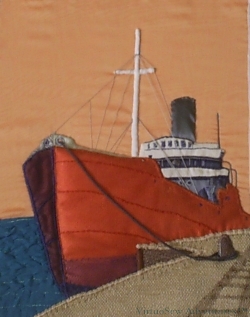
There were a few final details to be added to the panel while we discussed the wording of the border, and tracked down suitable materials for working it. These are things like the radio mast and framework beside the superstructure which were worked in a mid-toned, matte grey cotton. The radio mast is in broad chain stitch, which produces a smooth and heavy line, while the framework is in whipped stem stitch which produces a more rounded effect.
Then even more importantly, there was the mooring line. In reality there would be one fore and aft and possibly another amidships, but there is such a thing as too much accuracy!
I tried several ideas, such as crochetted single chain, or even a heavy, single thread, but I finally made the mooring line with mid grey pearl cotton, using a lucet. This is an ancient technique which produces a strong, square braid. It was looped twice around the bollard (which is layered with gauze and padded), and then the free end was whipped to the standing end to simulate the looped cable that would be the first thrown to the quay on mooring. It is only attached at the ends (that is, where it is lead through the scuttle at the bows, and by the bollard about which it is wrapped). That means that it hangs in a fairly natural curve, although it is also both heavy and stiff enough that it has held that curve through the process of framing and transport of the finished article.
Can you tell that my grandfather, too, was a Master Mariner?
Needs More Thought
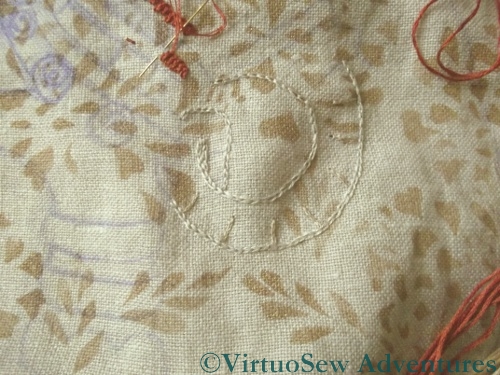
I originally decided to use plain stranded cotton for the Elephant Doorstop, in colours chosen to match the curtains in the living room as closely as possible.
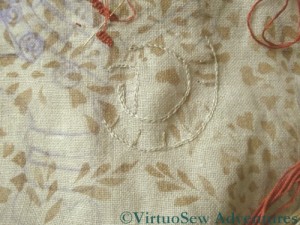
However, once I started stitching I rapidly came to the conclusion that that just wasn’t going to work. We don’t want the Elephant to cover all my careful stencilling, but at the same time, he needs to show up. And he looks pretty hidden, here, as you can see. What’s more, I wasn’t enjoying it, and picking stitches was proving troublesome. I knew I wanted to stitch him – revisiting the original inspiration has been in the back of my mind for a while – but somehow, not like this.
There are two things I need to think about – the colours, and the weight of the thread. The creamy colours we chose are too light to show up well against the rather busy stencilled background, and although two threads of stranded cotton would be fine on this fabric, if it were a plain fabric, it is rather fine. Furthermore, one of the stitches I want to use is braid stitch, which is always a bit tricky in stranded cotton.
I’d already unpicked this section twice before I came to this conclusion, and I was beginning to feel rather anxious in case inspiration flagged completely. Then out of the blue, I was deafened by some triumphant trumpetings.
“I know what to do, I do!”, said he.
“What, then?” said I.
“Use some of those variegated silk perlés you’re always looking at. You can do any stitch that takes your fancy, the colours shading in and out will give you the lightness of effect you want, and – Ta-DA!”.
So now I’ve been told….!
Christus Natus Est - More Progress
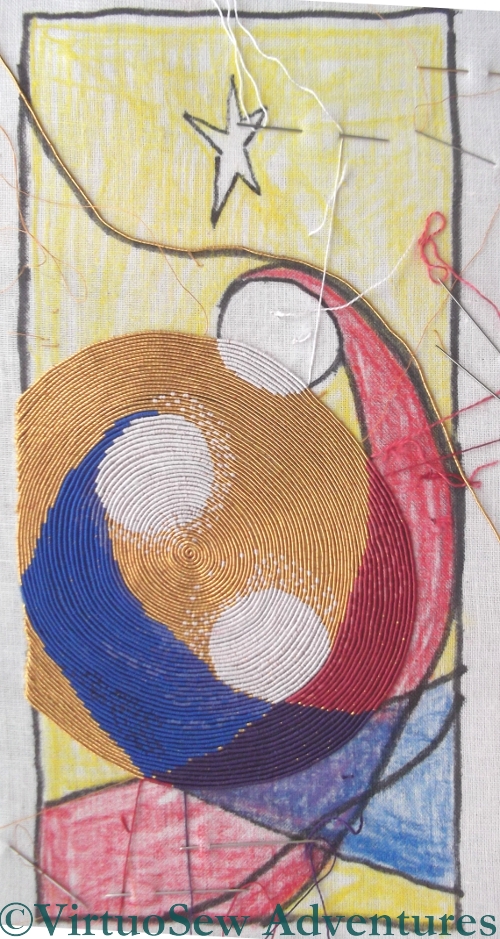
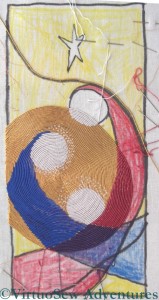
Since the Christus Natus Est panel seemed to be so popular, I thought I’d provide another update.
As you can see, the curves that indicate the Virgin’s robes aren’t right at all. I can correct that later, rather as I will correct the Christ Child’s halo – and indeed, put in St Joseph’s halo, which I decided not to attempt to include in the first stitching, because the other two haloes presented such challenges!
You can see that I have loads of needles working with all the different colours of silk and several sections of gold. It’s always more difficult working from the far end of a colour section (relative to the direction of the spiral) and using more than one colour on the robes has helped me there, because I’ve usually managed to have at least one of the colours placed in such a way as to help by catching the gold thread in place. Otherwise, because it is so springy, it’s hard to keep the curve smooth, and in a couple of places the thread is longer than it should have been and creates a slight gap with the line before.
Don’t those rows and rows of gold create a gorgeous background, though!
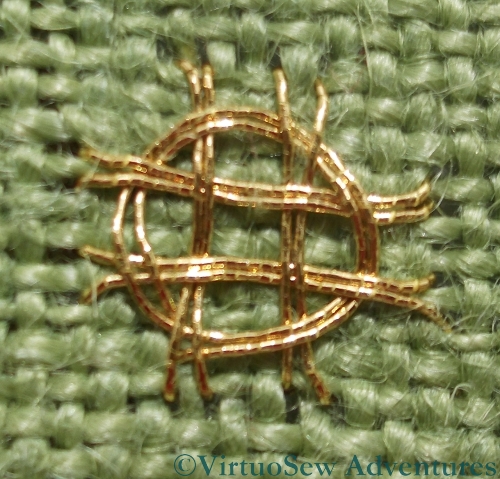
Circular Interlacing Stitch
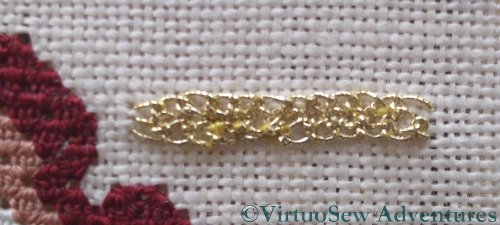
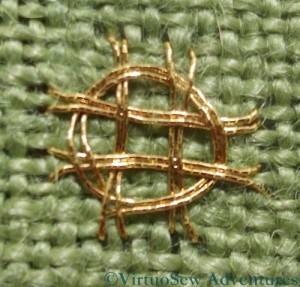
There were two more interlacing stitches this month, Circular Interlacing Stitch and Figure Eight Interlacing Stitch.
I know I’m always talking about scale on these stitches, but I’m pretty sure that at a reasonable scale of thread to fabric, the Circular Interlacing Stitch will create a lovely neat boss which would have all sorts of wonderful uses in representing jewellery and embellishment. Instead, on my loosely-woven practise cloth it looks rather leggy and a bit thin. I’m glad to see that I got the interlacing right, and don’t have any twists or tangles in it, though!
The most difficult part of the stitch, I found, was laying the foundation interlaced crosses using the correct proportions and directions. Sometimes a larger thread count makes life harder rather than easier!
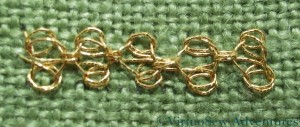
Figure Eight Interlacing Stitch
By contrast, it isn’t at all obvious that I even got the Figure Eight Interlacing Stitch right, although I am pretty sure that I did. It might have been better to pull all the wraps tighter to create a neater effect, rather than allowing the loops to create the uncontrolled springy appearance that they have at present. This is partly a result of the fact that I’m still reluctant to pull metal threads into tight loops because I don’t want them to strip their surfaces.
I do like the rich, textured braid effect that this stitch creates in the photographs in Tricia’s instructions, so I think it will be worth playing with it using different threads – not all of them metal, either – and seeing where it takes me.
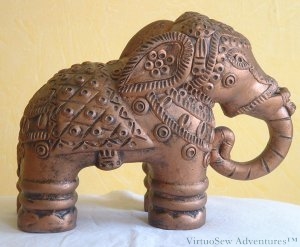
An Elephant Of No Distinction But Infinite Charm
Do you remember the Elephant of No Distinction But Infinite Charm, who inspired the canvaswork footstool I made for my mother? She’s now commissioned me to work a doorstop with the same inspiration. Naturally she didn’t want me to work it in the same technique. For one thing, the furniture in the living room has been reupholstered since I did it, and the jungle-inspired green background (although the footstool still looks quite happy) would no longer be as suitable as it was.
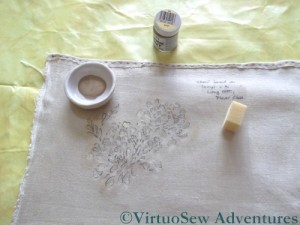
First Stage - stencil prepared and paint chosen
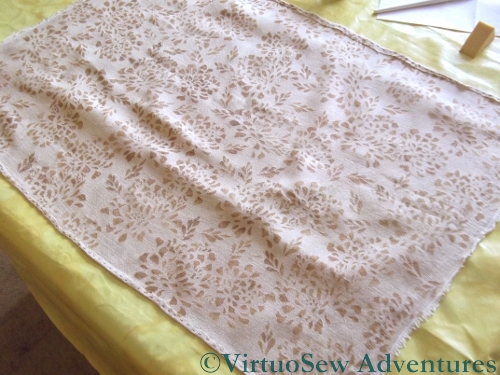
So we’ve picked a fairly loosely-woven linen, in a sort of pinkish beige (actually, “natural” unbleached linen run through the washing machine on Hot!), and rather than leaving the background completely plain, decided to stencil it with an all-over pattern taken from the lamps. The design is inspired by crystanthemums, as is the design on the curtains (a Designers Guild design which is older than me, and is proof that good design doesn’t date – it hasn’t looked dated or old-fashioned in more than forty years!).
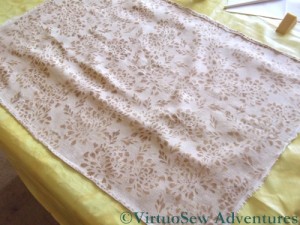
Stencilled fabric
After consulting my clients (!) I’ve decided to use a gold fabric paint for the background pattern. When I tested the stencil on paper the paint ran under it a little, so I chose to use a sponge instead. That seems to help in ensuring that the fabric paint isn’t laid on so thickly as to be unembroiderable, as well.
I didn’t create a proper, regimented repeating pattern, because I felt that it would make the stencil design too obvious. Instead I have twisted and turned the stencil and added extra leaves to fill in any really obvious gaps.
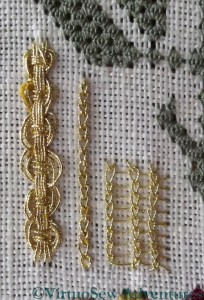
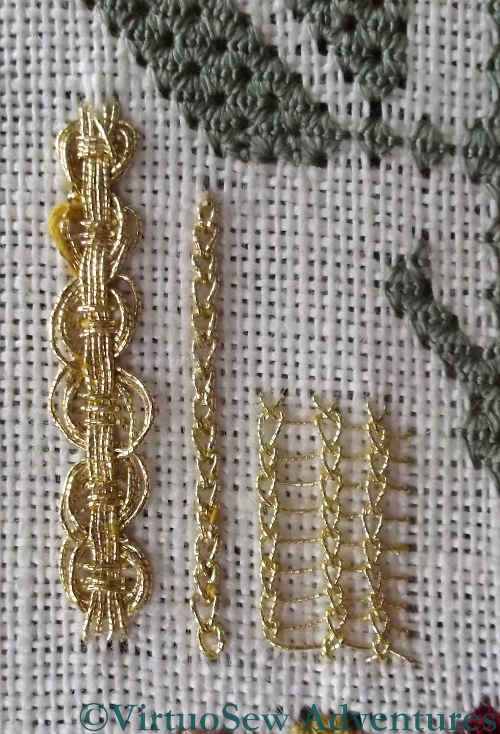
Guilloche Stitch, Reverse Chain Stitch and Ceylon Stitch
I have been working more on the Spot Sampler of late, slowly catching up with the metal thread stitchery. If you are confused by my posts on this, you aren’t alone – I spend a few minutes every time I sit down trying to work out where I’d got up to!
Some of the stitches are familiar – Ceylon Stitch, for example, I have used before. In this case I have used the lighter and floppier of the metal threads supplied. It creates a more lacy effect than Tricia intended, but I thought the thread might “strip” less dramatically (I was right, too!). When I finish the main body of the sampler I may go back and work new versions of some of the stitches around the edge, so in this case, for instance, I would choose to use the heavier, thicker thread. This will make the sampler even more useful by giving me some sense of the variation of appearance available through different threads..
As you can see, I still haven’t entirely got to grips with Guilloche Stitch, although using the stiffer thread did make the whole thing slightly easier. I was becoming slightly anxious about finishing the panel without starting a new length for the last course of interlacing!
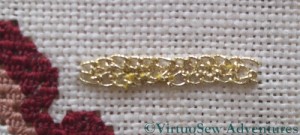
Reverse Chain With Buttonhole Edging
I’ve already used the Reverse Chain Stitch with Buttonhole Edging since I learnt it on this course, when I was working the Title of the Map for the Amarna Panels. Now I look at the photograph I see that my tension wasn’t entirely consistent across the whole width of this spot, and the thread stripped and clogged in a couple of places. But then, samplers are for practising on… I may choose to re-work this later, using the finer thread, since I think that if worked fine and delicately this stitch could find a host of new uses.
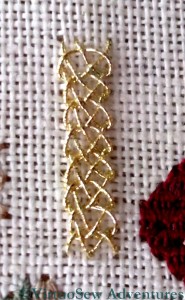
Plaited Braid Stitch on the Spot Sampler
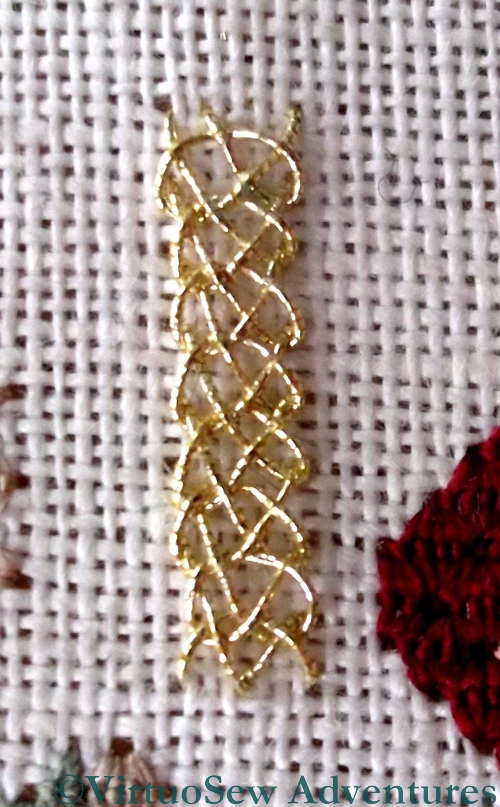
I felt when I finished my practising for Month Fourteen that the real test of my grasp of Plaited Braid Stitch would come when I came back to the stitch after a week or so. As you can see, I’ve worked it as a counted stitch here, in the larger size and using the heavier thread, and it seems as though I got it right. I kept the instructions to hand all the time, of course, but I’m very pleased with this. It is a real testimony to the clarity of the instructions, and the way they gave me some grip on the structure of the stitch, that I didn’t feel at all anxious when I was working this.
Can you hear me purring?