Tag: ornamental stitches
Stella’s Birds Finished
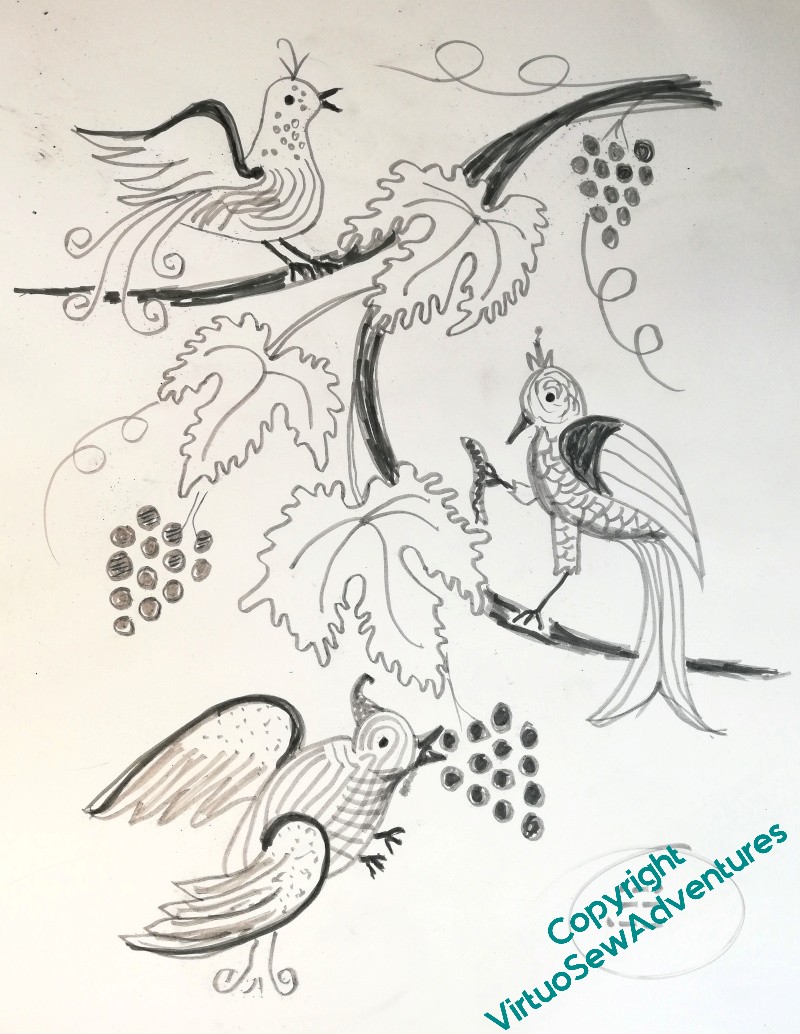
Once I got the design settled for Stella’s Birds, the principle elements remained pretty much unchanged when I got the stitching done. The details, not so much. The drawing shows where I intended to put most of the raised sections and the patterning. Note: intended!
I ended up not filling in any of the bodies of the birds, to leave the effect a little lighter and less blocky. Every time I tried to fill them in, they went grumpy at me, and if nothing else, I’ve learnt to pay attention when my embroidery shouts at me! Furthermore, Stabby has a leading edge, rather than a shoulder, and I simplified the structural details slightly, using the same stitch for all the curlicues, and another same stitch for all the stalks for the leaves.
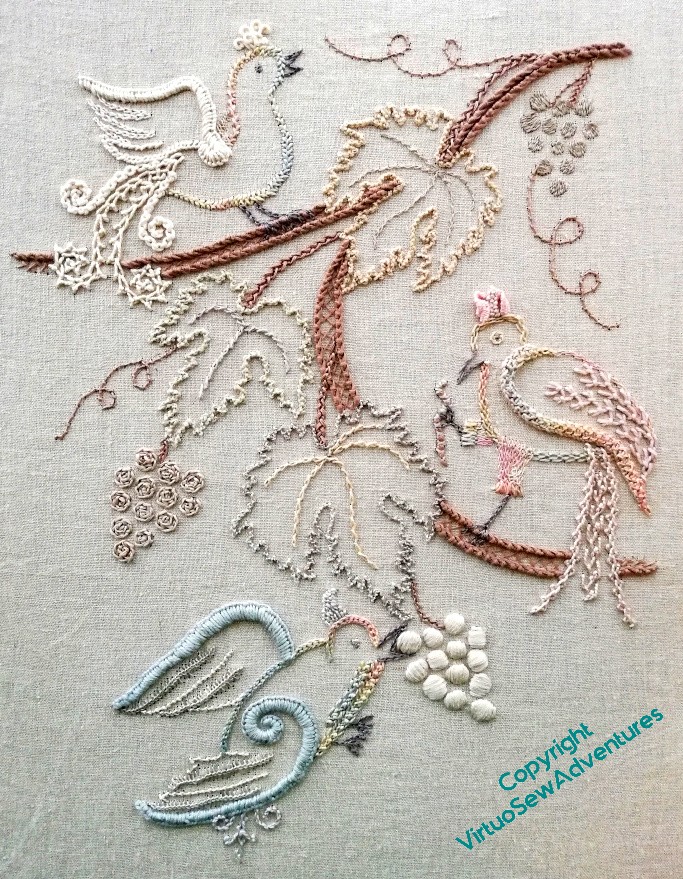
If you recall, the idea was to create something that might evoke the idea of a light, carved wood, but using a technique reminiscent of Mountmellick Embroidery. It gave me a chance to use some well-beloved stitches, and to rejoice in the textural effects available from those stitches and the choice of threads to stitch them with.
I’m pleased with it.
Stella’s Birds – Shouty Bird
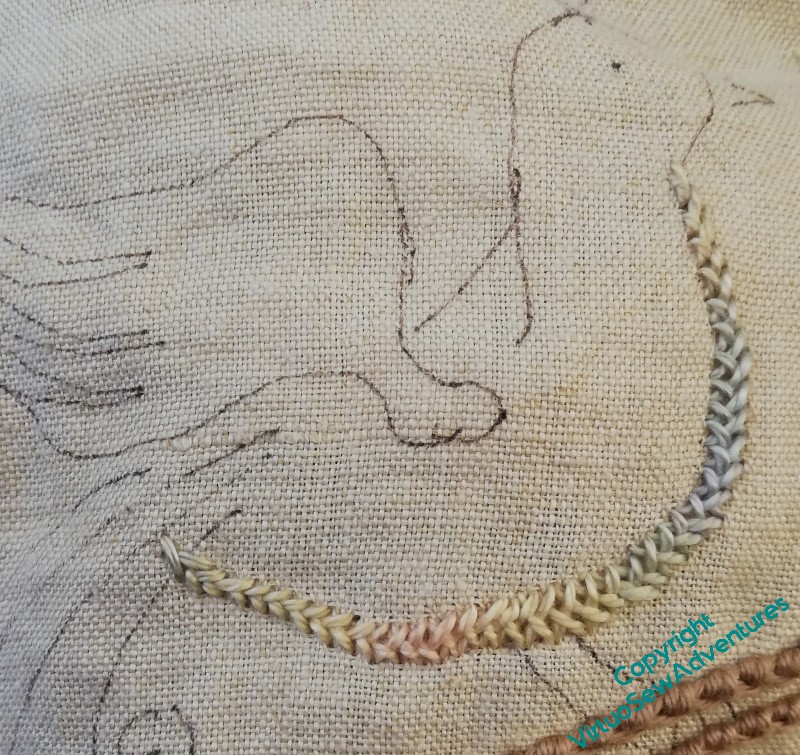
Shouty started off with basic herringbone stitch in the variegated thread. I do like the way the colours are shading here, but to be honest, I really didn’t think hard enough about the next few stages!
That’s been a bit of a theme with Stella’s Birds, there have been false starts and missteps galore, but I don’t mind too much. I am still learning to visualise the elements I want, and I don’t always see them clearly. Once I’ve stitched them, it’s much easier!
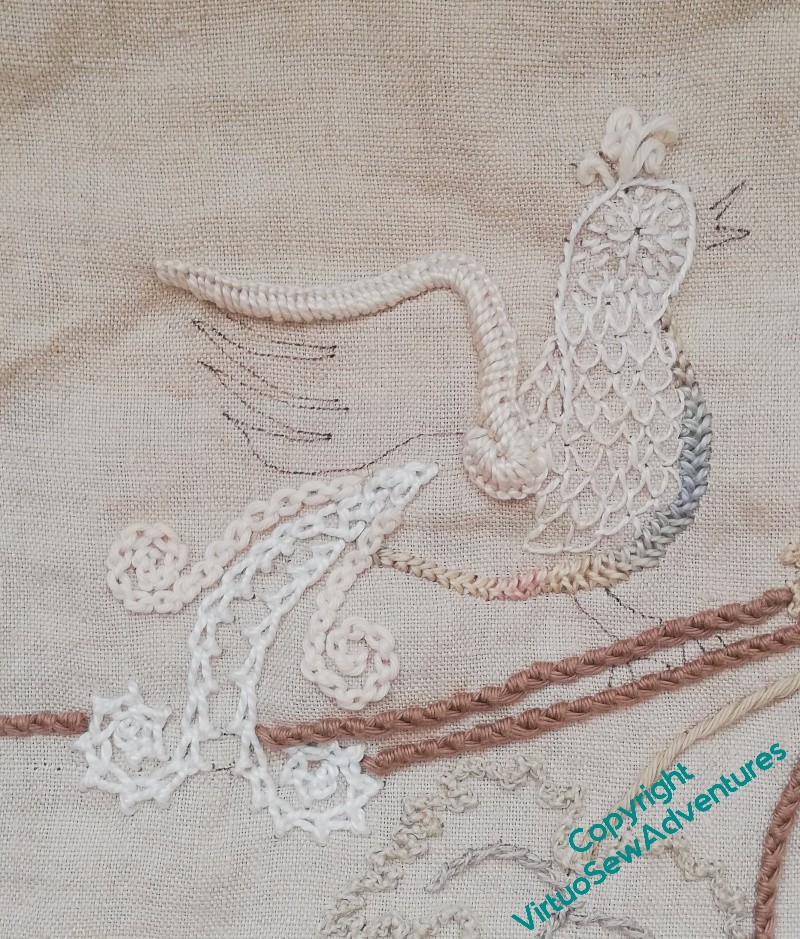
I’ve been keeping to the strongly raised leading edge of the wing, and I’m happy with that. But I’m not happy with the bird’s body – it’s either too textured, or not textured enough – neither fish, fowl, nor good red herring, as my Grandad used to say.
Furthermore, the two central lines of the tail are too bright, too white, shouting too loudly, louder than the bird himself. And the crest is untidy and coming undone.
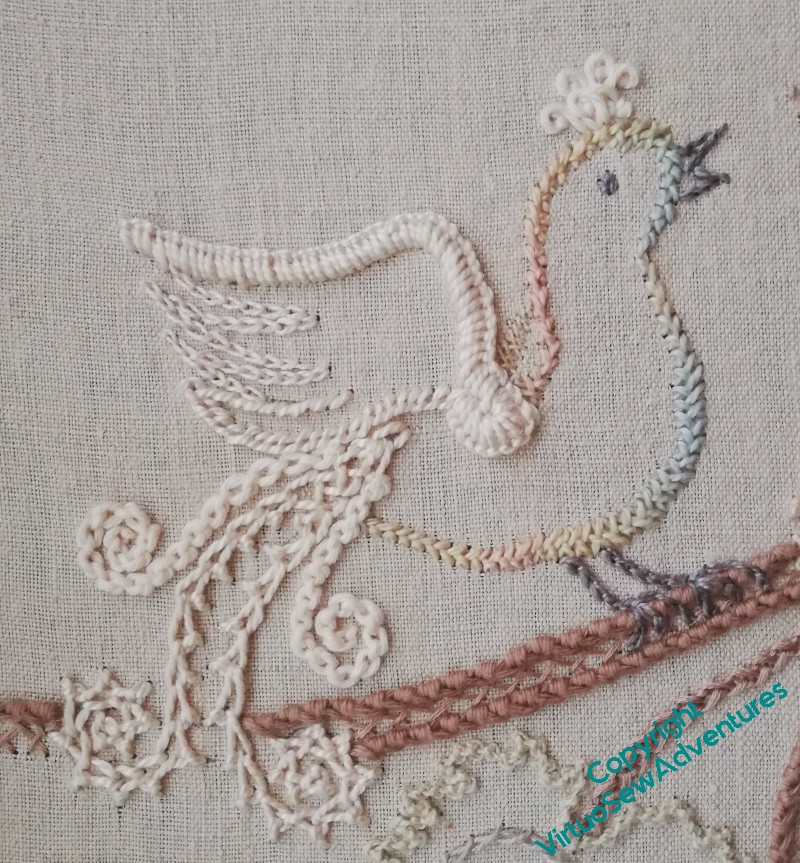
So a lot of it came out. I’ve knocked back the tail – a cream pearl cotton, rather than white. That was already better.
Then I went back to the variegated thread for the rest of the bird’s body, and I’ve left it unfilled – in the end, all the birds are mostly just outlined, with the odd point of detail.
The flight feathers are just simple lines of stitching, nothing too fancy, just enough. I like it much better now.
Stella’s Birds – Stabby Bird (part 2)
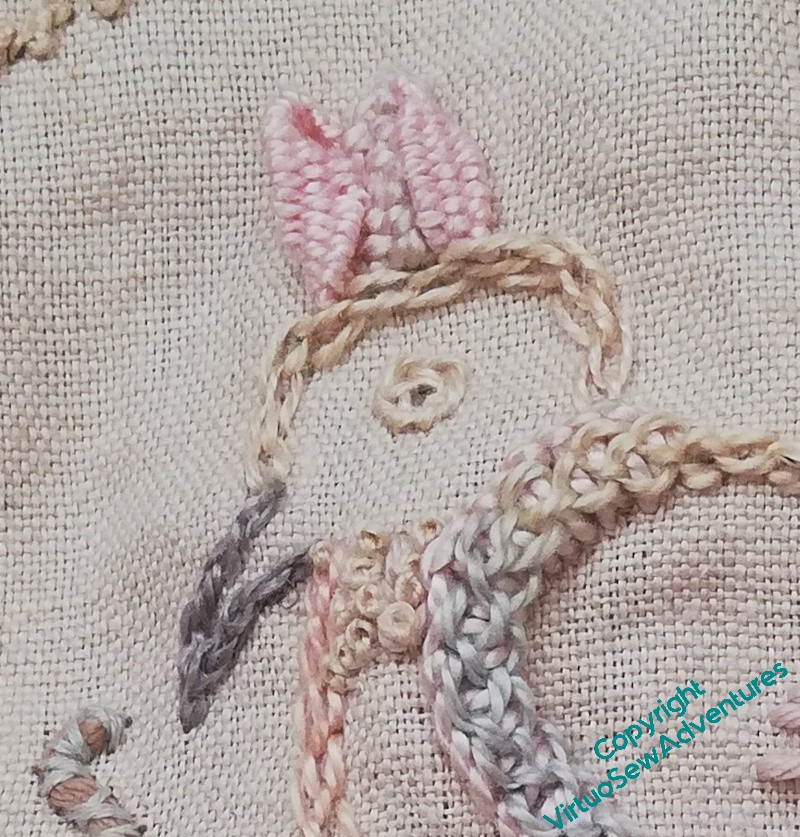
I wanted to play with some really raised stitches.. The little woven picots on the crest are worked with one end off the fabric, around a pin, which meant that I could give them a twist before stitching them down. It was a bit fiddly – the pearl cotton I was using is a bit on the chunky side, so the needle was too, and the space I had for it was a bit on the small side to be in proportion.
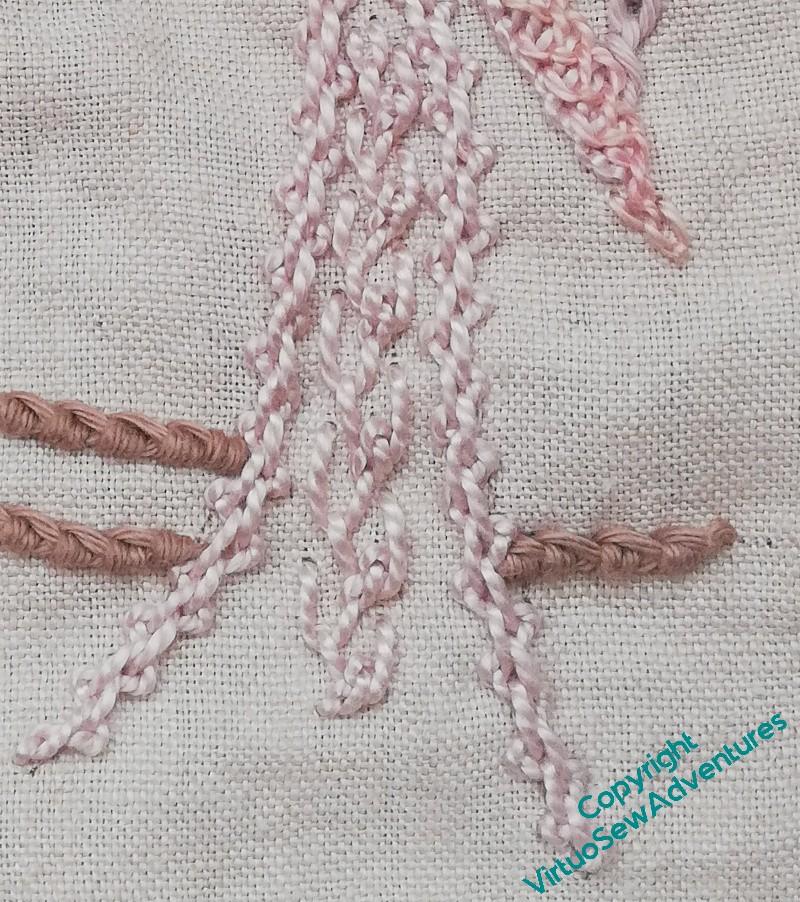
I’m using pearl cotton and soft cotton in tandem on each of the birds – the soft cotton ended up on the wing. The pearl cotton ended up on the tail: Mountemellick Thorn stitch down the centre, Spanish Knotted Feather Stitch down the sides. That’s another stitch I really enjoy and haven’t made as much use of as I would like to.
This whole panel is full of insufficiently-often-used favourite stitches. It has felt a little like coming home. I need to find ways to do more!
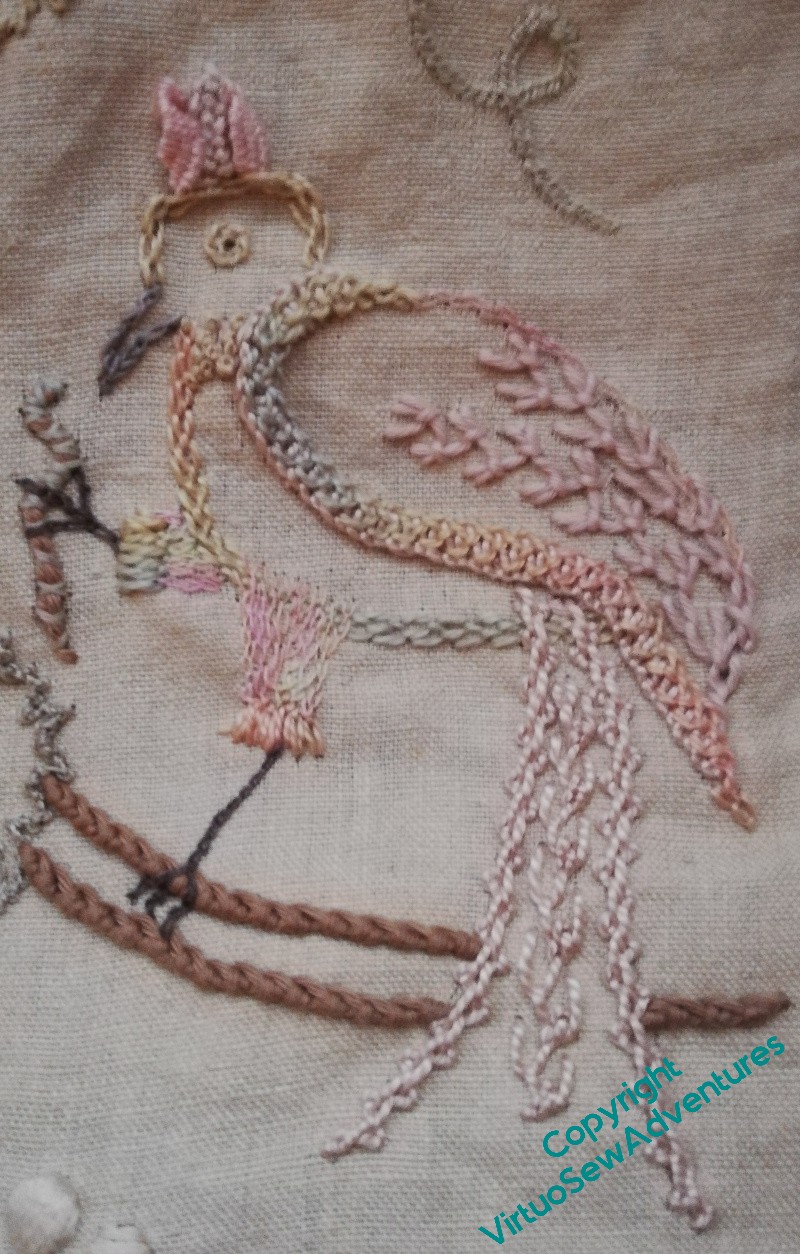
Tail in place, Stabby Bird only needed beak and legs to be finished.
Oh, and the worm to stab. I used a few short lengths of soft cotton, couched in a crossing pattern. I had intended something much more substantial, but when it came to doing it, it seemed to me that that would be too much, unbalancing the piece. So there is a worm, but not a very emphatic one!
I may reconsider the legs when the whole thing is done – they look just a bit dark in this photo. We’ll see. Tweaking and rebalancing is best at the end, when the whole context gives me a chance to decide more easily and definitively.
Stella’s Birds – Stabby Bird (part one)
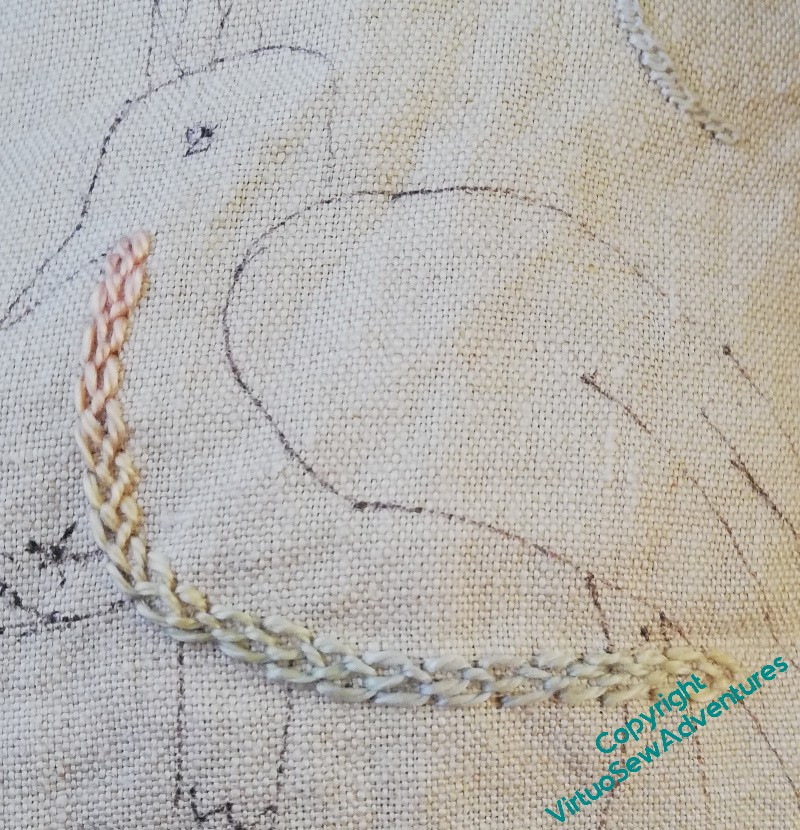
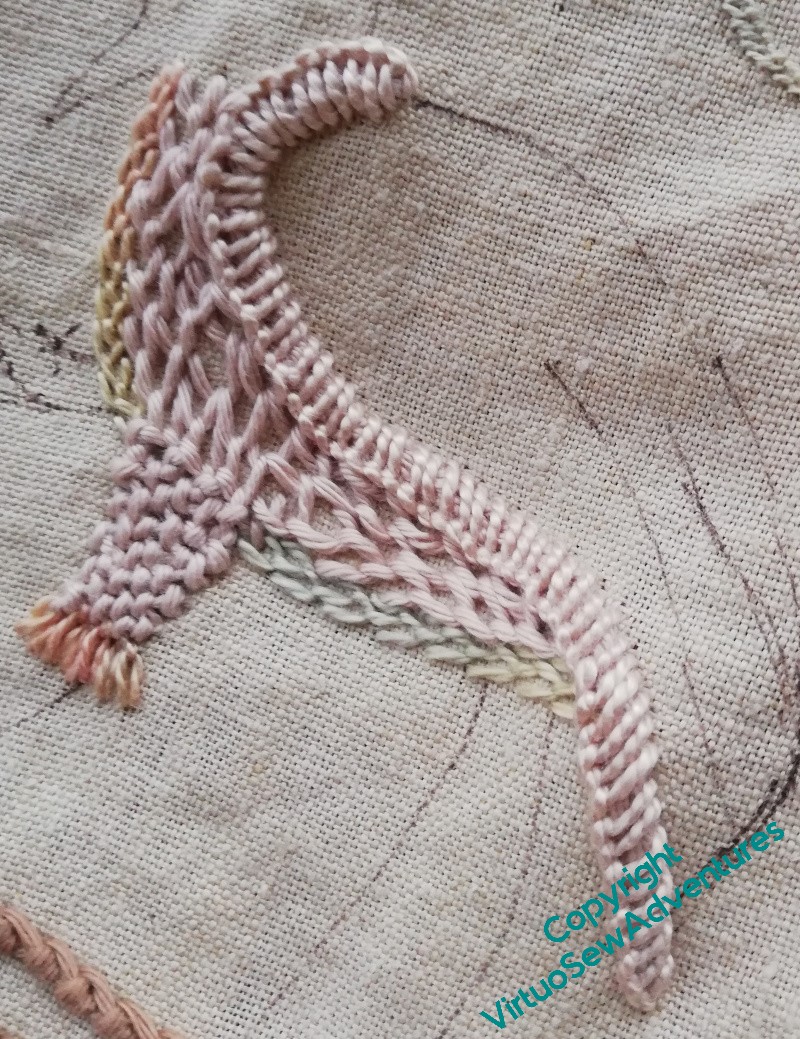
I started Stabby Bird quite simply with a line of feather stitch in the variegated thread, but then, my goodness, I wandered off the path of success and created a sad and congested mess!
I like the padded buttonhole stitch on the leading edge of the wing, but the tangle of fly stitches and feather stitches on the body , and the trellis stitch on the leg – nope, don’t like any of that. It’s too heavy and blocky, it doesn’t provide any light and shade, it just makes the wrong impression. Out it came!
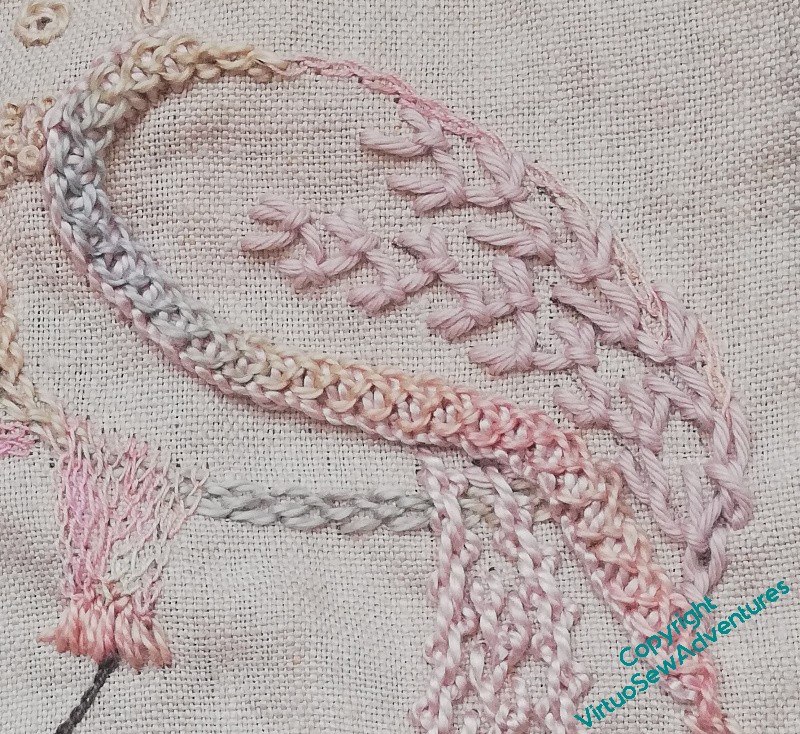
I added a bit to the leading edge of the wing – feather stitch in the variegated thread. I like that, I think it’s fun.
Floral feather stitch on the wing – that’s a stitch I’m very fond of, but don’t often remember. I must do it more often! The top edge of the wing, and the leg, both in feather stitch in a very fine linen thread. It’s a bit pinkier than I had in mind, but it doesn’t draw attention unpleasantly.
Stella’s Birds – Bitey Bird
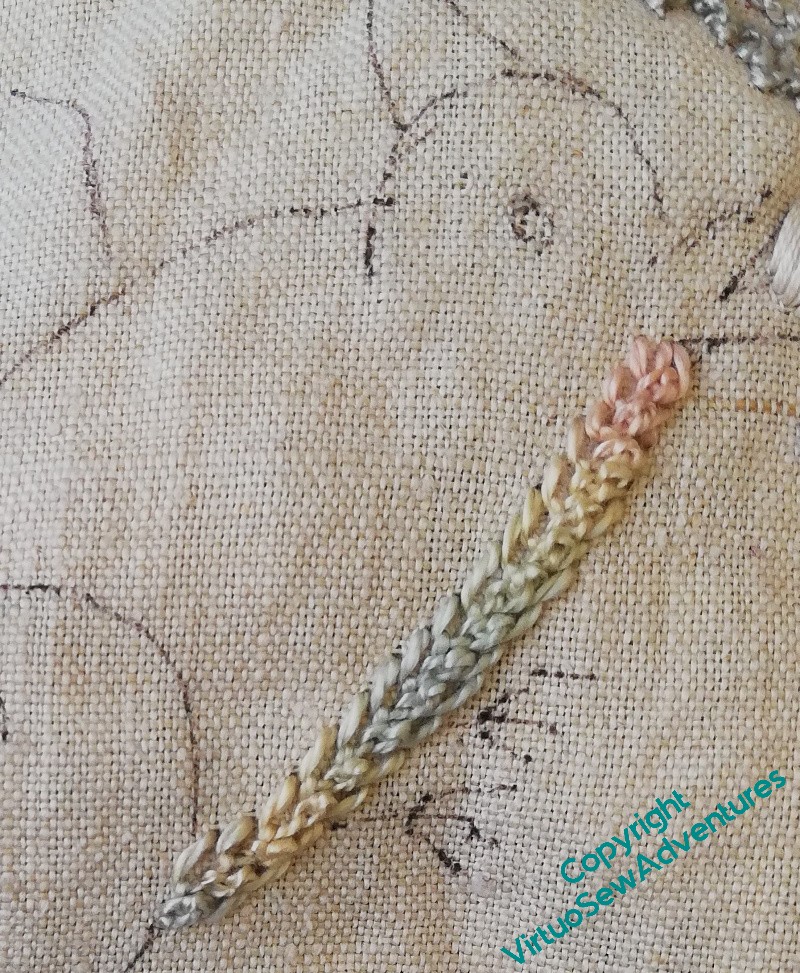
I decided that all the birds would have the variegated thread in them, and that it would be used to outline the body as a starting point. In the case of Bitey Bird, I used a single thread (“Watercolours” is separable into three plies, each of them just like a pearl cotton in behaviour) and started with Mountmellick Thorn Stitch. I did a second row to give Bitey a bib (as it were), and while it looks a little stiff as I concentrate on it, it will probably settle nicely when the whole panel is done.
The rest of Bitey was worked during the MathsJam Gathering, and I took no more photos of work in progress, so cue me desperately trying to remember what I did….
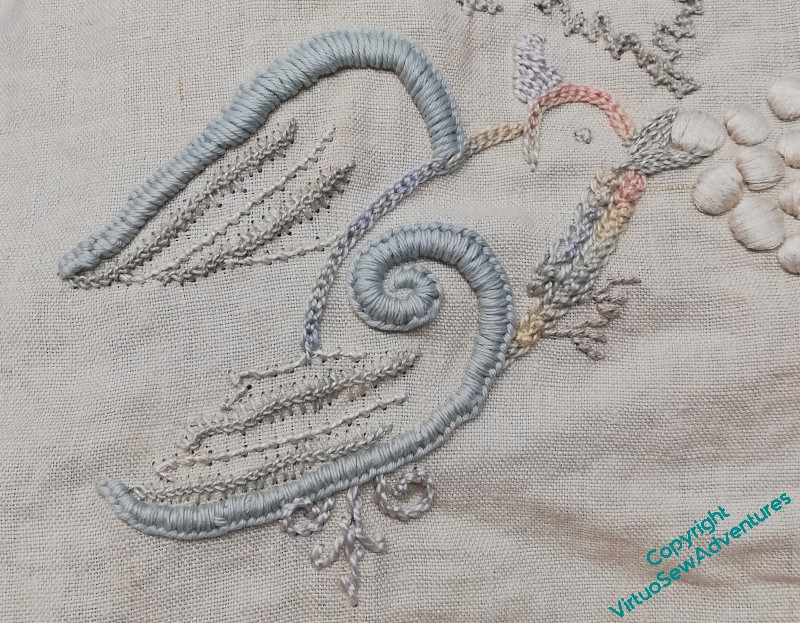
So here we go.. Hungarian Braided Chain for the bird’s head and back – see how it’s not such a thirsty stitch as the Mountmellick Thorn, so the colour changes spread out more? Vandyke stitch to separate the feathers, Cretan Stitch for the crest, Coral stitch in various other places.
I had specific areas I planned to make strongly raised, particularly the leading edges of the wings, so in this case I used Buttonhole Stitch, padded with chain stitch. I do love that redundant but highly ornamental spiral!
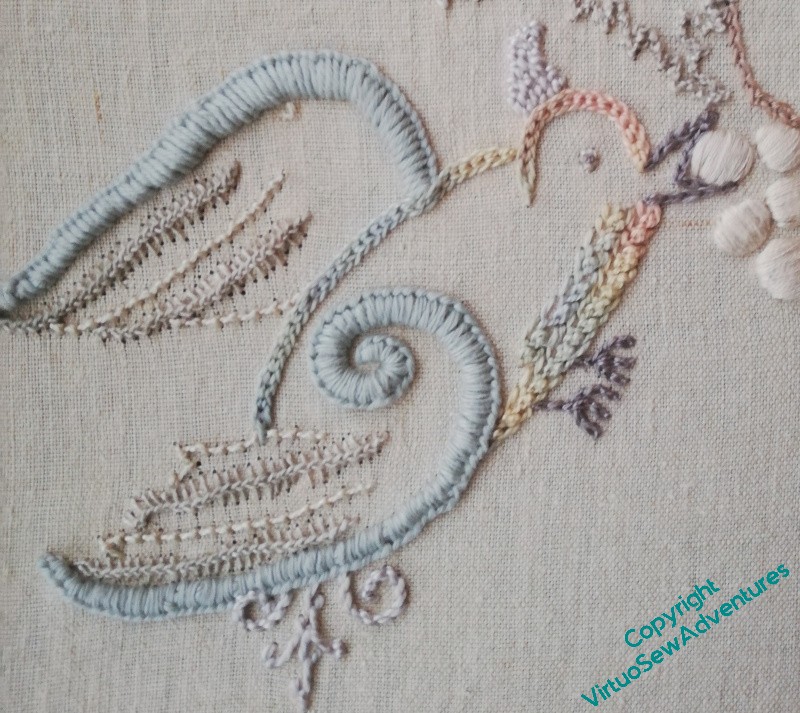
I finished Bitey – to a first approximation! – ten minutes before the formal part of the MathsJam Gathering ended, knowing, however, that various changes would be needed once I had the whole thing before me.
Not much changed, in the end – the beak darker, and outlined rather than solid, and the legs darker too. And now he looks nicely ornamental and joyfully voracious. Just as he should!
Stella’s Birds – A few false starts
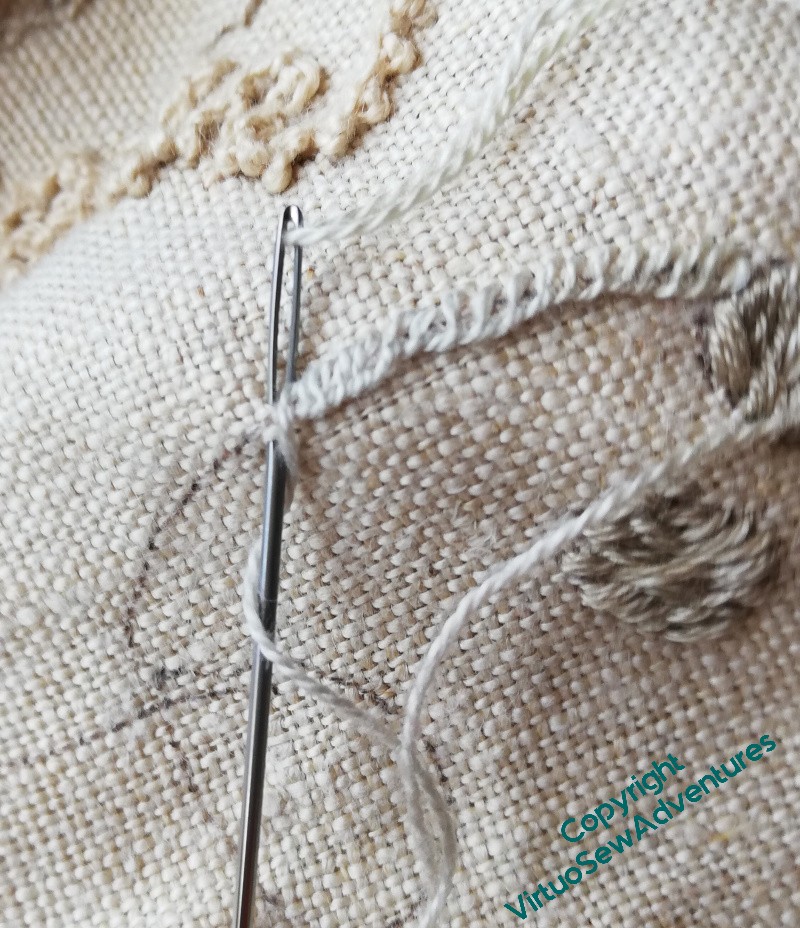
As anyone who follows my adventures will know, I always expect to improvise and have any number of false starts.
This is Cording Stitch, which is a classic Mountmellick work stitch, so I wanted to include it. I enjoyed stitching it, but once the whole design was stitched, I had Reservations.
I stared for a while, and then decided that it wasn’t working in the context I was using it, somehow it looked too stiff, and the thread didn’t seem like the right colour.
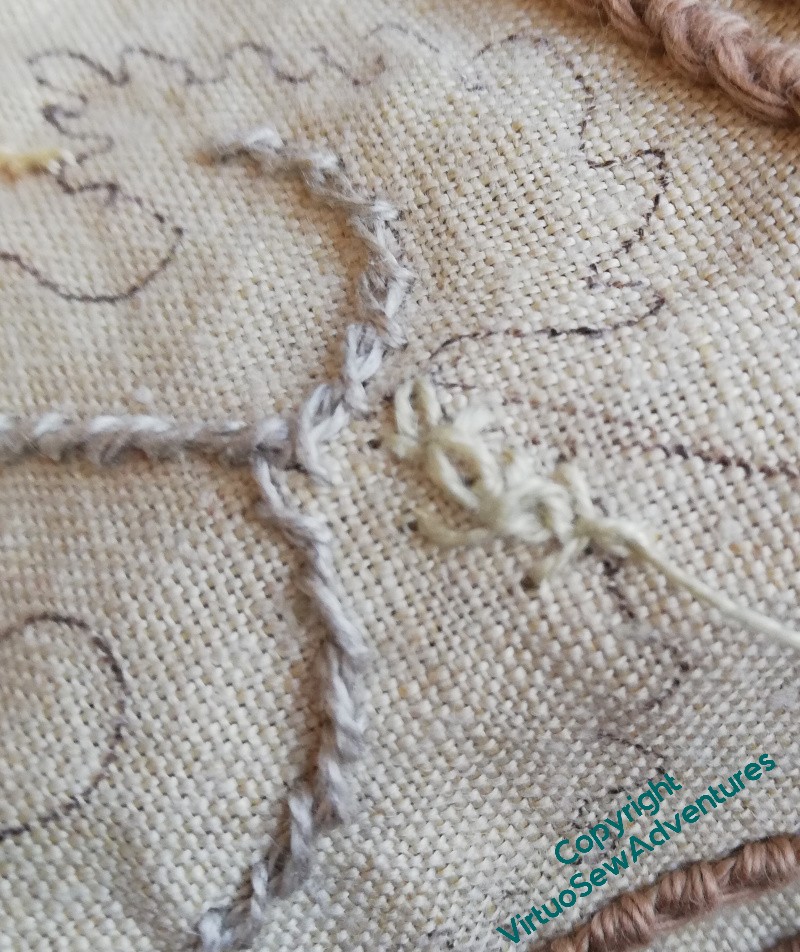
Another false start was when I started the second vine leaf. I was planning originally to have a riot of different stitches across the whole design. I was happy with the first one, in Palestrina Knot Stitch, but I thought I’d try something else.
Wheatear Stitch is a pretty stitch, and it fits well within the textural theme of the design, but it’s too broad – however hard I tried – to deal with all the wiggles around the edge of the vine leaves. After some thought, I realised that keeping some consistency in the “background” – the branches, the leaves, the tendrils – would enable the birds to shine.
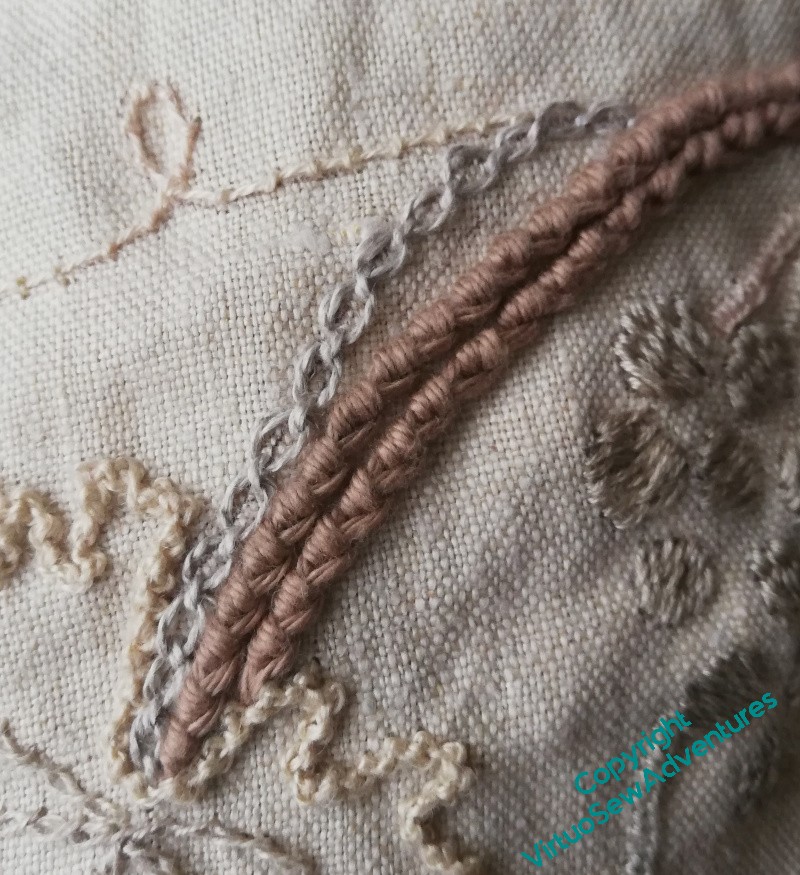
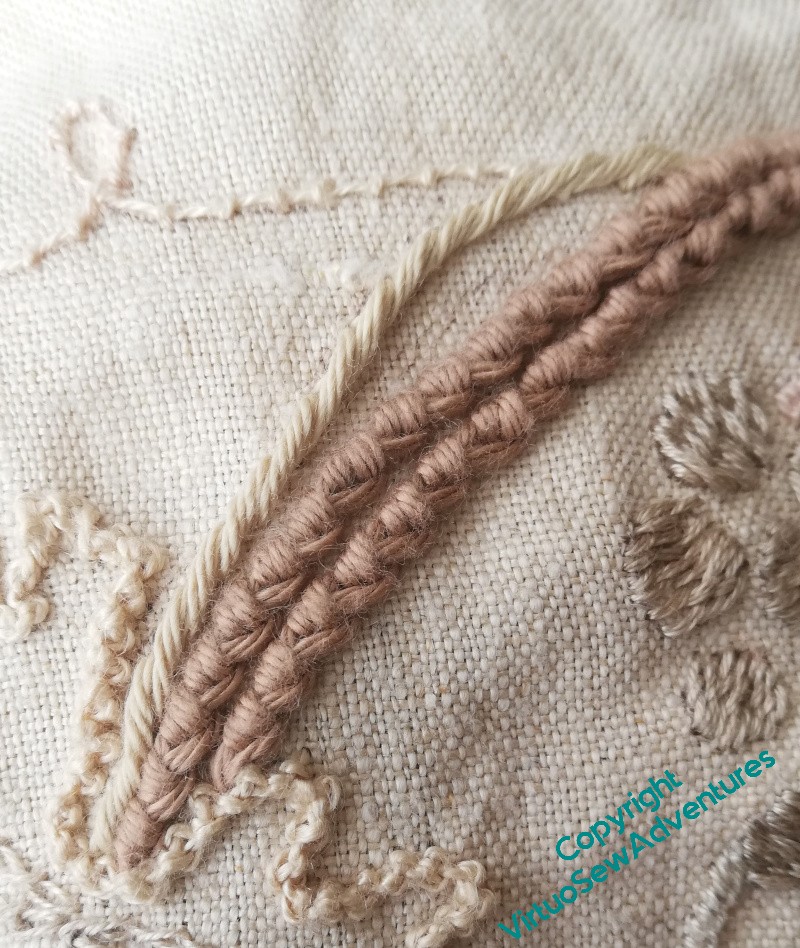
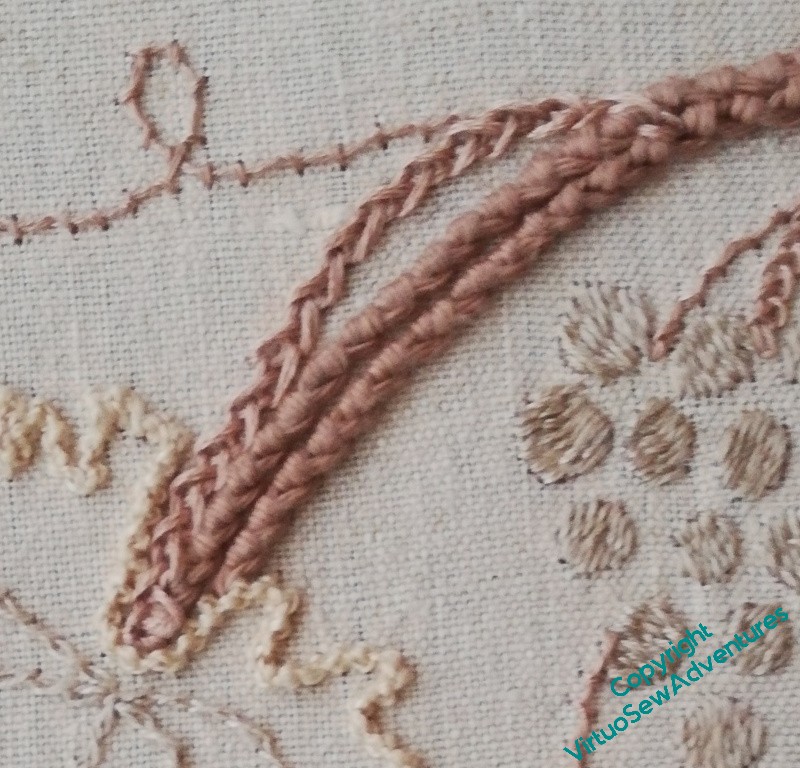
That insight helped me with the tendrils and the stems for the vine leaves, When I was first stitching them, I used different stitches, and different threads, and somehow the piece wasn’t hanging together. When I found a stranded cotton that matched the colour I used for the branches, and used that for the tendrils, and for the stems of the leaves and the grapes, that worked better.
The tendrils are now all in Coral Stitch, and the stems are a Feather Stitch variation. I’ve not been able to track it down, but it’s created a loose and pretty plaited effect that I’m very pleased with!
Another new project to think about
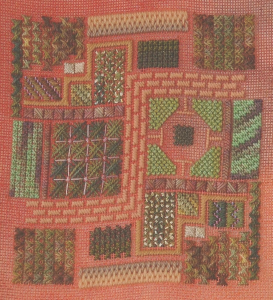
Remember this? It was an exploration of canvaswork, a very long time ago, and when I’d finished it, I hadn’t the vaguest idea what to do with it. Then my cousin said she knew exactly what to do with it, and could she have it, please?
She and her local soft furnishing people turned it into a rather fabulous cushion, and it has been sitting happily kicking welly-booted heels in the air on a chair in her conservatory ever since.
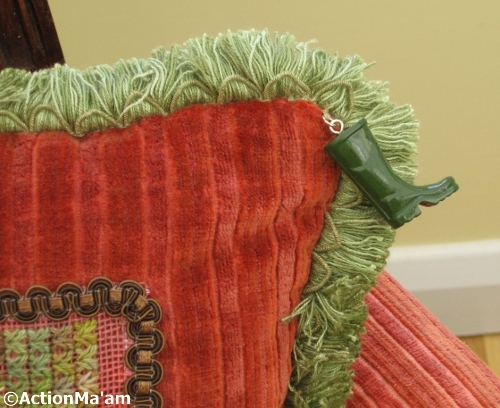
Fast forward to some recent reorganising in her house, and she has a another chair that might be interested in a companion piece. Not the same shape, and not the same canvas, fortunately, and not necessarily the same colours either, just similar. I have to find the canvas before I can get excited about this one, so it will be a while, but I do have something to think about.
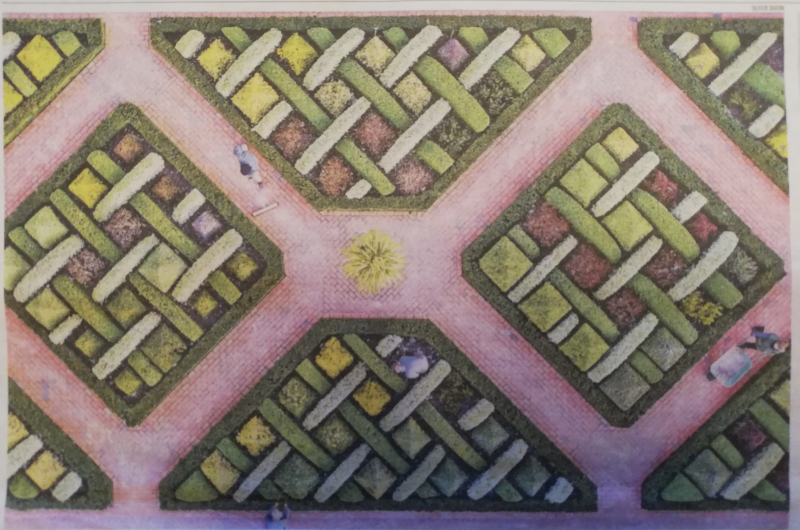
My cousin found a gorgeous drone shot of a knot garden in a National Trust property, and said “Start from this!”. The central tree might even end up as a sculpted piece of one of the pile stitches – that would be fun, wouldn’t it!
I’m thinking I might choose to use a brown canvas this time, and use as many variegated greens as I can lay my hands on. But as I’m not sure where I’ll find the canvas, my ideas have plenty of time in which to change….
Watermill Stitchery – Convento del Carmine
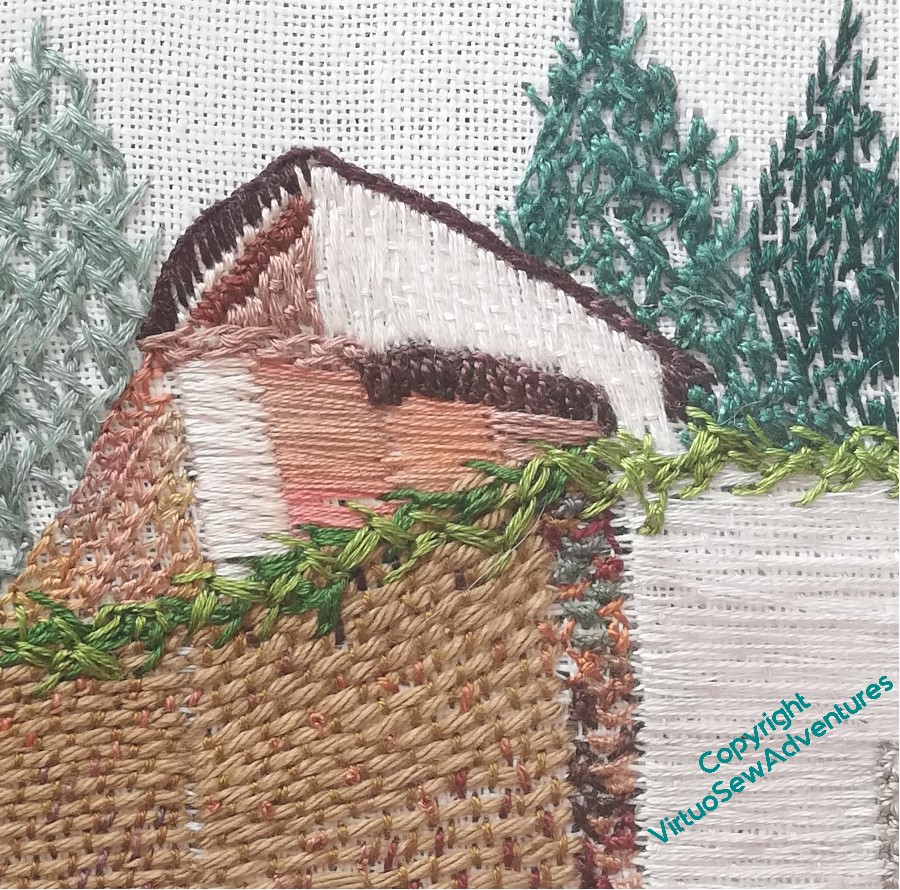
Once the walls were in place, I worked on the creepers.
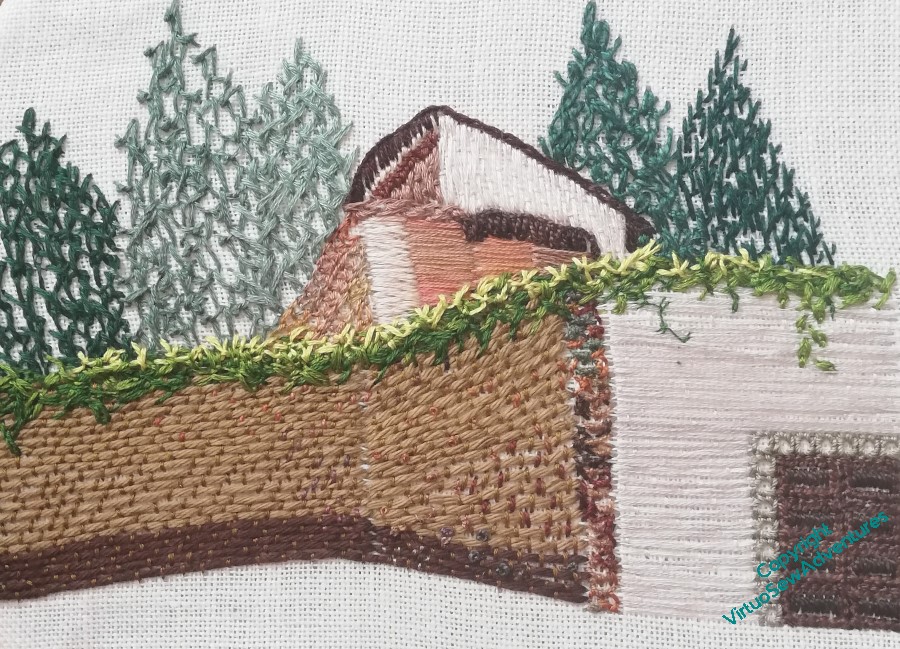
As you can see here, this involved not just more of the same, but a few extra tendrils, and some mixing of the number of strands and stitches used to create the right tangled effect. Feather stitch, floral feather stitch, feathered chain stitch, all layered up in a variety of shades, to increase the tangle almost to “Sleeping Beauty” proportions.
Yes, good so far.
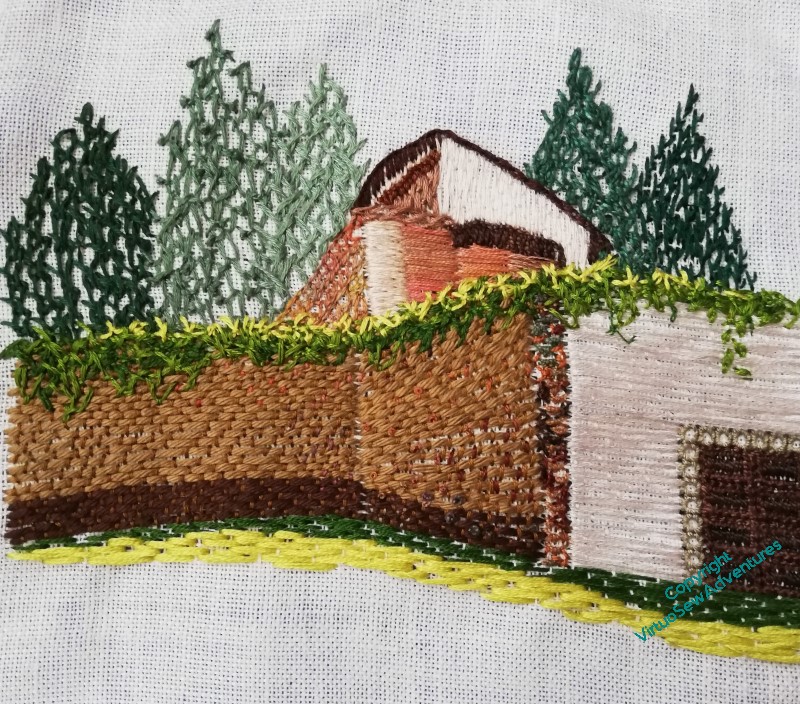
Then I decided that it really needed the grass at the front to pull the golden green forward, as it was in my memory.
Not like this, however. I think the choice of irregular running stitch is right, but although I chose to use six strands for the lighter colour to help pull it forward and push the building back – which is a good, rational, thought-through reason – it hasn’t worked as I envisaged. Cue some muttering and unpicking!
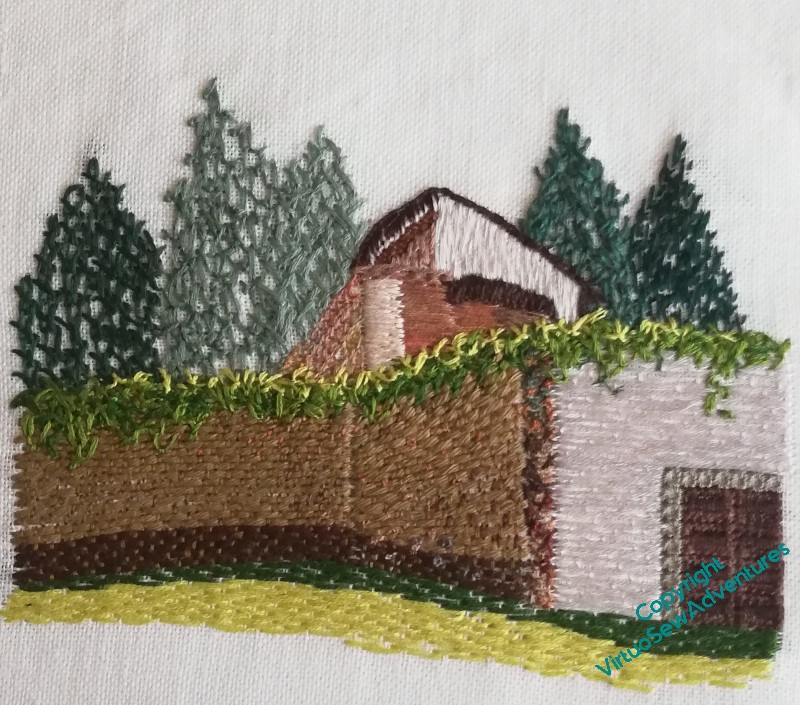
But I got there in the end…
In fact I’m very pleased with how this turned out. It allows me to demonstrate how to create different textural effects, even with a fairly restricted choice of thread – nothing exotic here, pearl cotton, soft cotton and stranded cotton.
I could add more details – roughen the stone further, add windows and doors to the walls in the shade – but I don’t think that the picture would be materially enhanced. And almost the whole trick with representative embroidery is the same as it is with painting: the finished piece is a new creation, not a copy of the thing it represents, so it is more important to end with a pleasing piece than an accurate report.
Watermill Stitchery – more progress on the Convento
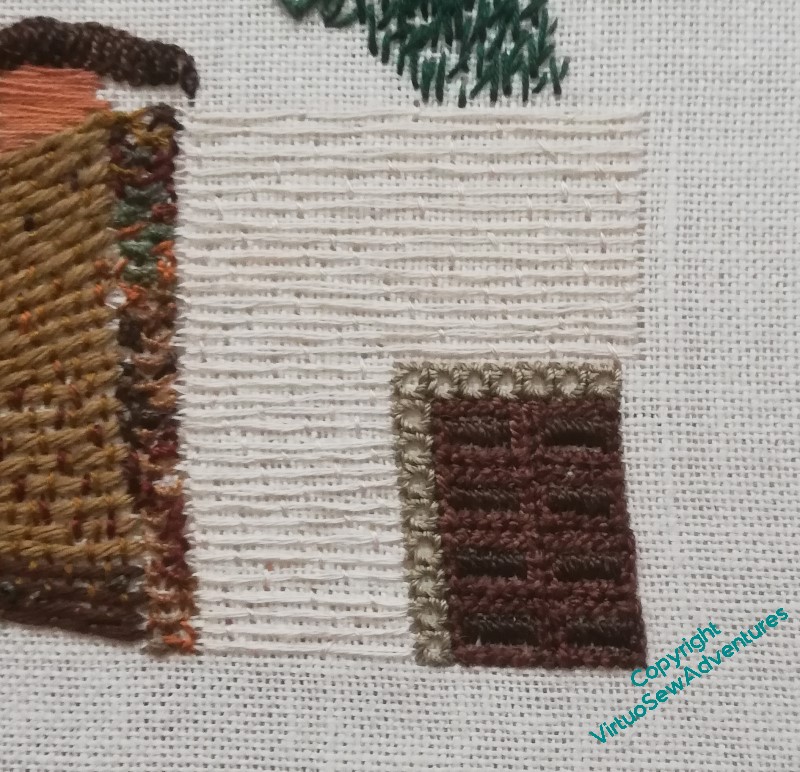
I finally had a couple of inspirations for the rendered wall and the door. I used two shades of brown pearl cotton for the panels on the door, outlining them using long legged cross stitch, and filling in the panels with satin stitch. While I was doing that, it occurred to me that this was a good opportunity to demonstrate, again, just how different a stitch can look if you use different threads to stitch it with. So the render is rendered (sorry!) in Burden stitch, using two strands of light coloured stranded cotton, and already you can see how very different it looks in comparison with the soft cotton. It’s very satisfying when something works that well!
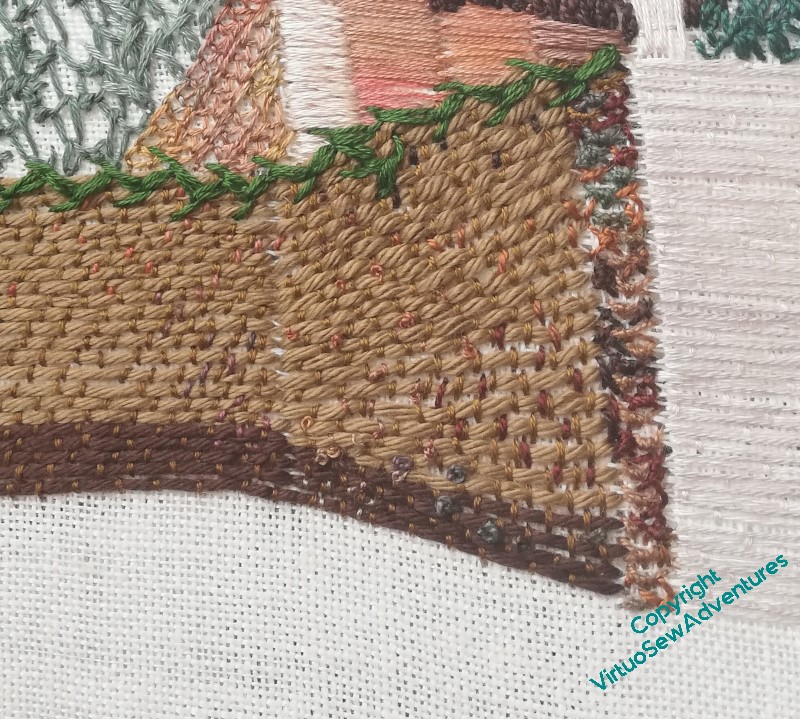
It was the golden light on the creeper that originally attracted me to this scene, so I need next to work out how to represent the creeper. I’m starting with feathered zig zag chain stitch, and I’ll use several colours of thread to create the variation of colour in the foliage.
I’ve added a few French Knots to the rough stone wall, to roughen it up a bit, and tweak the colour balance.
You can see here the start of the middle shade for the creeper, again using feathered zigzag chain stitch, and trying to zigzag the zigzags to vary how much of each colour shows.
You can also see that the facing light rendered wall is now done, and I have simply turned the Burden Stitch through ninety degrees. I think I may be beginning to be pleased with it!
Watermill Stitchery – continuing the Convento
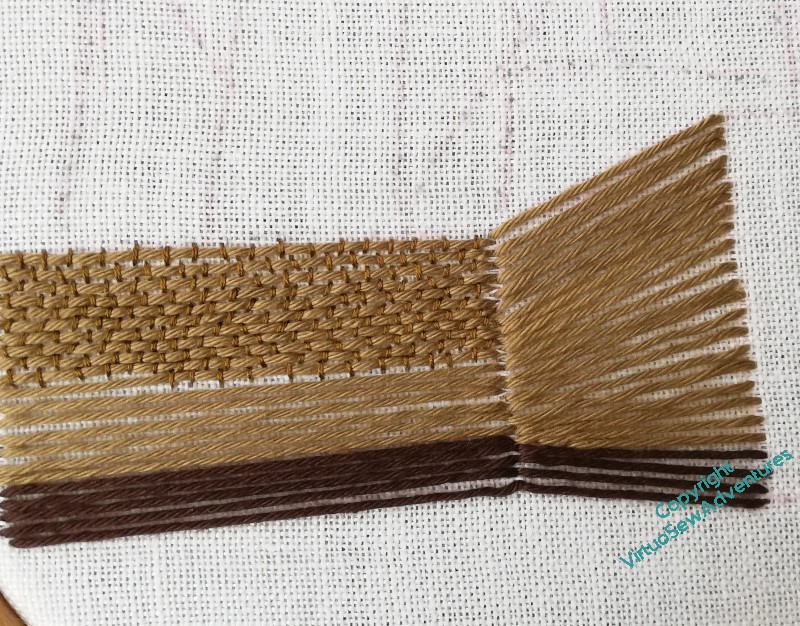
Burden Stitch does a good job for the wall – you can see it starting here. I’ve used Soft Embroidery Cotton for the underlying straight stitch and a mixture of single strands of ordinary stranded cotton with one of the slightly heavier and more tightly twisted threads from Caron Collection, which has a whole series of warm red and brown colours with some greenish ones to help suggest the variation of colour in the stone wall. I’ve used darker soft cotton at the base of the wall, where there will be deep shadows on the lawn to “ground” the building.
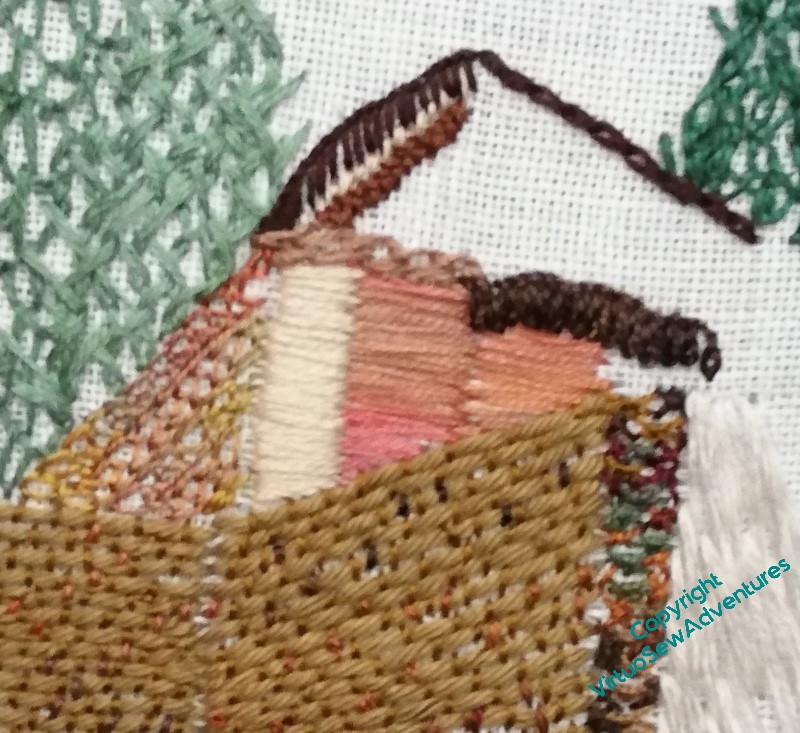
The buildings showing above the top of the creeper-bedecked wall are all rendered rather than rough stone, and I had a bit of fun trying to pull together stitches and threads to represent the tiled roof, shadows under the eaves, the render and the woodwork. How pleased I am with how this section work changes day by day, so I shall leave well alone, until I’m either Definitely Dissatisfied or Supremely Satisfied!
In the bottom right hand corner, you can see the first attempt I made to depict the render on the facing wall, and the rough-cast feel of the turn of the wall. I’m not happy with the roughly-done, diagonal encroaching satin stitch, but I’m very pleased with the multicoloured mixture of French Knots, diagonal cross stitch, and Danish Knotted Cross stitch.
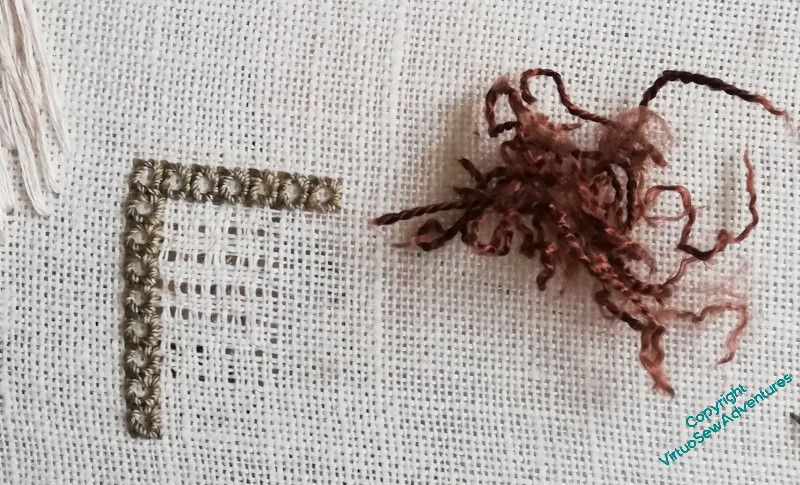
While I was rethinking the render, I worked on the door, which again, was not without missteps. The door surround, I am happy with – it’s Squared Chevron Stitch (found in one of my Edith John books), worked as a counted stitch. I then tried alternating two versions of Herringbone Stitch, hated it, and unpicked it promptly.
Oh, well, second mouse gets the cheese!