About Rachel

View all posts by Rachel
Floral Glove Needlecase – Second Stage of Finishing
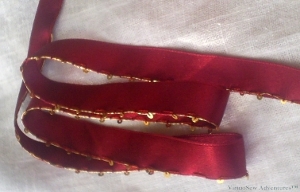
Silk Ribbon - First Stage
There is a sparkly ruffle between the cuff and the hand on the Floral Glove Needlecase, and of course we have to make it ourselves. You can’t go to your local needlework shop and say “Half a yard of Elizabethan glove trimming, please” with any prospect of success!
So the trim is composed of a length of double-sided silk ribbon, with Gold Twist and spangles whip-stitched down one edge.
The silk ribbon is wonderful stuff to play with, smooth and supple, and with just enough body not to flop. The idea is to ensure that the spangles all end up on the same side of the ribbon as each other and as the Gold Twist, and I think I managed it (not without the occasional tweak!).
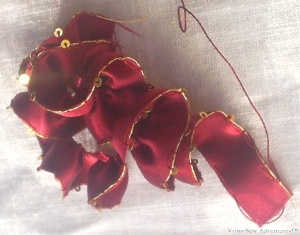
Silk Ribbon Gathered into a Ruffle
Then, we run a gathering thread down the other side and pull it up to make a ruffle. It looks wonderfully exuberant, doesn’t it, and I haven’t even set it into the shape it needs to fill on the project. Tricia suggests leaving that stage until the various unseen bits of backing are all assembled and shaped, and since I need to buy some fabric glue before moving to that stage, that is exactly what I am going to do.
Completing this fairly simple task took me most of an afternoon. But then, no one ever said embroidery was quick!
Piracy Follow Up – Two
I don’t like producing very long posts, so when I realised how much was going to be involved in a synthesis of the conversations about digital piracy that I had a few weeks ago, I decided to split the follow-up into two. This post is the second of those follow-ups, so there are now three posts, the original, the first follow-up, and this one.
Before describing the various business models that have been suggested, I thought I should give some idea of what is involved in producing a design chart, for those who haven’t thought of it before.
In producing a design for hand-embroidery, the designer spends hours thinking about the design, planning and re-drafting it, then working it and developing instructions for her customers to follow. If you’ve never written instructions – try it. Then give them to someone who doesn’t know anything about what you have written about and see how well they do.
It isn’t easy. In fact, just preparing instructions can take hours.
Furthermore, if a design is to be issued only as a chart, and not as a kit of materials, there are (in the UK, at least) three main thread manufacturers whose colour numbers need to be included. There are conversion charts, but I’ve often found that the results are unsatisfactory and need to be checked and corrected by hand.
Unless the designer is supported by a spouse or family, or has another job that pays the bills, all that time needs to be paid for somehow, or they will run out of money and need to do something else in order to eat.
The current business model – in essence – is that the hobbyist stitcher purchases a kit or a chart from which to work, perhaps because they lack confidence in their design abilities, effectively “outsourcing” the design work. The pricing for a kit or chart doesn’t include all the design costs because the designer or manufacturer hopes to sell a large enough number that those costs can be amortised over the print/manufacturing run. A full kit includes all necessary materials, and while they can be illicitly produced, that’s not common. A chart, however, is just a piece of paper showing the design, colour key and instructions, and is therefore very easily replicated. Indeed, a design that was never issued electronically can be scanned and saved as a PDF and suddenly that, too is online – possibly even lacking one of the crucial elements (such as the key).
The sale of charts in the form of PDFs is really a simple translation of this basic process to the web-enabled world. It has the merit of providing instant gratification (insofar as the chart is immediately available for the customer to print out and use), but there is the risk of abuse, in that others may offer the same item without paying the designer.
I was reminded, by one of the comments, that there is no copyright in the fashion industry, which nonetheless seems to be flourishing. I confess that I can’t quite see a way for the needlework world to make the same model work, since it relies on the fact that the people who buy high street copies of designer garments wouldn’t be able to afford the original pieces, but it’s a point to bear in mind. I’m not even sure what analogy one can make between sales of high street fashion and embroidery charts that would be illuminating, although I feel there should be one. Charts perhaps equate to dressmaking patterns, but certainly not to high street fashion.
In addition, as we are all aware by now, the open source movement in software has entire businesses working within it, even though the product (such as a browser) may be free. In fact, however, these businesses are selling, not software, but support. Perhaps the needlework equivalent would be workshops and courses. There are even courses being delivered online now, although the necessary precautions against illicit use of copyright material must put a significant technical overhead on them.
There were other business models suggested to me, too:
- Building a community around free designs. The suggestion is that this might even increase the size of the market by making access easier to new customers (again, there is a technical overhead here).
- Custom design – that is, individually personalised designs for individual customers (only for those with the hide of a rhinoceros – or those who can pick their customers carefully!).
- Cataloguing – the sale of temporary access to a catalogue of existing designs. This could be used to build up in effect a curated assembly of charts which would be of guaranteed quality – not something that can be said of informal file-sharers’ offerings. I think this would involve a technical overhead as well, although there may be an existing system based on those used by eBook providers.
- An honesty-based system for payment, such as flattr
- Escrowed prepayment, y similar to the way in which Mozart and Beethoven arranged their subscription concerts (which suggests that it would be most suitable for creators of art for public display)
- Creators funded by the state based on the popularity of their work (this perhaps would work for textile artists, but not for designers of kits for hobbyists to stitch at home)
- Distribute hardcopy via shops rather than via internet (this is still done, but is increasingly difficult as shops close)
If I seem to be picking holes in many of these ideas, it isn’t because I don’t believe they are good ideas or because I want them to fail. It is simply because I want to make it clear that this is going to be a really difficult problem to solve, and there are going to be artists and craftsmen and women who will suffer until a new model is created, a new market is created, or until the existing market is educated enough to realise how much work goes into the things they take for granted.
—
Thanks to: Davide ‘Folletto’ Casali, Robert Bronsdon, Mace Moneta, Harleqin, Alex, Eric Larson, Ed Marshall, Philip Hunt, Posy, and Janice.
Floral Glove Needlecase – beginning the Finishing Process
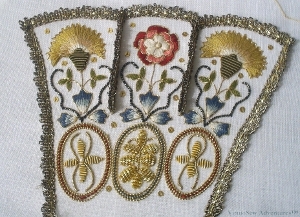
Floral Glove Needlecase - Gold Lace added
I’ve been prevaricating on the finishing process for the Floral Glove Needlecase, because it will involve glue, and I’m clumsy with that sort of thing.
I’ve worked very hard on the embroidery, I’m quite pleased with most of it, and I don’t want to fall at the last hurdle!
Finally, however (largely because I’ve been blogging about it and felt I should finish what I started!) I’ve screwed my courage to the sticking point, printed out the instructions and promised myself I would read everything twice before starting any stage of it.
That’s one of the effects I hoped blogging would achieve – providing encouragement to finish things properly. So I think we can count that as a success, can’t we!
What you see here is stage one of the fifth month’s instructions – adding the gold lace to the edge and around the tabs. This has actually been fairly simple, in that the lace has loops on the straight edge, and the whole thing is done with a single length. No joining ends to worry about, just making sure that the lace is neatly attached along the line, carefully controlled at the corners, and back-to-back on the lines separating the tabs.
I’m pleased with this. In real life it has a lovely sparkle and – yet again – the addition of further embellishment seems to have brought it to life even more.
A Glamorous Peacock
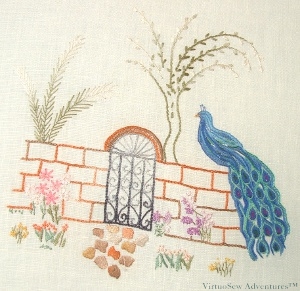
The Peacock
I’ve only recently begun to design my embroideries entirely for myself. To begin with I took painted canvases or transfers and worked them using a variety of stitches and thread combinations, depending on what I had to hand and what aspect of embroidery was catching my attention at the time.
I was attracted by this transfer of a peacock a long time ago, in fact I think I bought it when I was still a teenager. If I had paid attention to my whims I would have bought a good many canvases and transfers of peacocks over the years. In fact there is a painted canvas that I didn’t buy that I now would, if I were to see it somewhere!
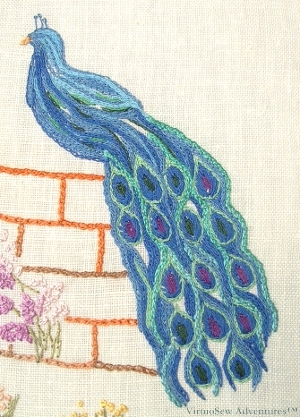
Peacock - Close Up
The fabric is a linen napkin, and the threads are a variety of silks bought when a needlework shop I worked in as a teenager closed. I got a very good discount, in gratitude for services rendered..
I didn’t actually get to begin stitching the Peacock until after I was married. He’s worked using chain stitch and heavy chain stitch, rows and rows and rows in blues and greens with a little purple in some of the eyes on his tail. I quite deliberately left some fragments unworked because it was beginning to feel rather congested, and although a peacock’s tail can look pretty bedraggled when it is closed, I wanted to bring to mind the glamour of the open tail and not the impediment of the closed one!
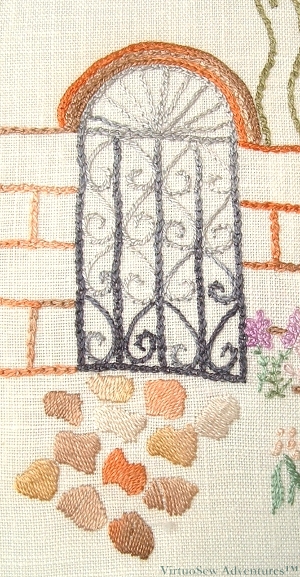
Gate - Close Up
Now I look at the design again, it is worked almost entirely in chain stitch and chain stitch variations. The olive green tree is worked in twisted chain, with detached chain stitch leaves.
The brick work is outlined in ordinary chain stitch, and the arch includes cable chain stitch, which is one of my favourite surface embroidery stitches. It looks much harder than it really is, produces a line which is slightly more marked than ordinary chain stitch, and can be tweaked and ornamented with French Knots or simple seed stitches inside the links.
I tried to make as much use as possible of the variation of colour in some of the threads, so the work in this piece is done by the colour variation rather than by trying to make excessive use of stitch texture changes. It is now stretched and mounted over padding and framed without glass, so that the textures and colours have the best chance of being seen, and hangs in our spare room. Whether our guests notice it is altogether a different matter!
Piracy Follow-Up – One
A few weeks ago, I wrote a post about designs being shared without the designer’s approval, and suggested that it isn’t right to do so. The post was linked to on HackerNews; then on a few more tech blogs and suddenly the whole subject was attracting attention and comments from a new range of people, and people, what’s more, who have an interest in the subject of copyright – software piracy is a problem too.
It became clear in the course of reading the comments, and the links, and the emails I received, that in fact (debates over ethics and terminology notwithstanding) most of my correspondents felt that the copyright and intellectual property system as it stands is ill-adapted to our digital world, and needs changing. As to how – none of us is very sure about that.
Essentially, the comments and emails fell into two categories: philosophical discussions of how/why the situation is as it is, and suggestions for new business models that might meet the changing circumstances. I’ve split my follow-up into two posts along the same lines.
First, though, my terminology was imprecise, so yes, technically, the unauthorised copying of a digital work is not theft, but copyright infringement.
Second, (going back to Monique’s original post on Inside Number Twenty) I acknowledge that when we see x downloads from the file-sharer, it probably doesn’t equate to x lost sales.
That isn’t the point, though, is it? The real point is that ease of copying has undermined the general appreciation of the value of the item in its digital form.
Any creative work already tends to be undervalued because non-creative people assume that talent does all the work. It is assumed that if you are talented, creating something comes easily (haven’t we all encountered that one?). We who create things know that this isn’t true, that talent needs to be supported by time, effort, and application. Thomas Edison was right when he said that genius is composed of 99% perspiration and 1% inspiration.
So there is a problem of education here. The consumer needs to be reminded that creation isn’t simply a matter of snapping one’s fingers, that the artist may have devoted years to learning their craft before being able to produce anything for the market, quite apart from the time they spend in refining their vision to create the final piece. They need to understand that when they use or enjoy a digital copy of a copyrighted artistic work for which they have not paid, the artists whose work they enjoy are the ones who suffer, even if in the case of music and films it is the big media companies that complain.
Taking the specific example of the needlework business – most of the companies, even those producing threads and tools, are really very small. They don’t have a huge financial buffer, and they can be as easily unbalanced by sudden success as by a fall in sales. The companies producing charts often aren’t companies, but just one person, trying to make a living in a way that fits around other obligations.
Even those of us who are not immediately affected, perhaps because we design most of our own pieces, need to remember that the sale of charts and designs supports and encourages the sale of threads, fabrics, tools and charms. If the designers go out of business we may very well find that manufacturers do as well. And we know that we don’t want that.
Perhaps, though, the current business model is truly unworkable, and a new one is needed. I’ll describe some of the suggestions I’ve been sent in another post.
—
Thanks to: Davide ‘Folletto’ Casali, Robert Bronsdon, Mace Moneta, Harleqin, Alex, Eric Larson, Ed Marshall, Philip Hunt, Posy, and Janice.
Tudor and Stuart Goldwork Masterclass – Month Four Stitches
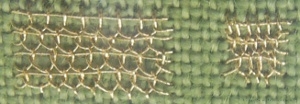
Detached Buttonhole With Return
While I continue to persevere with the silkwork, I am trying to keep up with the new stitches, practising on a separate cloth. In the case of the Detached Buttonhole stitch with Return, I think you can see that the fabric and the thread are not well matched, and so the structure is correct, but the appearance is not. The stitch should be much more closely worked, giving the impression of a fabric, not of a net. It’s tricky to be sure that the gold thread doesn’t kink back on itself in working this stitch, although this may be easier when I’m working on the real thing, using a slate frame on a stand, and therefore have both hands free to control the thread!
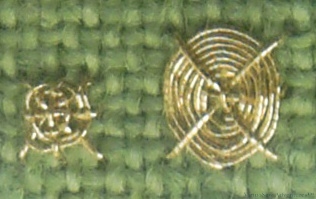
Eight Spoked Wheel
This second stitch is an Eight Spoked Flat Spider’s Web. It is very similar to the one in last month’s pair of stitches, but uses a foundation composed of a cross and an upright cross. I suspect it will be rather more stable than the four-legged version.
These “spot” stitches may come in very handy when I start thinking about some elements of the Amarna Panels.
I’m using a single type of thread for all these practise stitches. I don’t want to confuse myself with problems that may relate to an unfamiliar thread when I am already dealing with unfamiliar stitches! Still, already when I look down the row of stitches I’ve already tried, I see ideas for further experiments and even for applications of the stitches. This is what I hoped for when I joined the course, so I’m very happy with how it is going!
Tudor and Stuart Goldwork Master Class – Progress on the Silkwork
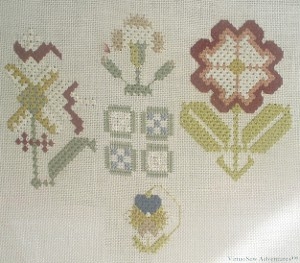
SilkWork On Sampler - Progress
I’m still working away at the silkwork on the sampler. It has been so grey and miserable recently that the light has been poor and it has been difficult to make any progress at all.
Some time ago I bought a daylight lamp to use in the evenings or when the natural light is poor. It works well for some projects, but not this one. I think part of the problem is that it glares on both the fabric and the magnifier, and believe me, I’m not going to work this piece without a magnifier!
So I can only work on this when there is good natural light, but not glaring sunshine, of which there has been all too little this summer. I’m also careful not to strain my eyes, so I work maybe two lengths each time I sit down, but no more.
I’m working one motif at a time, and letting it grow from the nearest point at which it approaches a previously finished one. That means I have relatively little counting to do, although sometimes I start a motif somewhere a little odd. The one I am working on at the moment started from the tip of the large leaf. When I do have to count, I count in fours – that is, the width of one Queen Stitch. I can almost do that by eye, and if I do miscount, it’s easy to double check.
The stitch produces a very pleasing texture on the fabric, and because it is a pulled stitch – at least on this fabric – there is a light and lacy look to it. If only I had better light I would be enjoying this even more!
Canvaswork Inspired by Clarice Cliff
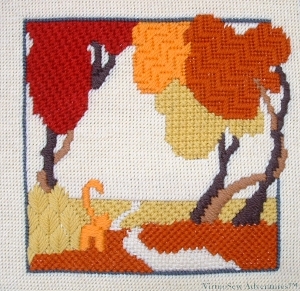
"The Cat Who Walked By Himself" in canvaswork
The design in counted cross stitch that I created, “The Cat Who Walked By Himself” (now being re-issued by Classic Embroidery – remember how excited I was a few months ago?) was such a success that I experimented with other ways in which the basic design might be used.
First of all, in ordinary tent stitch at a large size. Pleasant enough, but rather dull – for me, at any rate.
Then, at the same size as the original cross stitch, but using ornamental canvaswork stitches. Originally I had in mind to run classes based on these designs, in one of the local shops, but the shop closed, life changed direction, and I’ve not done anything with it yet.
As I post more of my early canvaswork, you will probably notice some stitches recur. For example, I like Upright Cross Stitch – it is sturdy and heavily textured – and Milanese stitch (I think just because I like the name). I usually sneak in Leaf Stitch as well (remember the Elephant of Considerable Charm?). I’ve also used Jacquard Stitch, and Satin Stitch. The background was worked in Encroaching Gobelin Stitch.
I’ve not put the heavy outlines on yet. Tapestry wool would be too heavy – some of the areas are quite small – but on the other hand, I don’t want to use something that will draw too much attention to itself by being shiny..
Dreams of Amarna – More Planning
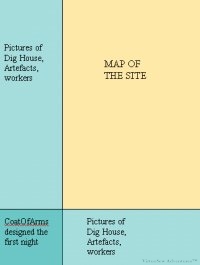
First Panel - basic design layout
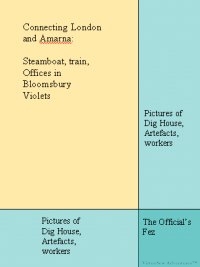
Second Panel - basic design layout
It occurred to me that now would be a good time to create some diagrams to show the design ideas that I have, so that when I refer to “backgrounds” or “side panels” it is clear what I mean.
The basic fabrics are dress-weight linens, one in a sandy colour (the High Desert is not that far away from the site) and the other two are in different turquoise shades, rather like faience.
I have not decided how wide the side panels will be, or how they will be attached. In some cases the design elements will be stitched separately (as the Faience Hippopotamus was) and then applied as a patch, and in others they will be stitched straight onto the base cloth. Again, I am not sure how I will decide what happens in each case. At present the project is progressing on those bits that I have made a decision on, and the more difficult matters are being left to one side.
John Pendlebury was fascinated by the medieval period as well, and over dinner the first evening they were at the site, Mary Chubb describes how they doodle a coat of arms for the dig. When I was a teenager I was fascinated by heraldry, so that was definitely going to be part of one of the panels; the fez is for an official at the Cairo Museum who acted as the intermediary between the Egypt Exploration Society and the Museum. The violets spring from Mary’s efforts to learn Arabic. More about that when I get there!
In reading the book, one feels as though Mary is haunted by the leading characters of the past – Akhenaten and his Queen, Nefertiti. She even finds herself imagining a visit by Nefertiti to the Dig House in the days when it was merely one of the houses of Aketaten. That is why all the activity on the panels will be overlaid by a faded “head shot” of either Akenaten or Nefertiti, screenprinted onto the finest and most transparent gauze I can find. I may decide to offset these a little so that the heads are over the tawny linen and all the bright elements around the outside have only the merest veil over them.There’s going to be a finishing problem right there, because I want the gauze to hang in front of the panels and not be stretched over them.
Still, we all like a challenge, don’t we?
The Faience Hippo Finished
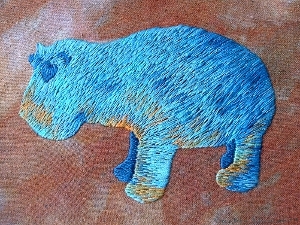
The Faience Hippo Finished
So here is the Faience Hippopotamus finished. That is, unless I decide to go over him with another layer of long and short stitch to break up some of the patterning even further…
I’m reasonably pleased with him, as a matter of fact. The loose weave of the base fabric was sometimes challenging to work on, and it isn’t at all a hardwearing piece – some of the stitches are half an inch long, which would be bound to catch on something – but as it will be part of a carefully protected wall panel if it makes the final piece, this is not going to be a problem.
I enjoyed doing it, as well. It was fascinating to see the colours change more subtly when I started using the thread turned end-for-end, and this vibrant turquoise/teal colour is one of my favourites.
And, yes, I did manage to work an entire piece in long and short stitch. It is fair to say, I think, that it will never be my favourite stitch, but it does have its place, and I am certainly happier to use it now I have had Tricia’s instructions on the Floral Glove Needlecase Course.