Month: March 2010
Trying Stumpwork
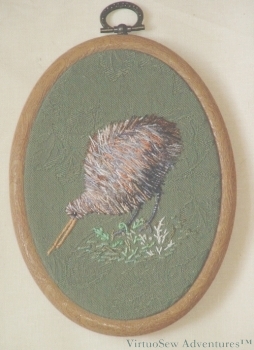
Kiwi In Stumpwork
As I’ve already mentioned, almost every embroidery technique I have done has been learnt from a book, or just developed by guesswork based upon something I have read.
In this case, I had been reading about 17th Century stumpwork, and had just returned from a half-business trip, half-holiday in New Zealand. And I had some rather gorgeous overdyed silk threads and wanted to experiment with them!
The body is worked in layers of straight stitches, using several different colours of the overdyed silks. I worked a slip, slightly smaller than the body, on a separate piece of fabric, then applied that piece over some padding, and used more straight stitches to cover the join – very thoroughly!
The legs and the beak are both worked by stitching very closely over a trailing thread of soft cotton. The background fabric is a sturdy cotton damask upholstery fabric, so the close stitchery did no harm. The ground is worked using still more straight stitches, with scroll stitch, coral stitch and fern stitch to create the fragmentary undergrowth.
This was intended just as a piece of fun, but I was happy enough with the outcome to mount it in a flexihoop frame. I’ve bought a couple of books on Stumpwork since I stitched this, but I don’t know that I would have thought of doing the Kiwi this way if I had read the books first.
The Autumn Leaves Skirt
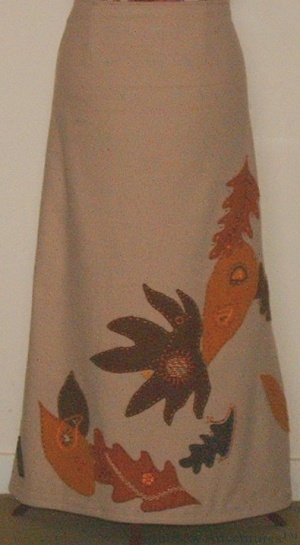
Autumn Leaves Skirt
I made this skirt last winter, and originally needlefelted the leaves onto the fabric. However, after a winter’s wear, and after looking at a good few blogs over the summer, I thought I could do better.
I took some ideas from some of SharonB’s Pintangle posts on seam treatments, fished some additional inspiration from a host of other blogs (wish I’d taken notes, now – I want to find some of them again!) and then proceeded to some adventures in embellishment.
It occurred to me that there was no need to keep within the leaf shapes, or even to add embellishment that resembled leaf characteristics in any way, so paisley shapes, spiders web wheels and trailing lines of feather stitch showed up all over the place.
I started off by sewing around the edges of all the leaf shapes in ordinary running stitch, and originally I had intended to stop there. However, when I did, it looked a little half-hearted, and I’m never that, so Something Had To Be Done!
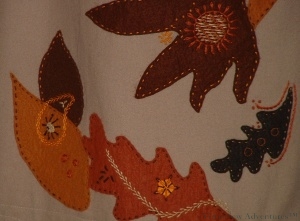
First Skirt Detail
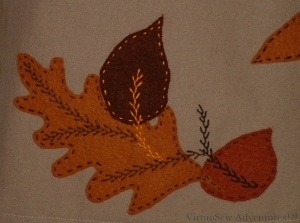
There’s a trail of French knots across the largest leaf, which has a circle of Rosette Chain on it, surrounding a disc of an interlaced filling stitch in three different colours.
I also realised (about halfway through!) that I didn’t have to keep the embellishment only on the applied fabric, so the skirt fabric acquired stem stitch lines with French knot finials, a spiders web wheel, and more French knots.
Second Skirt Detail
It is all worked in six strands of stranded cotton, un-separated to maintain a sort of cohesion. I chose colours that were fairly close to the colours of the felt leaf shapes, but working in the opposite direction, as it were, so dark felt was running-stitched in light stranded cotton.
All this on a skirt I originally made purely because I wanted a long winter skirt to cut the draughts in the office!
“Dreams of Amarna” – a very long term project!
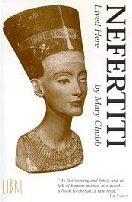
Cover for the book "Nefertiti Lived Here", by Mary Chubb
This is turning into a very big project, and there will be several posts with no embroidery in them. I will try to intersperse them with other projects too!
A good many years ago, I read a book called Nefertiti Lived Here, by Mary Chubb. It describes the author’s own experiences as Secretary to the Excavation in el-Amarna in the 1930s. Sounds as dry as the desert around the dig? Wrong. The book reads as well as a novel, and the characters of the archaeologists (led by the charismatic JDS Pendlebury), and some of the excavators, are beautifully described. The site itself, the Heretic Pharaoh and his beautiful wife Nefertiti, also become characters, and even for a non-Egyptologist, the book is entirely enchanting. I re-read it frequently.
As Mary Chubb was studying sculpture at the time she joined the expedition, it is perhaps not surprising that some of the artefacts they discovered are so vividly described or that the changes in Egyptian art in that period should have made such an impact on her, and through her on her readers.
Given my interest in embroidery, perhaps it is not surprising, either, that Mary Chubb’s fascination with Egyptian art should plant the germ of an idea for an embroidery…
Only a germ, unfortunately. It has taken years of thinking in the occasional idle moment for the idea to take sufficient shape that I could begin to consider the materials to use or the form it would finally take. In the meantime, Mary Chubb has died (at the august age of 99, in 2003 – Times Obituary ) so my early wish to show her what she has inspired has fallen by the wayside.
But that is no reason not to do it!
Floral Glove Needlecase Kit – Silk Work Finished!
Floral Glove Needlecase Kit - Silk Work Done
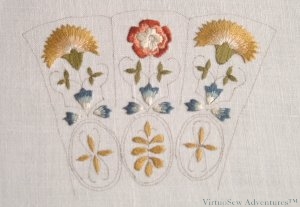
I’ve finished the silk work on the Needlecase Kit!
The new stand has been working well – it is very adjustable, so I can make it suit wherever I am sitting, and the magnifying glass has been very helpful too. The only slight hitch with the magnifier is that stitching away at magnification becomes normal and then when finishing off threads at normal vision, I get slightly spooked to realise how small the stitching is!
As I have said, I am not really a fan of satin stitch and long and short stitch, perhaps because I am self-taught. Both of these stitches look simple, but are difficult to execute well, and so are very dispiriting for someone learning from books, with no-one to give hints and tips for excellence. How I long to have had a Miss Hunter to help me!
Actually, the instructions that Tricia Wilson prepared for the course are very nearly as good as having her beside you. They are copiously illustrated with very high resolution photos, so that it becomes a matter of seeking to make the view through the magnifier match the printout.
I’m even coming to think I may enjoy satin and long and short stitch, in small doses!
The kit included whole spools of the silk thread, so I have plenty left to play with. I’m not expecting to go so quickly with the goldwork, but the instructions come nicely spaced out so there will be time to take stock and work on other projects as well.
The Persian Fantasy Finished
Finally Finished, Mounted and Up On The Wall
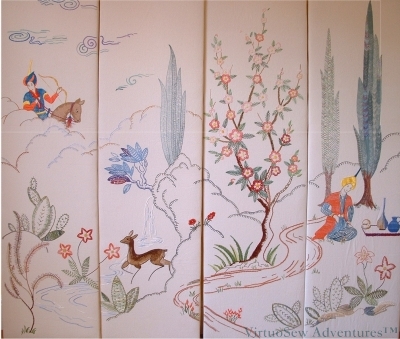
As far as I recall, I spent one month each on the first two panels, and then two months on the third, and three months on the final panel. I only embroidered in the evenings when I got back from work, probably not more than a couple of hours each night.
The closely packed fly stitches forming the poplar trees are largely responsible for the length of time the final panel took. I’m not the most patient person and I was nearly at screaming point with fly stitch by the time I had finished them!
The panels are mounted over padded wooden frames. I couldn’t find suitable two-way hinges to make a folding screen (and if I’m honest, we don’t have anywhere where such a thing would be useful!) so I simply hung them on the dining room wall. I don’t think anyone who has come for dinner has ever failed to comment!
Floral Glove Needlecase Kit – first stitching
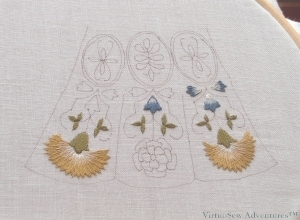
Floral Glove Needlecase - Beginning To Stitch
So, here is my progress so far. I’ve ended up buying a floor standing frame with a clamp so I have it ready to hand and don’t have to hold the frame, and I have bought a magnifier on a clamp as well. I’ve not had them up and running for long enough to comment on whether they really help!
There will be some goldwork in the later stages, but the first month concentrates on the silk embroidery. I’ve never used silk thread before, but it’s a lovely thread to stitch with. The thread is six strands and separable, like stranded cotton, but the resemblance ends there. The silk thread is supple, soft and shiny, and while not being difficult to work, doesn’t feel as lifeless as cotton sometimes does.
The first scare was to read the instructions and discover that the chrysanthemums were to be outlined in stitches about a millimetre long. Eeek! Then again, long and short stitch is not my favourite way to fill a shape. I admire the silk shading one sees at Royal School of Needlework shows, but it doesn’t fire me with a desire to emulate it. Still, Grandmama could do it (I shall photograph some of her embroidery and blog about it later), so I really think I should have a stab at learning.
I’m running a little behind, because of deadlines in other work, but when I get a combination of an afternoon of good sunlight and time to stitch, I become a very happy girl!
Stitching the Persian Fantasy – Four
There was so much going on that I consciously reused yarns, colours or stitches across the four panels in order to maintain some semblance of order. In fact as I moved on to each panel I would lay the completed ones side by side on the living room floor and scramble around putting piles of coloured threads on them. It must have looked highly comical, but my parents (I was still living with them when I embroidered these panels) were kind enough not to laugh. Besides, as long as it works…!
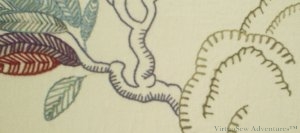
Crags worked in Caron Collection "Storm" (I think!)
I chose to use one of the Caron Collection threads for the basic outlines of the closer landscape, using Up and Down Blanket Stitch, my favourite blanket stitch variation. I’ve done a bit of hunting because it’s one of the more obscure variations and finally found it at the bottom of Sharon B’s Stitch Dictionary page on blanket stitch variations. For the further landscape or clouds (I never did quite work out what they were), I used a different colour range but the same stitch.
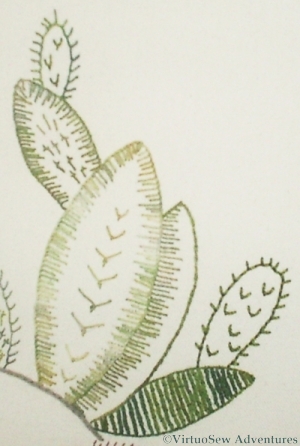
Some of the Cactus Plants
The cacti were worked in a variety of stitches, partly based on the lines of the original transfer, but then extrapolated as the stitches and threads suggested themselves. Although I did use several variegated threads in the flowers and the cacti, most of them are pearl-cotton types, and there is a certain unity provided by the use of the same set of threads wherever those forms appear. There are fly stitches, feather stitches, blanket stitches and sword stitches in this small section. I’ve diagrammed Sword Stitch at the end of this post.
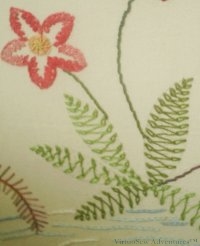
Large flowers with leaves worked in Chained Feather Stitch
The leaves for the largest flowers were worked using chained feather stitch – I had never worked it before and thought it looked fun. I caught down the long connecting stitches with a single strand of cotton, and was delighted to realise that that gave me the effect of a shadowy vein – one of those serendipitous effects that one cannot foresee, but only rejoice in.
The large flowers had centres of Whipped Spiders Web stitch and the outlines were worked in Rosette Chain stitch. The stems were simply a very heavy rayon cord, couched in place. They may well have been the most straightforward element of the entire four panels!

Sword Edging, or Sword Stitch
I couldn’t find a diagram of Sword Stitch on the internet anywhere so I spent a bit of time with a vector drawing package and Barbara Snook’s “Embroidery Stitches”, published by Batsford in 1963. I’ve redrawn the diagrams, changing them slightly where I thought the original used a strange order. When working a row, she seems to recommend working from right to left. The only other advice she gives is that the longest arm should point downwards – clearly that is the blade of the sword.
Stitching The Persian Fantasy – Three
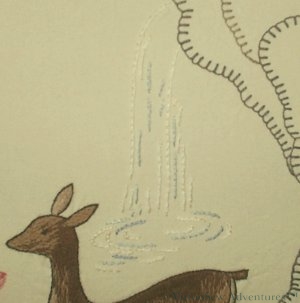
The Waterfall from the crag
I tried very hard to get a photo that does justice to the waterfall here, because it is another example of what I mentioned when I was discussing the gazelle, but I’ve not succeeded very well, I’m afraid.
The interesting point about the waterfall is that it looks like a trivial piece of design – just a few lines – and yet when I came to embroider it, I realised that it would be spoilt if I added “watery” effects with sparkling thread or metallics. I ended up stitching it very simply in stem stitch, using three colours of pearl cotton.
In real life (I wish I were better at photography!) this looks more like a waterfall than a few simple lines have any right to. I’ve looked at this panel over breakfast for ten years now, and I still can’t work out quite how the designer managed to do it!
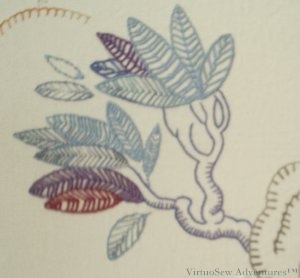
Tree On A Crag
This tree is a different matter. It doesn’t look much like a real tree, and it isn’t intended to. It is a purely decorative, “tree-ish” element of the design.
I’m coming to realise that the success of these panels rests partly on this balancing act, in which some of the elements look more realistic than others.
Something for us all to try, perhaps!
Stitching the Persian Fantasy – Two
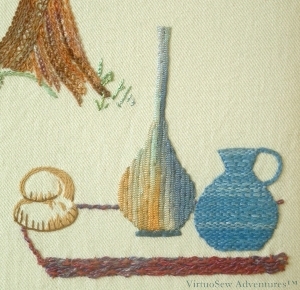
The Prince's Picnic, Panel Four
I enjoyed working on the prince’s picnic on panel four. The tall carafe is created using a variegated knitted ribbon (from Stef Francis), and has been used as if appliquéd. The inspiration here was those strange lustre-glazes that show widely differing colours in different lights, and I had great fun choosing particular sections of the yarn to create the effect. The blue jug is much more homespun (sorry – couldn’t resist!), using a Soft Cotton, this time inspired by coiled clay pots – a technique I remembered trying at school, although it was much easier in embroidery! Then there was the loaf of bread, using three shades of a plain matte, round cotton yarn, and the rug (or table – I’m not sure which) bordered with a complex border stitch in a strongly textured yarn.
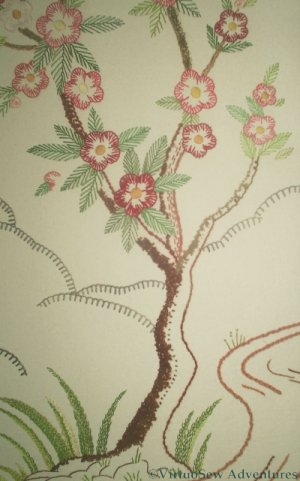
The Flowering Tree on Panel Three
The bark of the flowering tree on Panel Three was worked using various bouclé and other effect yarns, couched to the surface randomly. The basic design is so stylised that I was careful not to be naturalistic. I used a variety of yarns from a Texere Yarns Inspirations pack and caught them down with a single strand of stranded cotton, in loops and wavy lines. The flowers and leaves were working in plain stranded cottons. The flowering tree was already so dominant in the panel that it really didn’t need much in the way of emphasis from the yarns other than the bark. The tall grasses at the foot of the tree are in stranded cotton too, using feather stitch. I’m not sure that I would do this panel in the same way now, although I think that using satin stitch and long and short stitch, as in the original, might make it look a little serious, rather than decorative and fun.
And I wanted it to be fun.