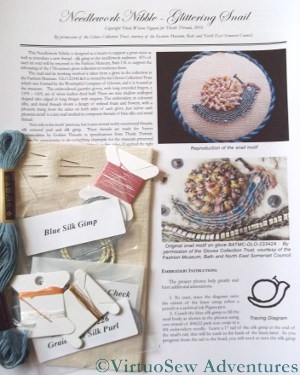
The Snail Kit Has Arrived In The Post
You may recall that in December I wrote about the Thistle Threads project to Stitch A Snail For Storage. We’ve been away for a while, but came back to find a huge pile of post which included a jiffy bag from Thistle Threads.
Since I’ve already printed out the instructions (as soon as I ordered the kit!), I can start just as soon as I’ve gathered my wits and drawn the design on the linen. Even though the basic concept of the design is simple, it will be complicated and probably a little tricky to do, because the snail is only about an inch from nose to tail!
Tricia had two reasons for developing the kit – one was to sell something in aid of the Fashion Museum in Bath, but the other was to introduce some new threads to us. So of course, the first thing I did was to rummage through to look at the the new threads, the silk gimp and silk wrapped purl. They look highly intriguing, and I am looking forward to playing with them…
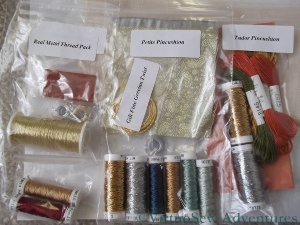
More Post From Thistle Threads
Yet more post from Thistle Threads – aren’t I a lucky girl!
This time, the post contained the real metal threads for the Spot Sampler, and the materials for two pincushions that also form part of the course. There’s a piece of silk brocade, and two pieces of linen, and even more silk threads… I’ve not caught up with printing the instructions yet, so I’m not quite sure what I’m going to be doing with them, although I have had a quick look, and there’s at least one new stitch variation in among them.
Progress So Far
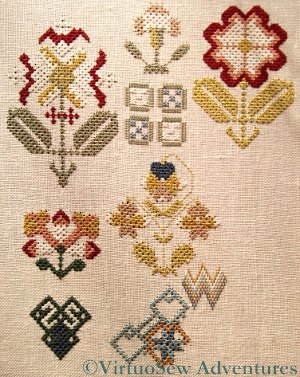
And bear in mind, I still haven’t finished the silk work on the Spot Sampler, and that there are going to be even more ornamental stitches to learn. This photo shows my progress so far. Over the last couple of days I have finished the bargello motif and made a lot of progress on the central motif at the bottom. I once reckoned it took twenty minutes to do ten Queen Stitches, and was very depressed by that discovery, but I think I’m speeding up again!
It’s intriguing to see the new fabric created by the Queen Stitches. It’s not often that the effect of stitches is quite so clear. Instead of the ordinary square-woven fabric, the closely-worked Queen Stitches create a sort of heavy openwork lattice. It has a completely different texture to the basic fabric and when I finally finish the piece, I will have to make sure I frame it or mount it in such a way as to make that quite clear.
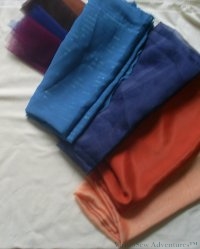
Fabric Choices
So here are the final colour choices for the Camberwell Panel, after much deliberation.
I wanted to maintain the flat expanses of colour used in the posters, together with the slightly unreal colours, but at the same time, I did not want to create a wilfully unrealistic colour scheme. So although I decided to use apricot organdie for the sky (after all, we’ve all seen strange colours of sky, haven’t we?), the fabric for the sea was a blue-green georgette, and for the hull a dark orange crepe-back satin, crepe side out. The dark orange is close to the terracotta/red lead colour often used on merchant shipping, while sitting comfortably alongside the apricot. Then I picked some fragments of net in a variety of dark colours to help with the rough textures of the quayside, and navy blue organdie to help create the shade on the hull.
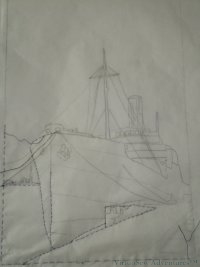
Transferring the Design
I chose a cream cotton velvet to make a solid, but pleasantly textured background, thinking it would make a pleasant surround when the panel was complete (as you will see, there were some design changes made during the process…!).
This in turn meant that transferring the design threatened to be an exercise fraught with difficulty – right up to the point where I realised that since much of the design would be applied in pieces, all I needed on the background velvet was basic clues for placement.
So I traced the design onto tissue paper, tacked it in place, put the whole thing on a slate frame and went over the main design lines in running stitch.
Easy!
Some years ago, I was asked by a magazine to design “my interpretation of buildings” in counted work. I produced three versions of the same thing – a set of steps in a Tuscan village, with plants in pots on the steps and a window looking over them. Then the magazine didn’t use them. Any of them. Sigh.
Never mind, I enjoyed doing them, and it was a very interesting exercise.
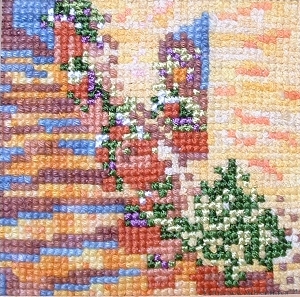
Steps in the Sun using various threads in counted cross stitch
The colours are inspired by Monet’s Rouen Cathedral series – strong, bright colours with purples and blues as the shadows. They are like impressionist oil paintings in another way, too – it’s not always entirely clear quite what the shapes are until you have looked for a while.
For Version One I used counted cross stitch in space dyed and other threads. The walls were worked using a cotton bouclé, and the steps in a range of soft unmercerised cottons. The terracotta plant pots were worked in stranded cottons (solid colour), and the plants themselves were worked in rayon, also in solid colours. The threads were rather heavier than stranded cottons, so I used 22 count linen and stitched over two threads. The bouclé battled every stitch of the way!
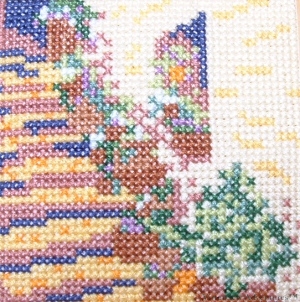
Steps in the Sun - Stranded Cotton counted cross stitch
For Version Two I used plain counted cross stitch in stranded cotton, chosen to reflect the colours of the overdyed cotton as well as I could manage. It is strange to see that the photograph gives the impression of the aida fabric showing through, which isn’t so obvious to the naked eye. This version actually is more successful in some ways than the first one, although I have them all three on the wall and I actually prefer Version One! Version Two is not so hectic, but still, it doesn’t “read” as clearly as I might like. Or at least, not to everyone. I see the steps in all three, but I know people who don’t.
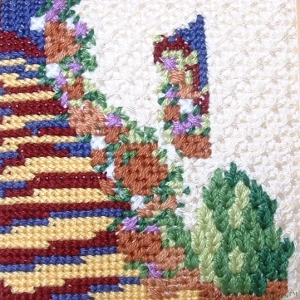
Steps in the Sun using canvaswork stitches in stranded cotton
In Version Three I became even more experimental – I knew the magazine wouldn’t go for this one, but thought it would make an intriguing exercise. The base fabric is ordinary aida, but I chose to use canvaswork stitches in stranded cotton. The bush in the bottom planter is worked in Leaf Stitch – oh, look, Leaf Stitch again! – and the steps are long-legged cross stitch. The wall is Double Straight Cross Stitch. I enjoyed this one the most, but at the scale of the piece (it is less than four inches square) there really is not enough space for most of the stitches to do their work properly.
An interesting exercise, all the same..
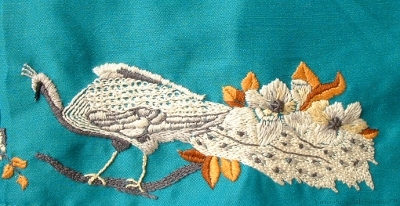
Peacock Motif
This design of peacocks and flowers was taken from a Time Life book on couture embellishments, and embroidered on a full skirt. It still attracts attention, and now full skirts are back “in”, I shall probably fish it out and start wearing it again. Although it has always been a challenge to find a suitable top!
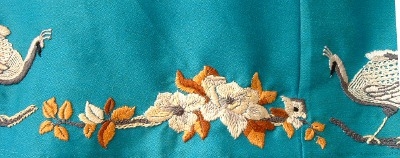
I worked this as a teenager, and wore it at a cousin’s wedding. The design was worked at three places around the skirt, with each third showing two peacocks confronting one another across the sprig of flowers. The original design used two shades of grey-green, several shades of grey, lemon and white on a red satin background. I simply changed the two shades of grey green to a dark yellow and a chestnut brown to work on the bright turquoise/teal background.
The design attracted me because – alone of the surface embroidery patterns I had seen up to that point, it included more than the basic stem stitch, satin stitch, and long and short stitch. The peacock’s back was worked in Pekingese Stitch, deliberately worked loose and spaced so as to create a slightly mottled effect. The flower centres used a whipped spiders web wheel, worked close and tight so as to be slightly raised. The branches were worked in a combination of Coral Stitch and Scroll Stitch – neither of which I remember seeing used in a commercial design up to that point.
It was quite fun to stitch, but the deadline made life a bit exciting, and my mother had to help out with some of the embroidery so that I could get the job done!
Flower Motif
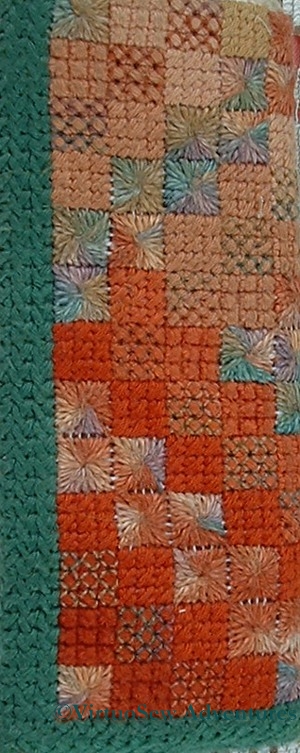
Canvaswork Spectacle Case Sampler
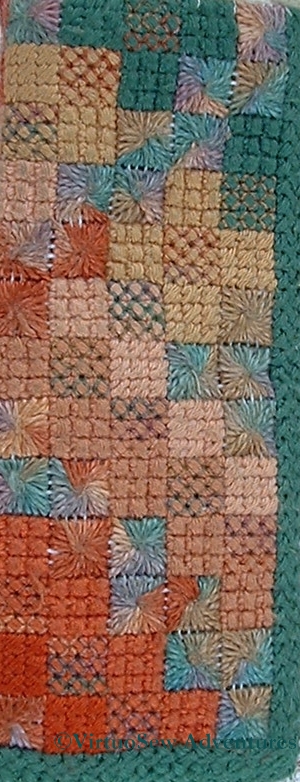
The Other Side Of The Spectacle Case Sampler
Strictly speaking, this isn’t one of mine. My mother stitched this, but she asked me to design it for her after she saw the stripy sampler.
It uses the same principle of plain soft embroidery cotton and matching Wildflowers and Watercolours threads. This time, though, instead of straight stripes, the stripes were V-shaped.
It was rather more complicated and time-consuming, but it must have been a success because it is still in use and I had to sneak it from her handbag for the photograph!
It did teach me, however, that designs should be planned with their final use in mind. This looked much better as a flat panel than it does as a spectacle case!
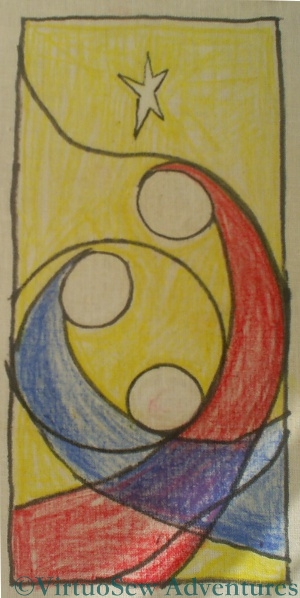
Christus Natus Est on Calico
The first step is to simplify the design, so that it becomes an embroidery design rather than a painting. I’ve transferred the simplified design using fabric crayons, and used a fabric pen to outline the sections. The design is about three inches by eight, which seems very large now I look at it, but I felt that if I tried to work it too small I risked multiplying the difficulties already inherent in learning a new technique.
The additional lines are contours for the gold threads, which I am going to couch down following the technique described in All that Glitters, by Alison Cole.
Thanks to some help and advice from Golden Hinde I’ve got the right sort of gold thread – an entire spool of it! I just hope one spool is enough…
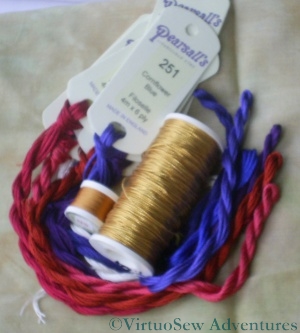
Pearsalls Silk and Gold Jap For Christus Natus Est
I’ve decided to use Pearsall’s Filoselle Silk. As I am not sure how much of the gold will be covered by silk, I’ve only purchased one skein of each colour.
Regular readers will have gathered by now that there is a lot of guesswork involved in my embroidery! I suspect that changes between dyelots won’t matter too much when I am after an impression of rich and changeable colour.
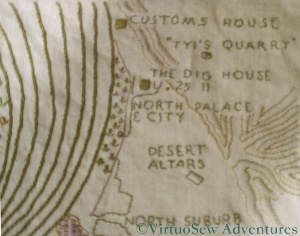
Section of the Amarna Map
This photograph shows a completed section of the Amarna Map, which demonstrates most of the design choices I have made as I went along.
The long lines to the left in the picture are worked simply in Chain stitch and represent the Nile that runs beside the site. Small tête de boeuf stitches represent the cultivation, represented by hatched stars on the original map.
The text is worked in Back Stitch. It isn’t perfectly regular, but it isn’t really intended to be, either. I knew that all my favourite line stitches would be too heavy and detailed for the scale and the intention I have, so it is deliberately chosen to be as simple as I can make it.
Remember there will be areas competing for attention here and that what I want is a general impression that the viewer can then look at more closely if they want details.
There is at least as much again to do before the Map is finished – that’s why I have tagged this post “Perseverance”!
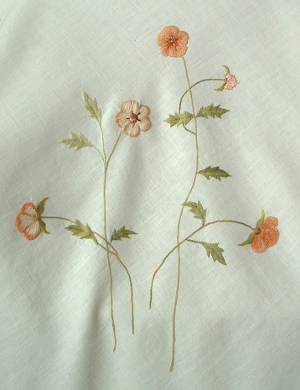
Corner Motif on the Piano Shawl
The Piano Shawl was only a metre and a half square (only!), so there wasn’t really space for a stave in each corner, even if Elaine had wanted four melodies included! At the same time, there was enough space in the corners that without something there, the whole thing looked half-hearted and unbalanced.
So I had to do something. I traced some of the stems and devised a very light floral motif, consisting of four stems and a few leaves. The main stems are worked in Broad Chain Stitch, using a plain stranded linen thread, which I used in the stems on the main design elements too, but the shorter, smaller stems are worked in Portuguese Knotted Stem Stitch, using a variegated silk thread. I used several different variegated silk threads for the leaves throughout the Piano Shawl. Again this is by no means a naturalistic treatment – the flowers are something like dog-roses, but the leaves (all worked in Fishbone Stitch) aren’t like any I’ve ever seen in a garden before!
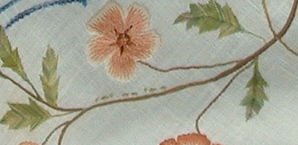
Initials in Morse Code on the Piano Shawl
My final picture is a shot to show my initials in Morse Code in one corner, pretending to be a caterpillar!
The picture also shows the centres of flowers, which were the same across the piece. The thread is a variegated, almost untwisted rayon thread, and it is used only in the centres of the flowers. It’s very like the thread I used for the headdress of the Prince’s Companion in the Persian Fantasy companion piece.
Now that I have seen the Piano Shawl in its destined place, I am happy with it. The overall effect is light-hearted without being entirely frivolous, and the time spent in Elaine’s music room pulling threads, and draping them over the furniture to make sure that they would all match nicely, wasn’t wasted.
However eccentric it might have seemed at the time!
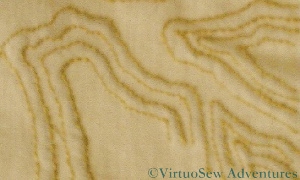
Contour Lines on the Map of Amarna
Fortunately for me, I’d already had plenty of ideas for working the Map of Amarna for the first of the background panels, and in fact, as soon as I decided to include it there was one section about which I was absolutely certain – the contour lines. I’ve worked them in Reverse Herringbone Stitch. The fabric between the lines is thus slightly raised – padded by the threads behind it. I got this far on the map quite some time ago and was very pleased with myself when it turned out Just As I Hoped.
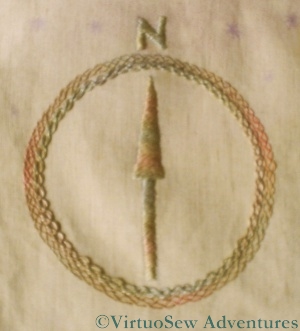
Compass Rose on the Amarna Map
Then I moved on to another section and found myself struggling. In the drawn map, the compass rose is indicated by three lines. When I tried that, it looked clunky and rather sad. So I returned to my stitch dictionaries, and looked for line stitches. Cable Chain Stitch was an obvious choice, as it has been a favourite of mine for years, and the outer ring is worked in Closed Feather Stitch. I used two Caron Collection threads in the same colourway here – a single strand of the heavy pearl cotton type which has three strands (Watercolours, I think it is called), and the much finer one, which I think is Wildflowers. It is interesting to watch the colour changes as they appear very different and have different emphases in the different threads.
I may yet decide to run a “shadow” to one side or the other of the arrow, using a simple stitch such as stem stitch, to throw the satin stitch into stronger relief, but for the moment I am happy that the flatter outer ring creates the illusion of a raised compass rose, while still being clearly something stitched.