Month: February 2011
Tudor and Stuart Masterclass – Month Ten
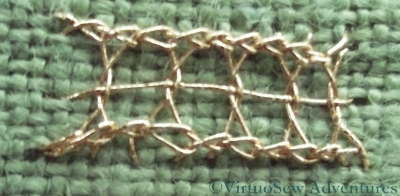
Interlaced On Ladder Stitch
The two stitches in Month Ten of the course are both based on Ladder Stitch foundations. You can see here that something went a little squiffy with the foundation for the Interlaced stitch. I ran out of thread in the needle and in bringing the new thread in, I didn’t keep the the tension quite right. It wasn’t clear until I took the photo with the macro lens, and cropped it to size. As it is only a practise, I shan’t lose any sleep over it – I’ll just make a mental note that Tension Matters.
The interlacing is just like the sort of interlacing I am familiar with from drawn thread work – I’ve not done it before, but it is a style I’m familiar with seeing and a construction I can understand. It would be quicker to practise the interlacing on a foundation of straight stitches, but I suspect (if only I had got the stitching right) the Ladder Stitch would create a more stable basis.
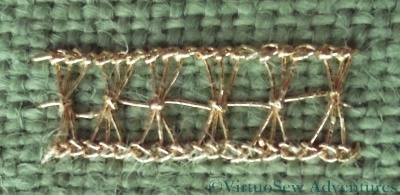
Wheatsheaf On Ladder Stitch
The second stitch worked on the Ladder Stitch foundation is another I recognise from drawn thread work. This is a wheatsheaf-style stitch. Other variants might include a knot instead of a mere wrap, or include two rows of interlacing in the same style. One of the advantages of this course is that it is pulling together many of the techniques I have seen before, but never had the opportunity to do.
It has also given me permission to “play”. I’m enjoying that!
The Camberwell Panel – Three
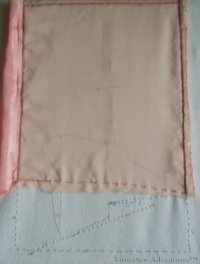
The Sky being sewn into place
I could have left the background until I had made some progress on the Camberwell herself, but I wanted to be sure I kept the design balanced, and having the background ready so I could lay the cut outs on it to think about seem the best way of achieving that.
The fabric for the sky is a pale apricot coloured georgette. At this stage I still had not decided whether there should be two layers, to create a deeper colour and more dramatic effect, but as I was going to be working on the ship herself on a separate piece of fabric and applying it later, that decision could be delayed. I used a zigzagged back stitch in rust coloured embroidery cotton to attach the georgette to the backing.
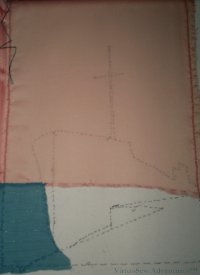
The Sea and Sky
The blue-green fabric I chose for the sea has a glittering thread running through it at intervals. I was hoping that this would create the effect of sunlight sparkling on the water, without drawing unnecessary attention to itself.
I also found a piece of white cotton twill – slightly lighter in weight than the material used in uniform “tropical whites” but very similar – which seems the perfect choice for the base fabric (for so many reasons). This fabric provided a sturdy basis for the superstructure and the hull, which would involve both fabric appliqué and embroidery.
Tudor and Stuart Goldwork Masterclass – Month Nine
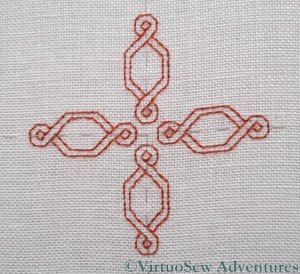
Tudor Pincushion - Stage One
It’s been rather chilly of late, and I couldn’t quite face sitting in the window working on the Spot Sampler, so I spent some time mounting the Tudor Pincushion on a bar frame, and started working on it.
The first thing I did was to part-colour the chart. I’ve never been comfortable with charts, and it’s easier to orientate myself if I have at least some elements coloured in to act as guides. Specifically, I have to colour them in myself, because I’m no happier with printed colour charts than printed black and white charts. I think that colouring the chart myself helps me to understand how the design is put together, and then I find it easier to stitch.
I’ve also tacked the centre lines in. This is something I rarely do – generally I just find the centre, work whatever is over it and then count from that. In this case, there’s no stitching at the absolute centre – not until I start on the metal thread work, anyway – so I made sure that the centre point was marked, at least for the first stage of outlining.
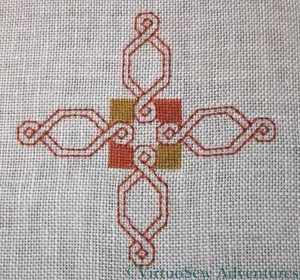
Tudor Pincushion - Stage Two
In fact, as you can see, I’ve already taken out the tacking. At least, I’ve left it in at the edges, but now I’ve got all four of the central outlined motifs in, and worked the first set of tent stitch blocks, everything else can be counted relative to the nearest landmark point that is already stitched.
Since the silk stitching is either in tent stitch or back stitch, it’s not difficult to do, although as it is on a very fine linen – 38 or 40 hpi (holes per inch), I think – I’ve been very glad of my magnifying spectacles!
Australian Wildlife – Introduction
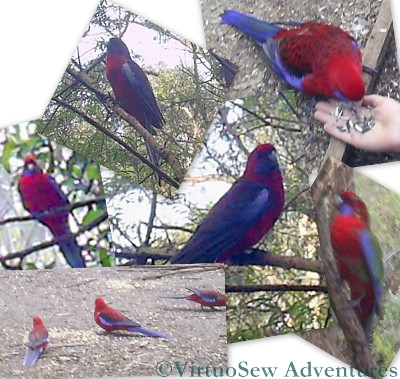
Rosellas
My life and personal circumstances are not often relevant to my embroidery, but in this case…
My husband is Australian, so we try to go to Australia to visit his family as often as we can, which is usually about every two years.
To someone brought up in Northern Europe, among the Oak and Ash and Thorn of Puck’s England (do you know “Puck of Pook’s Hill“?), the blue-green foliage of the Eucalyptus is a strange sight, and strolling through a reserve amid the smell of eucalypt and tea tree, spotting kookaburras, koalas and kangaroos, is an experience which never becomes over-familiar.
In addition, the Australian embroidery magazines have a completely different focus to those in the UK, and a huge variety of styles and projects, like nothing I see at home.
So perhaps it is not surprising that, although I haven’t yet worked an Australian project, I have a huge collection of photos I’ve taken as inspiration, and magazines I’ve bought to read, and re-read, and – frankly – gloat over. I’ve a book about working Australian flowers in Stumpwork, and one of these days I intend to work a bouquet of them…
In particular – being accustomed to rather more dun-coloured birds – I’ve been rather taken by the idea of working something depicting, or inspired by, a Rosella. I took a lot of photos on one of our visits a few years ago, and, as with all of my projects, I’ve been thinking about it on and off ever since.
During our visit at the beginning of this year (we had New Year’s Eve on the beach!), some of the ideas began to crystallise out a little more, and I have been writing them down to make sure I don’t lose them.
Watch this space!
The Glittering Snail – part two
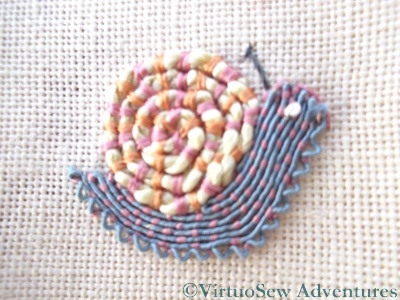
The Snail In Silk
So, bright-eyed, bushy-tailed, and full of enthusiasm, I sat down with my Glittering Snail Kit and got started. And, in fact, the silk gimp and silk-wrapped purl are not the only threads new to me, so it was great fun.
The pink and orange threads are both silk floss rather than spun silk. Occasionally I snagged the floss on the screw on the hoop, or a fingernail, or even on another bit of thread (how? don’t ask!), but I really enjoyed it, all the same.
The snail’s body is worked using the silk gimp and stretched silk-wrapped purl, couched with the pink floss. They were easy to work with – they felt gorgeous! – and I have a tiny bit left to play with a little while I think about how I might use them in my own embroidery. At the moment, nothing is really springing to mind, but I’m pretty sure that somewhere along the line some silk-wrapped purl will appear..
The Canvaswork Abstract Garden
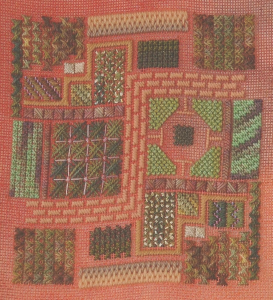
The Canvaswork Abstract Garden
Following on from the Knot Garden, I decided to play a little more with the idea of using the canvas as a background, rather than covering it entirely. Since I already knew the canvas would not be covered, I chose a piece of dyed canvas (from “Kate’s Kloths”, which I haven’t been able to find online).
The first element was the simple path in expanded brick stitch, worked in wool. The rest of the panel was then built up as a pattern of varying stitches and threads. There was no predetermined idea, simply the aim of keeping a sense of balance and rhythm in the pattern densities. You will notice that block sizes and shapes are repeated, reflected across the path which snakes across the centre.
I’m not particularly comfortable with abstract work or even with designing it, so this repetition and reflection of the blocks was a way to give myself a structure for the piece. Otherwise I find abstract work often feels rather chaotic and it doesn’t offer me the chance to puzzle out “a good stitch to represent such-and-such”, which is where a lot of the fun of the Persian Fantasy came from.
This was an interesting exercise, but like the Knot Garden, it has remained as a piece of canvas, not mounted, framed or incorporated into anything, because I really haven’t a clue what to do with it!
The Glittering Snail – part one
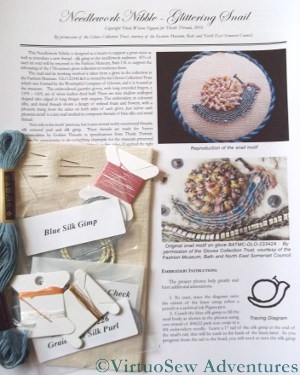
The Snail Kit Has Arrived In The Post
You may recall that in December I wrote about the Thistle Threads project to Stitch A Snail For Storage. We’ve been away for a while, but came back to find a huge pile of post which included a jiffy bag from Thistle Threads.
Since I’ve already printed out the instructions (as soon as I ordered the kit!), I can start just as soon as I’ve gathered my wits and drawn the design on the linen. Even though the basic concept of the design is simple, it will be complicated and probably a little tricky to do, because the snail is only about an inch from nose to tail!
Tricia had two reasons for developing the kit – one was to sell something in aid of the Fashion Museum in Bath, but the other was to introduce some new threads to us. So of course, the first thing I did was to rummage through to look at the the new threads, the silk gimp and silk wrapped purl. They look highly intriguing, and I am looking forward to playing with them…
Tudor and Stuart Goldwork Masterclass – More Post
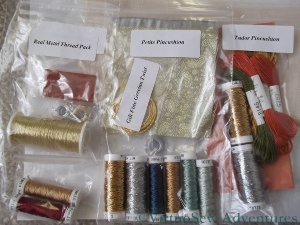
More Post From Thistle Threads
Yet more post from Thistle Threads – aren’t I a lucky girl!
This time, the post contained the real metal threads for the Spot Sampler, and the materials for two pincushions that also form part of the course. There’s a piece of silk brocade, and two pieces of linen, and even more silk threads… I’ve not caught up with printing the instructions yet, so I’m not quite sure what I’m going to be doing with them, although I have had a quick look, and there’s at least one new stitch variation in among them.
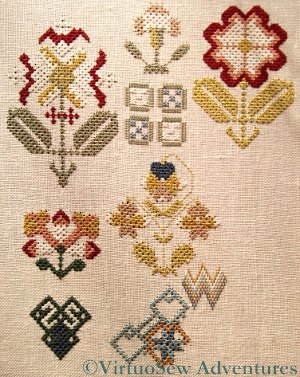
Progress So Far
And bear in mind, I still haven’t finished the silk work on the Spot Sampler, and that there are going to be even more ornamental stitches to learn. This photo shows my progress so far. Over the last couple of days I have finished the bargello motif and made a lot of progress on the central motif at the bottom. I once reckoned it took twenty minutes to do ten Queen Stitches, and was very depressed by that discovery, but I think I’m speeding up again!
It’s intriguing to see the new fabric created by the Queen Stitches. It’s not often that the effect of stitches is quite so clear. Instead of the ordinary square-woven fabric, the closely-worked Queen Stitches create a sort of heavy openwork lattice. It has a completely different texture to the basic fabric and when I finally finish the piece, I will have to make sure I frame it or mount it in such a way as to make that quite clear.