Month: July 2010
Tudor and Stuart Goldwork Course – Month Three Practice
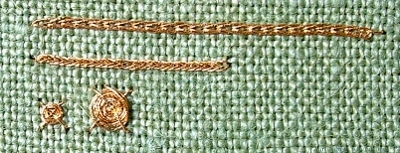
Month Three Goldwork Practice
I am continuing to work practice lengths and fragments of the stitches in the Goldwork MasterClass, since I am still working the silk motifs that form the basis for the Spot Sampler.
Again I worked the Heavy Chain Stitch in two “scales”. I find it rather surprising that the stitch changes width with the length, even though the needle comes up from and returns into the same hole. Still, it is useful to know that I can change the appearance of scale so much without changing the thread I am using.
The second stitch is Four-Legged Flat Spider Web Stitch, and I’ve not found a diagram on the web anywhere. It is a large cross stitch, woven around in a weaving pattern. Simple to do, if you make sure to go over the top layer of the cross stitch and under the bottom layer. The challenge lies in keeping the thread spiralling smoothly around, rather than catching itself and crossing where it shouldn’t. I think I would be reluctant to use this stitch on a garment or something that would move a lot, as I would be uncertain of the stability of the coil. Using it on my sample cloth might reveal that, of course. I shall try to remember to examine it at the end of the course!
C is for Cat
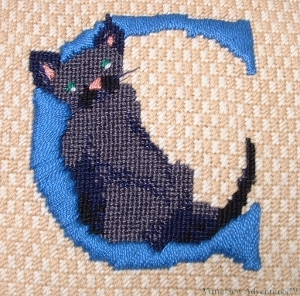
C is for Cat Cushion Panel
When I saw this as a painted canvas is a needlework shop, it immediately made me think of a friend who had a black cat, so I thought of doing it as a present.
The original canvas showed a seal-point Siamese with blue eyes, so I stretched a few points and used grey and navy to create a black cat that was light enough to show its shape and markings, and gave him green eyes as well. The cat is entirely worked in basketweave tent stitch. Much as I enjoy working the ornamental stitches, sometimes restraint is advisable!
Besides, the bright blue “C” is double padded with soft embroidery cotton and then satin stitched over with pearl cotton. I thought that would be quite dramatic enough without any additional flourishes!
The background is worked as a gentle oblong check in Straight Cashmere Stitch, using two shades of soft embroidery cotton that tone with the velveteen I used to make the cushion it is mounted on. I’d almost forgotten about this panel until I was rummaging for notes of some other embroidery I had done and found a reference to it, so it is gratifying to find that I am still very pleased with it. It was a fairly simple and straightforward design, and I think my choice of stitches and threads was simple enough to reflect that while having enough variation to be interesting.
I’m not sure what the real cat thought of his portrait. Cats are what they had in mind when they came up with the word “inscrutable”!
Dreams of Amarna – The Faience Hippopotamus, Second Stage
The reason I am calling this poor fellow an experiment is that I’m working him in long and short stitch. I have said that working on the Floral Glove Needlecase project has been illuminating and that I am warming to long and short stitch – well, we’ll see what I think when I’ve worked an entire piece in long and short stitch!
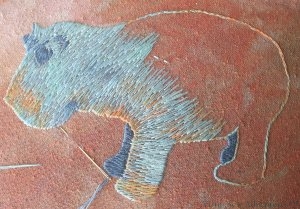
Half Done Hippo
In the meantime, here he is, half done. The darkest and lightest shades are ordinary stranded cottons, but the middle three use overdyed threads. One of them shades from turquoise blue to russett, and the others are both fairly subtle variations on a dark and a light turquoise.
I am using two strands, with one of them turned end-to-end in comparison with the other. I’ve never done this before, but it means that the shading of the overdyed colours is slightly more spread out and more subtle than it would be if I left them both as they came off the skein. It also means that the twist in one strand runs counterwise to the twist in the other so one strand shortens during stitching. I’ve chosen not to mind about that, but if you did happen to mind I think the way to achieve the same effect would be to buy two skeins and start them at different points in the cycle of colours.
I’m also working in slightly untidy sections of the body, with two or three needles ready to go, depending upon the colour I need. I’m using long stitches, and aiming to cover the fabric beneath without packing the stitches too closely.
I’m really pleased with this so far. The colours are working well, and the variations will give a bit of modelling without attempting to create a needle painting.
A Closer Look at Modern Goldwork – Five
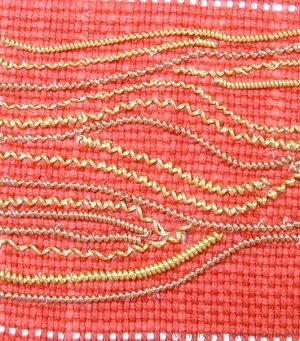
Bark Effect
For this panel, Tracy told us to think of tree bark and then to use stretched and unstretched pearl purl of different weights couched to create a bark pattern of light and heavy lines.
I really enjoyed this for some reason. The pearl purl is stiff and springy, and doesn’t feel as fragile as some of the other metallic materials.
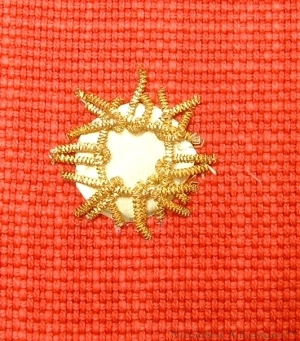
Shisha Variation
The second panel shows an adaptation of shisha work. The “mirror” is in fact a circle cut from a piece of metal foil, and the “stitches” holding it in place are made using check purl. This looks clumsier than I would have liked. Partly, no doubt, because it is not an easy technique even with the standard materials, and I leapt straight in with non-standard materials. Partly also, I think, because having decided to do this I should then have picked a finer purl to use for the “stitches”. It might have been easier to achieve the effect I want if I had thought through my choice of materials. I recall also that the metal foil was flexible and tricky to keep in place while I worked the “stitches” over it.
Note to self: Next time, try the standard technique using the classic materials before making life more difficult for yourself!
I think it is fair to say we all had a wonderful time on the course. Never having worked with metallic threads before, I think the Modern Goldwork course provided an entertaining introduction, whereas it is possible that going straight into classic goldwork might have proved a little scary!
Dreams of Amarna – The Faience Hippopotamus, First Stage
I have two Amarna projects already on the go (one of the backgrounds, and the Dig House) but they are both monochromatic, and you will have gathered that I like colour. So I thought I would experiment. Again!
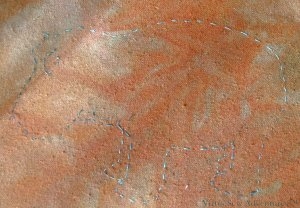
Small Hippo Outlined
My rule for the panels and motifs is that I may only depict items that Mary Chubb mentions, or that she would have known about, or which were excavated in Amarna about the time she was there. That means that anything seen in Howard Carter’s excavation of the tomb of Tutankhamun or excavated by Flinders Petrie is also allowed. So a faience hippo is just about permissible, as they seem to have cropped up in a lot of excavations, not just those of the Egypt Exploration Society. I’ve also just purchased (courtesy of Alibris, since it is out of print) “Tell el-Amarna”, by JDS Pendlebury, who was Director of the Excavation when Mary was Secretary. It should give me more ideas about what was known or thought at the time, which in turn will help me to plan more illustrations.
The background fabric is an overdyed silk noil from Stef Francis, and I will be using some of her stranded cottons as well. I began by copying the outline onto tissue paper and then went over the outline in running stitch. I rather like this technique for marking designs, at least where the design is relatively simple (see Ruth O’Leary’s Spirograph hangings for a less than simple design using the same transfer method – eek!).
I then stitched around the edges using split stitch to make the edge of the design clear, and took a deep breath…
A Closer Look at Modern Goldwork – Four
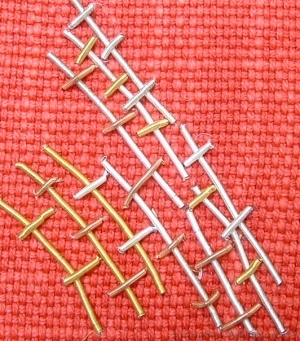
Burden Stitch
The next two panels show contrasting materials and techniques.
This first panel is using purl to create the pattern of “burden stitch“. This can be more or less closely spaced, and while I worked it as a very open, rough texture, it would be possible to use it to create the impression of basket weave. I’ve used Burden Stitch before, but only in thread.
I’ve used Smooth Purl here, threaded on the needle like a bead – which is fairly hair-raising when the bead in question is a floppy tube about three inches long which could easily be damaged and allow the needle through prematurely!
This next panel shows a classic, straightforward couching of imitation Jap gold, worked as a simple doodle.
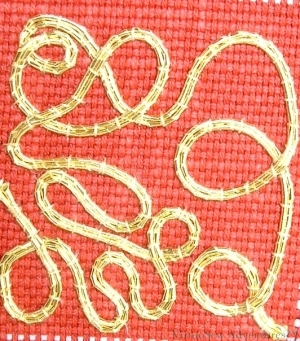
Couched Gold
I rather like the effect of this – rather like the old idea of “taking a line for a walk” that is one way of creating the basis for an abstract painting.
It also provides a gentle introduction into the method of couching that can be extended and formalised to create or nue.
As such, I have plans for using this technique and its variants on the Amarna panels!
Tudor and Stuart Goldwork Masterclass – the first two Goldwork Stitches
I’ve not come near finishing the silk work on the Spot Sampler, so I am going to do some practising first. The fabric is a heavy plain weave, about 16 threads to the inch. Compared with the linen for the actual piece it is almost like binca! I chose it to give me some chance to see what I was doing and to count the threads if it proved necessary for the stitches. It wasn’t really for the first two, but I did so anyway!
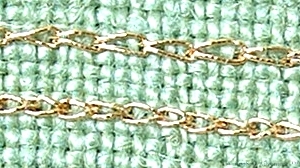
Reverse Chain Stitch
Reverse Chain Stitches
This produces, to all appearances, simple chain stitch, but it doesn’t involve the “scooping” motion used when working in the hand and seems somewhat easier to control.
I’ve done it both over three and over two threads.
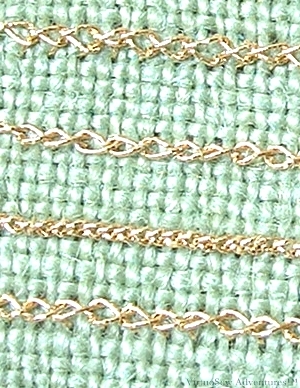
Reverse Twisted Chain Stitch
Reverse Twisted Chain Stitch
Again, the resulting appearance is of simple twisted chain but the stitch is worked backwards, I think this reduces the chances for the gold thread to snag on itself, which certainly helps.
As shown in the original diagram, it is worked over a grid in effect, of two threads by two. After doing that fairly easily I decided to play a bit.
So I worked several variants, over two by four, two by one, one by one, and two by two.
The one by one was quite a challenge, but I am pleased that I have an impression of the changes in appearance effected by the different stitches.
Dreams of Amarna – The Dig House Experiment
I’ve been thinking so hard about Amarna over the past two years that I have begun to get itchy fingers. So I thought I would try something… I don’t know whether this will find a place in the final pair of hangings, but it was time I started stitching!

Photo of the Dig House (courtesy of the Egypt Exploration Society)
Mary Chubb comments in the book that the Expedition House is one of the houses of Akhenaten’s time, built back to roof level and then roofed, so of course I want to include it. The photograph I am using came from the Egypt Exploration Society, and I simply sketched a freehand outline of the Expedition House on the cotton with a quilter’s pencil and started stitching.
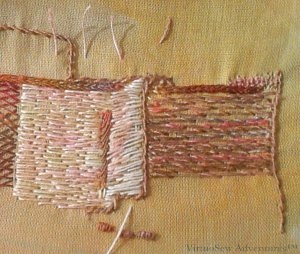
Dig House - Detail 1
In a sense what I am doing here is treating the original photograph as a pattern of dark, medium and light tones, and trying to recreate that tonal pattern. I hope that if the pattern in accurate enough, the whole piece will make visual sense as a representation in fabric and thread of the house that the members of the Expedition lived in.
The fabric and threads are by Stef Francis, the fabric a fine turban cotton, overdyed in sandy and stony colours, and the threads, stiff linens and cottons, a greyish blue and blues shading into dark reddish browns.
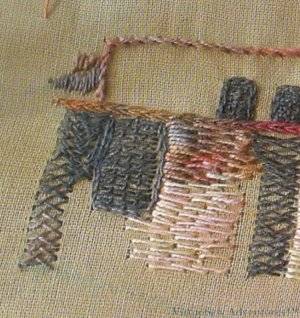
Dig House - Detail 2
The threads are really much too stiff to work as well as I’d hoped. They are difficult to control and need a more substantial fabric than I am using as a basis. They are also not quite the colours they seemed on the hank, so the overall colour impression is unanticipated.
The stitches include herringbone, stem stitch, chain stitch, couched filling, even a sort of brick stitch – all simple stitches, but this is an exploration of the image and not really of technique.
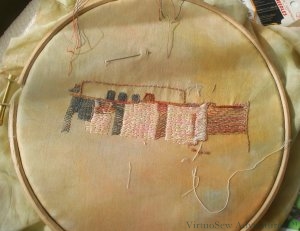
Experiment in stitching the dig house
This is very much an experiment as I’ve never worked with so sketchy (sorry!) a plan or so little on the fabric before when I’ve been working on something so relatively complex. It’s quite scary, but as I mentioned in a previous post, over the past couple of years I have also been learning to paint in watercolours, and I’ve discovered that in that medium I do much better when I don’t put too much on the paper before I start painting. Of course I get many fewer “successes” than if I were to draw in detail from a photograph, but it makes me observe more closely and take more pains.
At the moment I am not entirely happy with the way this is turning out. I was hoping to use the fabric as a mid tone, but the threads are not close enough in colour family for that to work, and so I am having to stitch more of the design than I would have liked. I should maybe try again using a different fabric, but in the meantime, persevere with this to see what else I can learn.
A Closer Look at Modern Goldwork – Three
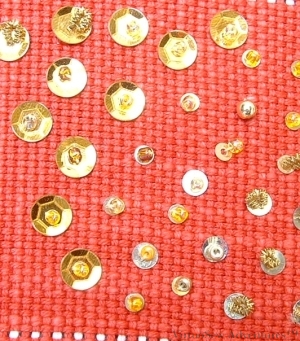
Sequins
We used a wide range of different materials and techniques, so the course provided exactly what I wanted – an guided overview of both.
Tracy pointed out that you don’t need to use beads to sew sequins down. These two panels therefore show some of the variants she suggested.
The first panel shows sequins caught with beads and with short lengths of purl used as beads, with both sequins and beads differing in size and colour.
The second panel shows sequins couched down with sections of check purl, irregularly spaced and grouped. There are additional beads and sequins added to increase the range of textures that appear.
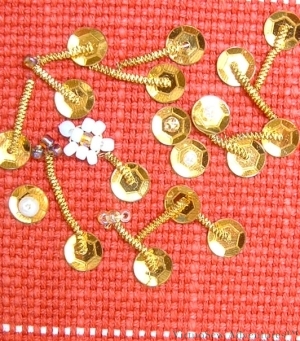
Tied Down With Check Purl
It’s probably very easy to tell from looking at these that, for all my embroidery has a somewhat improvisatory quality, I’m not entirely comfortable in situations where the work has to be completely freeform. I like to have a structure underlying my improvisations.
Also, at present, neither of these techniques is asking to be used in the Amarna panels or anything else I have in mind. I’ll think of something, no doubt, but in the meantime this is simply one for the notebook.