I am going to start rereading the book again, at some point soon, but in the meantime, since I’ve rediscovered my “Vision of Placidus” notebook, I know that one of the birds I was going to include is a woodpecker.
I’m going to have to go to the shops and find some more gauze soon, as well, but while I can squeeze an animal in to the existing fabrics, I will do so.
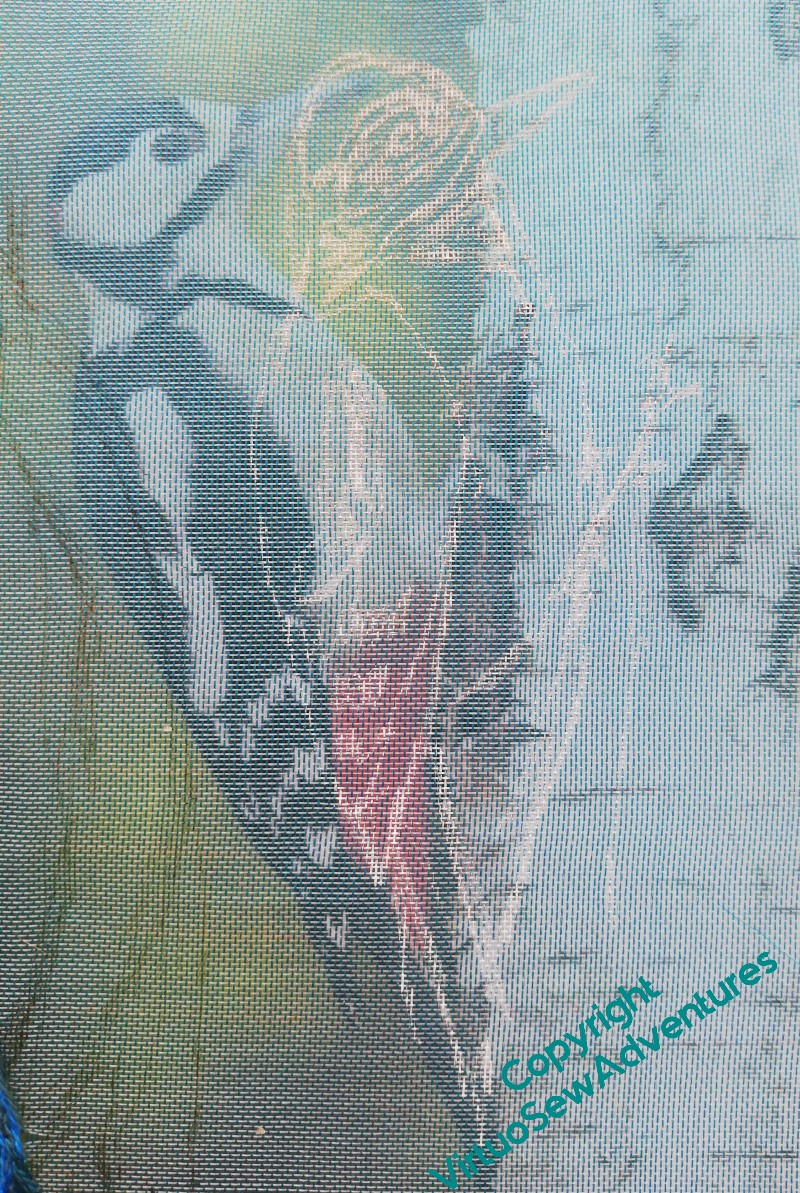
I’ve commented before, I think, that getting a readable and workable design drawing onto gauze is a non-trivial exercise, but this opaque white line (a Posca pen) is pretty much the best I’ve found so far, and it also allows me to help myself by putting a few extra emphases on the lightest parts.
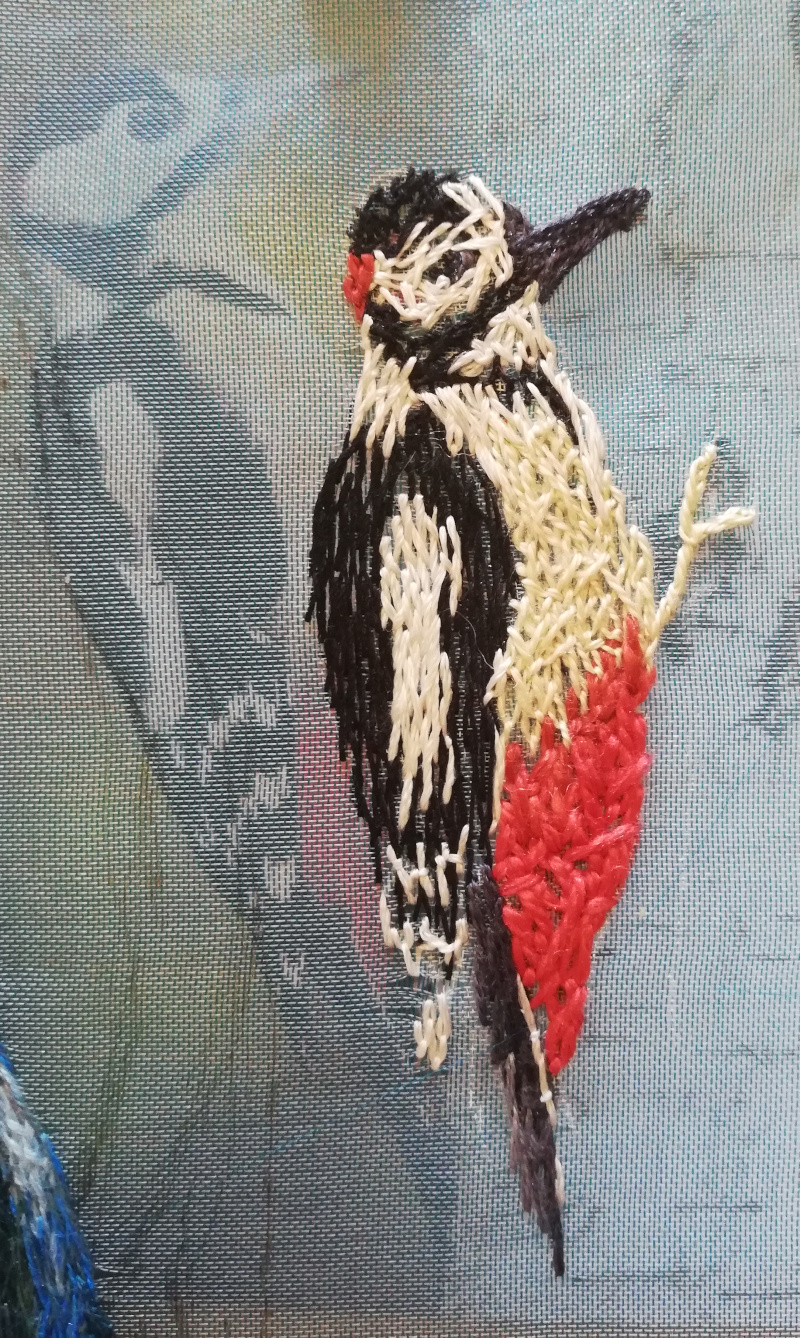
It’s amazing how quickly these little animals go, once I have a chance to get started. In fact, I was so entranced by how Woody was growing that I didn’t stop to take photos. In fact, I barely stopped to draw breath.
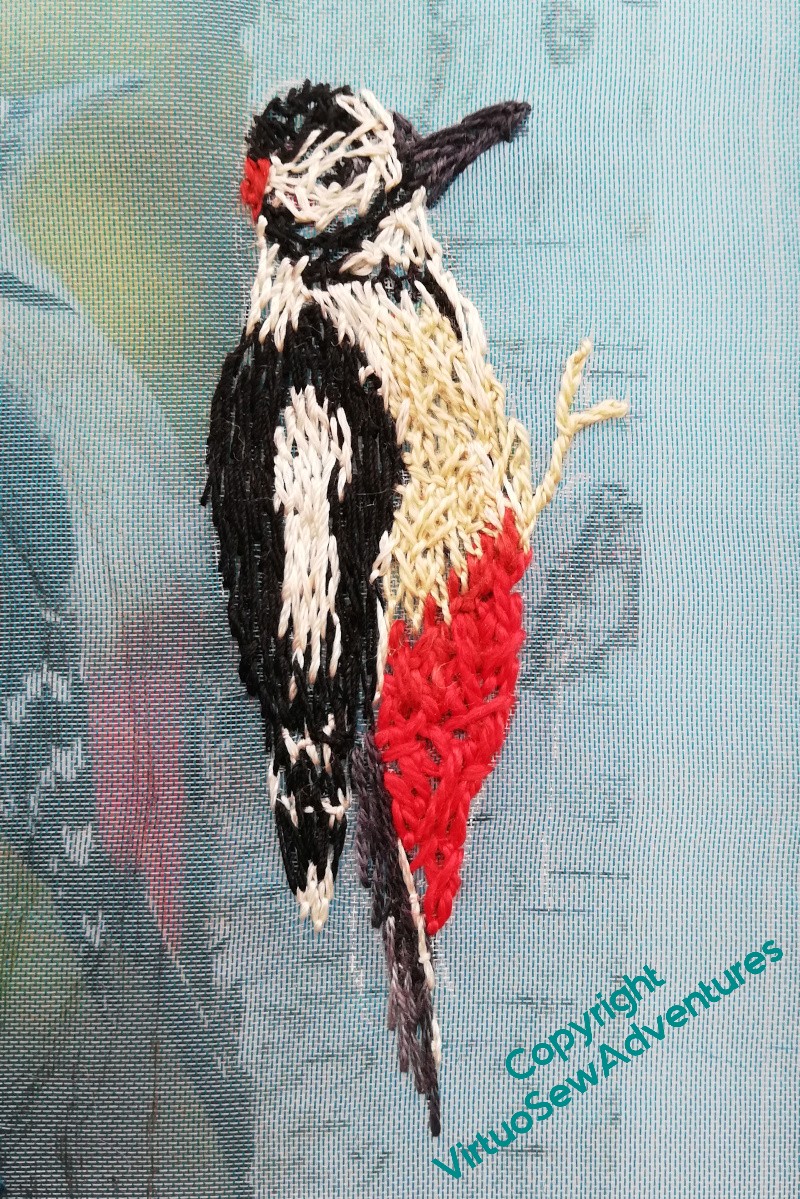
So this photograph shows a single afternoon’s work. I’ve used mostly fine silk threads, although his red breeches are a soft perle, and some of the white is probably cotton. As for approach – I simply tangle my stitches together, feather stitch variations, Cretan stitch variations, the occasional chain stitch or straight stitch. What I’m hoping is that the tangle of stitches will create a subtle variation in colour that will help the whole thing feel alive when it’s viewed from a reasonable distance.
I didn’t have much I wanted to add, in the end. A few highlights, filling in the wings a little, and then really the woodpecker is done. I may add more when it comes to assembling the piece (remember all those seed stitches I added to the View of the Excavation once I started assembling the Dreams of Amarna panels?), but that can wait until I know what is being balanced with what.
I have been thinking, on and off, since I was asked about it after my talk, that assembling Placidus may prove to be an exceptionally challenging process. The panel I envisage is going to be about five foot by four foot, and I have a horrible feeling I’m going to be propping it against a wall or slinging it from hooks or even emulating one or other of the great Impressionists by somehow arranging a slot in the floor to drop it into while I tackle the top.
Maybe I shouldn’t be in too much of a hurry to finish this one…!
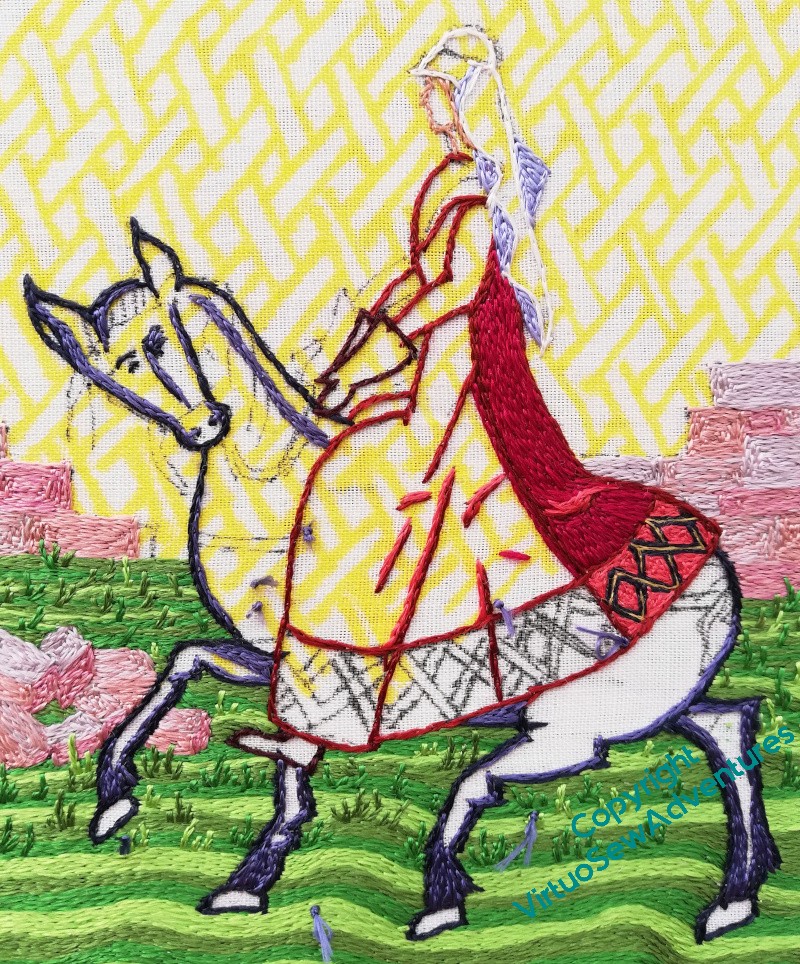
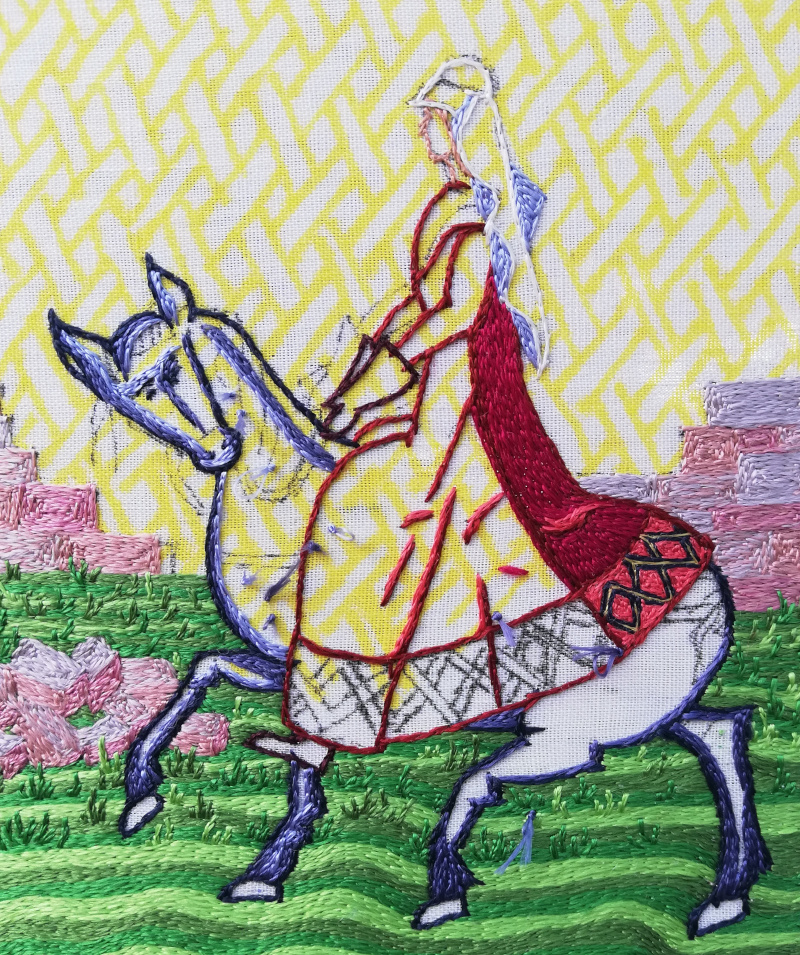
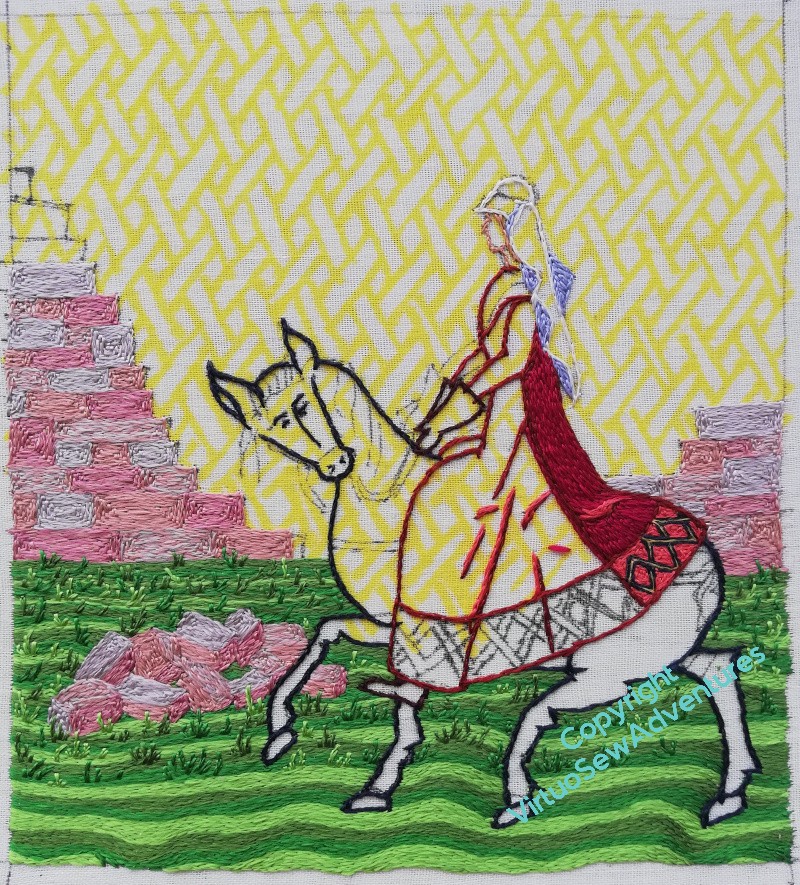
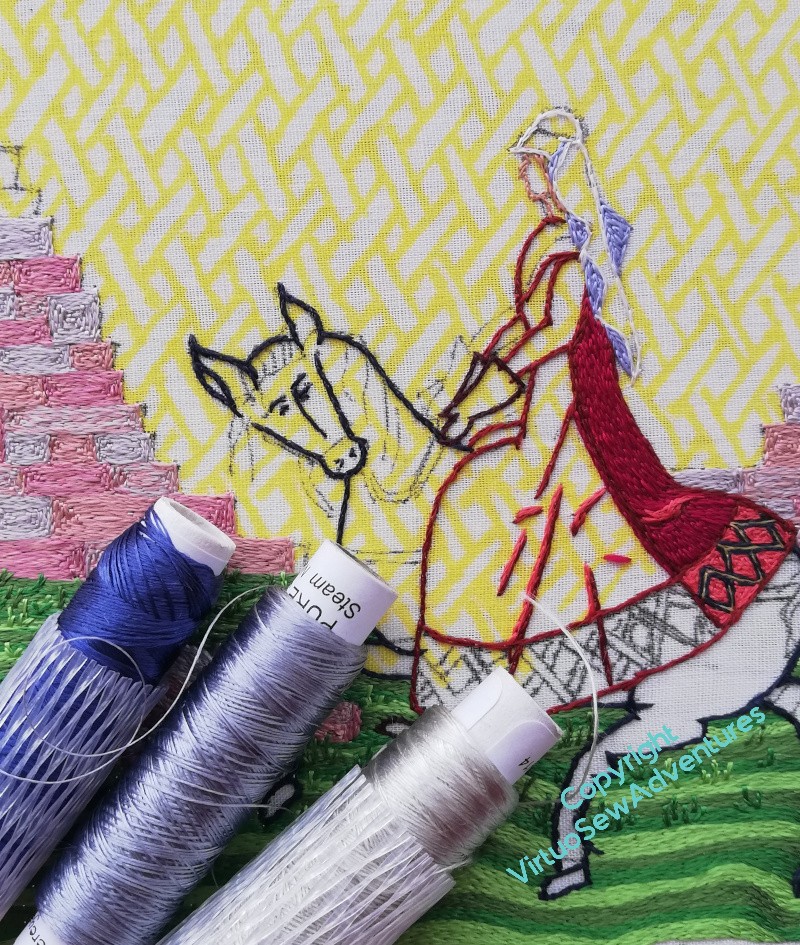
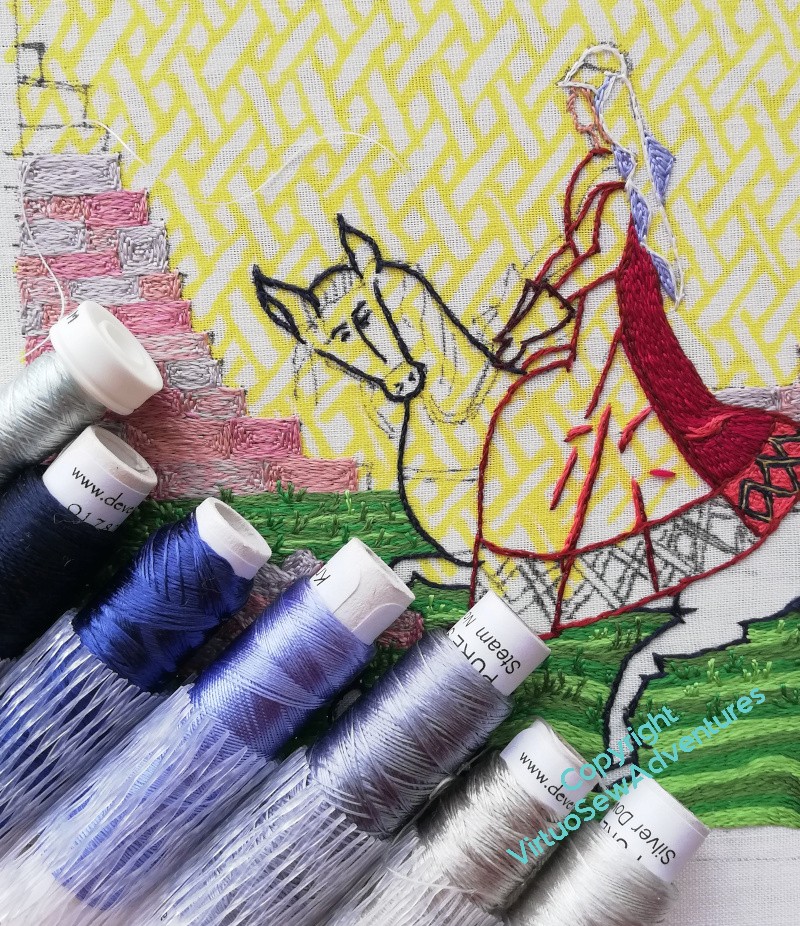
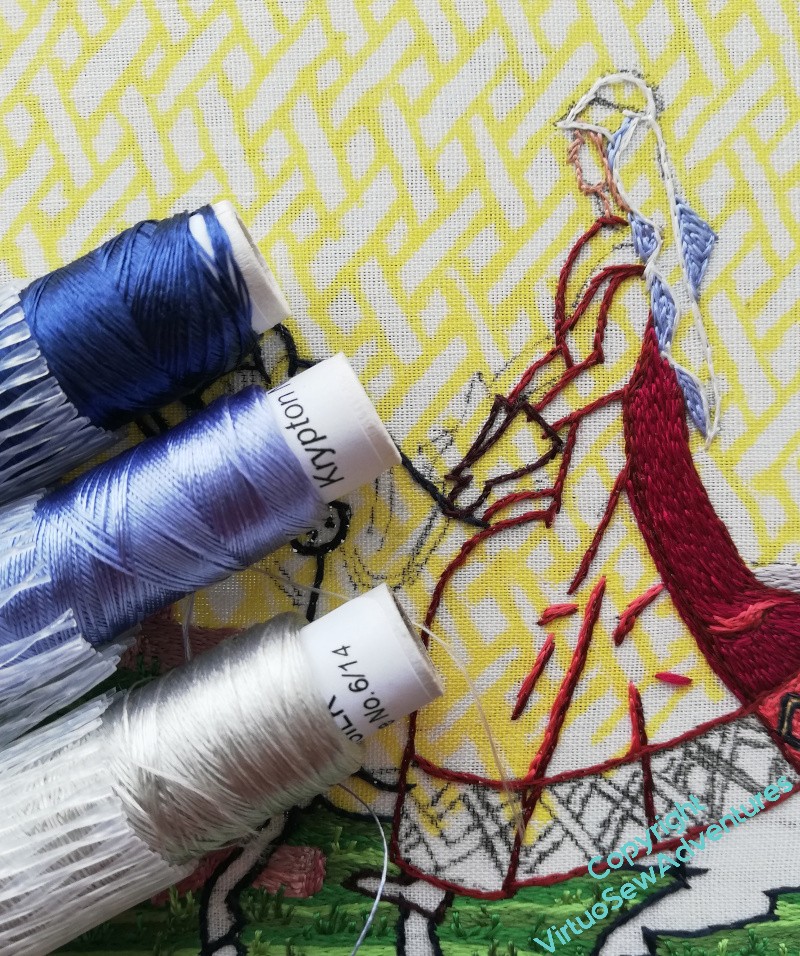
Now the thing about Opus Anglicanum is that it’s lots of very small stitches, so you maybe don’t see so much of Aethelflaed, but apart from occasional periods of Life getting in the way, she is making progress.
I’ve started on her horse. It’s going to be a grey – what you see of it, what with her riding dress and all! – so with a wave of my artistic licence, shadows and details are going blue.
I have time to wonder what she’d call her horse – all the names I can come up with tend towards the Norman French (Blanchemain, Blanchefleur), and that’s a good couple of centuries too early. So I’m looking for something Brythonnic, or Welsh (although the Mercians weren’t on reliably good terms with the Welsh, so maybe not..). Welsh would suggest something with “gwyn” in (for “white). Moving to Old English, “hwita” is “white”, but “aedre” is “stream”, and then suddenly you have a name starting with the same syllable as the rider’s. And that is the sort of thing you find in retellings of myths as a way to bring the two close together in the mind.
I would like to have a small pencil bag to take sketching, and I’ve been finding myself in the evening, fidgeting because I can’t concentrate on the complicated stuff and my crochet has fallen so far out of my head that I am contemplating pulling the whole lot out (most of one sock, from rib to the beginning of the toe) and starting again.
And yet I would like my hands not to be idle.
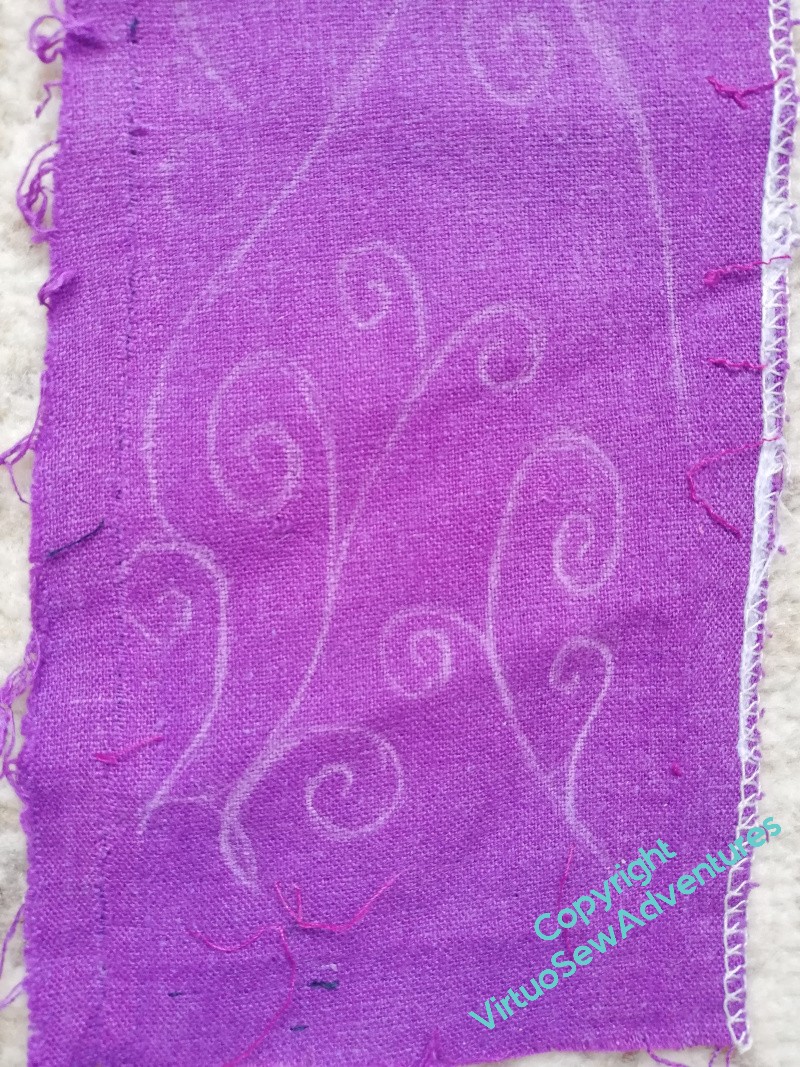
I’ve just taken a pair of side panels out of a skirt, so I’ve pressed one of those panels and drawn some rough fernlike curlicue things on the fabric in chalk – just freehand, nothing complex, no attempt at evenness, just a sense of balance and an all over pattern.
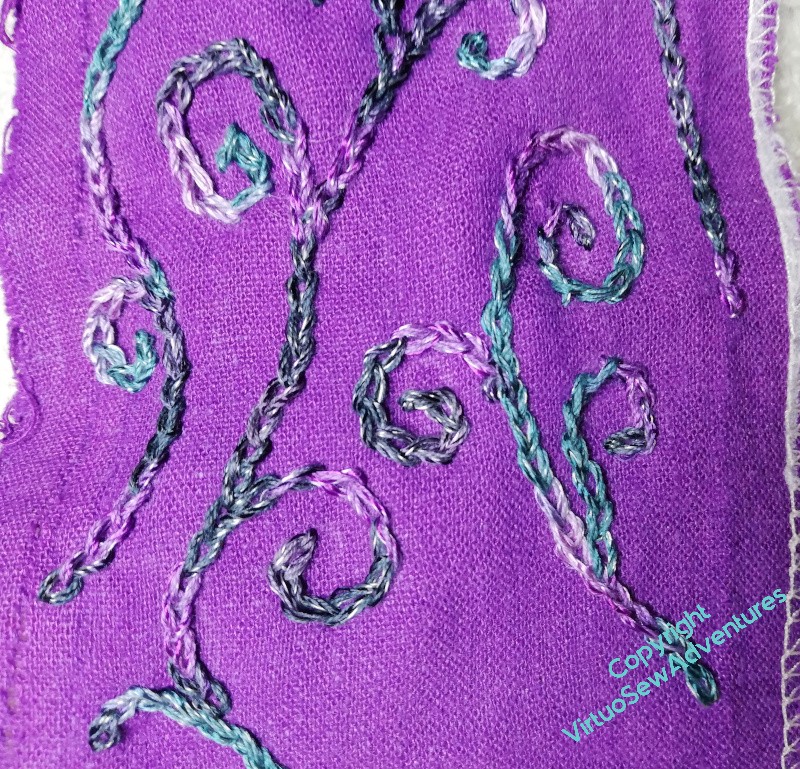
Then I went rummaging for a thread that would live happily on the fabric. This is quite a heavy thread on a cardboard spool, and I’ve not the vaguest idea where it came from. It varies from a very dark teal to a lighter version of the purple of the fabric, and it’s going well so far.
Strictly speaking that thread is on the heavy side for the fabric, and I may find that coming back to bite me, but for now, my little homage to the “Fernmania” that brought you the scrolls on custard creams is going well.
When I’ve done the whole length I will need to decide, do I line it with the other side panel or save that to make another bag with? Little drawstring bags are always useful, after all….
I’m on to the next layer of stitching now, changing the granularity of the colours, changing the balance of colour, trying to really see what my source is showing me.
I’m not quite sure where this refusal to do detailed planning drawings has come from, but for these Animal Vignettes I simply don’t. Partly, I think, because once the first layer is in you can’t see the details you want in the second layer, partly because I have become engrossed, if you like, in the challenge. When it works, it can work phenomenally well, and even when it doesn’t, as Hebe Cox puts it in her book about embroidery design, it has the virtue of spontaneity!
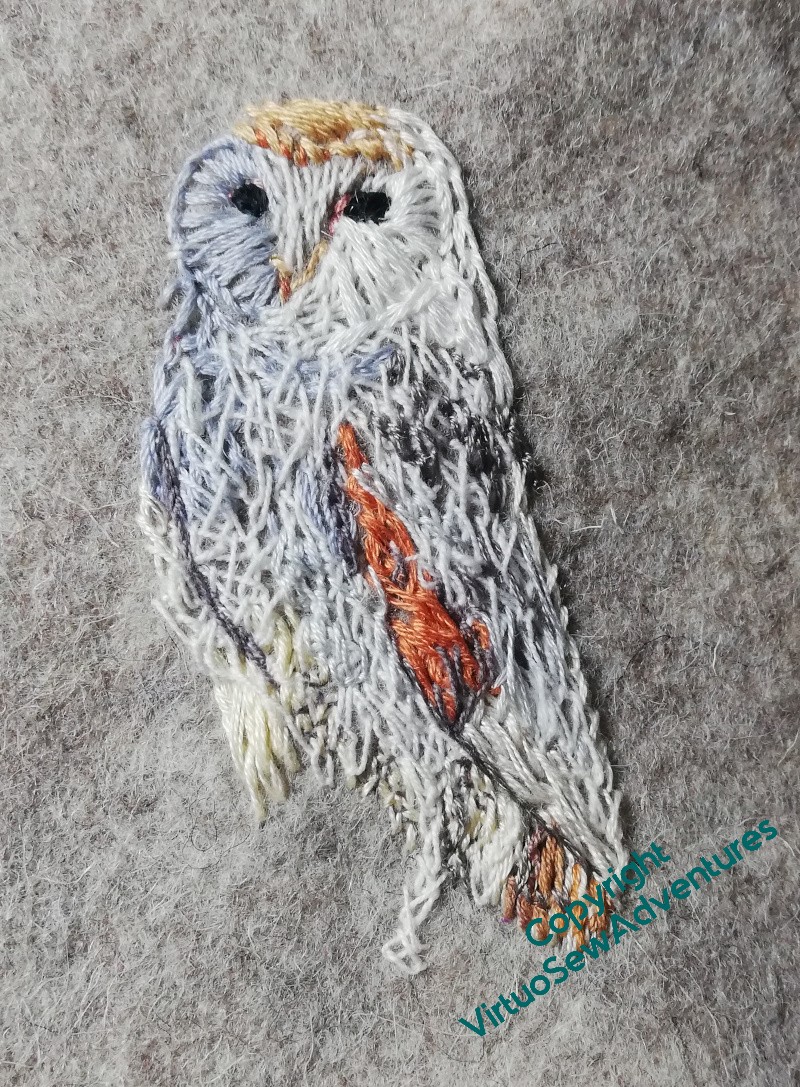
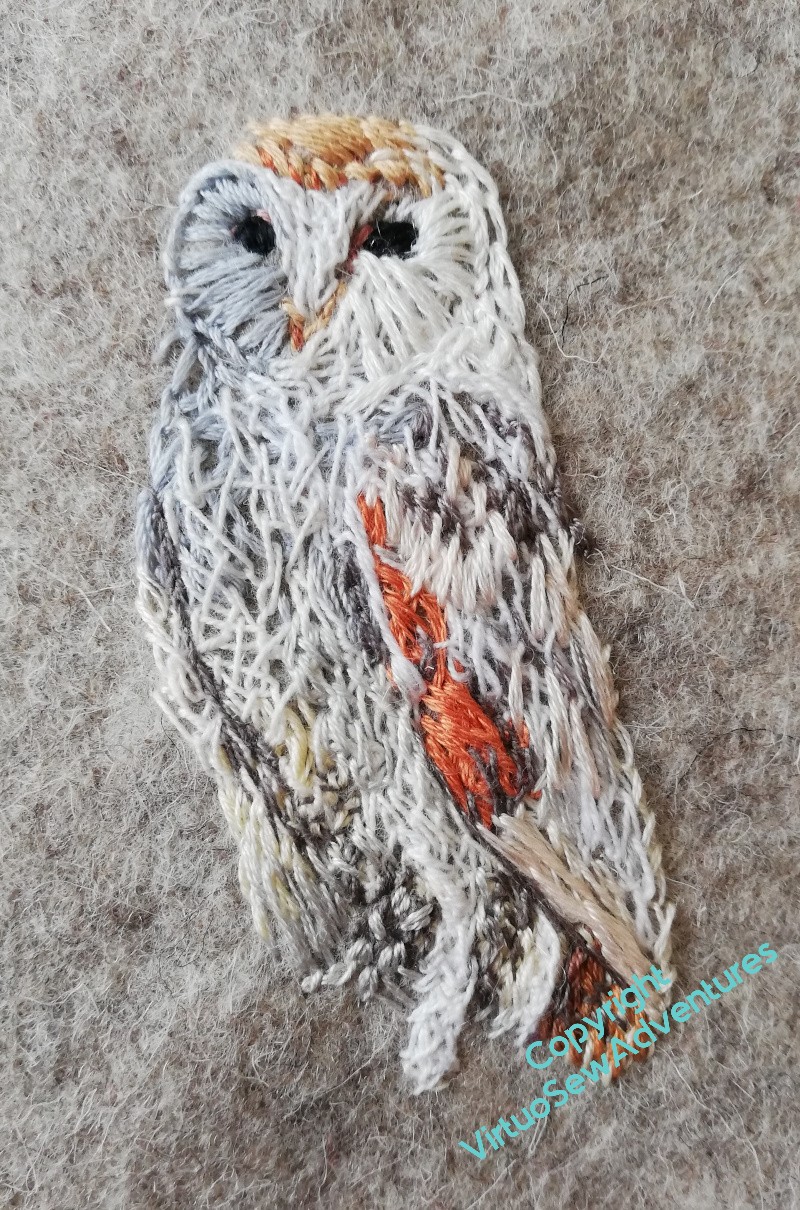
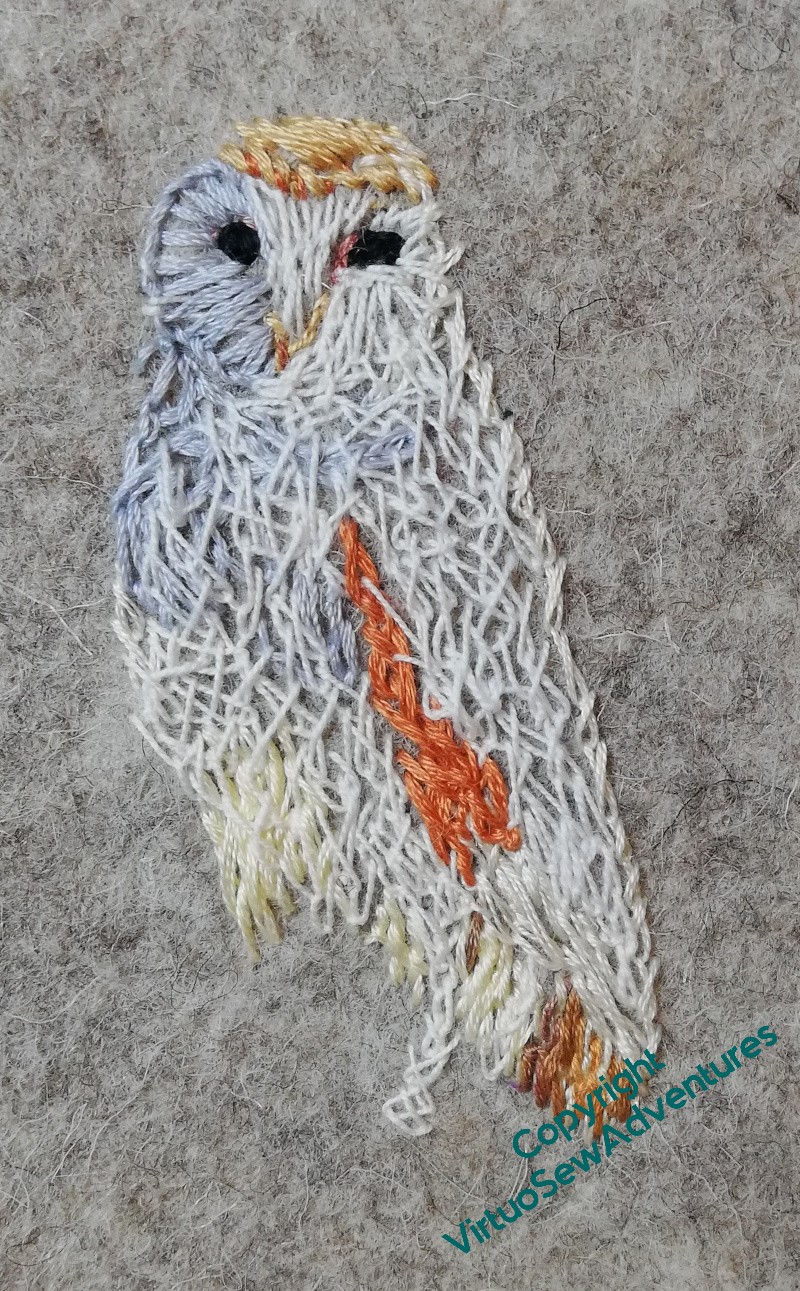
The owl is proving quite tricky. I’m not seeing the shapes and their relationships as well as I might, and I’m struggling to get the colours nicely combined.
However, I am also being reminded that in this way of tackling my stitching, I expect not to get it right first time. There are iterations, tacking from my stitching to my source and back again. Staring, stitching, trying to analyse the image, find the shadows, find the highlights. In fact, treating each fragment rather like a painting en plein air. Well, I’ve said before that if I fall into any artistic tradition, I’m an impressionist!
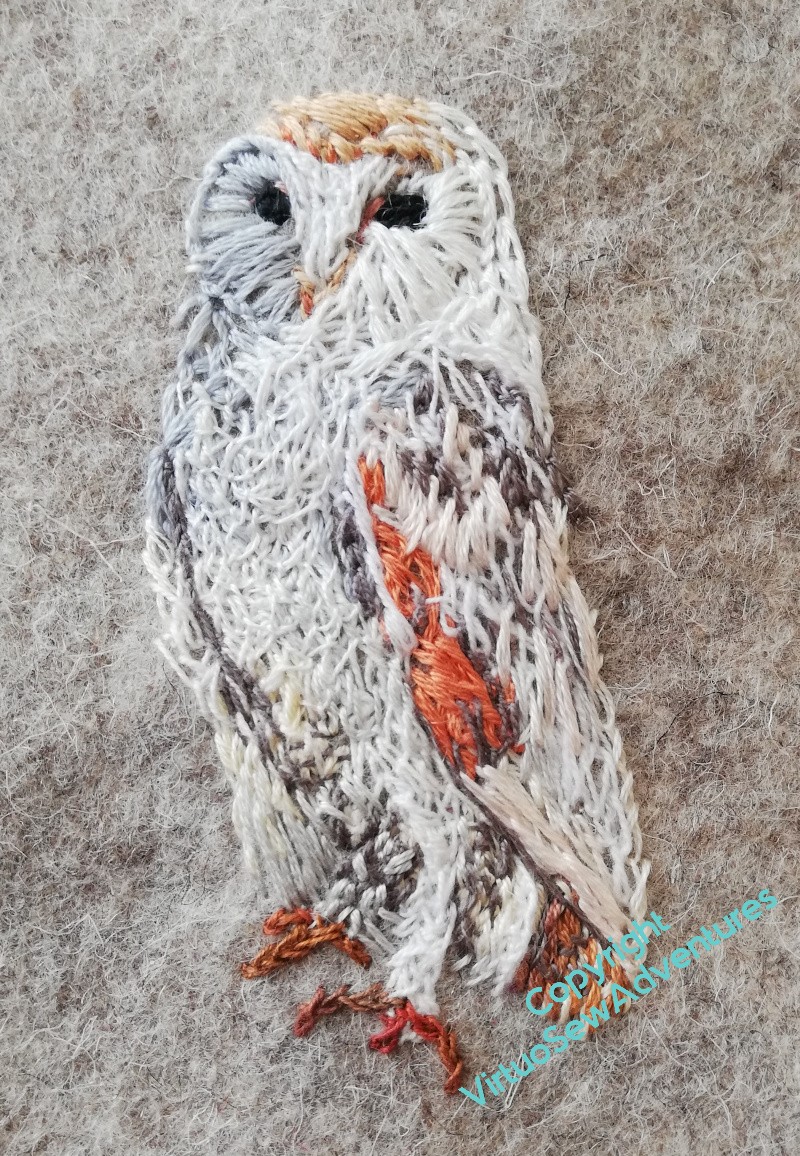
I’m not at all sure about this one. I think it’s done as far as I care to take it at the moment, and it’s certainly much better than it was. The fine layer of stitching – single strands of stranded cotton in a tangle of feather stitches and fly stitches – has made a considerable improvement on the breast, providing a contrast with the wing and some of the stitched shadows under the body. But I’m not sure that it’s right, I’m not at all sure that it’s finished, and I may very well find myself doing a new version of the owl later on, either because it’s too big for where I want it to sit in the final piece, or because I decide it’s got too much wrong with it and will draw the eye.
But then, this whole project is partly inspired by a fifteenth century masterpiece, and the anatomical exactitude of fifteenth century animal representations isn’t exactly perfect, so maybe my flaws of observation will contribute positively to the atmosphere?
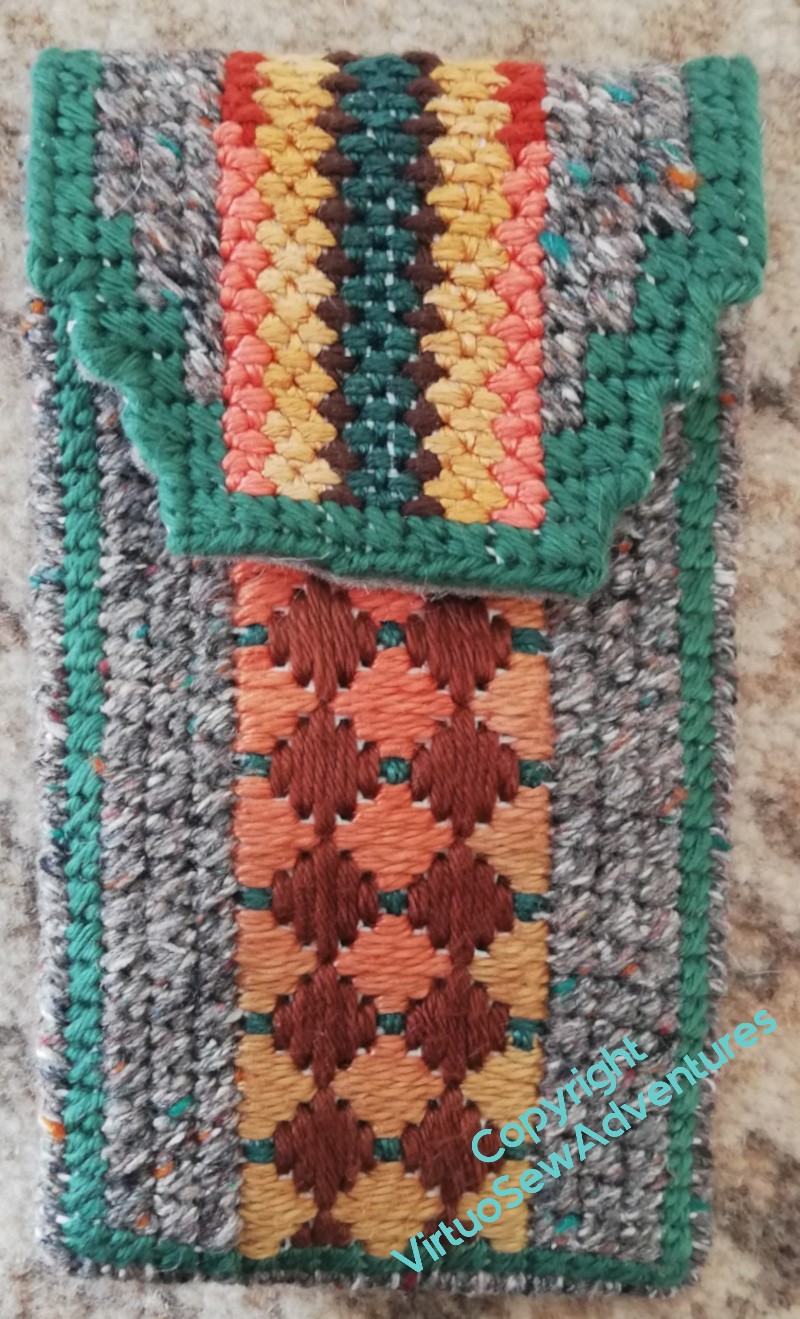
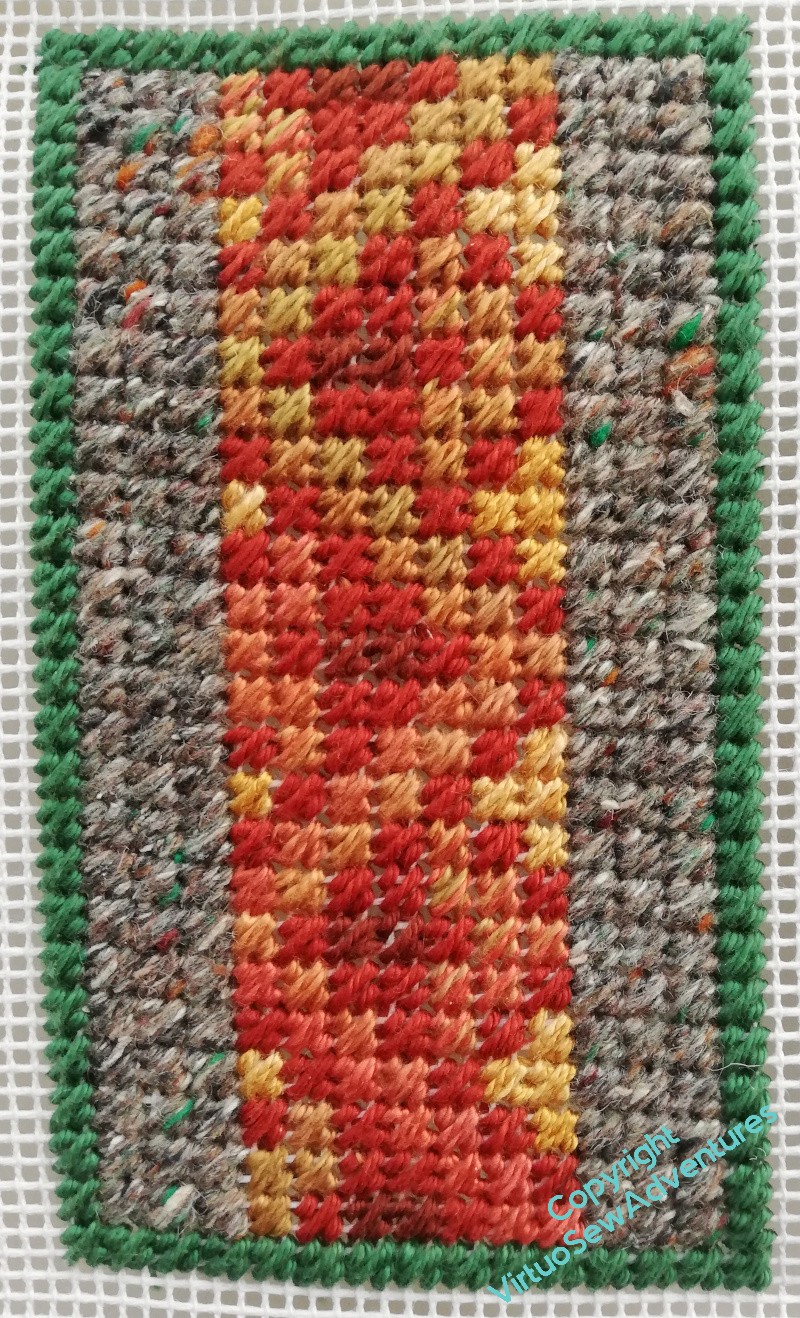
The penknife case came together fairly well in the end.
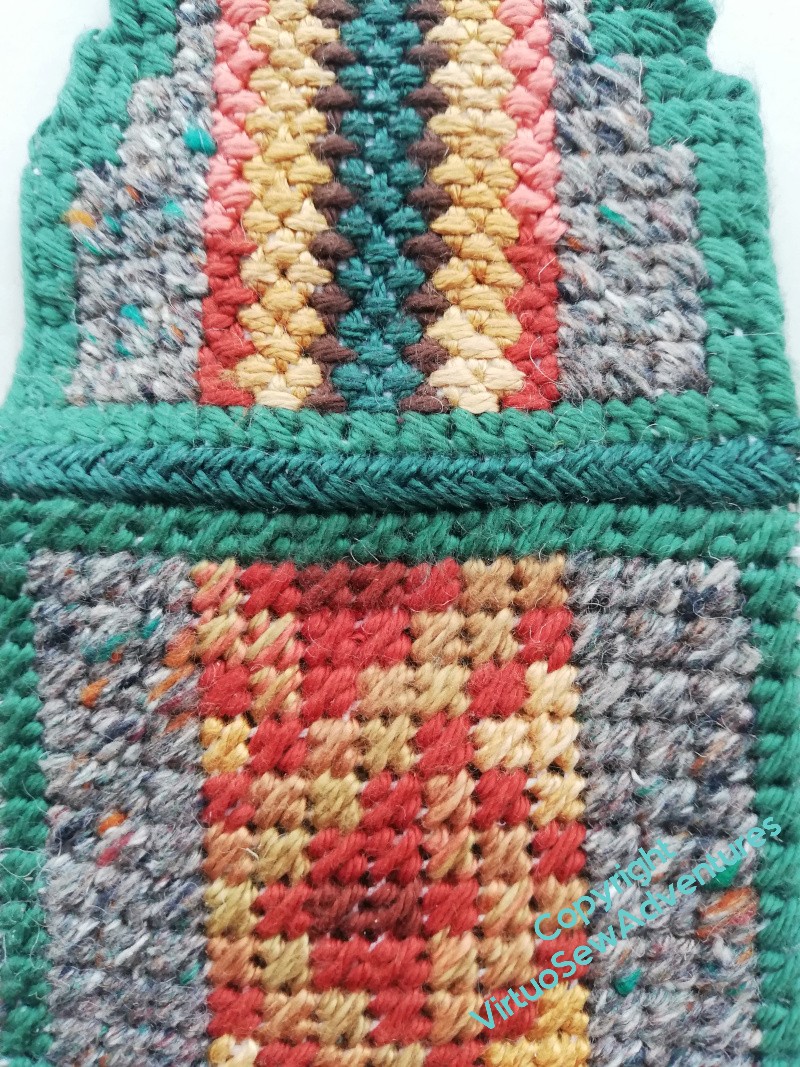
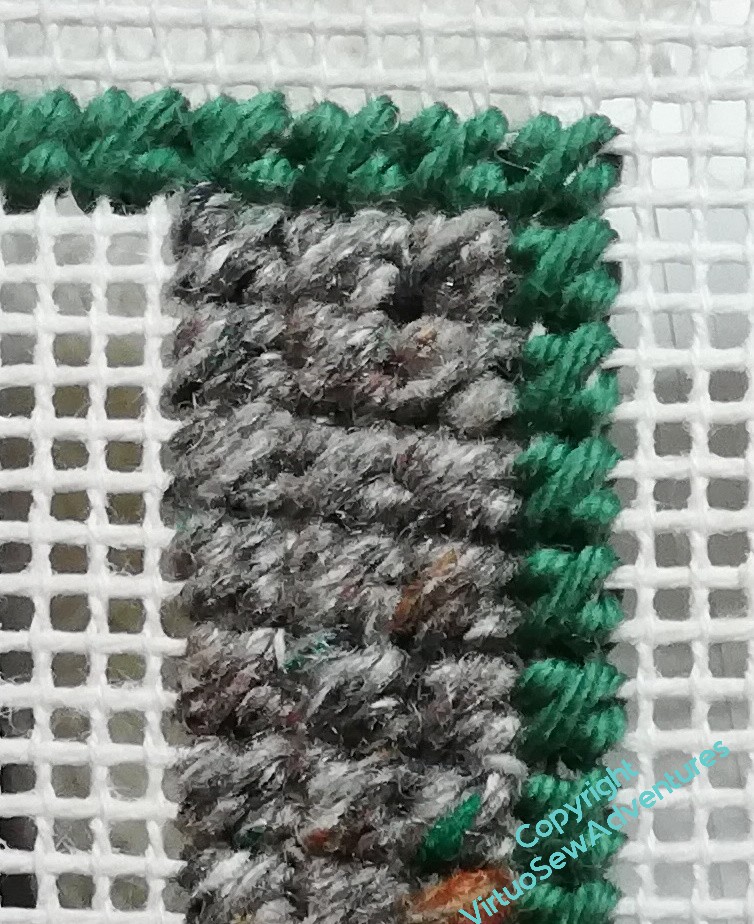
Some years ago I settled on a satisfactory way of joining two canvas pieces at an edge. It’s a sort of long armed cross stitch, which goes into each hole twice. That means it’s fairly secure, but doesn’t take security to excess, and it’s easy to do, even when I’m a bit weary.
I used the dark green thread I used on the front for the cross stitches, and I think the top, “hinge” seam has turned out well, if a little stiff.
For the side seams, having run out of the green, I used the grey mottled thread.
That was a bit more of a challenge. I didn’t quite have to heave the needle through with pliers, but it was, nevertheless, quite an effort at time.
I don’t think this seam is going anywhere in a hurry!
However, it’s all nicely finished and secure now, and I didn’t buy any thread at all for it. Or canvas. Or felt to line it with.
Given how often avowedly “Stash Busting” projects turn into “Stash Growing” projects, I am going to take that as a significant win!
I believe that by now, anyone who signed up for my talk a couple of weeks ago should have received access to the recording.
Thank you to those who were there at the time, and thank you for the kind comments I’ve received. Please do ask more questions if they occur to you!
… although I will admit that sometimes I don’t manage to fight away all the things that get between me and my frame at a time of day when I have any chance of stitching her sensibly!
However – I’ve done the grass!
Well, I stopped doing tussocks when I thought I might want to do more extensive tussocks in the foreground, and decided to do the horse first, in case I wanted seedheads nodding over its legs. But apart from the tussocks, the grass is done.
However, that means I now have a decision to make…
I’ve decided she’ll be mounted on a grey (contrasting with William The Marshall’s chestnut), and that it will be grey tending to blue. But which blue, and how much blue, and what colour should the lightest shade be? This is going to be important, as I think I’m not going to do dapples this time, just shading and a smooth coat.
For the next animal vignette, I’ve changed fabric.
This is partly because it’s what I had to hand, and partly because I think it’s a better surface for my purposes in this case.
What it definitely doesn’t provide is a a good surface for the outlines that I promise you I’ve put on! This is going to be a more than usually improvisatory animal, even by my standards. It’s as well that I’m doing so much sketching at present, as that should be helping me to improve my observational skills.
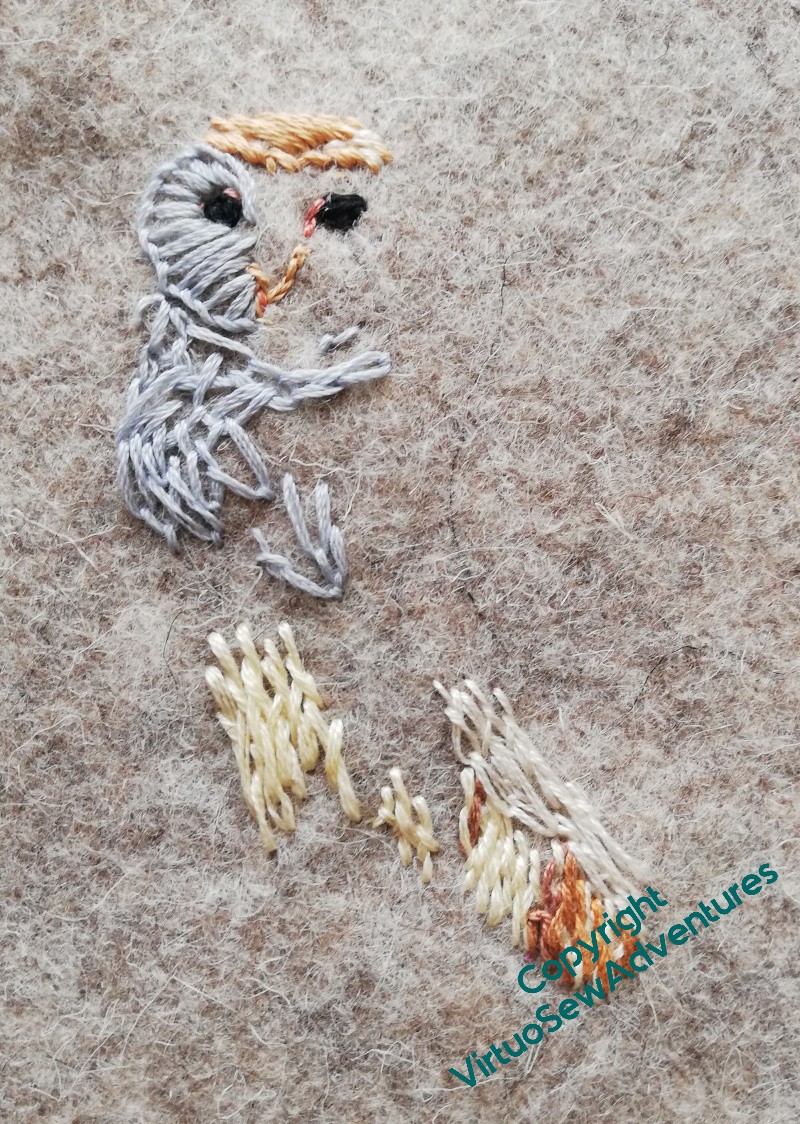
I’ve skimmed through the book again (Elizabeth Goudge’s “Herb of Grace”, for those who’ve lost track of my plans and sources), and there is a barn owl who lives near the inn, and occasionally wafts through the scene on silent wings. I’d forgotten him, so I was glad to be reminded and have a go.
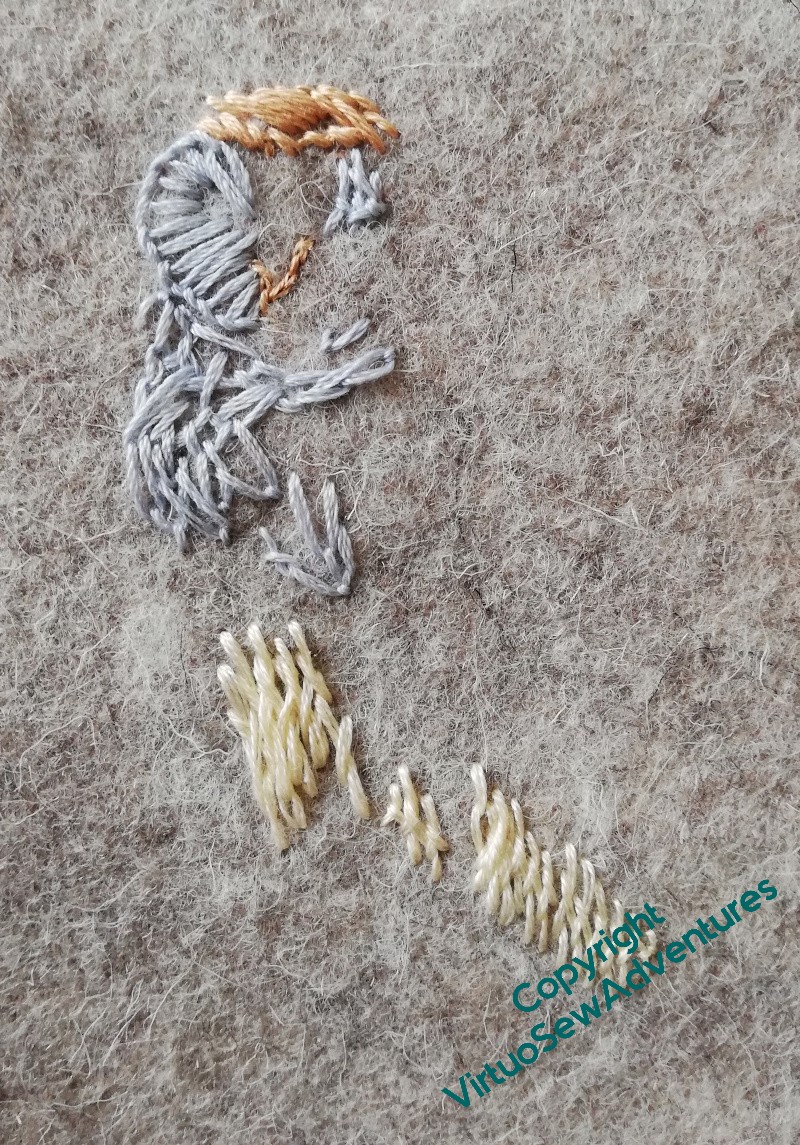
At this stage, I’m simply trying to put in the first shadows, and because I’ve got the rather heathered felt as the base fabric, I don’t mind if it shows through. It provides a sort of softening which I think will be very helpful.
Now that I’ve gone over the owl for the first time – just the legs and feet aren’t done – I can see places where I need to look harder and see more clearly. There are the markings on the wings to add, and a better sense of the legs being in front of the closed wings and tail, with shadows behind them.
But it’s a start, and since I have also now found my little notebook for Placidus Planning, I should soon be able to settle down to read again, this time with attention, looking for plants and animals I want to include. In my usual fashion, I will be bouncing between the story of the book, and the image that Elizabeth Goudge describes, and somewhere along the way it will acquire that twist that shows me the real root of my desire to stitch it.
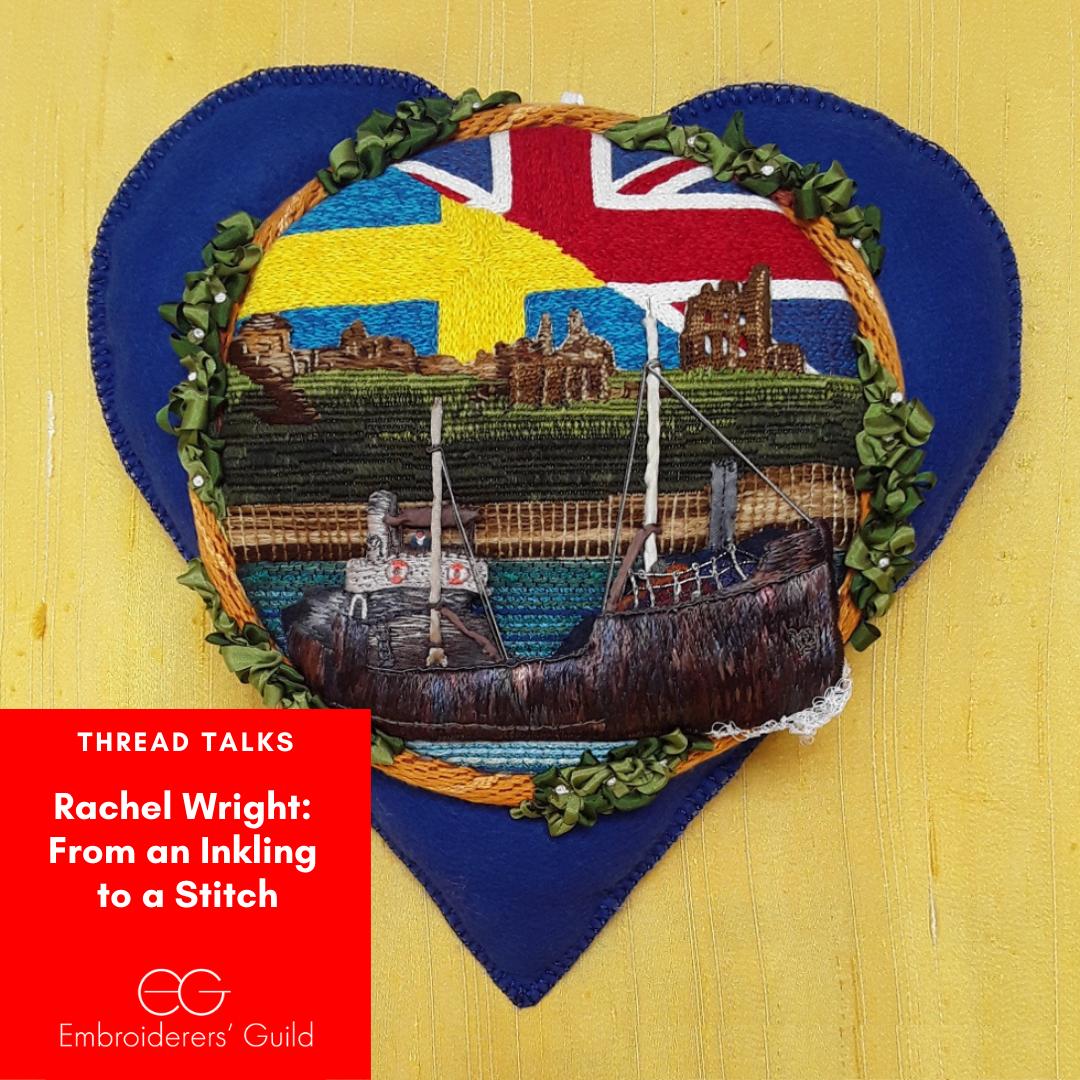
Final reminder! – I shall be giving a talk for the Embroiderers Guild on this evening (June 3) at 19.00!
I believe I’ve turned this image into a link to the Eventbrite page, and for anyone not in the right timezone, or otherwise occupied, the Guild makes recordings available for some time afterwards.
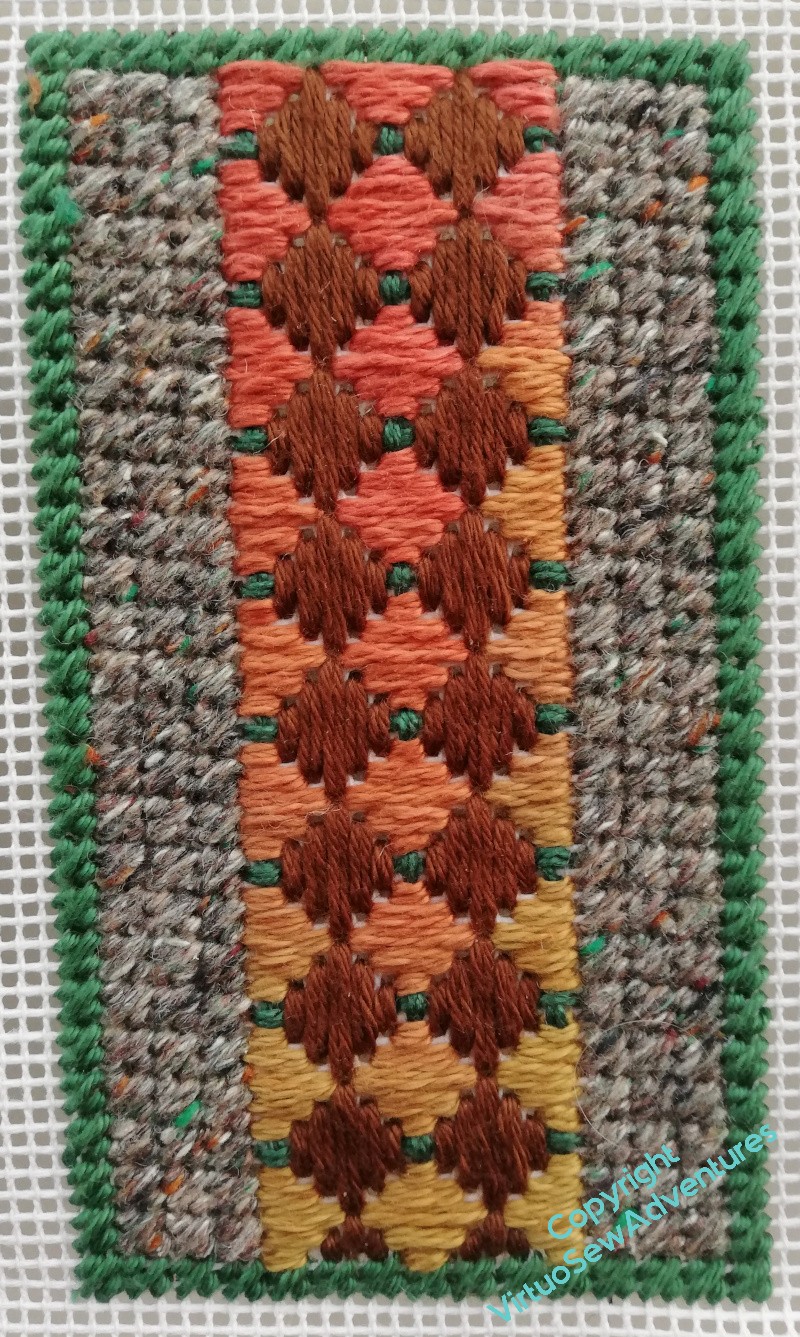
When you last saw this panel, there were gaps. They’ve now been filled with green cross stitches.
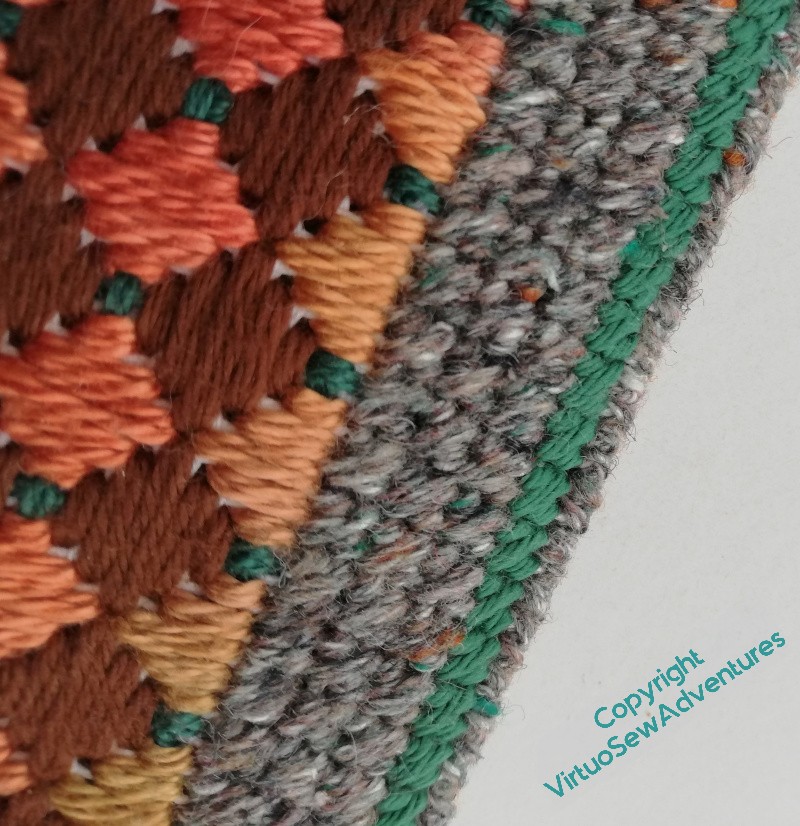
Yes, that works, I like the way the Caron Collection Watercolours thread runs from yellow to orange, the brown provides a bit of stability, and the green ties the inside and outside together. . It’s not the stitch pattern I was aiming for (I’m not sure what went wrong), but I like it.
However, that was, if I am honest, the last easy thing about this canvaswork!
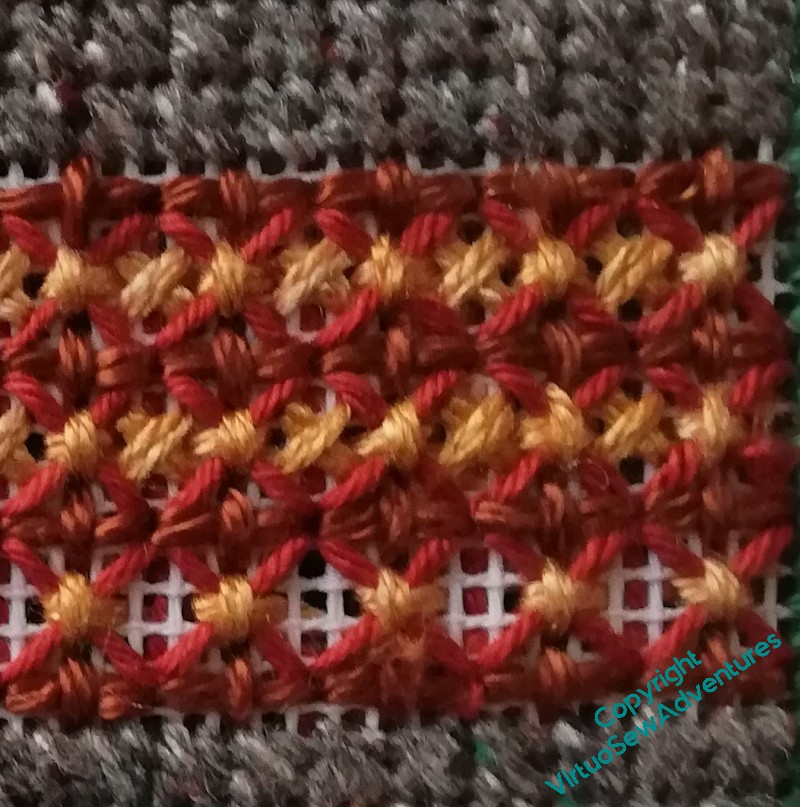
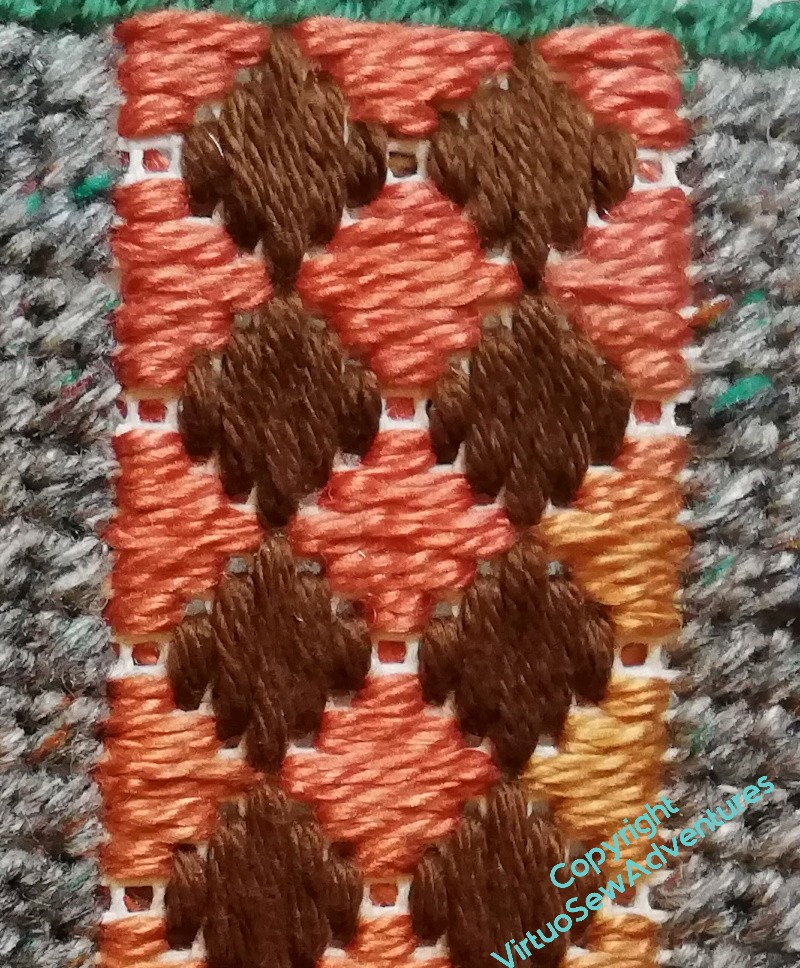
I wanted to put a different stitch on the back, maybe more hardwearing, because I was considering using the finished object on belt loops. This, however, isn’t it.
Again, somewhere along the line it’s not the stitch pattern I was aiming for, and I’m not sure quite what happened. Suffice it that reading charts and diagrams seems to be a somewhat episodic skill for me, and I am at present in an “Off” period!
Furthermore, the coverage I want is requiring too many passes, too much tangling, and looking altogether too busy. Out it comes!
In the end, I went back to Mosaic Stitch.
It is built up in a rather haphazard fashion of zigzags, starting with two rows in the Watercolours thread, again, then moving outward with soft cotton in two shades of brown and adding a few details in a goldeny mustardy pearl type thread that I think is absolutely gorgeous. Unfortunately I’ve not the vaguest idea where I got it from, or when. It might even be silk – and here’s me putting it on a cover for a penknife!
Oh well, better to enjoy using it than have it sitting in a box asking me When it will Get A Chance To Play!
Now – a very exciting thing! – I shall be giving a talk for the Embroiderers Guild on June 3!
I believe I’ve turned this image into a link to the Eventbrite page, and for anyone not in the right timezone, or otherwise occupied on the day of the talk, the Guild makes recordings available for some time afterwards.
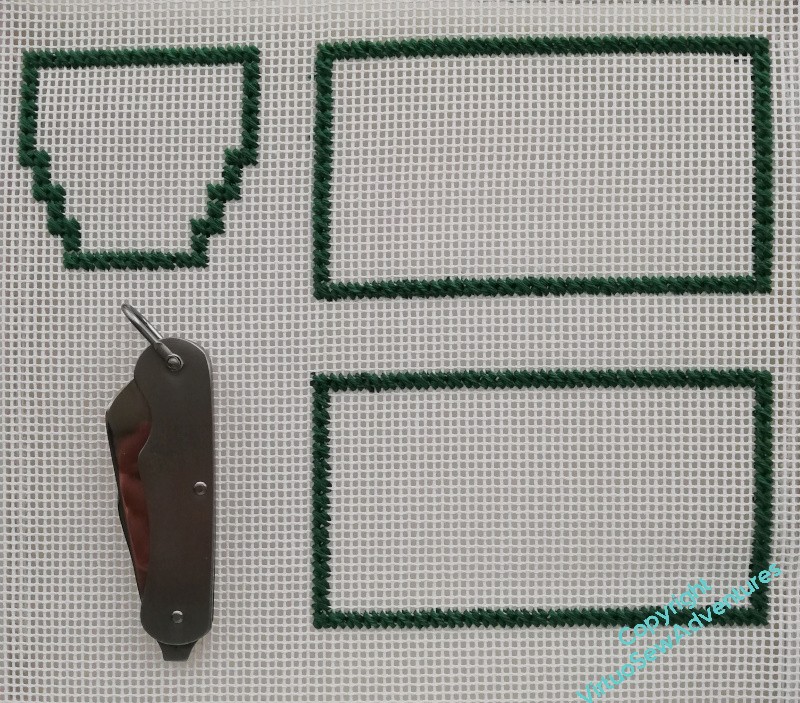
I’ve decided this penknife needs a case. (Of Course I Have!).
Canvaswork is often a good choice for this sort of thing, and I’m going to try to keep to stash. That may make things a bit harder, because my canvas is not especially fine, and as it turns out I don’t have much that’s suitable for that count of canvas.
I have prior experience of making something that ended up too small to do the job, so this looks very much too big. By the time it’s done, it might be the right size, but if it’s too big, even with padding and lining, I’ll simply start again, and use this for something else!
I actually started with the grey flecked yarn. It has flecks of green, and a browny-orangey colour, so I thought that might make an interesting challenge to combine. The panels are outlined in Mosaic Stitch, using a soft cotton in a green that goes with the green flecks. The grey had to be used double, so I think this is going to be quite a close run thing to get to the end with enough yarn to do the job!
The next panel started as Pavillion Steps, from Jo Ippolito Christensen, but I couldn’t quite make sense of the diagram, so it’s become something much simpler. Caron Collection (Wildflowers, I think) in one direction, soft cotton in the other, both of them used double to achieve reasonable coverage.
It’s clear I need to fill in that gap with Something, so now I need to rootle around in the stash to find something suitable. Several somethings suitable, in fact, as I don’t think the remaining stock of these threads will be enough for the rest of the case. I can do more Mosic stitch on the back, perhaps, but making sense of the top flap if I can’t run the same pattern across it is going to take a bit of thinking about.
Now – a very exciting thing! – I shall be giving a talk for the Embroiderers Guild on June 3!
I believe I’ve turned this image into a link to the Eventbrite page, and for anyone not in the right timezone, or otherwise occupied on the day of the talk, the Guild makes recordings available for some time afterwards.
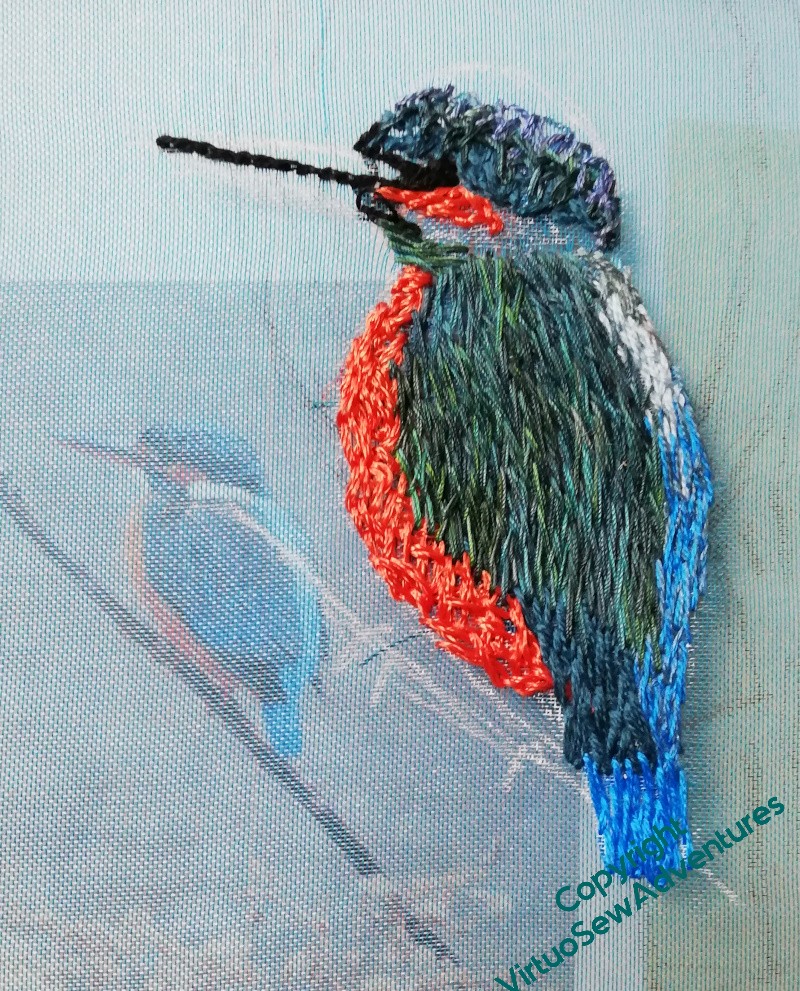
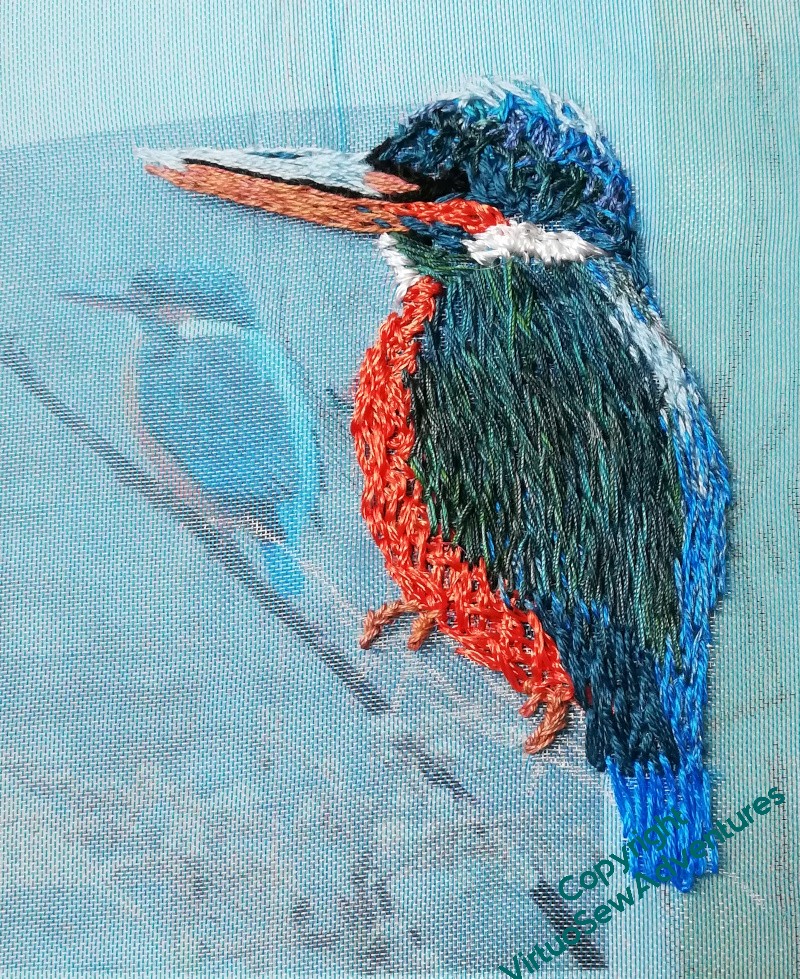
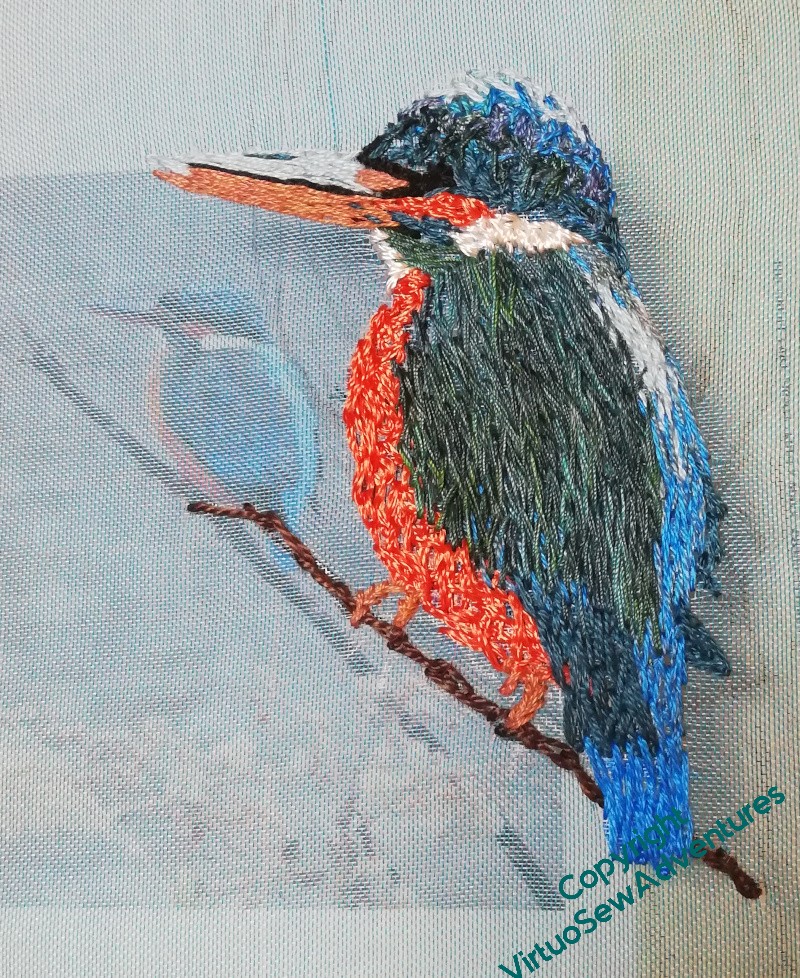
The kingfisher has been really quite tricky, but rewarding, too.
I do enjoy these colours, for a start, and the chance to use the really glossy rayon thread that helps his bright orange breast to shine. For the bright stripe of his back and tail, I’ve ended up combining threads in the needle to get just the colour I want. Even with a full range of Madeira stranded cotton in my thread stash, the precise colour and tone weren’t quite there. There’s another variegated mercerised machine thread in the mix as well – I think the motto for this piece is going to be “Whatever It Takes!”!
When I looked closely, I realised that the lower beak and the little claws were a very similar colour. The feet have been made a little scalier by stacking single twisted chain stitches atop one another so that they narrow into claws.
I’ve made the dark line of the beak narrower by bringing split stitches close in on either side, and done a lot of staring and adding little areas – the top of his head, the white flash at the side of the head, and the tiny bit of white at the throat. When I put him wherever he ends up, that will be one of the push-pull elements that helps him to detach sufficiently from the background to do his job.
Finally, I decided that the couple of bits of dark showing the underside of the far wing did in fact need to go in – more of the push-pull.
Then he wanted a twig to sit on. When I come to set him in place, I may cut some of the fabric close or turn it under, but other parts may be left so that the blue gauze modifies whatever is underneath. Some of this twig may be undone, some of it may be enhanced and extended.
I am reminding myself that I don’t work my best when I’m fretting about the Whole Thing. I do very much better when I get started and work out the whole thing later. I need to read the book again, to see whether there are particular animals I have to include. That will be no hardship, it’s a much beloved book!
I shall be giving a talk for the Embroiderers Guild on June 3!
I believe I’ve turned this image into a link to the Eventbrite page, and for anyone not in the right timezone, or otherwise occupied on the day of the talk, the Guild makes recordings available for some time afterwards.