Category: General Embroidery
Lower border done, and a decision made
The lower right hand side of Aethelflaed’s border came together reasonably well.
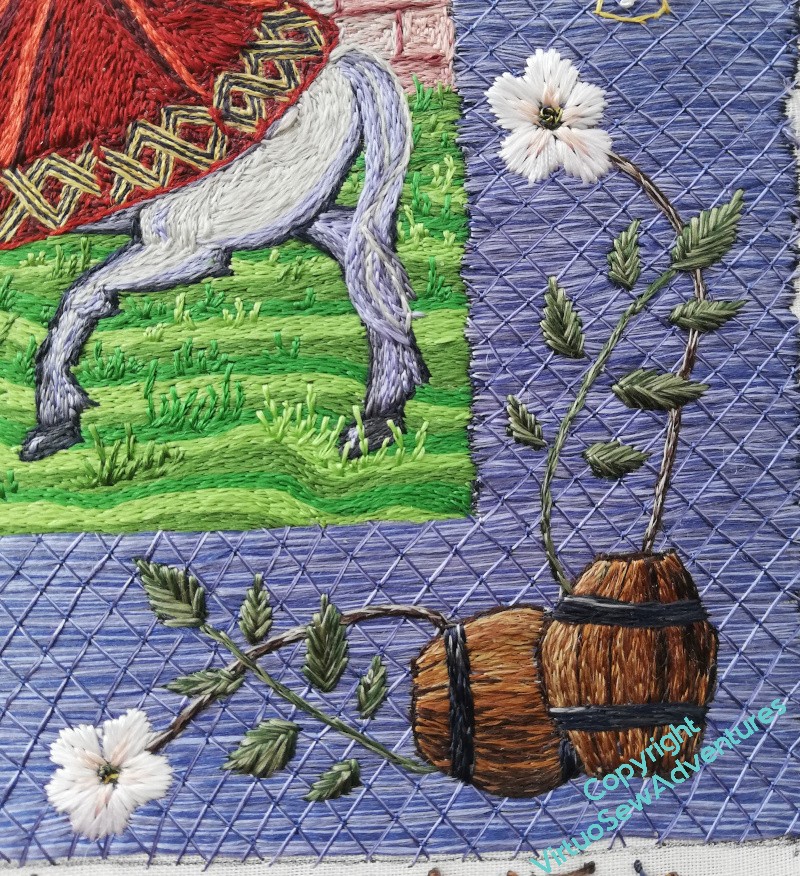
I bore in mind the idea of the light coming from the top left which I used when working Aethelflaed’s dress to make sure that the barrels are sensibly lit from more or less the right place. What I haven’t done is give them a stand to make sure that the one lying down doesn’t roll away, but at this point I am betting that there is so much going on in the image that people will either stroll past, completely unengaged, or be so caught up in what is there that they don’t notice the lack of a stand either!
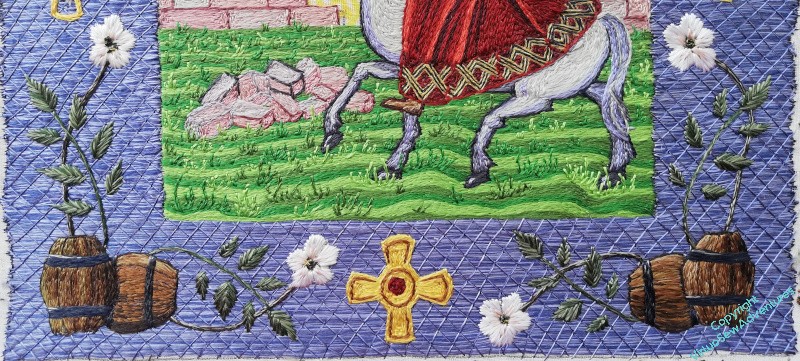
Now I have the whole of the lower border in place, complete with cross, I can look at the combination, and consider whether the colours are going to work.
I think that if I make the bee skeps slightly greyer and less brightly straw coloured than I originally intended, the crosses will probably work well. At least, I’m sure enough to keep working them as I’ve worked this first one.
Pooh-Bah – a closer look
I thought it might be interesting to have a closer look at the way I am trying to bring Pooh-Bah and his ridiculously deep and fluffy fur to life (honestly, I think if I tried to find the body of the dog through the fur I’d lose my arm to the elbow!). It’s very much being invented on the spot, and although the approximate idea is the same, each animal is taking it differently.
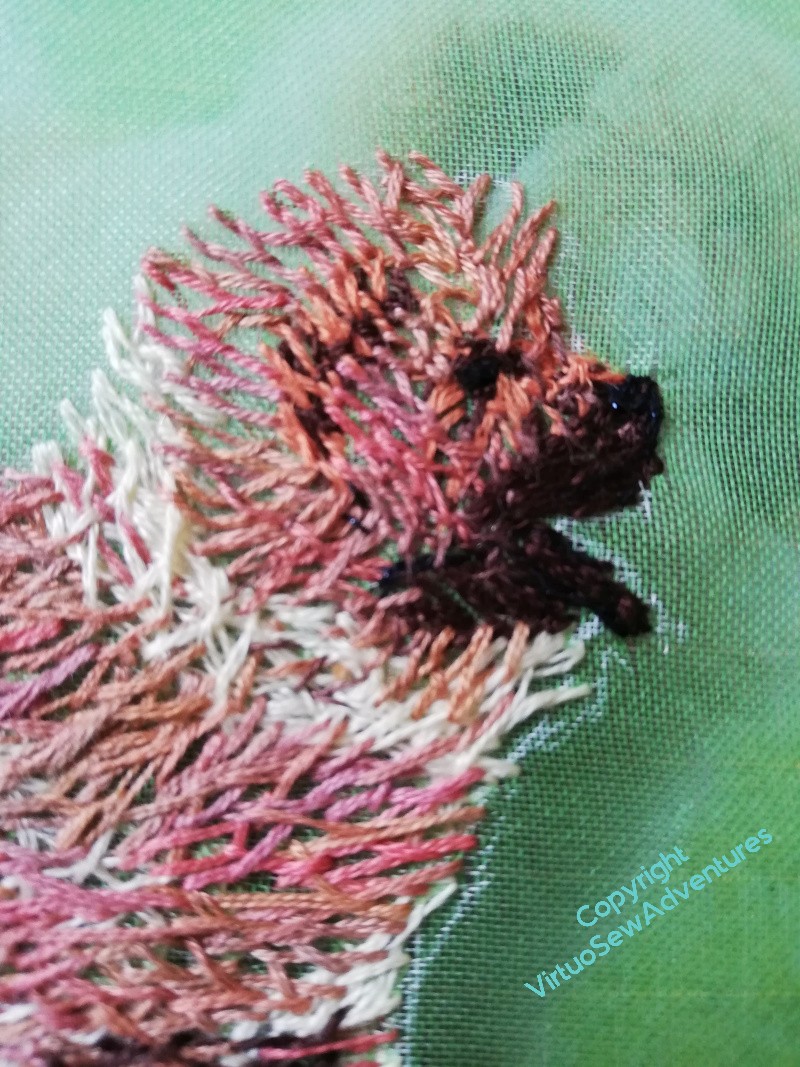
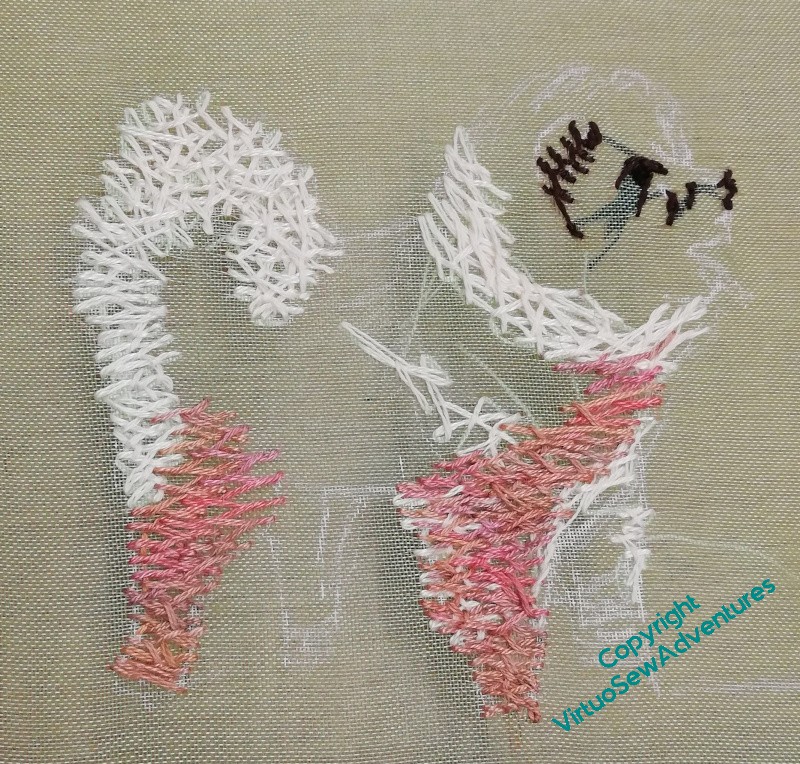
So here you see, probably, stage three or four.
I’ve done the eye and the muzzle and lower jaw, quite densely. I tried to find some of the shadows of the ear and under the chin, and the highlights around his ruff.
And from that point it was really a case of “scribbling” my first layer of stitches in very sloppily worked Cretan Stitch. No, that’s unfair. At this stage I’m not trying to be very precise in my stitch placement, so “scribbling” is a reasonable approximation. But I’m trying to balance that sense of a layer of colour with leaving enough space for the next layers and the sense of the depth of fur. I’m not being precise, but “sloppy” isn’t quite right either!
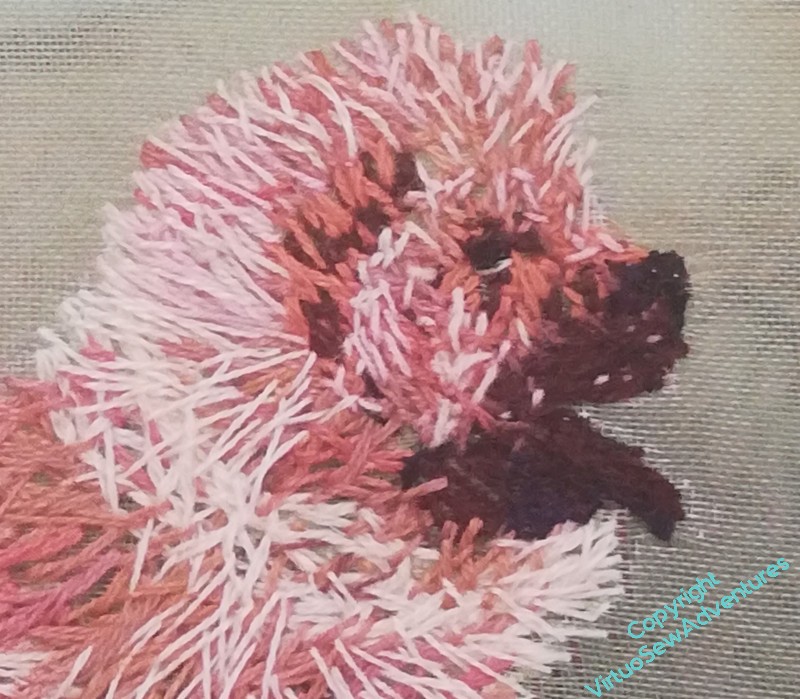
Now look at Pooh-Bah at a somewhat later stage.
The next layer of stitches is in a lighter thread (Pooh-Bah is a creamier colour than the photo I have), and I’ve used much shorter stitches around his muzzle and his face, to suggest the shorter fur. As I move outwards, I’m trying to stitch into the layers below, tangling my stitches to help build the fluffiness.
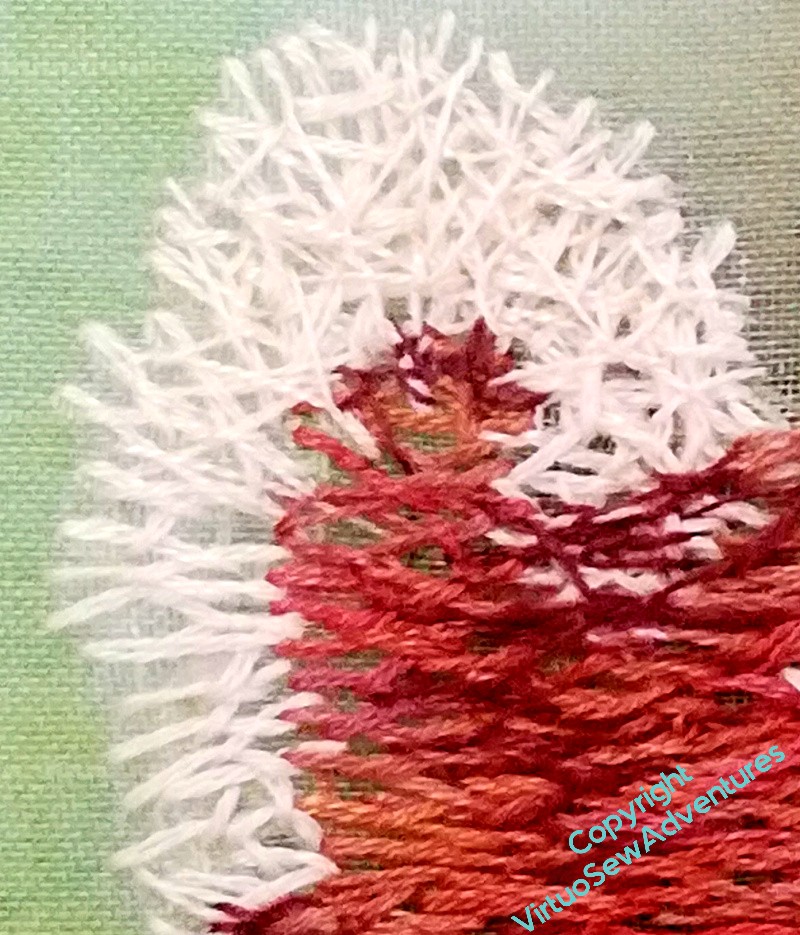
You can see the same thing happening with the tail, here. There’s a sort of basic “scribble” layer, in this case in something more like Herringbone Stitch – although, if you think about it, it’s not hard to mutate Herringbone into Cretan! I used two strands of stranded cotton for the scribble layer, but I’m beginning to go over it in single strands. I’m hoping that when I come to the final layer, I will be able to tangle it into previous layers enough to camouflage the order of work.
More on Aethelflaed’s border
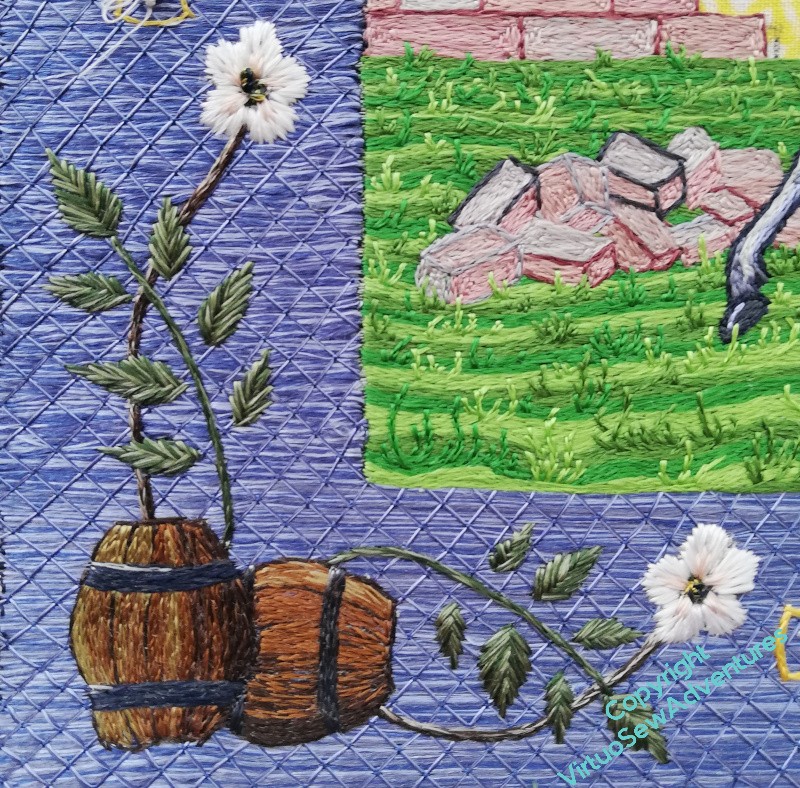
Aethelflaed’s border continues to make progress.
I’ve reversed the colours of the dog roses relative to William Marshall, making the outer edges of the petals white, with only a hint of pink towards the centre. The rose leaves have been heathered, pale and dark green in the needle together. I may decide they need a bit of the paler green around the edge to make the edges more obvious, but for now I think I’m content with them.

The next thing I wanted to do was to get the crosses in progress. I’m having quandaries about the skeps, and doing the crosses at East and West will give me some thinking time.
I remember with William that leaving the crosses until last left me a bit doubtful about them, and since I learned then that the crosses needed to be filled in, the only question, really, was How?
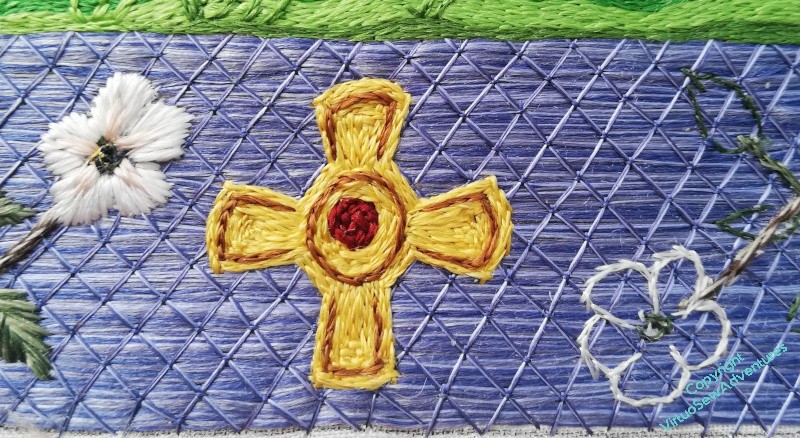
As I want to bring to mind the several crosses found in the Staffordshire Hoard, and some others of the period, they are obviously going to be gold and garnet – we got that far when I was doing the design work. However, How much detail of chasing (engraving) or embellishment with niello do I want to add? There’s the real gold of the background which is going to alter the balance of the whole piece, so I may need to add more, but for now, a single outline for each shape and a central garnet, and I think I have a reasonable version for my purposes.
Beginning to assemble the Lotus Flower Coat
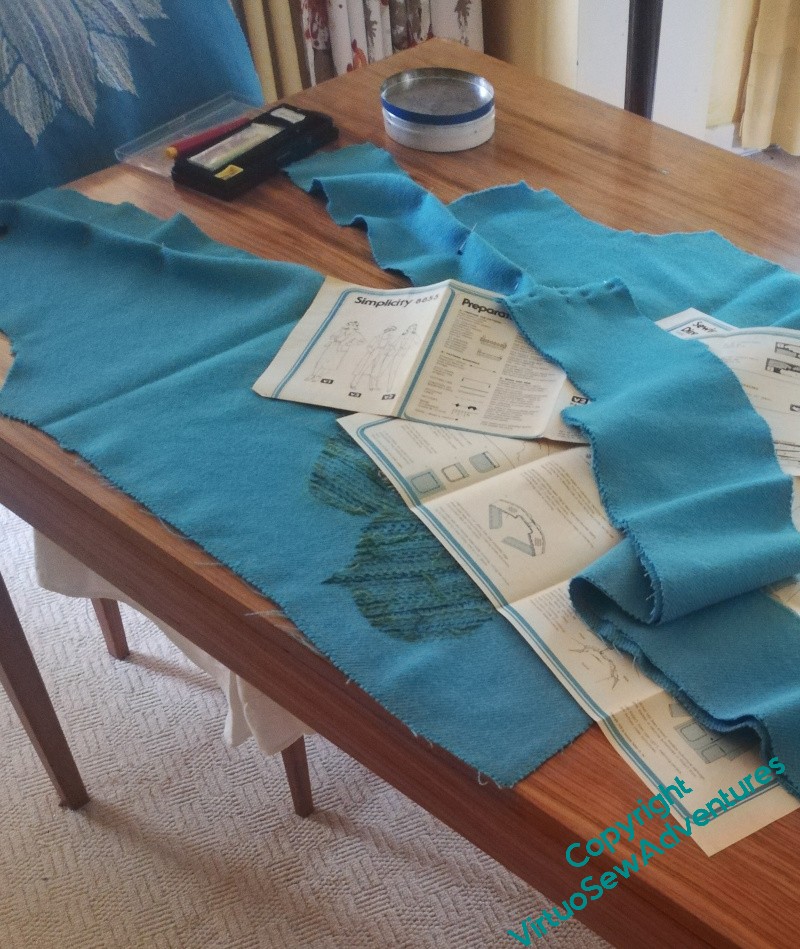
Having finished the embroidery I’d planned, and concluded that I can only decide on any extra twiddles once the jacket is made, I’d best get the jacket made. I want to be wearing it this Autumn, after all!
After a bit of a summer hiatus, I fished out the pattern pieces and the pattern instructions, and made a start, only to be immediately wrong footed. The shawl collar was a bit tricky to wrangle, and then I realised that the entire process suggested in the pattern was contrary to what I’d been assuming.
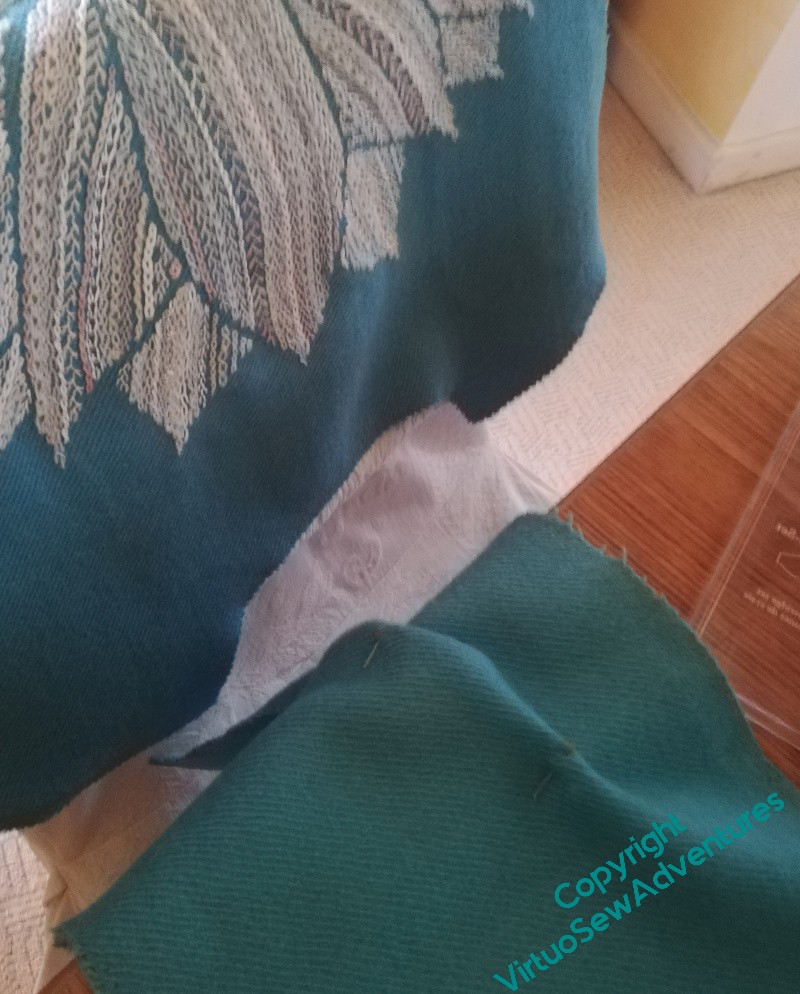
Picture one bemused sewer in a mental four-wheel skid!
Control resumed, darts inserted in the collar, sighs of relief that I jettisoned the idea of pockets. I did wonder about pockets in the lining, and I think, probably not. I’m not sure what I could put in them without ruining the line of the garment, and besides, as I think I’ve said before, I like a bag for carrying things!
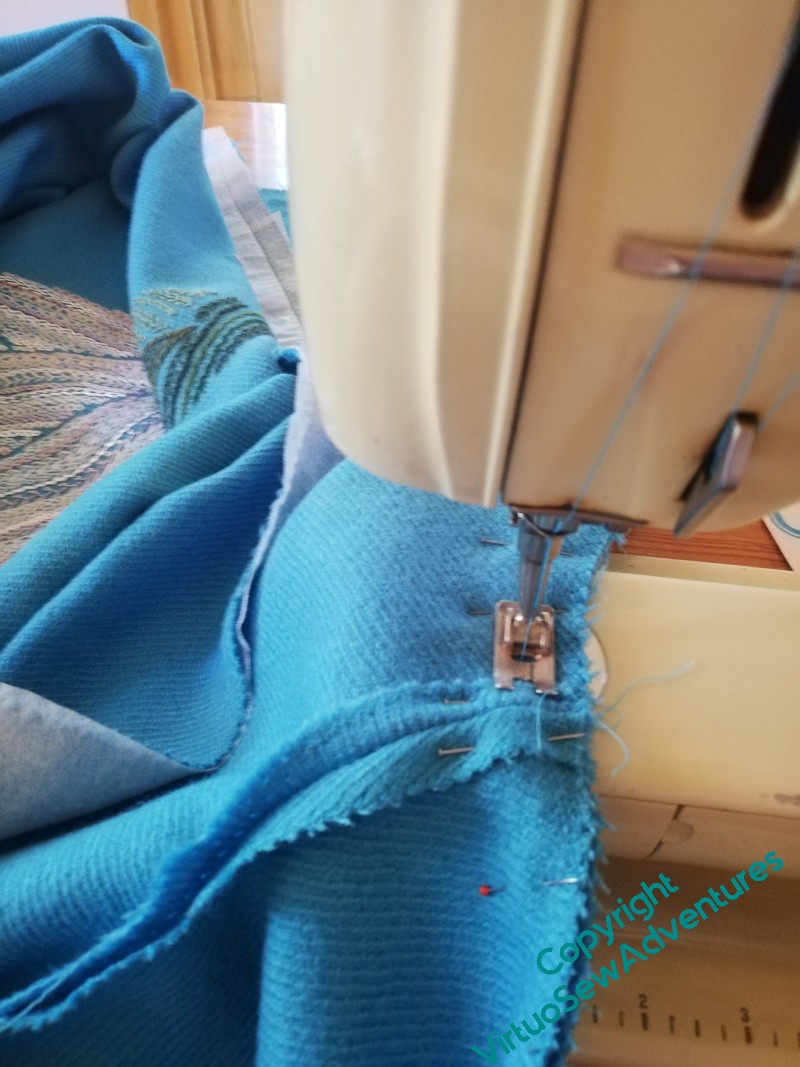
Sit down, spectacles perched on nose, solemnly reading the pattern, hoping I’ll understand it this time… (I wouldn’t last five minutes on The Great British Sewing Bee. I’m not quick, I’m easily derailed, and I never see all the problems ahead in enough time to dodge.)
There are two great advantages to using my mother’s Bernina, rather than my hand-cranked Jones. One is that I get two hands to control the fabric. The other is that if I am truly bemused, I can ask for help!
We had a very productive day, me sewing and my mother doing a painting. Neither is yet finished, but we are certainly closer than we were!
Experimenting with leaves for Placidus
The Vision of Placidus is going to be a large panel – I think about five feet by four – and the story is set in a forest. So I’m going to need some trees, trunks and foliage, as well as some sort of distant scene and a rock for the stag to stand on.
I’m not at all sure how I’m going to render the forest, but after all, improvisation and exploration have become very important parts of what I do and how I do it. So, here I am, Exploring!
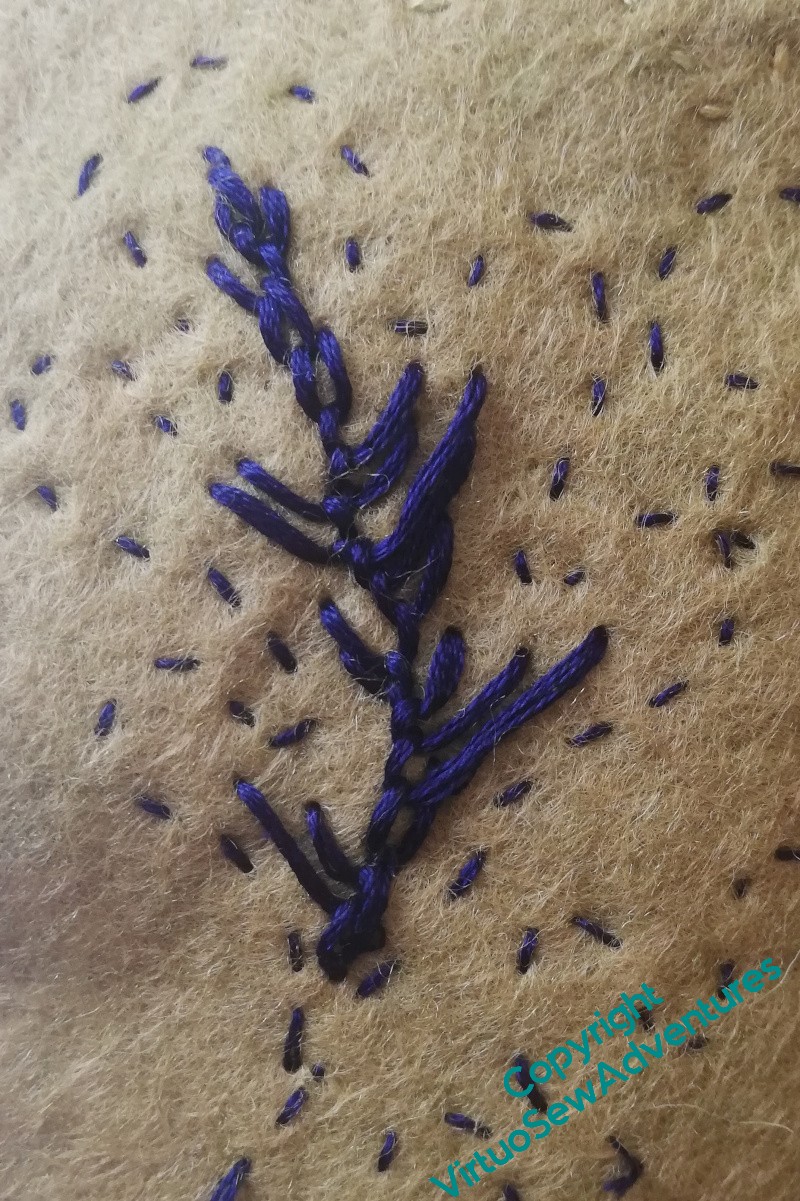
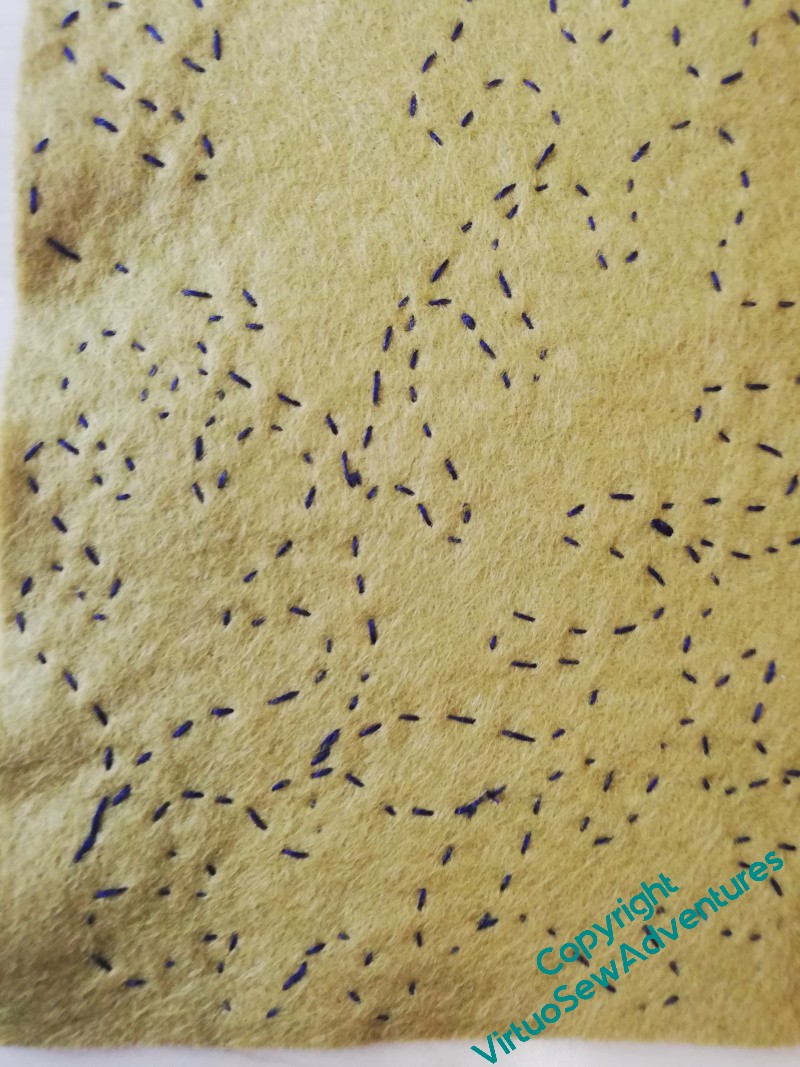
I was wandering in the Lady Lever Art Gallery recently, and strolling through the dimly lit rooms that house the Mortlake tapestries gave me my first idea. The differential fading of the natural dyes used often leaves darker greens much more blue than green, so I have thought, for my first experiment, to take a sheet of green felt, draw oak leaves on it – freehand – and work across in blue, making all the central elements of the leaves stronger.
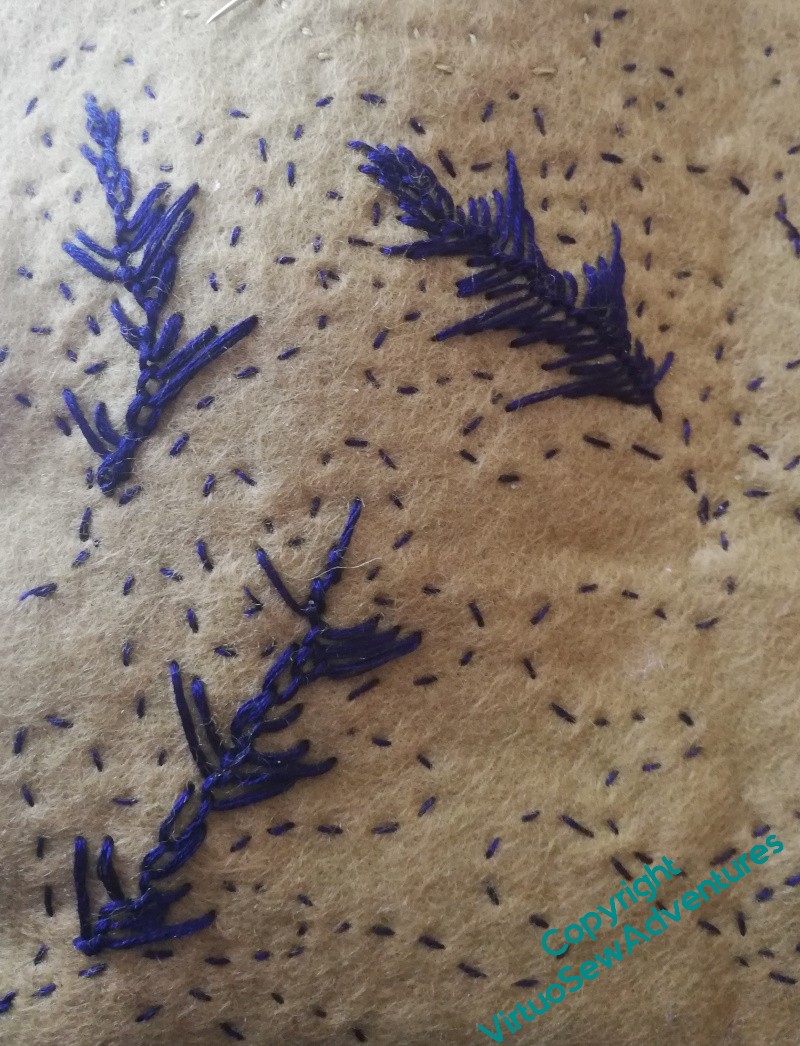
I think if I like the effect I will need to rework it in wool, perhaps with some overworking from the embellisher, to blend the colours and layers together.
I’ve made a start, and at the moment I am unconvinced. We’ve heard that before, of course. I’ll keep going, see what I think with a whole sheet of these leaves done and cut out and laid over one another.
I still like the idea of referencing the tapestries. I maybe have to find another couple of ways of doing it.
Pooh-Bah coming together..
Pooh-Bah is going to be difficult. I’m trying to Trust The Process here, since I’ve come up with a technique that seems to work, but the Chow’s fur is so different to the fur and feathers I’ve done so far that I’m not at all sure it’s going to make sense.
Besides, the technique makes enormous demands on my observation and imagination, both at once. Observation, because I have to see the details in my source photo that make the animal believable. Imagination, rather trickier, because my stitching is not using tiny dots of ink on paper, but relatively large stitches on fabric.
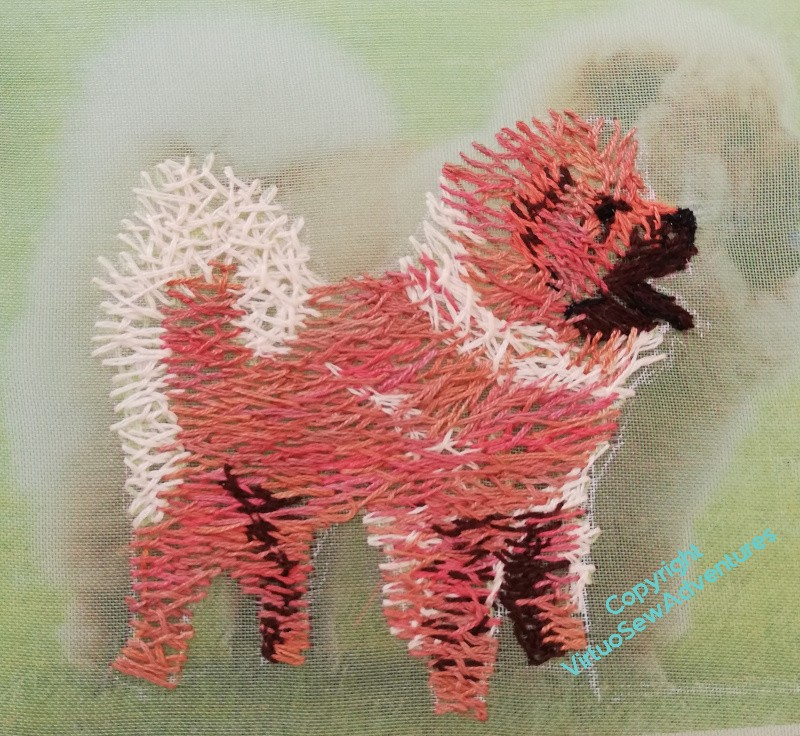
What my relatively large stitches have to do is to combine to create the effect of much smaller dots of colour, to create something lively – and alive – and yet definitely stitched. So as I’m stitching, I’m trying to arrive at an interaction of stitches and shadows that works.
This is not, yet, achieved.
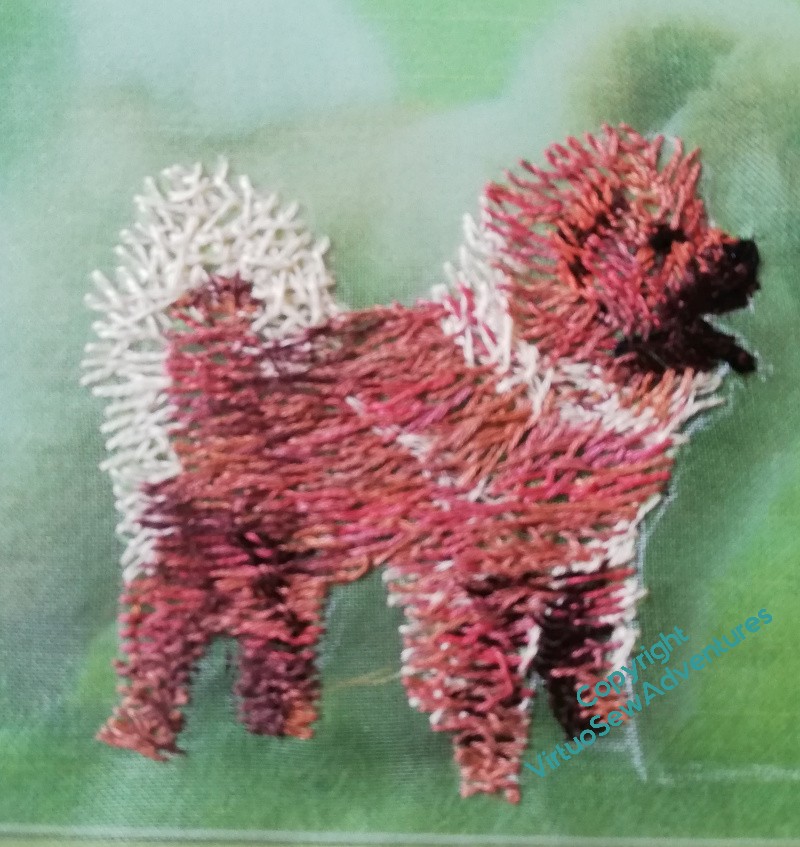
But at least now I think I have enough in place that I have markers that I can work between. I’ve not got the proportions or the underlying shading quite right yet, and I’ve not quite worked out how to get the sense of the deep, fluffy fur.
But I do think Pooh-Bah will eventually approve my efforts!
Making a start on the border..
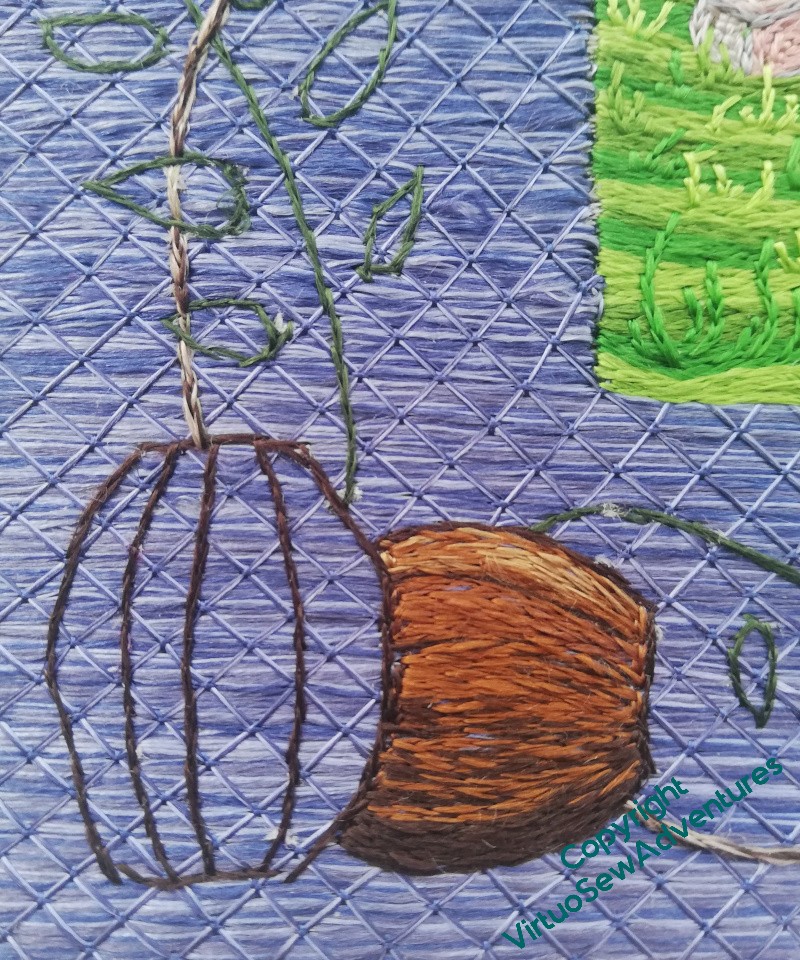
When last you saw Aethelflaed, I had split-stitch transferred the design onto the border, and made a start on the first barrel.
I am using memories of the barrels that figure so prominently in “Asterix in Britain” to give me an appropriate level of colouring, something not too subtle, but not too clunky either. If I can manage it, I want to have something fairly simple convey a greater level of detail than is really there.
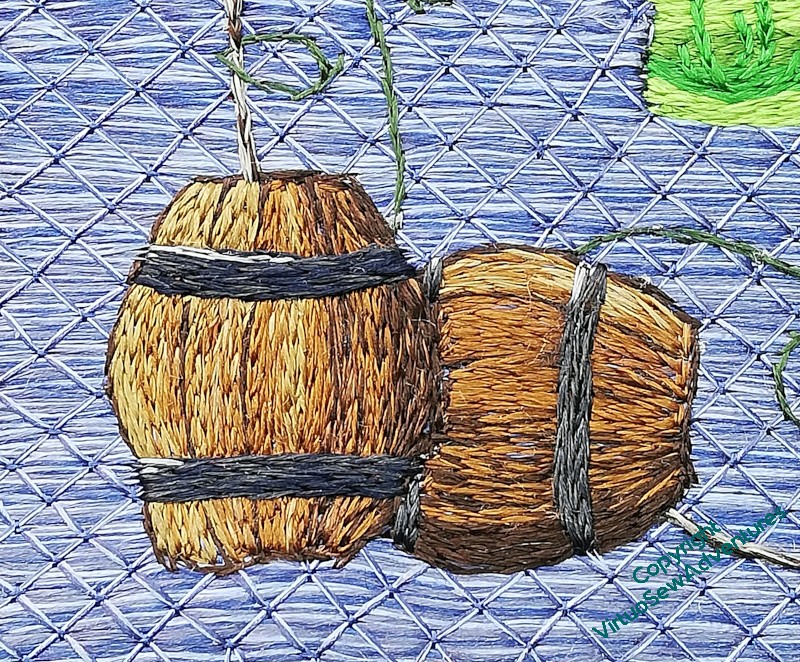
And honestly, I think I might be achieving that. Blending the silk threads stretches out the tones slightly, but the other thing it does is to create some impression of the grain of the wood. It might be a bit too much, too detailled when it’s seen up close, but at any sort of distance, I think it works.
And now, for some record keeping…
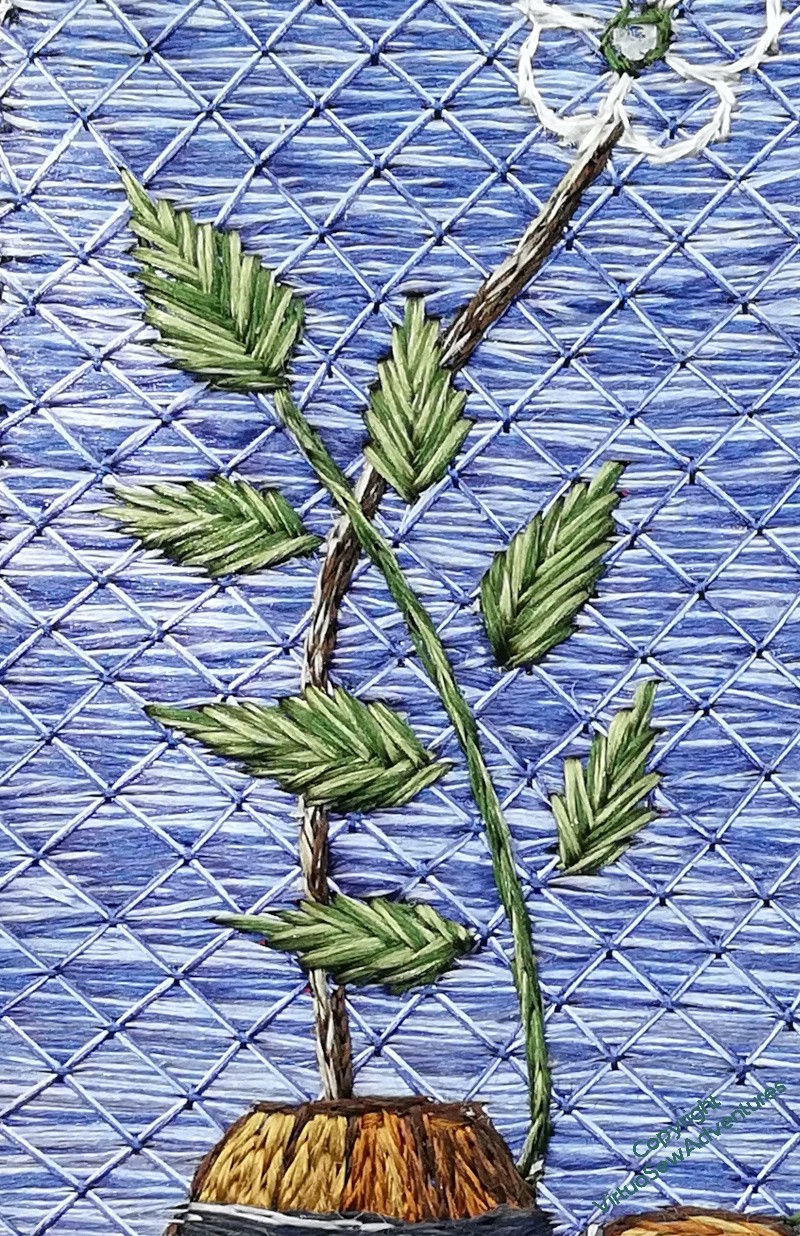
I have been slow to learn that I need to keep track of what I’m doing. At various points in the Dreams of Amarna, I had a very bad moment or two when I couldn’t track down the information about something I’d done so that I could do something similar somewhere else. One of the uses of a blog is to keep records!
So far in the border, I have been using four strands of silk in my needle, just as I did in the rest of the piece. For the rose leaves, I’m using eight, four light and four dark. I want them raised over the stems without any sign of the stem behind them.
That seems to be working, too.
Starting Pooh-Bah the Chow
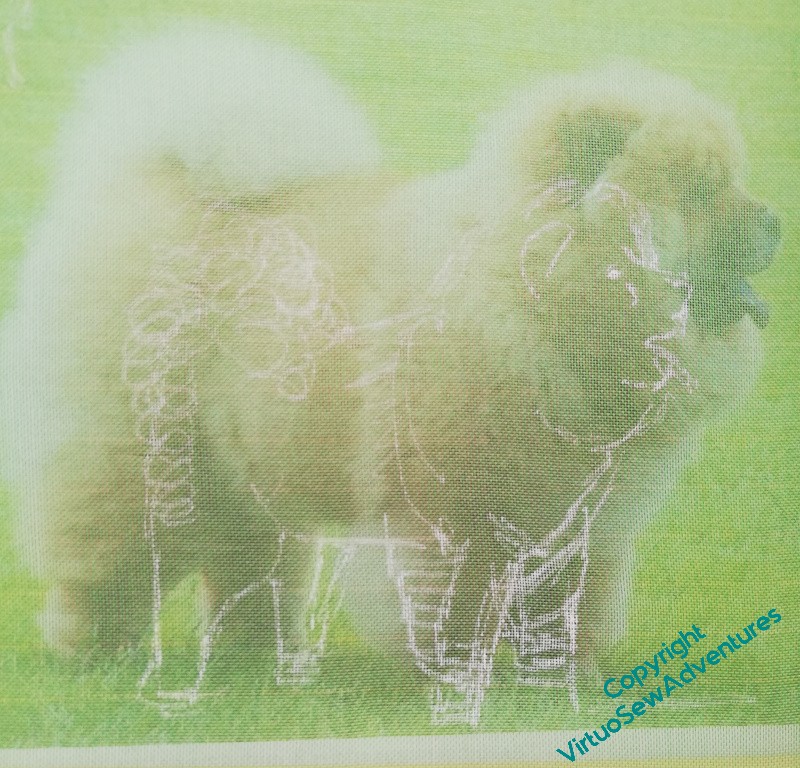
It’s been a while since I did any work on the Placidus panel, or more strictly, on the various elements thereof. It’s not for want of trying, but in my usual fashion, I became distracted by the Lotus Flower Coat. Now I’ve got that in the state where it’s awaiting assembly, I can return to my previous progress!
I am becoming aware that I have run out of “easy projects”. I need to start thinking about how I’m going to do the forest and the rocks, the stag, the man and his horse… At the moment, I’ve not the vaguest clue about that!
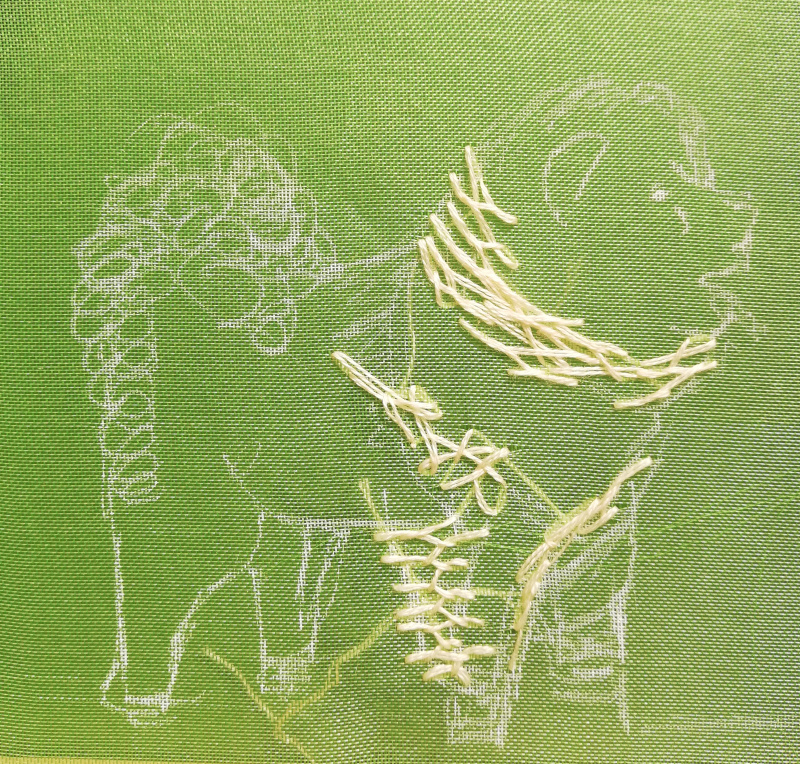
However, for Pooh-Bah the chow, I’m continuing as for the other animals I’ve done, with layers and layers of entangled stitching. I’m having to stitch myself painfully back into the right mindset to see what I need to see in my source material and then to bring it alive in my stitches. In this case, I’m scrambling in a light underlayer where I want the lighter coat, and I’m hoping that the final layer, in the direction of growth, will then look like the deep, fluffy fur of the animal.
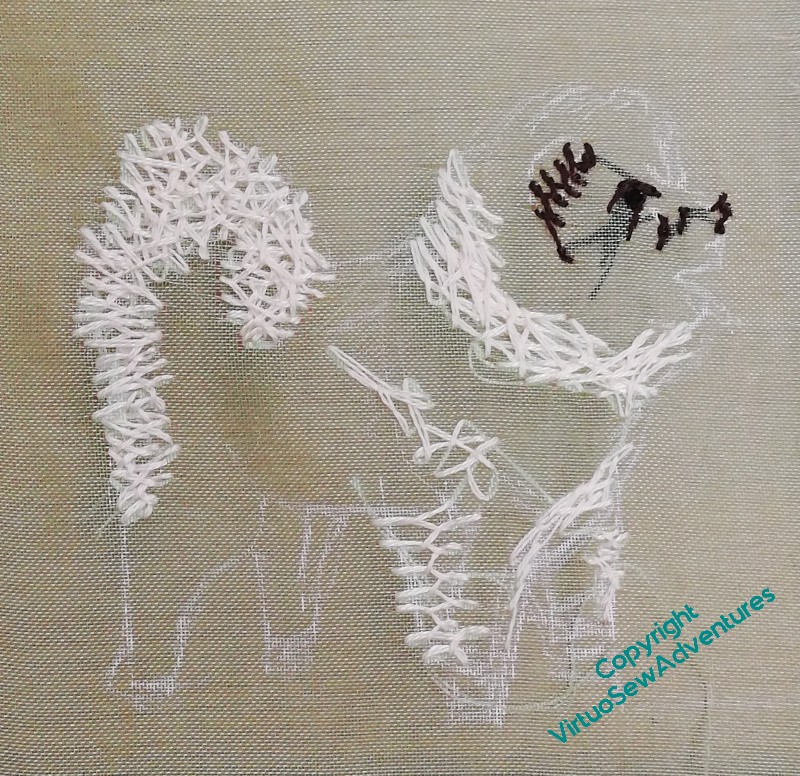
There’s quite a lot more cream in place. More around the neck, short small stitches on the foreleg, trying to work myself back into my technique. It’s coming, I think. The foamy tail is looking suitably tangled here, and I’ve now added in a few dark stitches, the eye, ear, and start of the nose.
Lotus Flower left front
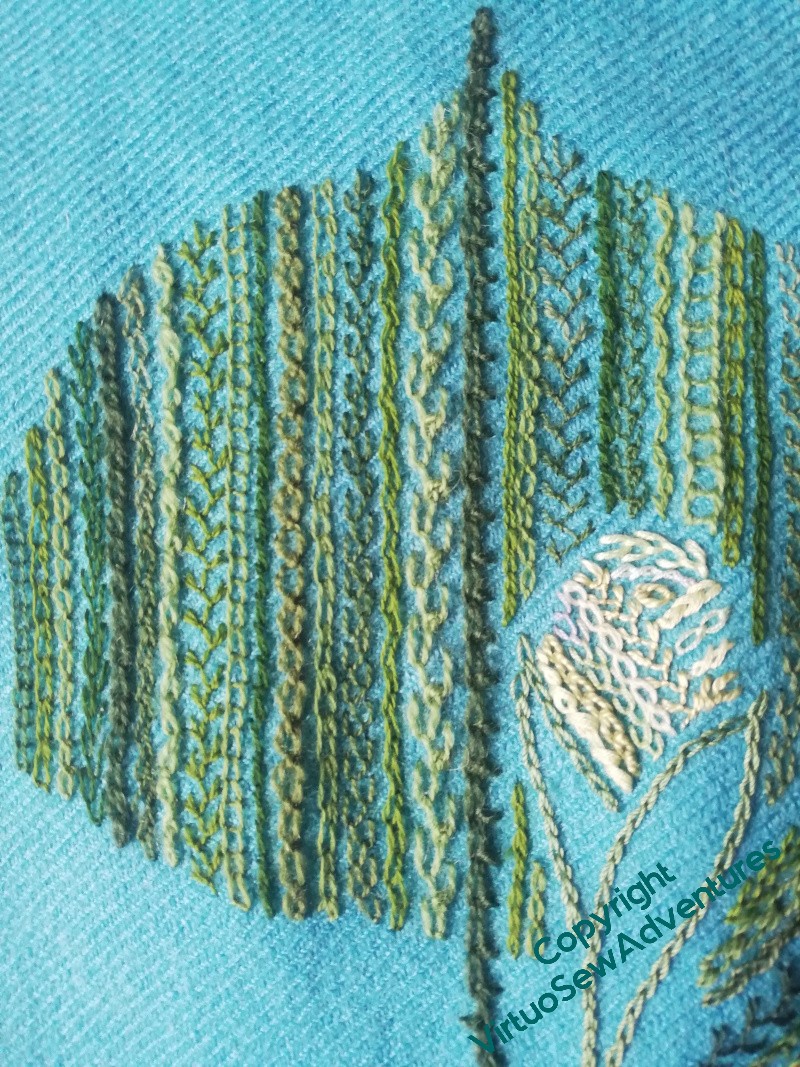
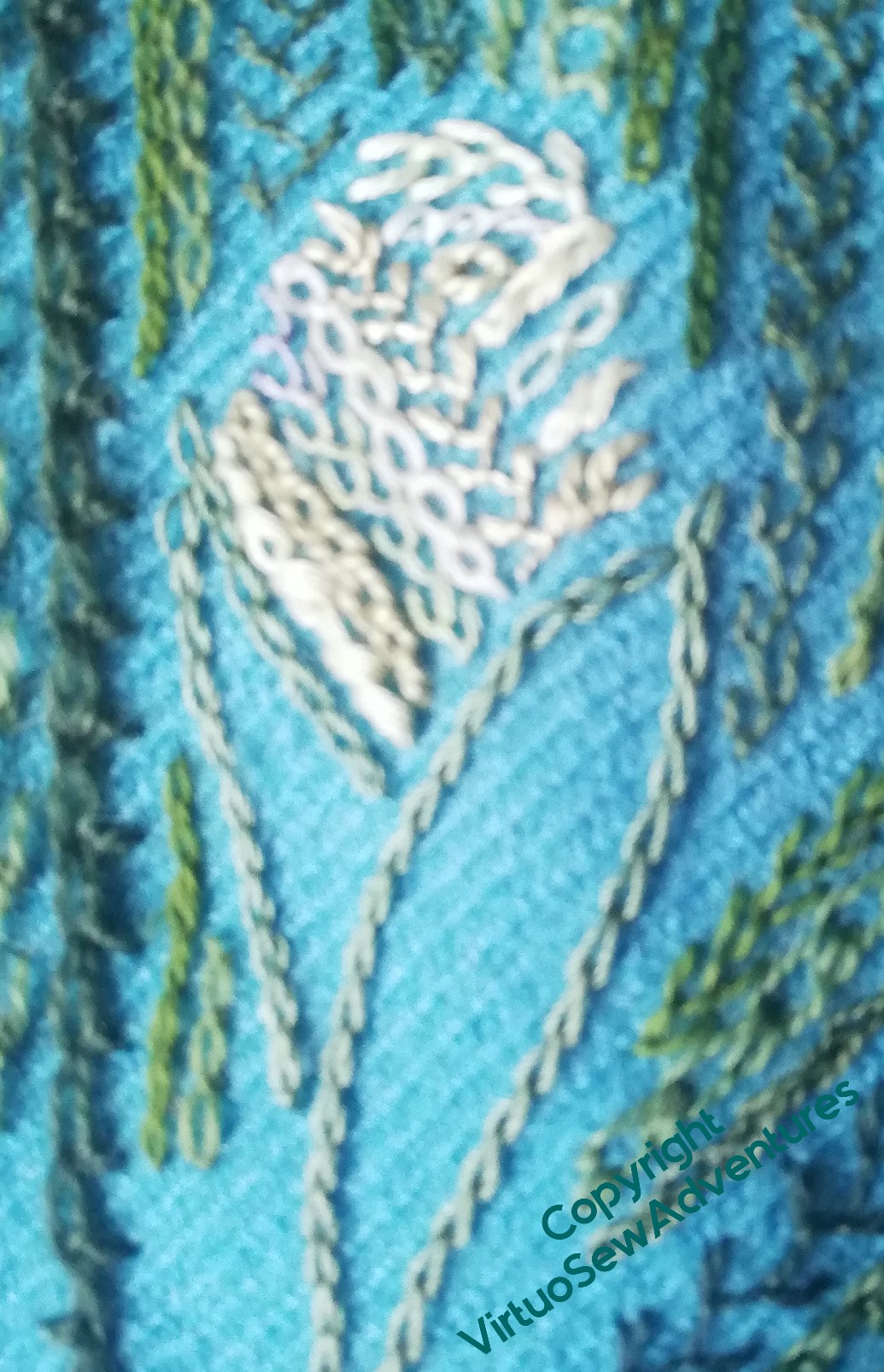
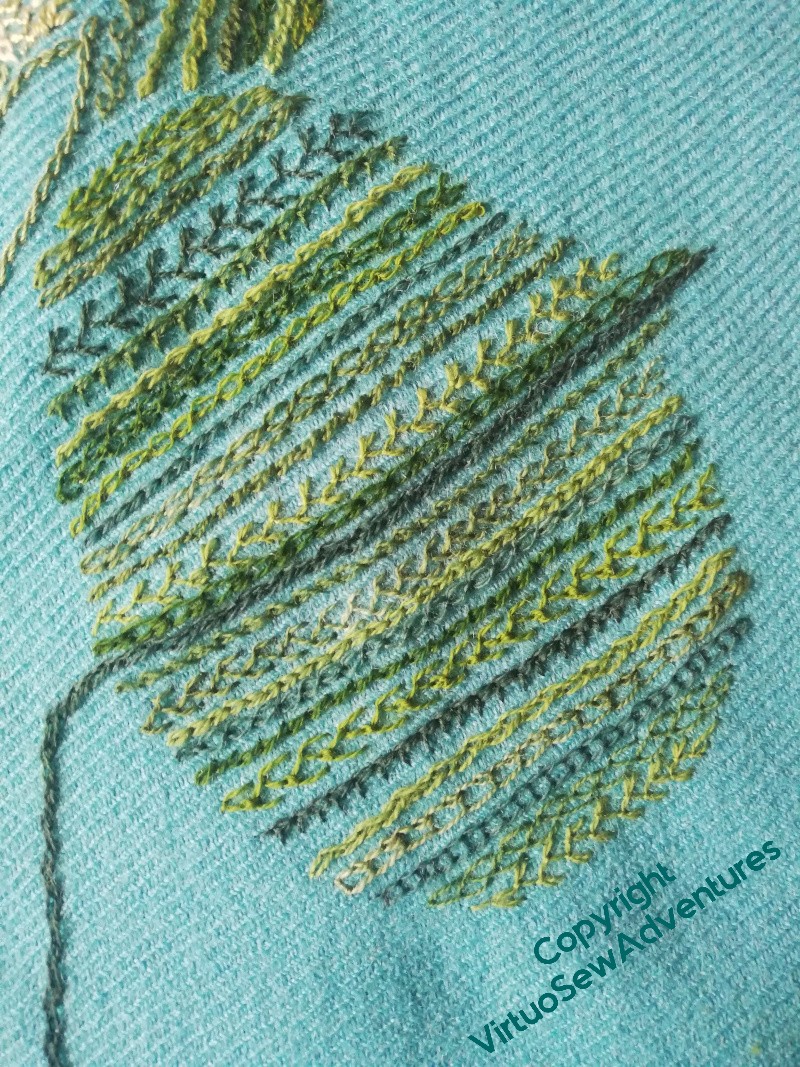
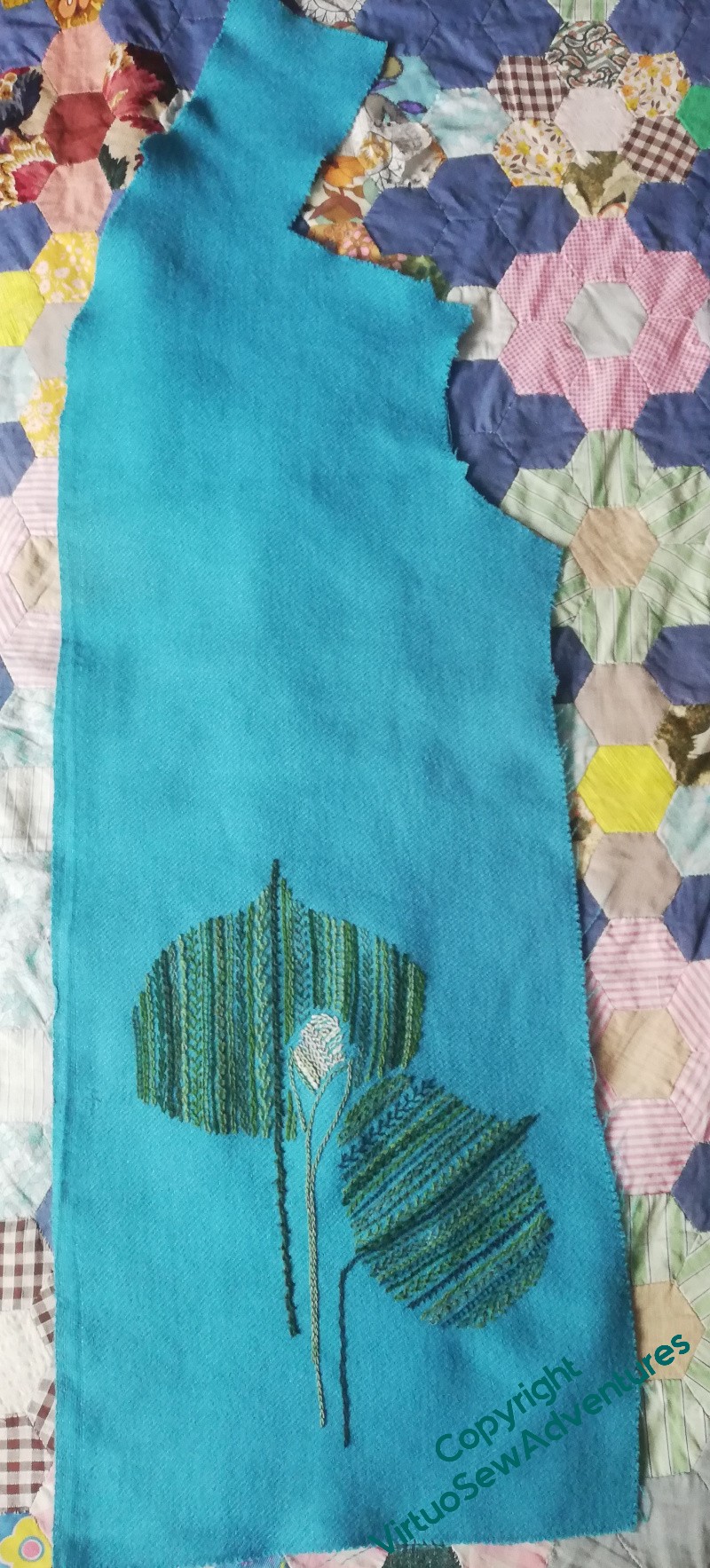
I’ve continued exactly the same style for the Left Front of the jacket as I did for the back – lines and lines of stitches in close(ish) tones. I’ve used some broader stitches – floral feather stitch, feather stitch, Mountmellick Thorn stitch – and some narrower – cable chain, closed feather, shell chain. And I’ve differentiated the two leaves, partly by putting the bud between them, partly by leaving a channel of fabric between them, and partly by including a few darker blue-greens in the lower one.
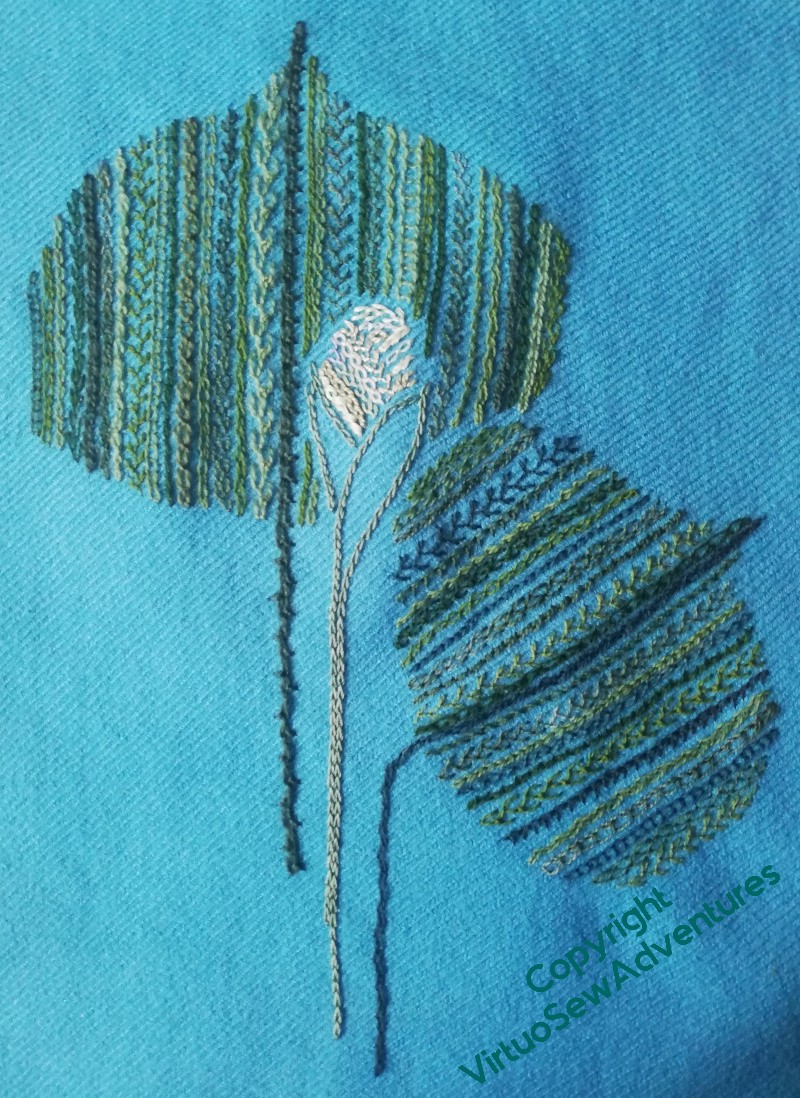
I think I’m fairly pleased so far – although I may add an extra line at the extreme left of the upper leaf as we look at it, to round it out a little more.
First, however, I think I’ll need to get around to assembling the jacket. I’m almost certain I don’t want any embroidery on the right front. Almost.
That, however, is a judgement I can’t make until I’m looking at the garment in at least semi-complete form – which means that if I change my mind, the embroidery will be accompanied by much muttering and the closest approaches to profanity that I ever allow myself. It’s an index of my confidence in my decision that I’m risking it!
Finally getting on with it
It has been quite the epic trial, getting Aethelflaed’s border designed, fiddly and full of repetition. I have learnt over the years that in fact that’s what I need to help me gain some surety in a design. And in turn, that is why I’m working so hard on being able to paint and draw. Improving those skills will make the iteration quicker and easier, so I may even be able to do more and gain greater surety. Rahere and Mother Julian are both going to offer significant challenges that I’ve not quite got the measure of yet!
However, one could write a substantial article on the various choices of design transfer method and when to use them. In fact, I’ve already written a blog post, many years ago during the Great Lady’s Magazine Stitch Off (happy days!), which described the methods I had experience with, and what that experience was. There are useful responses in the comments, too, describing other experiences and favourite tools.
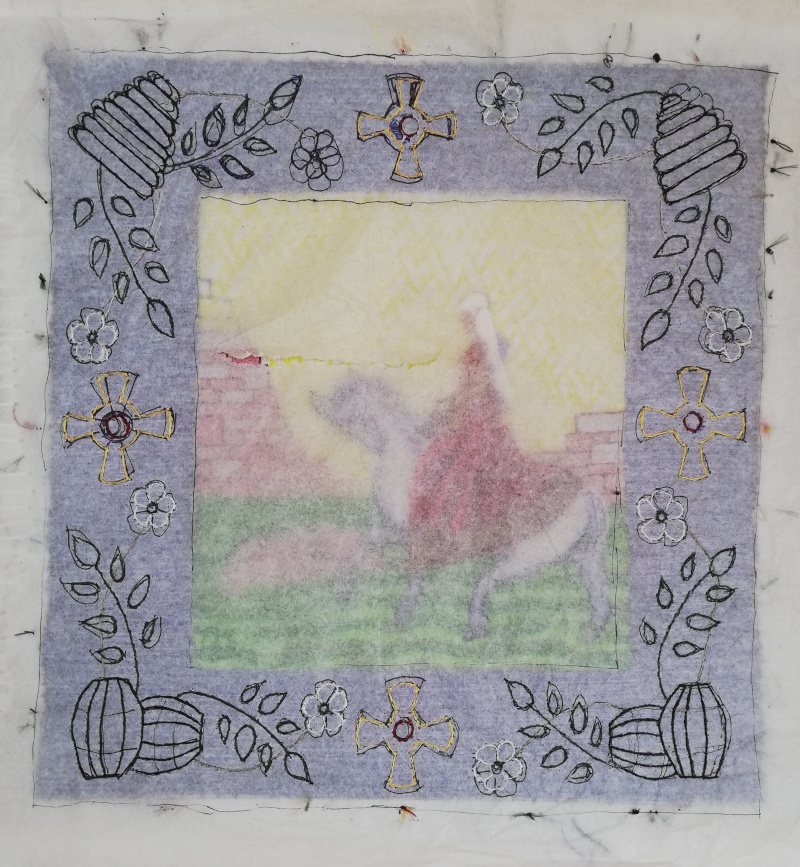
In the case of these Opus Anglicanum panels, there’s really only one sensible choice of design transfer method. Since I will be stitching over stitching, and what’s more, that stitching is in silk, I really can’t attempt to draw on it or transfer marks to it.
That leaves the running-stitch-through-tissue method, except that I discovered with William Marshall that that didn’t make the design clear enough to follow! Having learned from that, therefore, I went directly to split stitch through the tissue paper. It took several mornings of stitching, but I got there in the end.
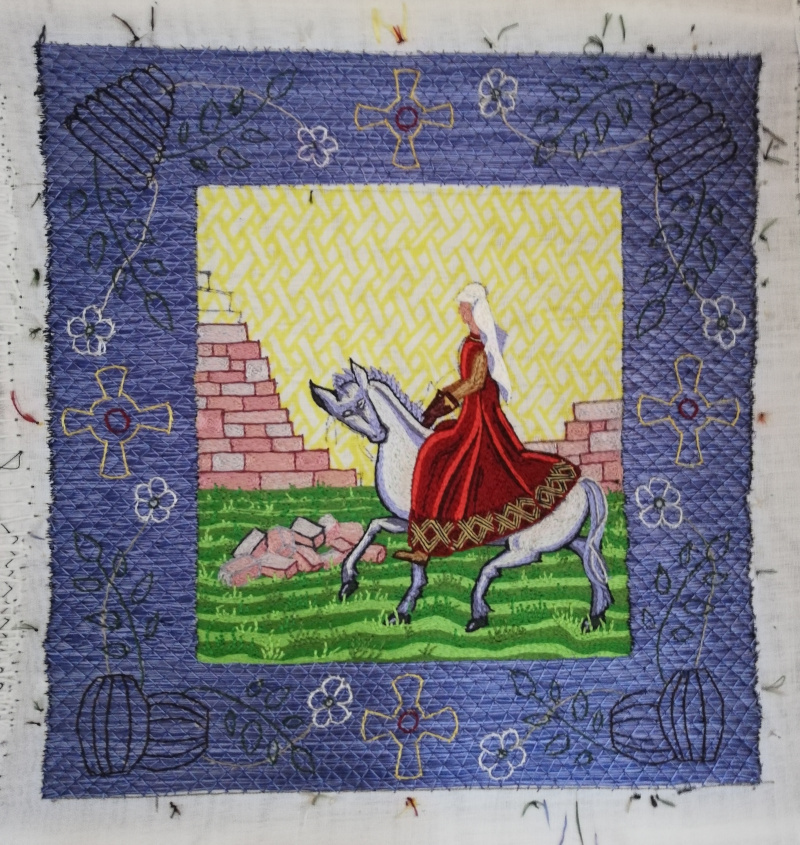
And I have now managed to get started on it. I’m using blended strands in a couple of places – as I’ve said before, I’m not attempting to do something that looks as though it was done during the medieval period. This is a modern piece, by a modern embroiderer, exploring how the ancient and modern techniques can be in conversation with one another.
And yes, that does sound perilously like an artist statement in an exhibition, but it captures the sense I have of the techniques alternating the lead, as it were. It doesn’t really sound better if I say the techniques are dancing, does it?