About Rachel

View all posts by Rachel
Close Ups on the Flowered Blouse – Part Two
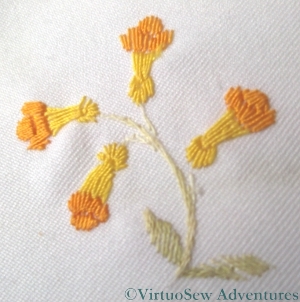
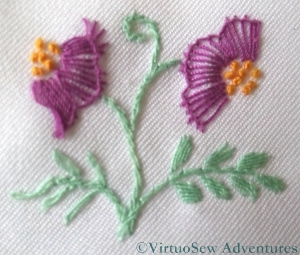
Flower 6 - Close Up
Here is the second installment of close-ups of the Flowered Blouse embroidery. I’ve noticed in picking out the Needlewoman magazine that the transfers came in that the colours I have used bear absolutely no resemblance to those suggested. For instance, flower 6, here on the left, is named as “Lobelia”, and a quick search suggests that real lobelias are bluey-purple!

Flower 7 - Close up
Flower 7, here on the right, is the same as Flower 2, but in different colours, and in fact stitched more openly. It is described as a Convolvulus in the the magazine.
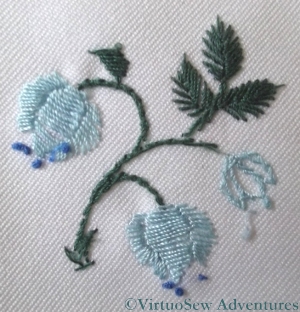
Flower 8 - Close up
The Flower 8 is the same as Flower 3. This time I used the same stem colours, again to help maintain a certain unity. They are supposed to be Globe flowers.
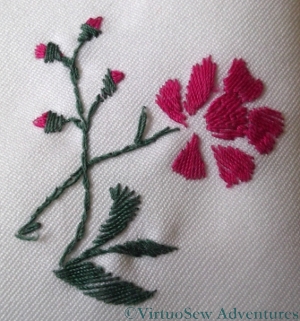
Flower 9 - Close up
Flower 9 is the same pattern as flower 5, and I think is supposed to be a Peony. I distinctly remember finding this one troublesome to stitch – partly, I think, because of the size of some of the stitches, and partly because I couldn’t make sense of the flower as depicted in the transfer. Nowadays, of course, I would go and find a peony, and stare at it until it made sense, but that method had not occurred to me at the time!
Flower 10 - Close up
Flower 10 is described as a Wood Anenome. Like Flower 4 (Forget-me-nots) it shows the edge of the blanket stitch curling in, rather than staying flat, but I am glad to see that at least the French knots loook better than I expected. I have always had trouble with French knots…
The magazine suggests a variety of uses for these transfers, including a “delightful party frock” for a little girl, a “dainty bed jacket”, and embellishment on a “puff handkerchief” which is an accessory I’ve never heard of before. For once the internet has not been my friend, although the drawing suggests some sort of combination of a powder-puff and a handkerchief that I strongly suspect would be nothing like as practical as the “two-tools-in-one” brigade would have us believe!
Tudor Pincushion Progress
Tudor Pincushion Silkwork Finished!
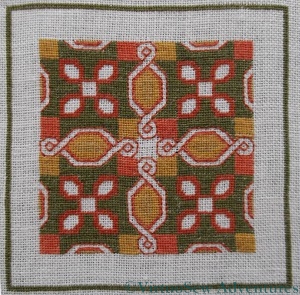
Finally, I have finished the silkwork on the Tudor Pincushion, which is part of the Tudor and Stuart Goldwork Masterclass course I am following.
I think I need to find something that is less fine stitching than this, to give me a rest from all these tiny stitches!
Still, you can see that the final pattern is simple enough in concept, and there is just enough subtle variation in the colours to make the design interesting. The final effect is almost one of a woven fabric, as though the goldwork were embellishing a genuine tapestry. Remember that a real tapestry is woven (the Gobelins ateliers in France are the best known, historically, although a lot of tapestries I’ve seen have been from the Netherlands). A real tapestry is not worked in tent stitch on canvas, whatever the kit manufacturer says, and the Bayeux Tapestry is in fact an embroidery!
First Stage of Goldwork
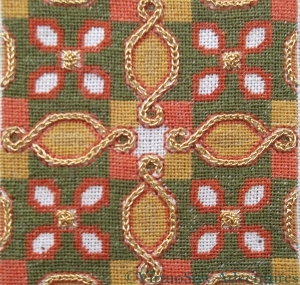
I’ve also begun to work on the goldwork stitches. The small gold spots are worked in Eight Legged Spider’s Web Stitch which I first encountered in Month Four, and which is a great trial at the size it needs to be on the pincushion. I’ve not quite persuaded myself that I need to restitch them, as they didn’t markedly improve over the four I’ve done, but I am certainly considering the possibility.
The channels between the back stitches are filled with Reverse Chain Stitch, which I first encountered at the very beginning of the goldwork section of the course. This is an easy stitch to do, and very satisfying to see it build.
The course materials have included two Japanese hand made needles, which I was hoping to experiment with at this point, but I can’t even thread them! The eyes are much too fine for the thread, which is awkward, since I may be wasting quite a bit of gold thread unnecessarily because my ordinary needles strip the gold from its core.
There has to be a better way…
Close-ups on the Flowered Blouse – Part One
Flower 1 - Close up
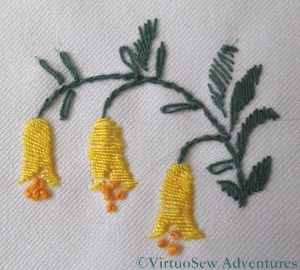
You may recall, not so long ago, a post that I wrote about a blouse embroidered some years ago, during a particularly impoverished period in my life. Here are the promised close-ups of the floral motifs.
Or at least some of them. When the connection started slowing when I put all ten in one post (before I even started to add any text!), I decided to split them up. I’m hoping to put five per post and just write two posts…
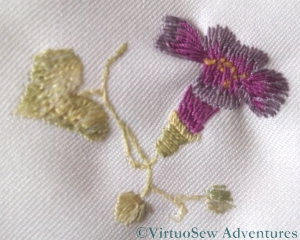
Flower 2 - Close Up
I’m no botanist, and if I am honest, I suspect the original designer wasn’t either. The various pictures and descriptions in the magazine did not suggest a slavish adherence to the natural colours of the flowers – even supposing one could be sure of their likely species!
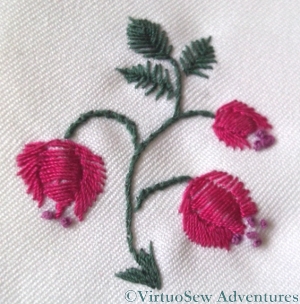
Flower 3 - Close Up
The polyester was not an easy fabric to embroider, and frankly the blouse wasn’t worth the effort I put into it, being a lot like a cheap school or office uniform blouse, but as I said in the original post, I didn’t really have a choice at the time. That said, I do still wear it, not without pleasure, so there is something to be said for all that effort, perhaps.
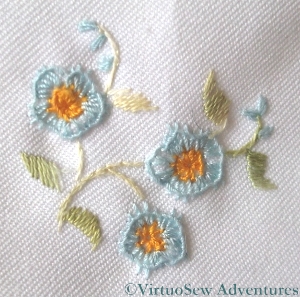
Flower 4 - Close Up
The stitches used were very simple ones, for the most part – satin stitch, fishbone stitch, stem stitch, blanket stitch, and the occasional French knot. The close ups show that the blanket stitch refused to settle properly and the spine of the stitch has rolled inwards from the edge, but that may simply be the result of years of wear and tear. The blouse goes in the washing machine when it needs a wash – inside a pillow case or lingerie bag, admittedly, but I don’t hand wash it.
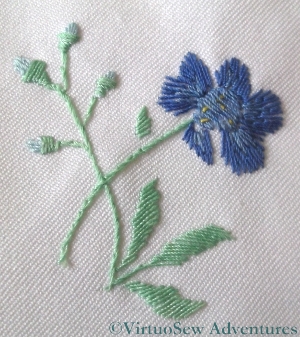
Flower 5 - Close Up
When I was choosing the colours and the stitches was more concerned to balance the colours across the front of the blouse than to create accurate depictions of plants, but for all that, there are some motifs more reminiscent of the real thing than others!
A flowered blouse
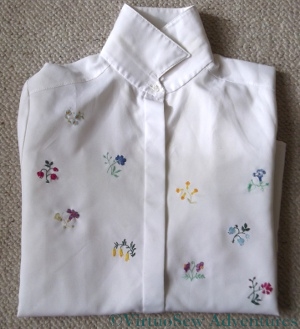
Blouse embroidered with flower sprigs
As Spring shows her head after the chill of Winter, I am beginning to fish out clothes other than bulky winter woollies. This is a simple polyester blouse I embroidered some years ago when I had time, an itch to embroider, but absolutely no money to buy fabric.
I used a Free Transfer from The Needlewoman of January 1934 (from the boxful that Grandmama gave me), showing sprigs of flowers which they suggested might be used for lavender bags, traycloths, handkerchiefs, or underwear (if only I had the time and skill to make lovely silk embroidered undies!). The silk threads came from my stash (even fifteen years ago my stash was extensive and varied!), and in fact I think the whole idea of the project was that I wanted to use those threads in particular.
I’m not really a “floral”-type person, or at least the florals I stitch tend to be quite heavily stylised, and I’m also not someone who likes perfect symmetry. So I snipped out some elements from the transfer and arranged them irregularly on the front of the blouse. Once they were transferred, I arranged the threads, so each colour appears on each side of the button placket, but not on the same flower sprig.
I will provide close ups in another post, when I have worked out how to format them!
Tudor and Stuart Master Class – Month Eleven
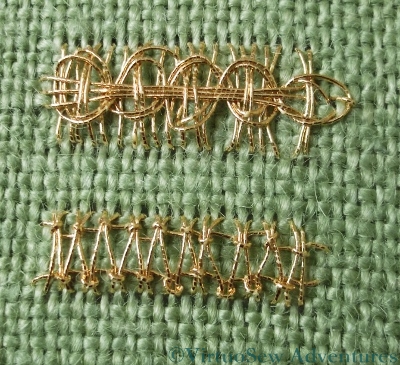
Month 11 Goldwork Stitches
So while I continue with the silkwork for the Spot Sampler and the Tudor Pincushion, here are the two new stitches for Month 11 of the course.
The two stitches are Guilloche on Ladder Stitch, and Hemstitch on Ladder Stitch. In both cases I have cheated and just worked a panel of straight stitch bars as the foundation. This is because I wanted to get a firm grip on the structure of the stitch, rather than spending my time on working the foundation.
As the stitches become more multi-phase and more complex, the green doodle cloth is becoming a less suitable foundation. While it makes things easier by making the stitches larger when using the counted diagrams for them, it also makes things more difficult by making the stitches larger! I find that I am having difficulty in getting tension and stitch length neat and correct – in fact, you can probably see that from the rather floppy loops on the Guilloche Stitch Of course when I come to work on the real fabric using the real gold and silver threads, this problem should be much reduced, but I think I will find myself using a stiletto or a laying tool to try to keep the thread under rather closer control, even so.
The Camberwell Panel – Six
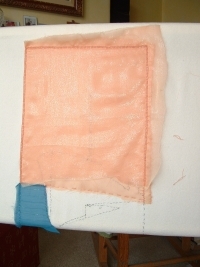
Gauze doubled over the sky
I finally decided that I wanted to use two layers of gauze for the sky. The apricot gauze has a slightly reflective surface, which would make the sky glow behind the ship.
I also worked blanket stitch around the outside edge of the panel. At this stage I intended to use a raised band stitch of some sort to frame the work, so the blanket stitch was to form the foundation of the final raised band.
Later I was to discover that the Camberwell herself had Other Ideas, and all of this was completely changed.
I think it is important to show some of the dead ends I investigated here, or at least to describe them. One thing that people who are at the early stages of their creative life always assume is that everyone else gets straight from “Germ of an Idea” to “Finished Design” without really passing through any points in between.
We don’t.
Any of us.
And we are not fair to them – and risk discouraging them – if we allow them to think that we do.
Oops. Rant over!
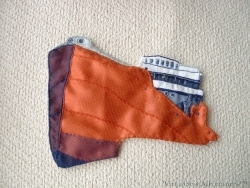
Camberwell - the Slip
This next photo shows further progress on the slip for the hull, in which I worked on the superstructure of the bridge and living quarters. I pierced the cotton drill where the anchor chains are lead through the hull and worked one of the portholes on the bridge in a raised satin stitch boss. Almost all the actual embroidery here used ordinary stranded cotton, although sometimes I blended colours in the needle.
Tudor And Stuart Masterclass – Pincushion Progress
Tudor Pincushion Progress
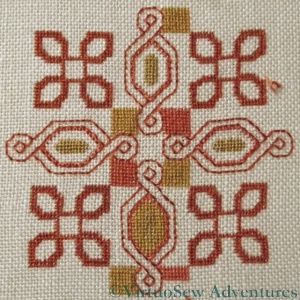
So here is the progress on the Tudor Pincushion.
There are two close shades of red and two close shades of tan in the design, – this will increase the appearance of rich, subtle colour variation in the final piece, which will provide a gorgeous background for the gold and silver threads. It also means that I have to be super-organised with my thread. As soon as I cut a length, it is wound onto a card with the thread number written on it, because even my daylight lamp sometimes isn’t enough to help distinguish the colours.
I’ve miscounted and had to restitch the corner motifs in a couple of places, but that is probably because, first, it is a very fine count of fabric, and second, tent stitch is an oriented stitch.
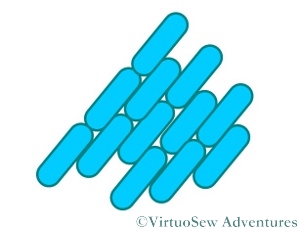
Tent Stitch - demonstrating edges with the orientation and against it
That is, because it creates a diagonal stitch, diagonal elements of the design look different when stitched, depending upon whether they slant with the stitch or in the opposite direction. This doesn’t cause a problem once the piece is finished – especially given how small the stitches are! – but it does mean that it isn’t so easy to know at a glance whether details are right. When the details are wrong, it becomes clear that they are wrong just as soon as you stop stitching, and then it becomes a matter of how much or how little needs to be unpicked.
Of course, I suppose I could interpret (probably correctly!) that as a sign that I’ve been stitching for too long and my eyes are tired…
More Details on the Peacock Skirt
Do you remember my Peacock Skirt? Megan of Elmsley Rose asked for some more close ups of the embroidery, and while I have been remodelling it (for a slightly less sylph-like waistline – I was a skinny teenager!) I took the opportunity to take some.
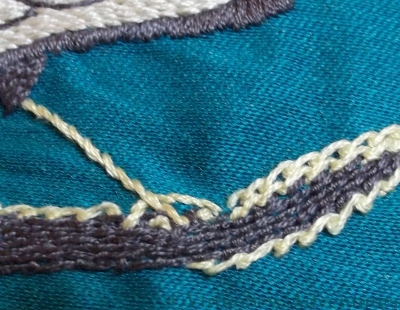
Close Up Of Branch
This, therefore, is a close up of the branch the peacock is standing on. I simply followed the instructions here, using coral stitch for the dark grey elements of the branch and scroll stitch for the pale yellow. I think that now if I were do something like this again, I would spend a bit of time tweaking the colours a little more, because I’m not sure I like having the peacock’s legs the same colour as the highlight on the branch!
You can see, too, that I struggled somewhat with tension and the fabric is a little puckered. This seems not to matter when I’m wearing the skirt – people still admire it!
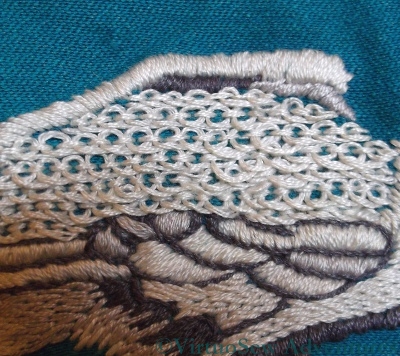
Pekinese Stitch On The Peacock's Back
The instructions for the Peacock’s back said to work the Pekinese Stitch fairly loosely to create a slight variation on colour and texture. Since the embroidery was worked in two strands of stranded cotton, that too contributes to a slightly “fluffy” appearance. The satin stitch sections around where the wing should be are in slightly different shades of grey, and worked at slightly different angles, again to produce varying tones and textures.
Looking at this close up now, I think the rows of stem stitch used for some sections of the body represent the feathers of the bird more successfully (although, again, the design doesn’t attempt a photo-realistic representation) than the sections of satin stitch or pekinese stitch. I do admit, however, that it was the chance to work pekinese stitch that attracted me to the design!
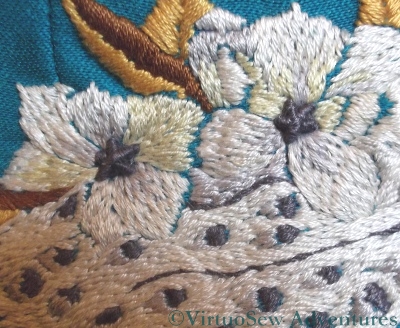
Spiders Web Flower Centre
The centres of the flowers were worked using a Spiders Web Wheel. The instructions specified working as much thread into the stitch as possible to obtain a raised and highly textured effect. This contrasts very well with the long and short stitch flowers and the stem stitches on the peacock’s tail.
Again, coming back to these pieces years after stitching them, it’s fascinating to look at surprising details. The gold and russet leaves look as though they’ve been padded, but I’m quite sure they weren’t. I remember doing padded satin stitch for the first time quite recently and wishing I’d known about it earlier!
Dreams of Amarna – The Patches on The Map
After finishing the text and the villages on the Map, I need to decide what to use for the cultivation… You may recall from my earlier post that I have decided on the stitch I’m going to use – tête de boeuf stitch – but that I’ve not quite worked out what thread to use.
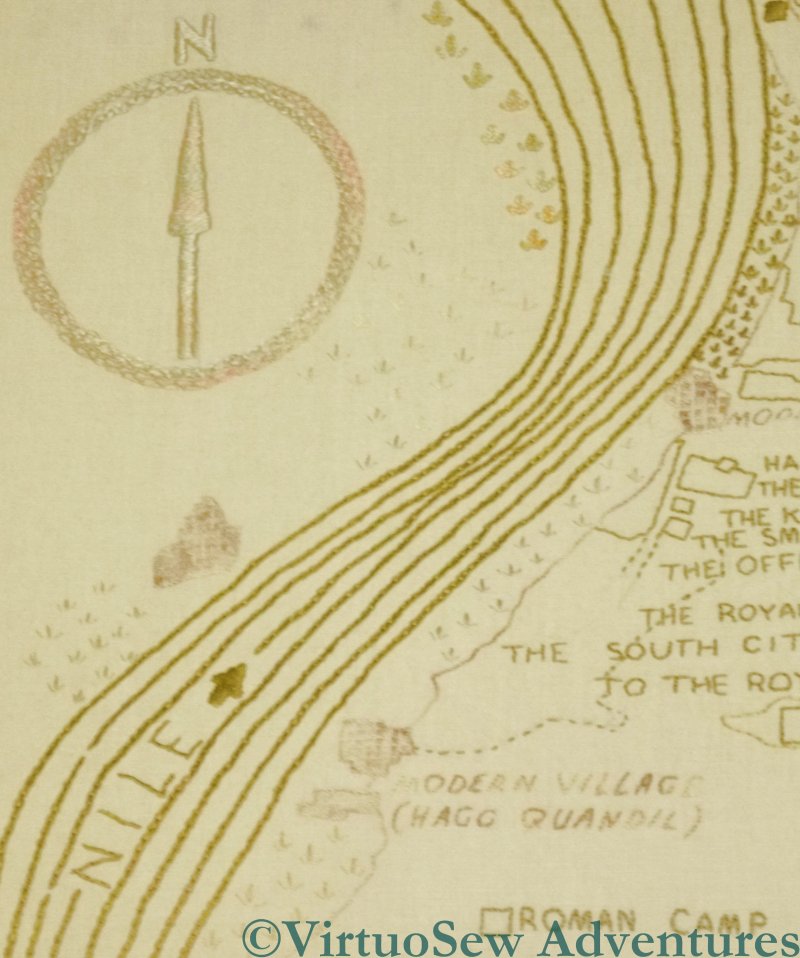
Trial Patches On The Map
I’ve stitched a variety of trial patches, using stranded cotton, flower thread, pearl cotton, and several different silks, and now all (all!) I have to do is make a decision. I’ve propped up the fabric in the living room and stand staring at it every chance I get!
So far, I feel sure I won’t be using the pearl cotton (too chunky) or the flower thread (also too chunky), but that leaves me two variegated silks (one pale green shading to pinkish purple and one brighter green shading to terracotta) and two plain silks (one slightly darker than the colour of the fabric, and one the same colour as the stranded cottons I used for the contour lines. I’ve tried very hard to get a photo that does reasonable justice to the various threads and colours, but I don’t think that the one I’ve got here helps very much…
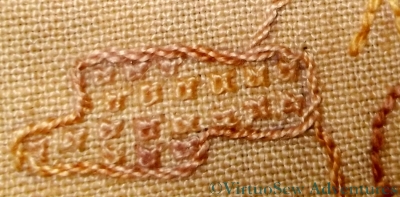
Sorbello Stitch Village
I chose Sorbello stitches to represent the modern villages. These are worked at a very small scale, as you can see from the thread count. Again, had I followed the cartographer’s symbols, I would have used something like Jacobean Couching, but I felt that this stitch in fact reflects the idea of buildings rather better. I’ve used the same gold-shading-to-purple thread for all the modern villages, both the names and the associated areas. It doesn’t draw the eye, in real life, quite as much as you might expect.
An Experimental Seahorse
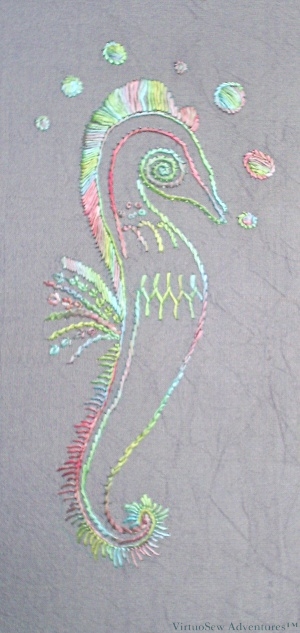
Small Seahorse in overdyed filament silk
Sometimes I play with threads for no other reason than to play with them. In this case Stef Francis gave me a skein of overdyed filament silk to play with. She tends to create a much more “freeform” style of embroidery than I do and she wanted to know what I thought of the thread.
I found a simple transfer that offered scope for several different stitches, and started playing. I had been concerned that it might twist up when I didn’t want it to, but it stayed fairly flat most of the time, and it is noticeable that the stitches look and feel different in a flat thread, as compared with a round one.
For example, in a round thread, the stem stitch line tends to be more textured, and the direction of slant is more obvious. Here, the slight flatness creates a smoother line. That same flatness makes the satin stitch smoother and cleaner looking. It also helps to mask any slight imperfections in the stitching!
On the other hand, that same slight “spread” of the filaments clouds the distinctiveness of the Wheatear Stitch in the fin on his back, so not an unalloyed success, but interesting and worth trying all the same.
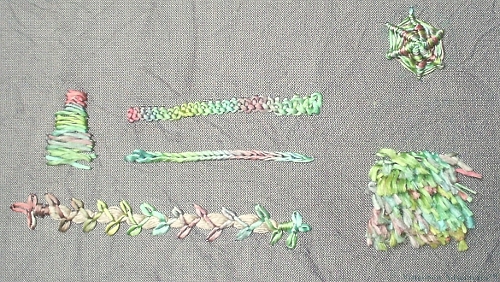
Silk Filament Experiments
Then I started just to play with stitches in a spare corner of fabric. The Braid Stitch (top row) works quite nicely, I think, and the Turkey work (bottom right hand corner) is better than I hoped, especially considering that I’ve not done it before. I can’t imagine what I would use that texture for in these colours, but Stef has a fabulous range of overdyed shades and I am sure that something would spring to mind for one of them. The little triangle of Closed Herringbone Stitch is hardly a success, but that may be a problem of scale. I don’t think the Braid Stitch would have worked if it had been any wider than it is here.
I don’t think this thread adds anything to the Reverse Chain Stitch, or to the Spider’s Web Wheel, but I do like the Chained Feather Stitch couching. In fact, that might have been better had I had the courage of my convictions and made the base that’s being couched about twice the width.
All in all, I had a lot of fun playing with this thread. I’ve now got a much better idea of What To Do and more importantly What Not To Do with it. One important thing to remember – make sure hands are smooth! Silk catches on everything and filament silk does so even more!