Tag: ornamental stitches
Canvaswork Inspired by Clarice Cliff
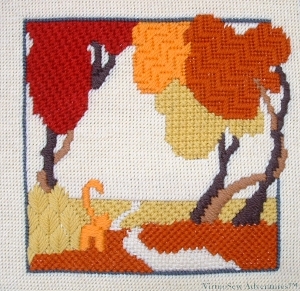
"The Cat Who Walked By Himself" in canvaswork
The design in counted cross stitch that I created, “The Cat Who Walked By Himself” (now being re-issued by Classic Embroidery – remember how excited I was a few months ago?) was such a success that I experimented with other ways in which the basic design might be used.
First of all, in ordinary tent stitch at a large size. Pleasant enough, but rather dull – for me, at any rate.
Then, at the same size as the original cross stitch, but using ornamental canvaswork stitches. Originally I had in mind to run classes based on these designs, in one of the local shops, but the shop closed, life changed direction, and I’ve not done anything with it yet.
As I post more of my early canvaswork, you will probably notice some stitches recur. For example, I like Upright Cross Stitch – it is sturdy and heavily textured – and Milanese stitch (I think just because I like the name). I usually sneak in Leaf Stitch as well (remember the Elephant of Considerable Charm?). I’ve also used Jacquard Stitch, and Satin Stitch. The background was worked in Encroaching Gobelin Stitch.
I’ve not put the heavy outlines on yet. Tapestry wool would be too heavy – some of the areas are quite small – but on the other hand, I don’t want to use something that will draw too much attention to itself by being shiny..
The Canvaswork Knot Garden
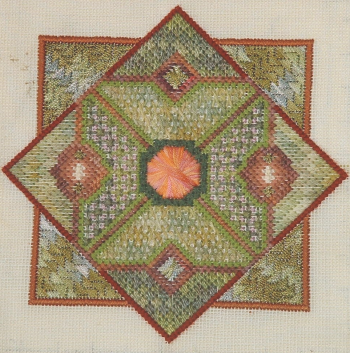
The Canvaswork Knot Garden
This piece arose from my fascination with the knot gardens and parterres of early formal garden design.
It began with the octagonal Rhodes Stitch at the centre. I wanted to use the stitch, but not as part of a repeating pattern. In fact it proved much more difficult to get right than I was prepared for. I now can’t remember how many times I unpicked that wretched octagon!
From that central point a variety of little paths and beds radiate out, using slightly subdued colours again inspired in particular by the colours of herbs. The variegated threads are all from Stef Francis, pearl and soft cottons, and a chainette (in the corners). The stitches include Hungarian Stitch, cashmere stitch, and upright cross stitch (which for some reason turns up a lot in my canvaswork).
I realised that the interesting stitches I was using weren’t producing complete coverage of the canvas, but I decided not to worry about that, as I felt it might lead to something interesting.
As you can tell, what it has not yet lead to is a sensible finishing decision. I cannot for the life of me decide what to do with this. It would be a pity to put it under glass, as that wonderful raised boss of the octagon would lose all of its impact. At the same time, because the coverage is so varied, and because the octagon is such a vulnerable point, turning it into a cushion seems positively half-witted.
Take heed, and design your pieces with their end-use in mind!
The Elephant Of Considerable Charm
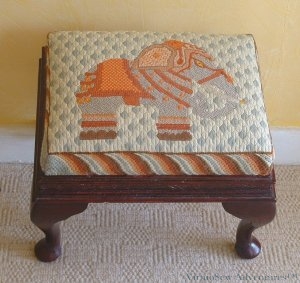
The Elephant Footstool in canvaswork
I don’t confine myself entirely to surface embroidery. I’ll give most things a try, and needlepoint is fairly high on the list of things I enjoy.
This is the second footstool I made. The first one, which I made for Grandmama, was an adaptation of a design from the Reader’s Digest Complete Guide to Needlework, but I designed this footstool for my mother after we had Grandmama’s in the house for a while, and she decided that she really liked Putting Her Feet Up Properly.
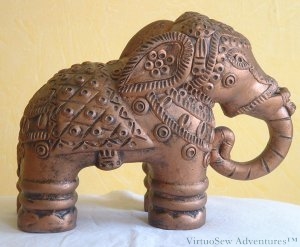
An Elephant Of No Distinction But Infinite Charm
There are several elephant ornaments in my parents’ living room, but the inspiration in this case was a glazed terracotta elephant which we call the Elephant Of No Distinction But Infinite Charm (to distinguish him from the Elephant of Considerable Distinction, who joined the family much earlier, when I was still a child!). I thought his decorated saddle cloth and harness simply cried out to be rendered in canvaswork of some description, and thought it would be fun to try.
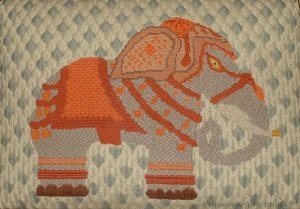
The Elephant In Canvaswork
I used two strands of Paternayan Persian wool for the whole piece. The background is worked in Leaf Stitch Filling in two shades of green. This is partly for a stylised jungle-like effect, and partly to echo the green damask fabric covering the furniture.
The reds, oranges, and browns pick up the curtain colours, and echo the Elephant Of No Distinction himself. The harness uses cashmere stitch variations, the saddle cloth is upright double cross stitch, and for some reason I can’t now recall I chose to use Byzantine stitch on the elephant’s ear.
The sides were worked with a Bargello rope pattern, but I had to fudge the final piece because I discovered the pattern wasn’t going to meet up – I hadn’t thought that far ahead when I planned it (if you can call it planning!). Almost everything I do has a slightly improvisatory element to it and in this case, I left enough space to put my mother’s name around the corner that wasn’t going to match. It almost looks deliberate!
I’m not displeased with him, but I would do something entirely different now, I think!
Extending the Persian Fantasy – More Cacti
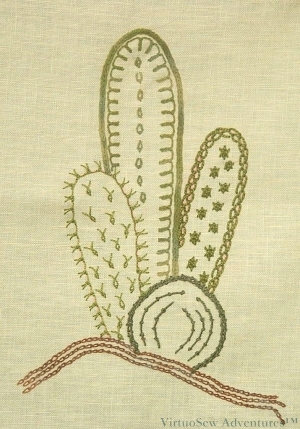
Cactus Extension Design 1
By this time I had run out of the fabric I used for the screen, and I was beginning to realize that if I wanted to continue to embroider in this sort of style I would need to find another suitable fabric. I’d enjoyed the Persian Fantasy so much that I didn’t want to do that…
So I designed two clusters of cacti, to use in experiments. The designs were inspired by the cacti in the Persian Fantasy, but not actually like them, and I worked them on a plain 28count linen intended for counted cross stitch.
I used chain and feather stitches, ornamental blanket stitches, and some isolated stitches as well, all to create variety and and texture. The designs themselves are very minimal, so all the interest in them lies in the combinations of the threads and the stitches.
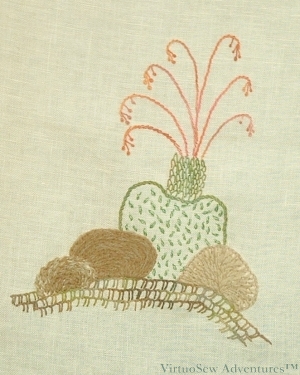
Cactus Extension Design 2
It wasn’t easy – I wanted to use some of the ornamental stitches I had used in the original piece, but the fabric/thread combinations were very frustrating to work with. The linen threads were too closely set and rigidly finished to respond forgivingly to some of the heavier threads, but they did at least provide me with more opportunity for experimentation. Even if my conclusion had to be that I had to find another sort of fabric for this sort of embroidery!
The rocks in the second design were worked using wool as that provides a different quality of matte effect to the effect of a matte cotton.
Where, oh where, did my header come from?
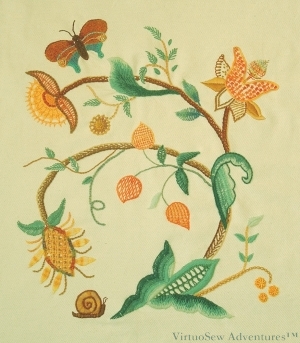
Jacobean Style Fire Screen, worked to go with the living room fireplace
I designed and embroidered this piece shortly after I was married. It was my first design for Our House, and I suspect it gave my husband fair warning (if he hadn’t already guessed) that furnishing it would not be a simple matter of a trip to a furniture shop!
I took some of the motifs from a tablecloth that Grandmama stitched using surface embroidery and needlelace. Then I combined them with some Jacobean leaf shapes and the occasional curlicue. The snail and the butterfly are added because Jacobean designs often included bugs and animals, and although our house is nearer to Arts & Crafts in style than Jacobean I wanted to work on a Jacobean crewel-style design.
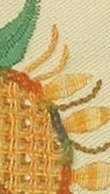
Fragment of the Jacobean Firescreen design, battlement couching and Pekinese Stitch
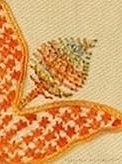
Second Fragment of the Jacobean Firescreen design, star stitch and fishbone stitch
I had enormous fun playing with ornamental stitches and threads. There are Persian wools, soft cottons, pearl cottons, stranded cottons, rayons. The butterfly even had some metallic thread in it, and I don’t often use metallics. Stitches included Battlement Couching, and Pekingese Stitch using overdyed chenille thread, and open Fishbone stitch in a crinkly overdyed rayon.
That rayon thread is much more difficult to embroider with than the chenille, but I am realising as I photograph and study some of my past embroideries that I seem to use a great deal of it. I should have a stern word with myself about that, because every single stitch with that thread is accompanied by muttered swearing – which can’t possibly be good for me!
I seem to be going through a phase of gold and teal at the moment, so when I wanted a picture of some of my embroidery to put in my header, this seemed the obvious one to pick. I’m not wholly happy with some elements of the design, but every time I see it I remember the fun I had making it. So it is a good representation of the sort of “virtuosewer” I would like to be.