Finally getting on with it
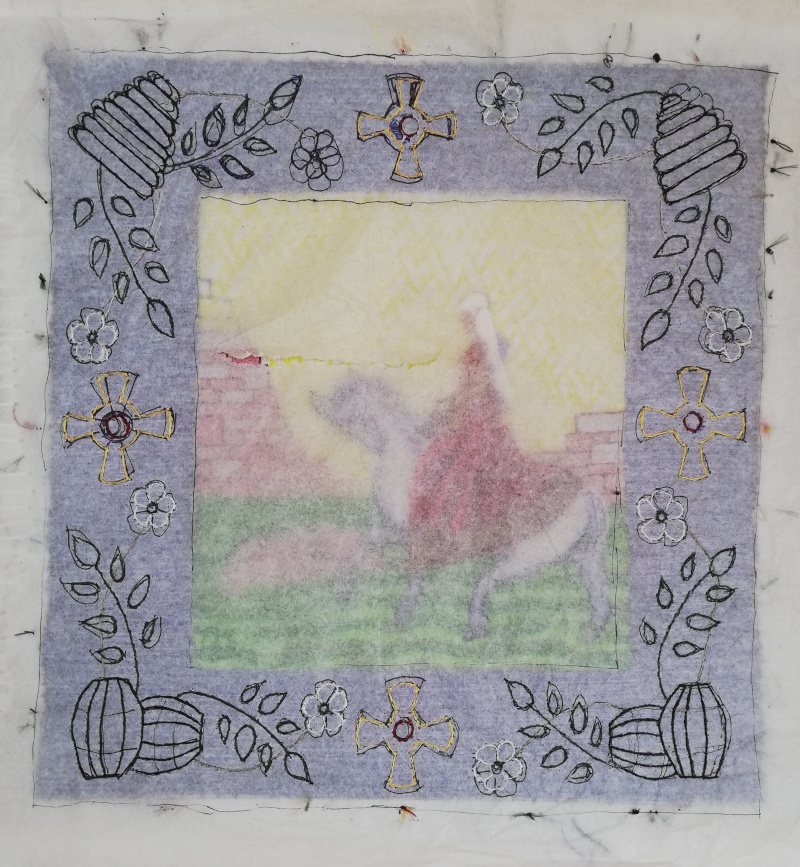
It has been quite the epic trial, getting Aethelflaed’s border designed, fiddly and full of repetition. I have learnt over the years that in fact that’s what I need to help me gain some surety in a design. And in turn, that is why I’m working so hard on being able to paint and draw. Improving those skills will make the iteration quicker and easier, so I may even be able to do more and gain greater surety. Rahere and Mother Julian are both going to offer significant challenges that I’ve not quite got the measure of yet!
However, one could write a substantial article on the various choices of design transfer method and when to use them. In fact, I’ve already written a blog post, many years ago during the Great Lady’s Magazine Stitch Off (happy days!), which described the methods I had experience with, and what that experience was. There are useful responses in the comments, too, describing other experiences and favourite tools.
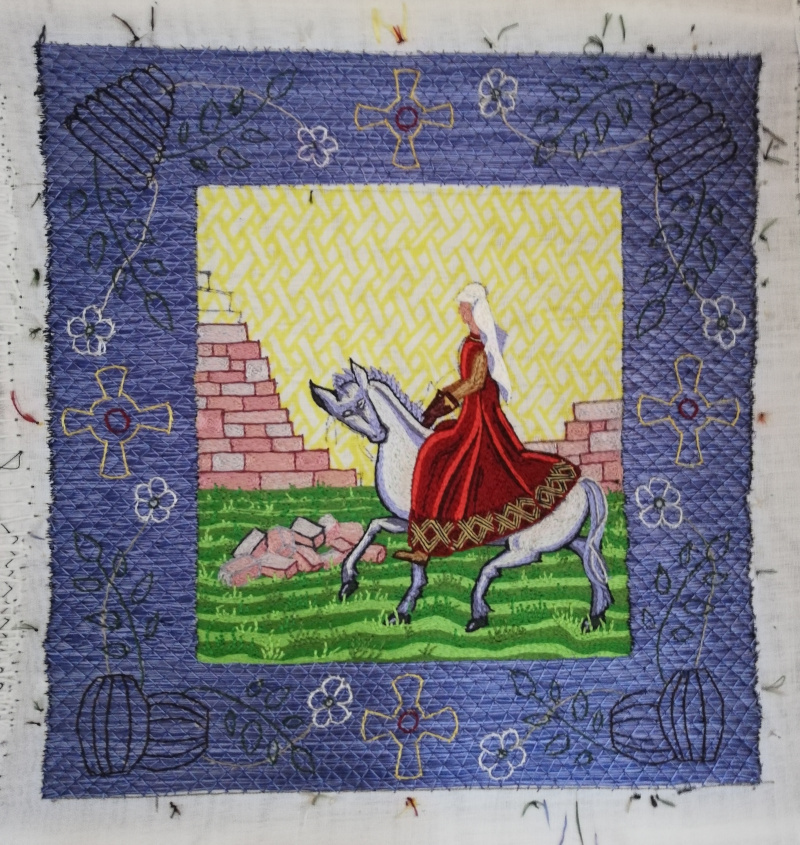
In the case of these Opus Anglicanum panels, there’s really only one sensible choice of design transfer method. Since I will be stitching over stitching, and what’s more, that stitching is in silk, I really can’t attempt to draw on it or transfer marks to it.
That leaves the running-stitch-through-tissue method, except that I discovered with William Marshall that that didn’t make the design clear enough to follow! Having learned from that, therefore, I went directly to split stitch through the tissue paper. It took several mornings of stitching, but I got there in the end.
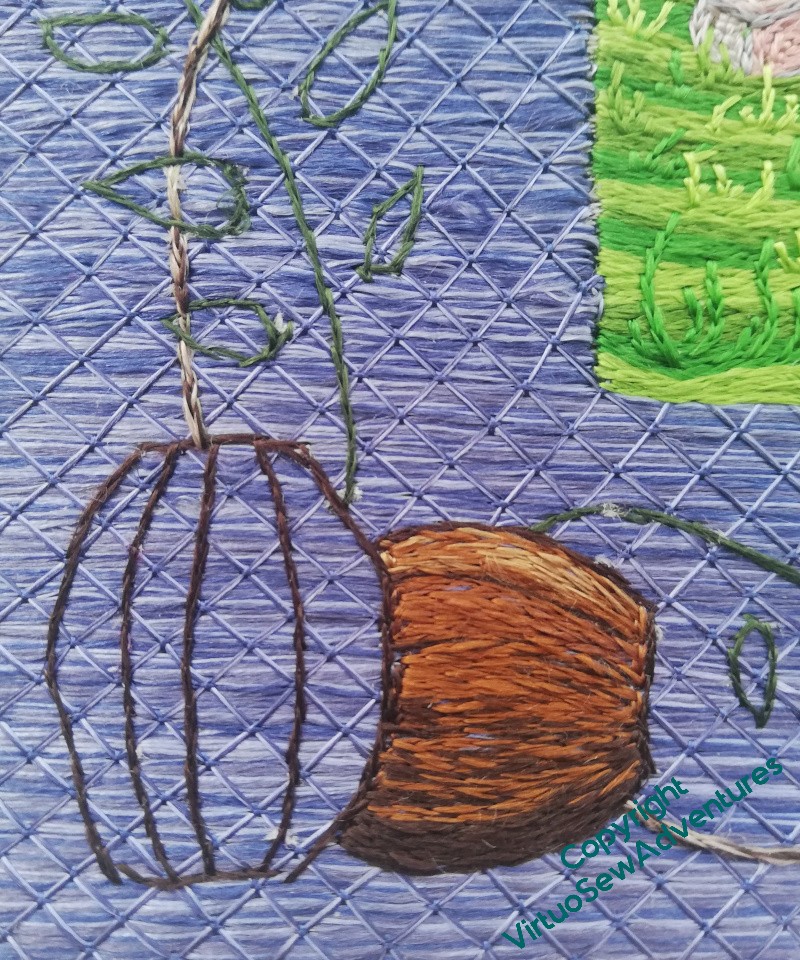
And I have now managed to get started on it. I’m using blended strands in a couple of places – as I’ve said before, I’m not attempting to do something that looks as though it was done during the medieval period. This is a modern piece, by a modern embroiderer, exploring how the ancient and modern techniques can be in conversation with one another.
And yes, that does sound perilously like an artist statement in an exhibition, but it captures the sense I have of the techniques alternating the lead, as it were. It doesn’t really sound better if I say the techniques are dancing, does it?

The split stitch method is a great idea – it looks really clear and unlike anything drawn or marked, it can be unpicked if you need to.
Marking a stitch line on stitches must be a nightmare, so yes, the tissue paper method sounds the most suitable.
What do you do to keep the tissue paper as whole as possible? I fear the paper would shift and ‘misbehave’ a lot?
Queenie
There is a method for every situation – finding the rignt one at the right time is the problem. Good to have that out of the way.
Seeing the design appearing on the background makes it clear that this is a well-planned border that adds to the overall effect of the panel and enhances the storytelling in the picture. I hope the stitching goes smoothly.
I learned split stitch instead of running stitch for pattern transfer the hard way but it’s a lesson I’ve not forgot! I like the border pattern you designed – it took a minute to realize that whilst you have repetition it isn’t an exact repeat. That’s very clever – keeps things cohesive and provides balance but makes it more interesting. I think that’s very good design sense – I’m looking forward to seeing it stitched.