Tag: Dreams of Amarna
Dreams of Amarna – preparing the background
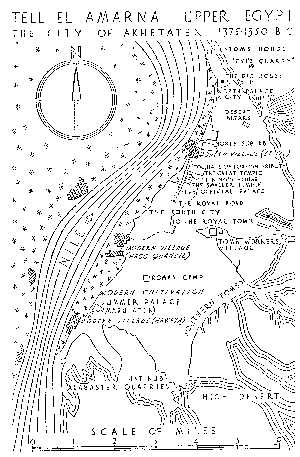
Map of the dig site at el-Amarna
I prepared a transfer based on the map used in the book. It was easy enough to scan it, flip it, and then print it out ready to be traced over using transfer pencil. Very dull, and oh, I ached after I had finished making the transfer. It doesn’t matter where I set myself up to do this sort of thing (living room floor, dining room table…), I always end up uncomfortably placed and aching somewhere or other.
Does anyone have a solution to that?
Still, once the transfer is transferred, the fun can begin!
I’m using a sandy coloured dress-weight linen, and a variety of closely matched threads. The design needs to stand out enough to cope with being surrounded by bright images on a faience-blue background, but I don’t want it too strong. There may be a lot of unpicking and re-stitching involved here.
The panel is quite large – more than eighteen inches across – so the picture I used to create the transfer looks much more grainy at this size than it does in real life. I’m hoping for greater clarity when I start stitching it!
Dreams of Amarna – Working on ideas
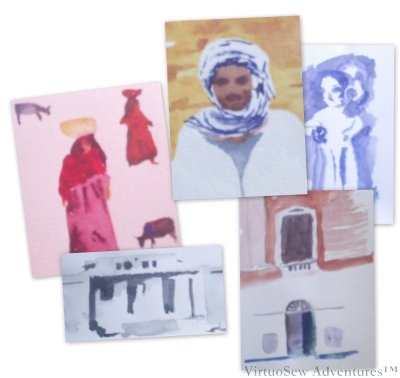
Collage of painted sketches for the Dreams of Amarna project
I’m still trying to think about and plan what to include, so I have been taking some of the photographs, and trying to produce paintings or drawings based on them.
This is serving a twofold purpose, as I have been developing my understanding of techniques, as well as learning how to distil the detail in the photographs. If it is important to simplify the sources in painting, it is more important in embroidery, where the effects created through stitch choice, thread choice, or the decision to raise the surface with padding also contribute to the final result.
The paintings aren’t particularly good, but that really isn’t the point of them, so I don’t mind. They aren’t finished pieces – I simply want to force myself to look at the photographic sources with an analytical eye. I hope then that it will come more naturally each time I find a bit I want to work on and embroider.
In fact as I look at this collage of paintings, I’m quite pleased. At least I have shown an appreciation of where the darks and the lights need to be, and those are what make a picture easy to understand.
Dreams of Amarna – Researching Techniques
I know that an embroidery which is “about” ancient Egypt – even if only indirectly – will have to include some gold and silver – not least, that same Crock of Gold hoard that caused so much consternation to the excavators when it was found (artefacts have a fairly limited and specialised market, while gold bars are much easier to sell, so there was some concern about security that would never have troubled the dig under ordinary circumstances).
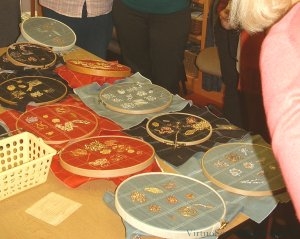
All our own work!
So the next step was a trip to Durham, for a two day course in Modern Goldwork, given by Tracy Franklin. I had a fascinating time. Tracy is an excellent teacher, and it was a real treat to be able to concentrate on learning something entirely new to me. The class had the bonus that Tracy had plenty of goldwork materials available for purchase, and my local embroidery shops don’t have any. Some of what I bought for my coursework was in fact for “Dreams of Amarna” instead!
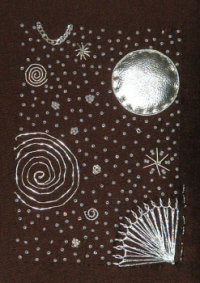
"Starbright", completed November 2008
When I returned, I worked a small panel as an attempt to consolidate my grasp on the techniques and the materials. I even included some padded silver kid leather, and the background is starred with beads.
I’m quite pleased with the panel, as I managed to use almost every technique we were taught. The base fabric was a tightly woven brown synthetic, which was rather trying to work with, but I wanted something very firm for this first solo attempt at goldwork.
I will need to use very different fabrics for Amarna, and I expect that trial and error will be much employed!
You might be able to see a line of stitching, running up the edge. That’s my “signature,” in Morse code. It’s much easier to do small and neatly than letters, and sometimes I manage to hide the signature in the design.
When I am creating an embroidered piece for someone else, I try to make sure that I also provide something about the design and the making of the work. Not just care instructions, but a description of the design choices and why I made them, or if I was working to a brief, a description of the influence of the brief on my approach to the work. Given my interest in history and archaeology, it’s perhaps not surprising that the idea of providing Something For The Archive rather appeals to me.
And on that score, and on behalf of those in the future who will be interested in embroidery – please, sign your work, date it, write about it. Just think how thrilled we always are to gain an insight into the work of designers and artisans of the past!
Dreams of Amarna – researching the ideas
As it happens my family has always had an interest both in archaeology, and in the history of art, so I started to look through our books to see whether I could find any reference material. I found a few things, but in truth, not enough to support the work I was trying to develop. That is scarcely surprising, really. The “Amarna Period” covers maybe thirty years. Ancient Egyptian civilisation lasted for several thousands of years! So I did the obvious thing – I contacted the Egypt Exploration Society, for whom Mary Chubb worked at the time of the dig, and asked whether they could help.
They could, and they did.
I spent a delightful (if wearing) afternoon in the library of the Society, and was even able to read and refer to the publications of the expedition, and then some months later received an email to tell me that the Society had been digitising its’ photographic archive and if I was interested, they would be happy to let me look through the archive for more source material.
Was I interested? Well, of course I was!
This time it was an entire morning, but then, the archive not only included the photographs of the finds and records of the excavation. There were pictures of the excavators at work, shots of the surrounding area, the felucca loaded with supplies… “Wonderful things!”, as Howard Carter said…
I know, I know – I haven’t set a stitch yet, but there’s so much to think about!
I also found an article about excavation organisation and methods, written by JDS Pendlebury (Director of the Expedition) at about this time, and a much later paper, written by another archaeologist about the Hittite amulet that was part of the “Crock of Gold” hoard that they found during the season. I won’t provide a link to those, as they are behind a paywall. The fact that I did pay for and download both articles shows just how attached to this project I have become!
I haven’t yet bought the biography of JDS Pendlebury. At the back of the book Mary describes his fate – parachuted into Crete (where he had been site Director at Knossos under Sir Arthur Evans), he coordinated the resistance to the German invasion, was wounded and captured, and then dragged from his sickbed to be executed. It saddens me every time I read it. Not just because of him, but because of the thousands of others, young and not so young, who were also cut off at the height of their powers, with so much yet to contribute to the world.
Dreams of Amarna – planning the design
After a lot of thought, puzzlement, and general head-scratching, I decided to produce two panels.
The embroidery will be worked on linen, and mounted on board, and in front of each embroidered panel will hang a gauze panel. The gauze will be screen-printed with the most familiar images of Akhenaten and Nefertiti, in a pale “faded” colour. The idea is to reflect the dominance of the historical personages in the work of the archaeologists, who try to interpret what they discover in the ground to tell us more about the historical life of the place itself, and to provide an echo in fabric of Mary Chubb’s own imaginative response to the site.
The linen panels will be made up of several sections. The main sections, in a sandy colour, will be embroidered mainly in monochrome. One panel is to show the map of the site, and the other will provide the links between the work in the office in London and the work in Egypt – sketches of the office building, a steamer, and maybe the Pyramids (visited when they paused in Cairo).
Around these panels smaller panels will be attached, embroidered with representations of some of the finds, with pictures of the excavation, and with any other illustrations I can gather together.
All this came together in a rush, a couple of years ago, when I was helping my cousin to clear out our Great Aunt’s house after her death. You can’t talk about banks and inventories all the time, and the final idea just happened to come together as I began to describe my nagging Project. It deserves the capital letter, don’t you think – ten years, I’ve been thinking about it, maybe more!
“Dreams of Amarna” – a very long term project!
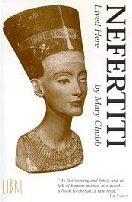
Cover for the book "Nefertiti Lived Here", by Mary Chubb
This is turning into a very big project, and there will be several posts with no embroidery in them. I will try to intersperse them with other projects too!
A good many years ago, I read a book called Nefertiti Lived Here, by Mary Chubb. It describes the author’s own experiences as Secretary to the Excavation in el-Amarna in the 1930s. Sounds as dry as the desert around the dig? Wrong. The book reads as well as a novel, and the characters of the archaeologists (led by the charismatic JDS Pendlebury), and some of the excavators, are beautifully described. The site itself, the Heretic Pharaoh and his beautiful wife Nefertiti, also become characters, and even for a non-Egyptologist, the book is entirely enchanting. I re-read it frequently.
As Mary Chubb was studying sculpture at the time she joined the expedition, it is perhaps not surprising that some of the artefacts they discovered are so vividly described or that the changes in Egyptian art in that period should have made such an impact on her, and through her on her readers.
Given my interest in embroidery, perhaps it is not surprising, either, that Mary Chubb’s fascination with Egyptian art should plant the germ of an idea for an embroidery…
Only a germ, unfortunately. It has taken years of thinking in the occasional idle moment for the idea to take sufficient shape that I could begin to consider the materials to use or the form it would finally take. In the meantime, Mary Chubb has died (at the august age of 99, in 2003 – Times Obituary ) so my early wish to show her what she has inspired has fallen by the wayside.
But that is no reason not to do it!