About Rachel

View all posts by Rachel
Research for Aethelflaed
I think I’m going to try to do Aethelflaed next.
At the moment, my thought is to have her riding (side-saddle) towards the refortification works at Chester (which is where I grew up). I looked up “side-saddle”, owing to having some doubts about how recent or not it might be, and the history and techniques of riding sidesaddle seem more complex than would at first appear.
Of course they are.
There’s the technique you probably think of first, with a leg hooked up and the rider facing forwards (think Queen Elizabeth II riding Burmese to Trooping The Colour, way back when). The development of that design is credited to Anne of Bohemia, Richard II’s Queen, so it would be anachronistic, to say the least, for Aethelflaed. However… The older style is more like a chair set on the horse’s back, with a footboard, and the rider faces sidesways. Generally the horse is then lead, either by a someone on foot, or by another rider, but I simply cannot imagine Aethelflaed not being under her own steam, as it were. I suspect that she would just have a really voluminous skirt or a slit skirt or even just wear men’s clothing and ride astride. But that would not create the image I want, so I’m going to have to balance storytelling with other concerns. Well, that’s part of what is interesting to me, so that’s ok!
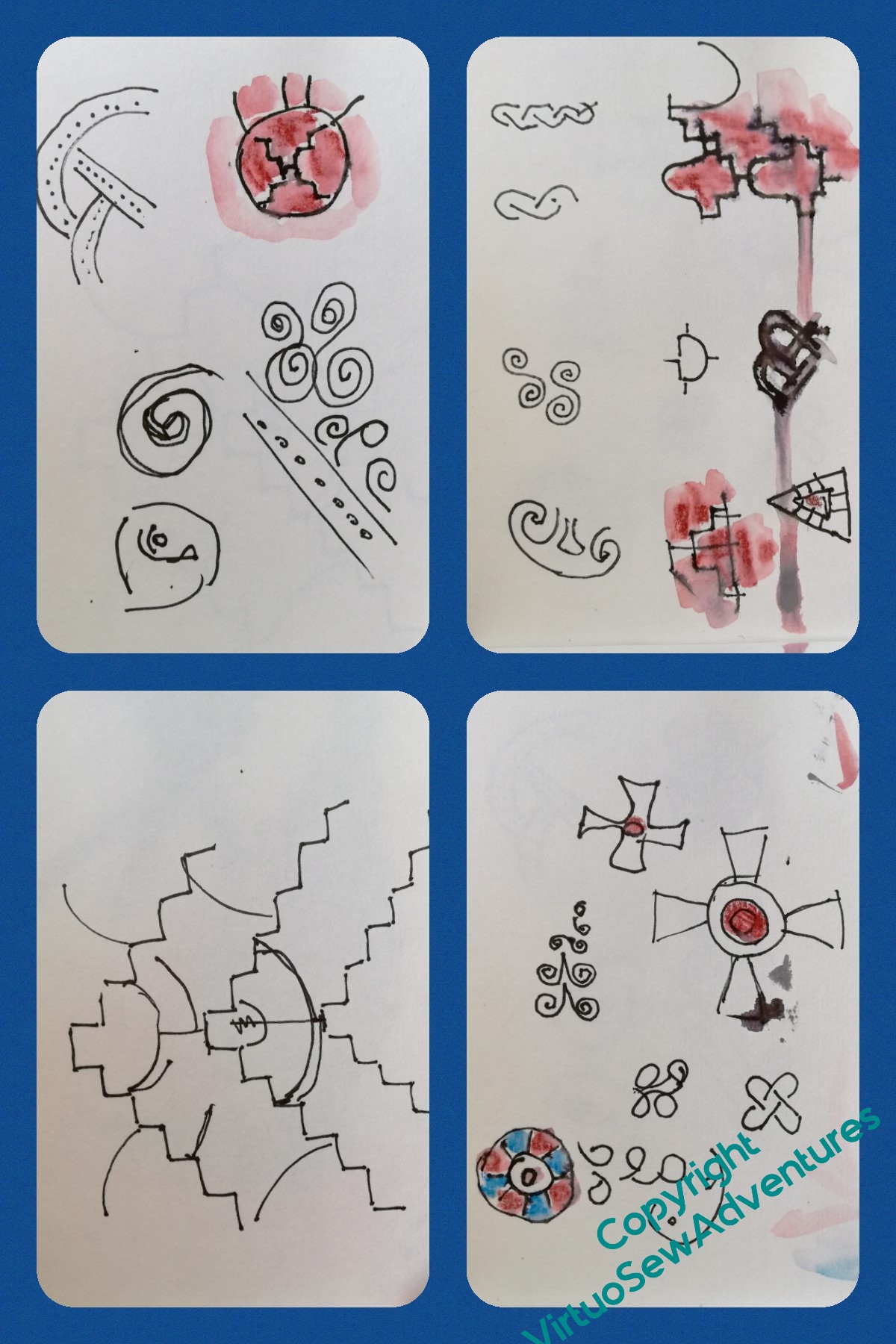
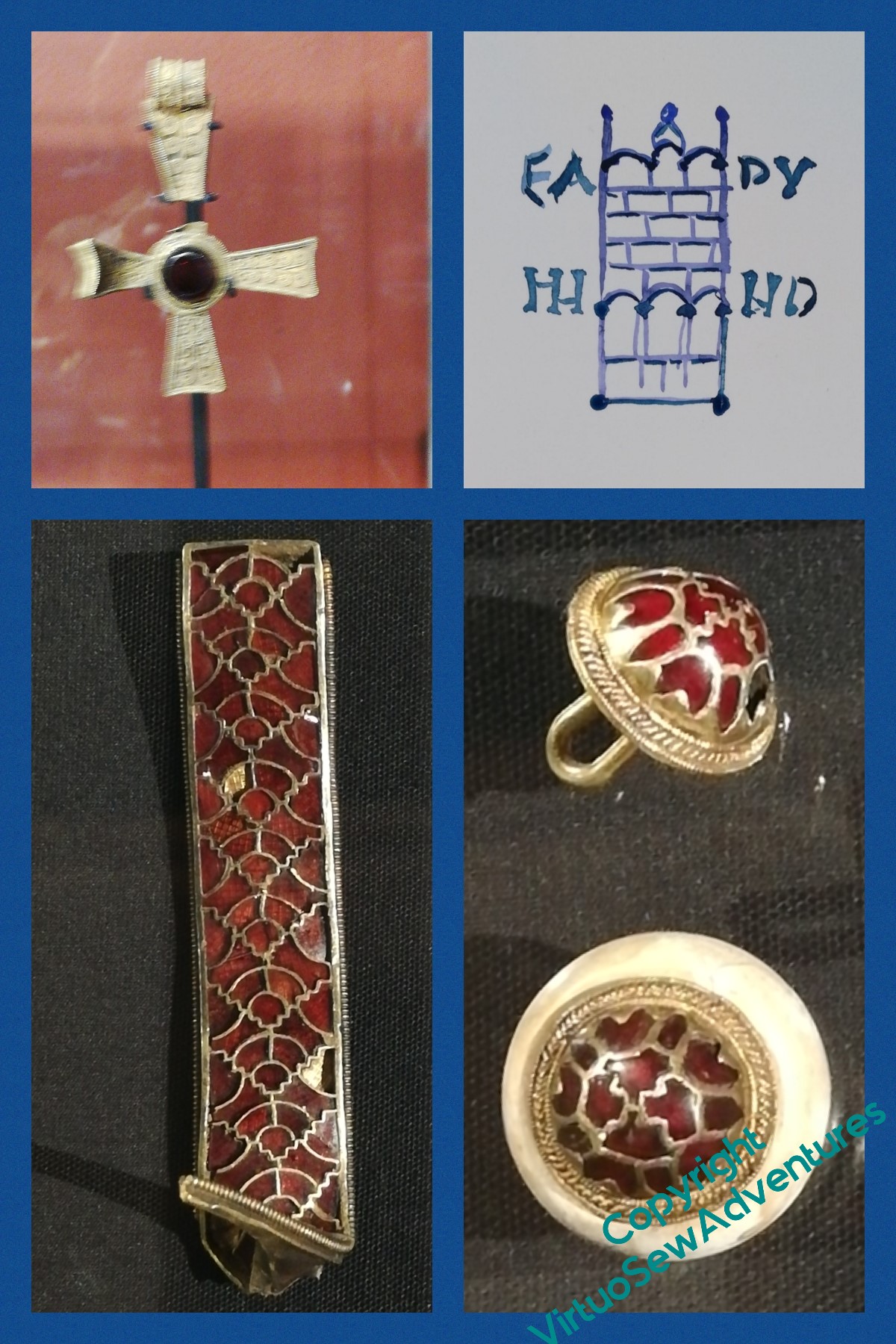
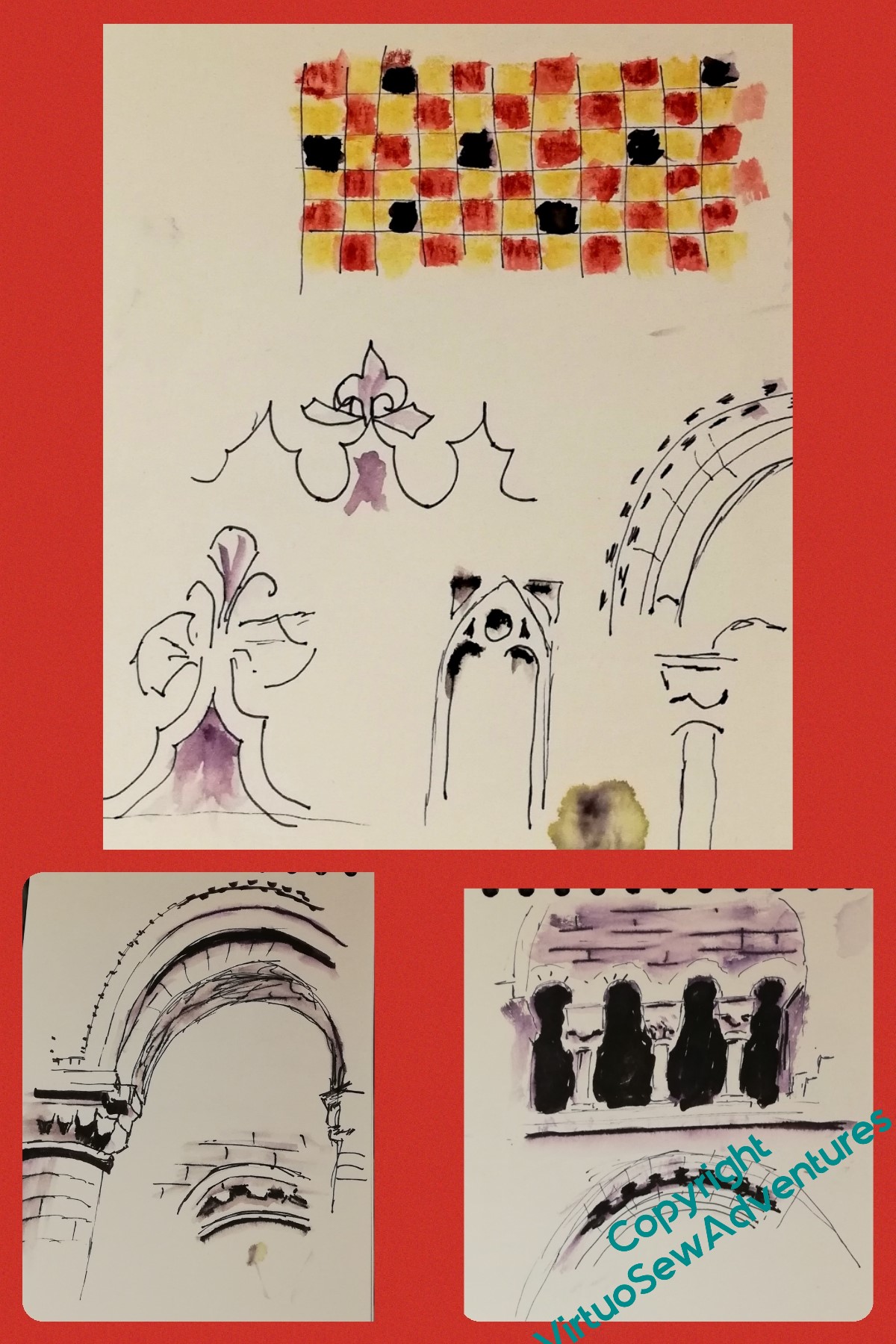
I had a lovely day out a little while ago to see the Staffordshire Hoard exhibition at the Museum in Stoke on Trent. It’s the closest source I can find for patterns that I might be able to use, and although none of these sketches or photos will be useable directly, I can, for example, imagine taking the style of that processional cross in the grid at the top, sketched in the grid to the side here, and using that at the cardinal points of the border.
I’m also wondering about taking one of the patterns from the pieces in the Hoard, and turning it into a border design, somehow. That might make everything a bit busy, so, more thought needed…
More on the Long Borders
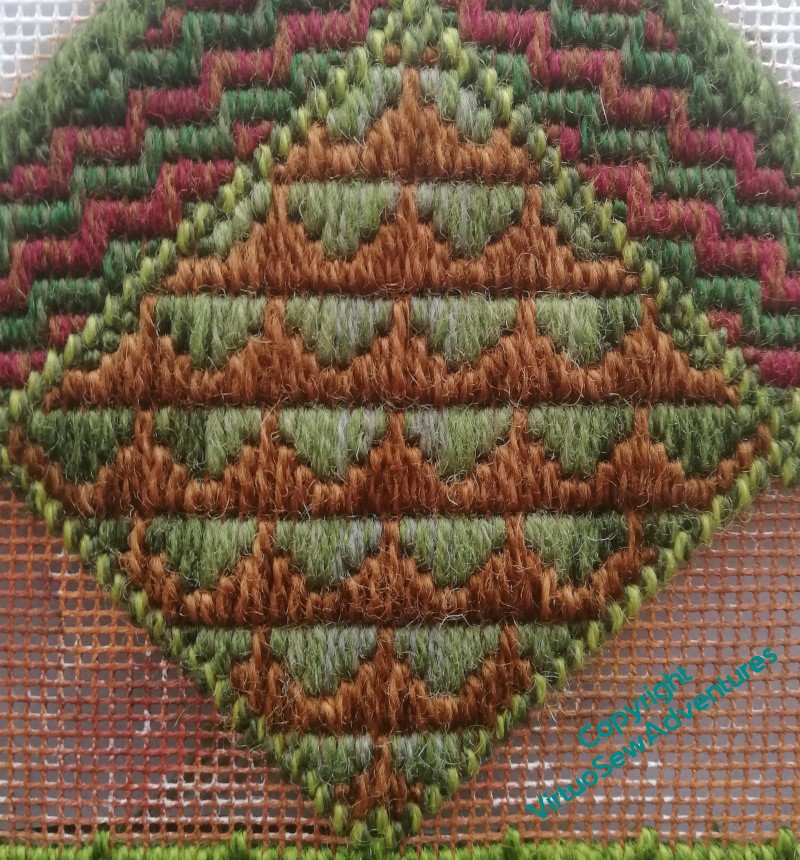
When I found a stitch called “F-106 stitch” and notionally inspired by delta wing aircraft, I thought it would be a good one to include. The section looked a bit monolithic, so I faded the colours of the “background” stitches outwards from the centre. Although I have to say – I’m no flier, but that formation looks dangerously close to me!
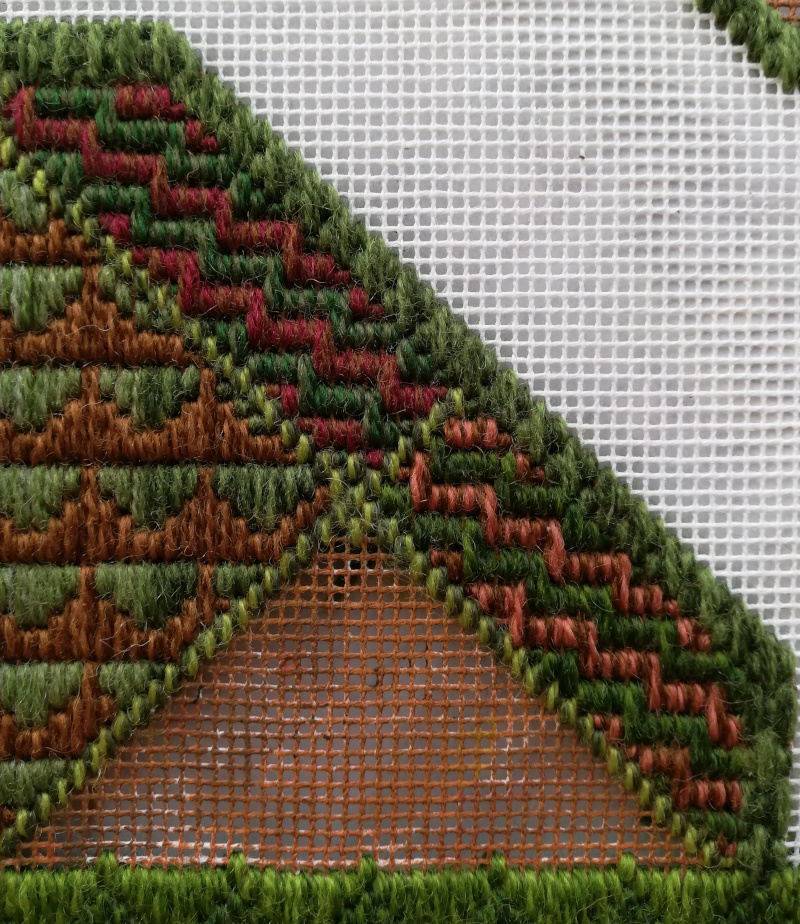
I’m trying to balance the patterns and keep them from proliferating too much so when I’d done these sections (on both long borders), I thought it would be a good idea to continue the Victorian Step Stitch pattern through the second outer sections, only altering the colours slightly. I’ve even tried to keep in step with the first sections across the divider.
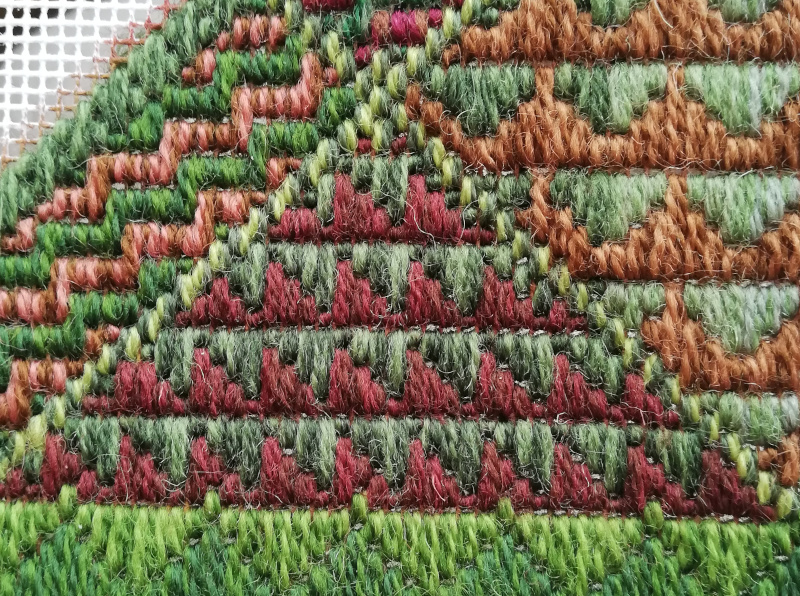
The triangles by the border required another pause, but in the end I kept with the aero theme, and picked a stitch called “Wild Goose Chase”, which I rather suspect may be inspired by a patchwork pattern. Trying to maintain a certain amount of echo and balance, I’ve used similar colours to the first blocks of Victorian Step Stitch, and also reflected the pattern on either side of the centre line.
Research for Rahere
I had another chance to go to the Church of St Bartholomew The Great in Spitalfields recently, and managed to get in a solid couple of hours of sketching and thinking while I was about it. I did attract a bit of attention – someone came and asked whether they could take my photo as I sketched, and even photographed the sketch itself, but it was in the morning on a cold and wet Saturday, so there wasn’t too much activity. By the time the tour groups started to come in and obscure what I wanted to sketch, I was becoming chilled and clumsy and in need of food and a hot cup of tea.
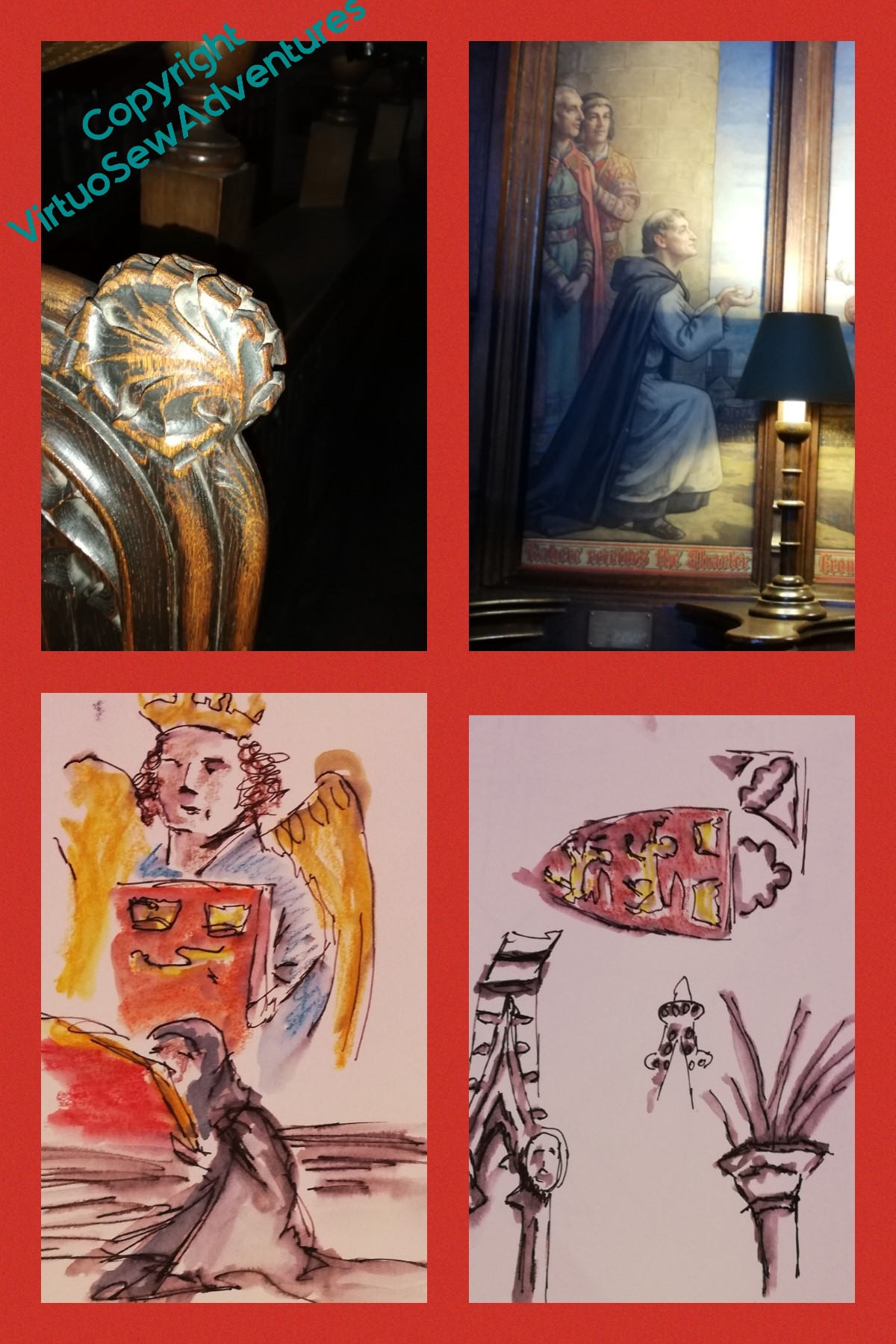
I might use that coloured tile pattern in the border of Rahere’s panel, instead of a plain colour. I think I’d want to make the colours closer, to create the effect of a rich damask-type fabric, but I feel a bit wider variation is needed among the four panels. I want each of them to stand alone, but if they end up displayed together, they need to look happy…
I had been wondering whether it would be legitimate to include scallop shells in the borders, to reference pilgrimage, since most often I have heard of the scallop shell being associated with the Camino to Compostela. Plainly the makers of the pews thought so!
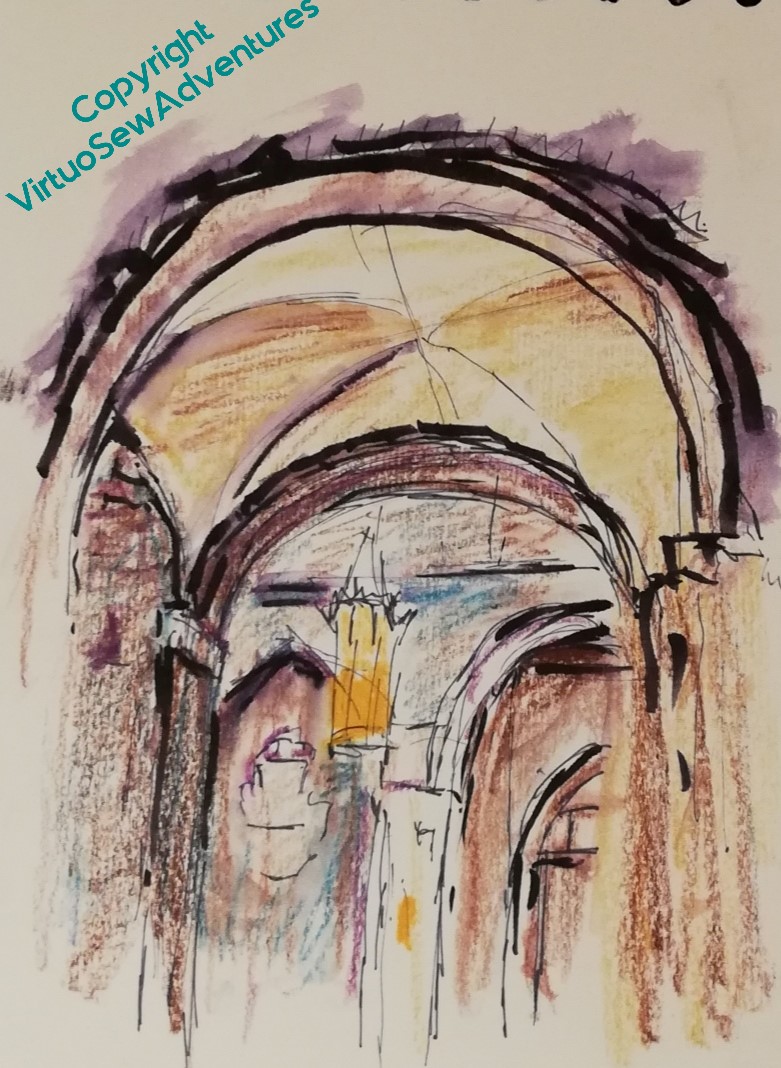
I’m still trying to work out what to set behind Rahere. Arches? A single arch, maybe, with the gold underside couching within. That may be a bit too reminiscent of a halo, and no-one, as far as I know, has ever even suggested Rahere as a candidate for sainthood. If Kipling’s version of him has any veracity (it’s certainly not based on research – you might call it a possible emotional truth), he’s very much in the category of people who make for an challenging example – speaking truth to power is not a gift we all have, although we may all agree that it is important that it happens.
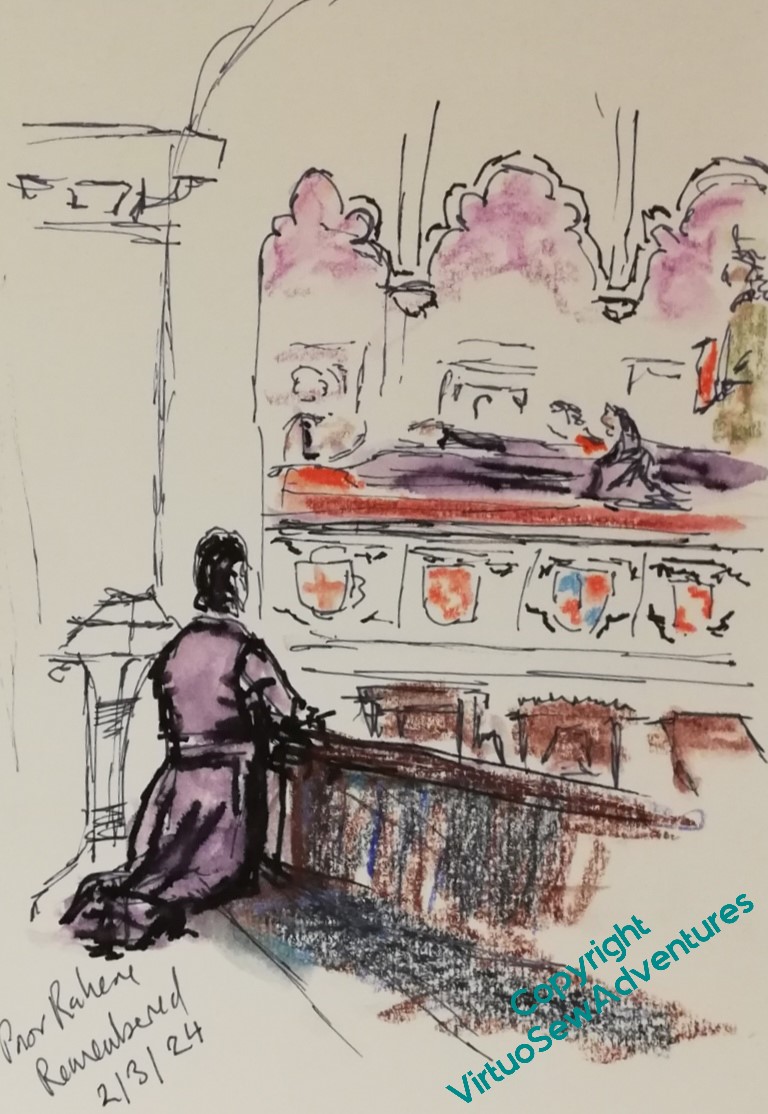
In truth I think he’s more valuable as an example to follow without the accolade. He is credited with founding an institution which continues to provide healthcare, 900 years after foundation, he is still remembered, and no one suggests that what he did is the less valuable for the lack of a sainthood.
As you see – he is still remembered.
Long Borders
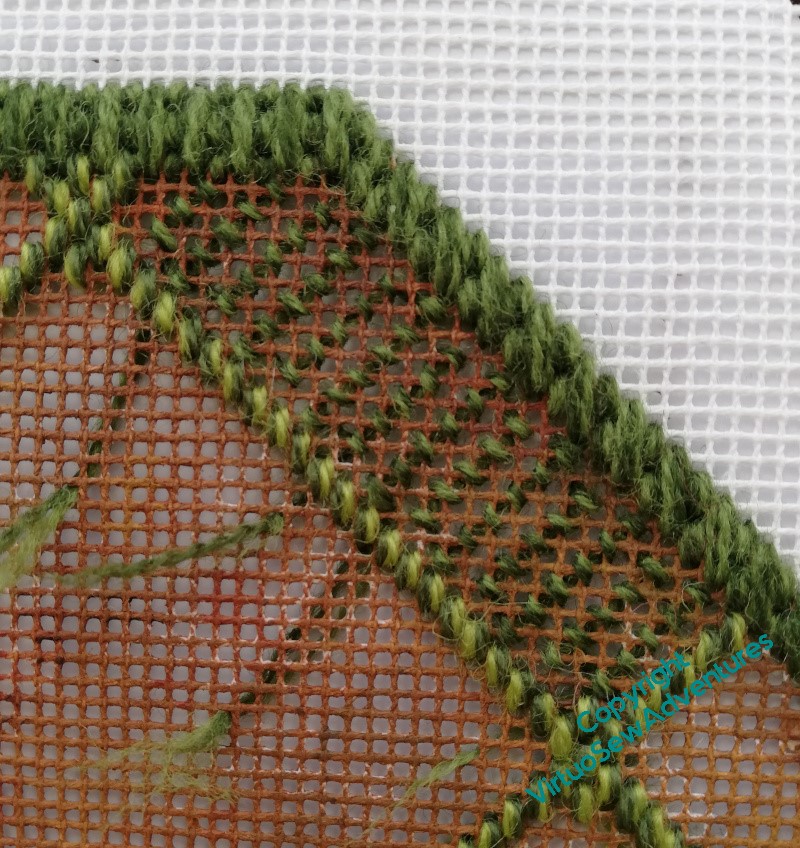
There’s a good deal of trial and error with this one!
Once I’d divided up the long borders (both of them, so that it remains easy to keep track of) I started to experiment with stitches to fill in the various sections.
For a while I thought I might like to play with voiding some of the patterns, so I started with a sort of skip tent stitch. I wasn’t happy with that – it ended up combining stripes with a general appearance of not being there at all.
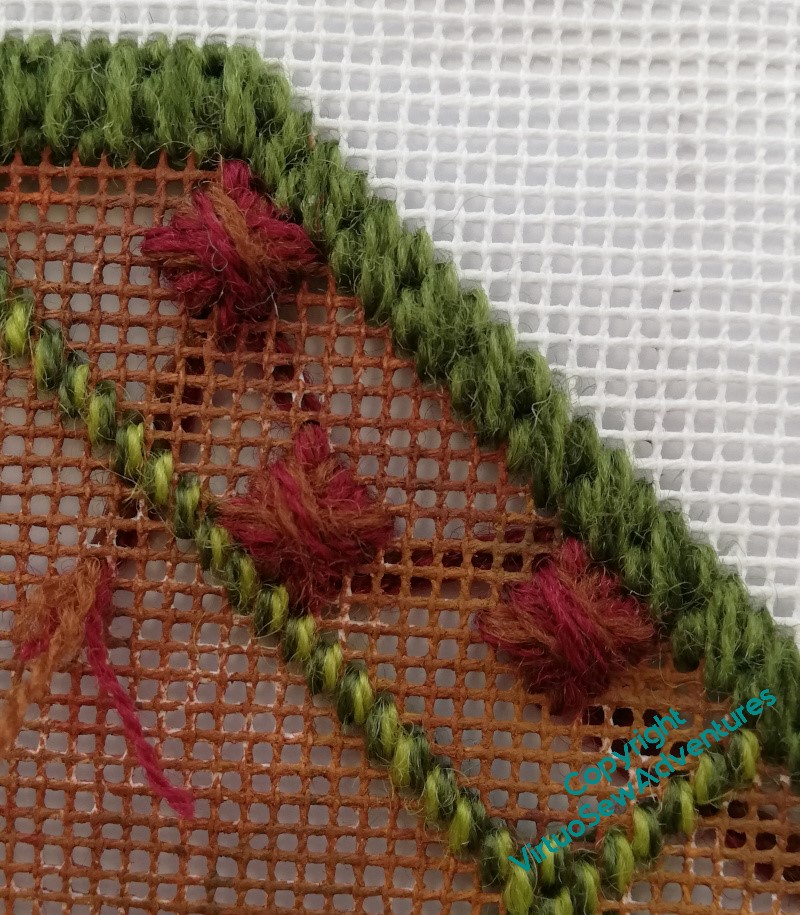
So, next trial – what about some large bosses, Diagonal Rhodes Stitch or something like that, which will be nicely reminiscent of the topiary experimentation that inspired the cushion?
I suppose this might have worked, maybe with a river of stitching in another colour to join the three diamonds, but when I looked at it in the context of the entire border, I wasn’t happy with it. Quite why, I’m not sure, but it felt like a false start. I’ve had quite a few of those with this project, and I’m beginning to recognise the sensation!
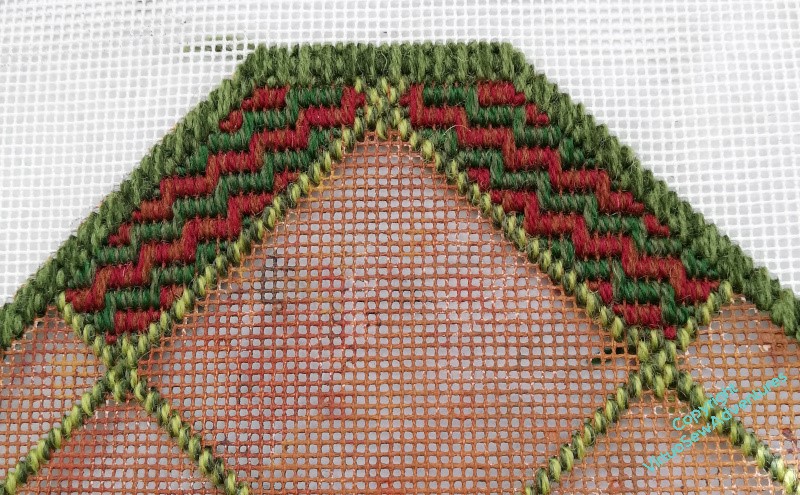
So, in the end, I settled for finding a smallish full coverage stitch, using vertical stitches like the borders, which isn’t on quite the same diagonal as the border edgings, but seems nevertheless to work. It’s called Victorian Step Stitch in Jo Ippolito Christensen’s book, and I’ve never seen it anywhere else (that goes for a lot of the stitches in that book!). A small advantage was that it mirrored relatively easily about the centre line, creating an arrowhead.
Fabulous Felt Shoes Finished
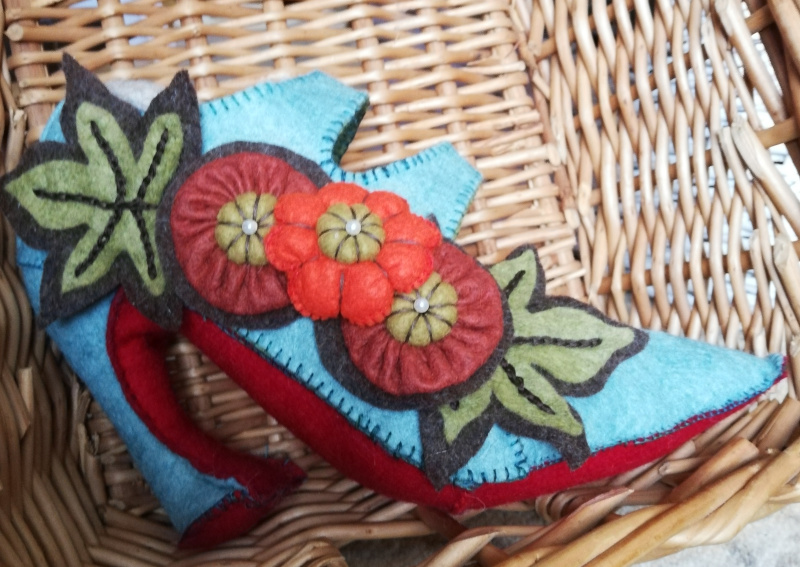
Yet another Twixmas project that lasted longer than I anticipated…!
I enjoyed making these – the instructions were clear, and in fact, you make a basic court shoe shape, and then add variations and additions. Some of the felt I had was a little flimsy, so the two decorative additions to the first two shoes are both made of two layers of felt stitched together, using patterned blanket stitches, before I attached them to the shoes.
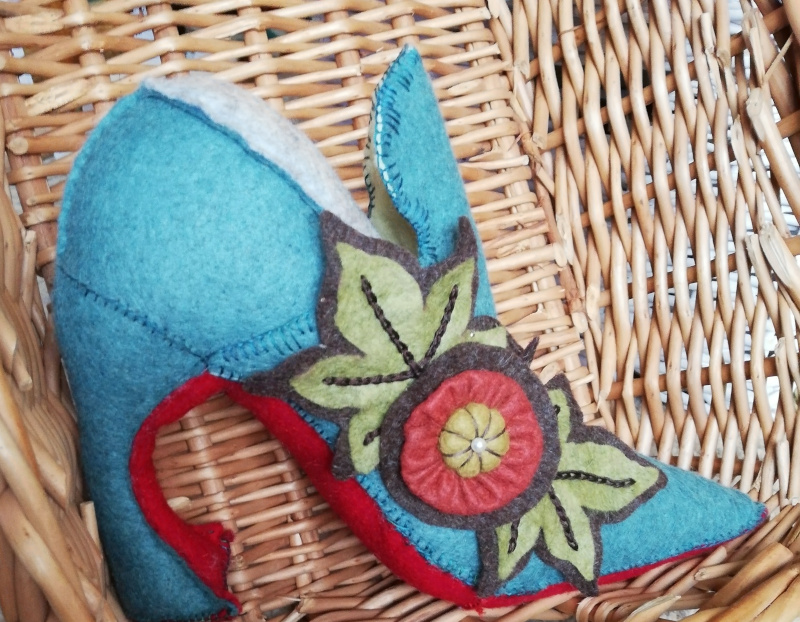
I varied the stitches I used, not quite following the instructions.
Of Course I Did.
The basic shoe shapes are put together using stab stitch, which I use when I’m making felt cradle toys. It’s secure, simple, and leaves a nice raised seam, which I think adds to, rather than detracts from, the finished effect.
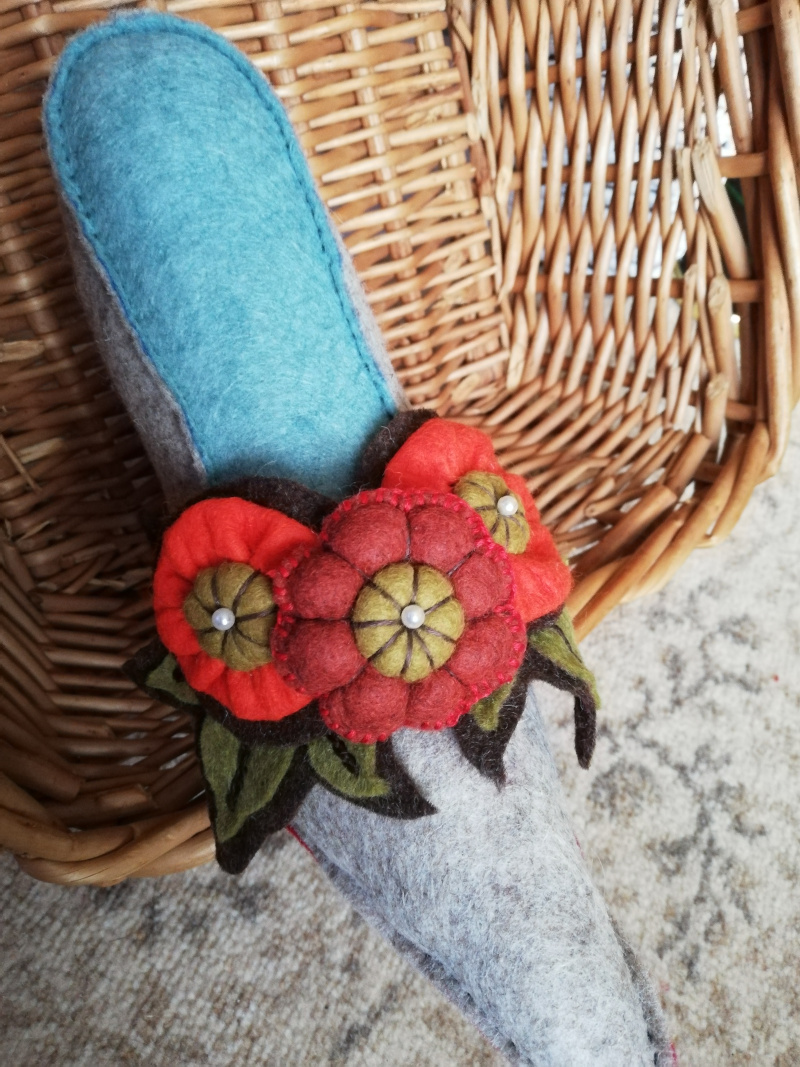
I think the instructions suggest back stitch for the leaves, but I’ve chosen reverse chain stitch. I like the solidity of the line, and it somehow enhances the slight dimensionality of attaching the two leaves together.
The instructions also suggest ready made felt balls for the flower centres – I didn’t have any, so I just made small stuffed balls of the same felt as the leaves. And there are two sorts of flower – one is made of two discs stitched together and stuffed, the other is, effectively, a Suffolk Puff.
I think they are both charming!
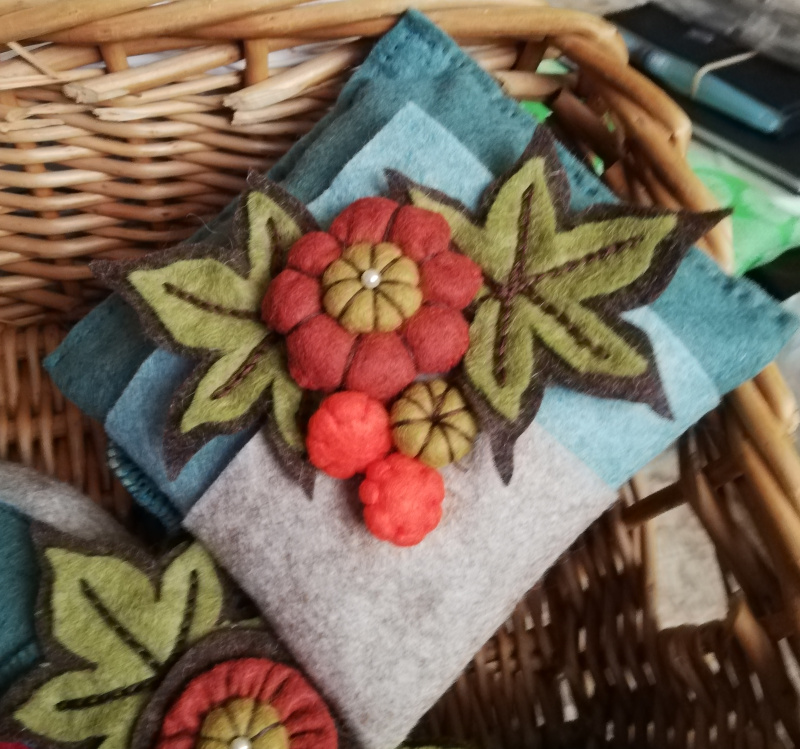
Once I’d done the shoes I gave some attention to hanging them. I had some felt left over, so I made a small felt cushion using the shoe colours, and then made some more flowers and leaves.
The finished mobile is delightful, but it goes very badly with my studio, which is still decorated in the taste of the previous people to live here – yellow (no quarrel with that) with a border panel in pink, blue, and green.
I’m going to have to redecorate the studio, aren’t I!
Planning the long borders
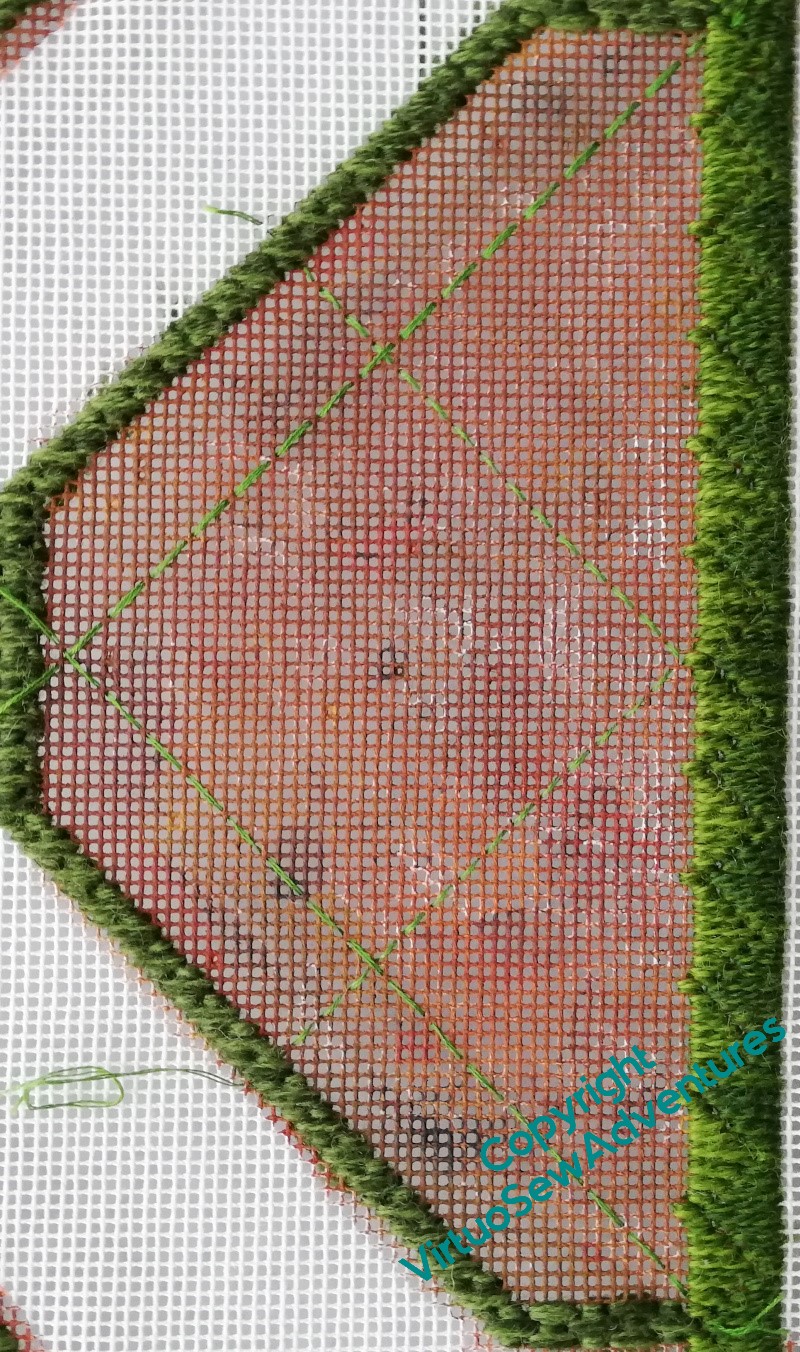
The long borders just looked too big, too monolithic, if you like, when I came to look at them with the corners in place. I don’t want the pattern looking too “bitty” and fragmented, but a certain amount of breaking up of the shape seemed to be a good idea.
I started by running tacking stitches in stranded cotton so that I could look at the divisions they created and make decisions based on those, rather than using the wool. Tapestry canvas is a destroyer of thread, and it’s rare that you can reuse much of it if you have to take it out. I’ve plenty of stranded cotton, and I can reuse it a few times for experiments – just not for the final piece!
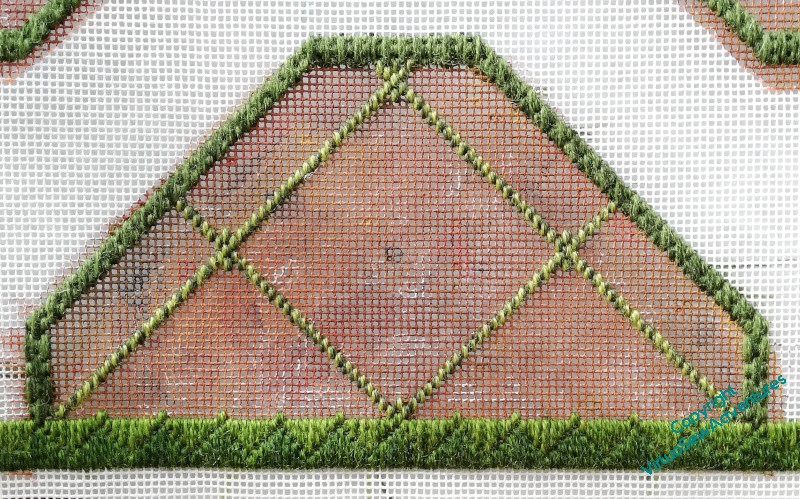
That seemed enough of a division, so I pulled out the stranded cotton and reinstated the new lines using short straight stitches in two shades of the Paterna.
I’m trying to use all the yarn in blends. It makes for a livelier effect, and given I’m not enamoured of Yarn Chicken, it will also eke out some of the yarns!
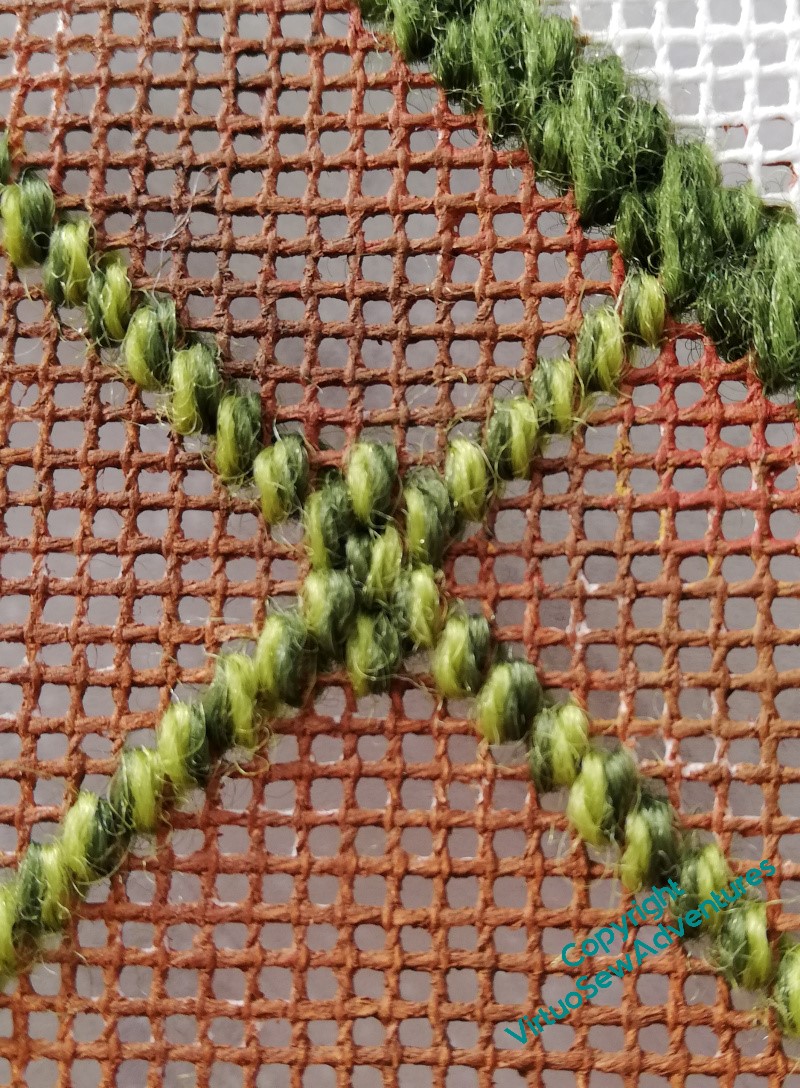
Once I’d looked at the first couple of intersections between lines, I decided to add a bit of subtle emphasis. At this point, I had no idea what stitches I would be using in the “beds” (to retain the link to gardening), but I somehow felt that I needed to blunt the apex of the diamond and triangle shapes.
I couldn’t tell you why – any ideas?
Return to William, just because!
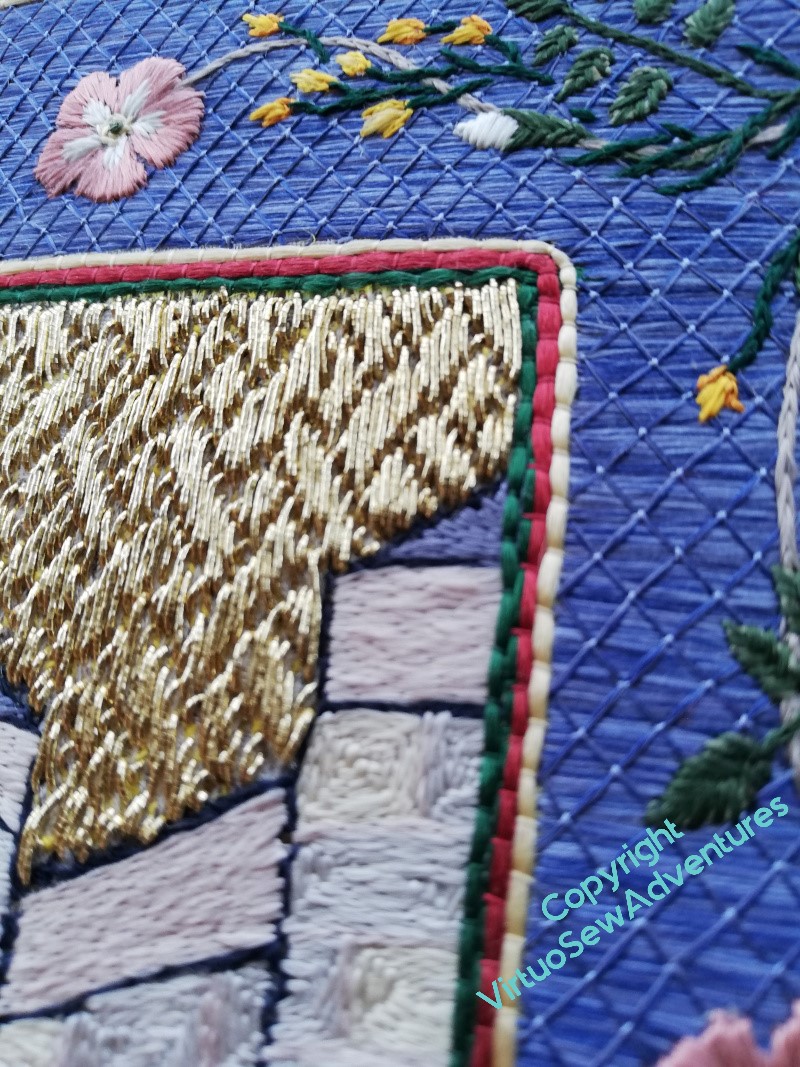
I thought people might enjoy some shots of William from different angles and in different lighting, both of which affect the gold and silk very strongly.
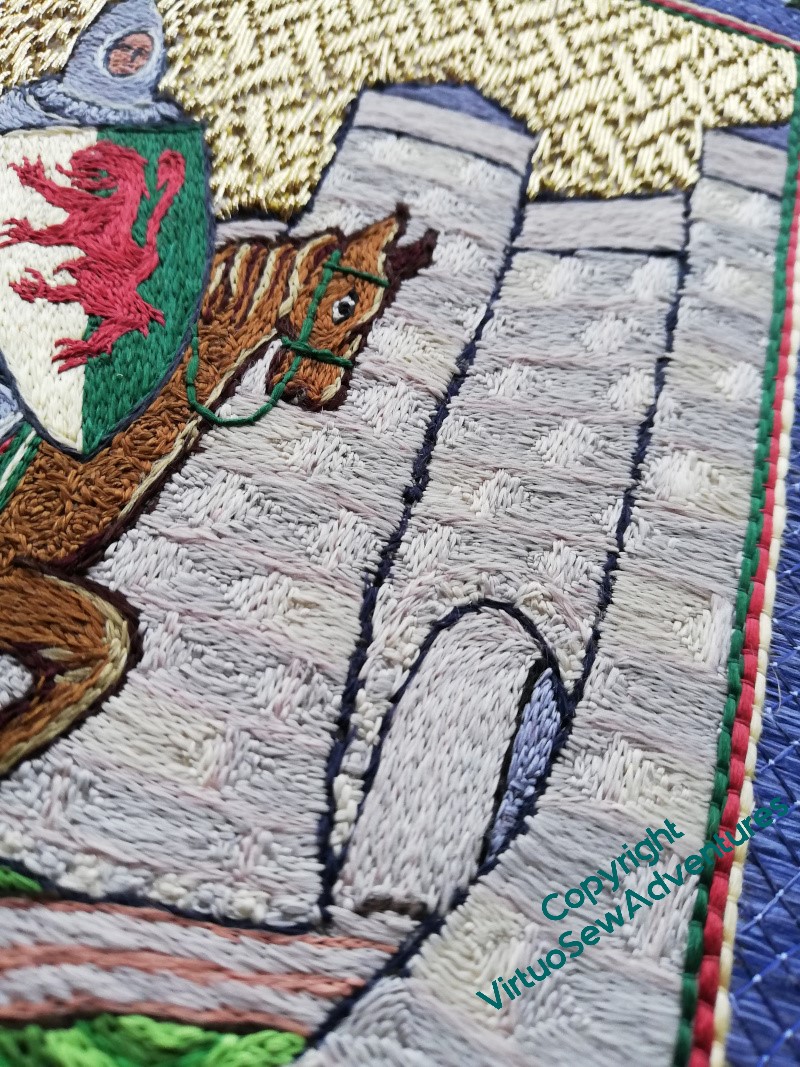
I don’t have much to say for myself, just – Enjoy (with a little editorial, as it were)!
I had intended to fill in the end of the gatehouse tunnel with underside couching, but decided in the end it would make a lot less sense of the picture.
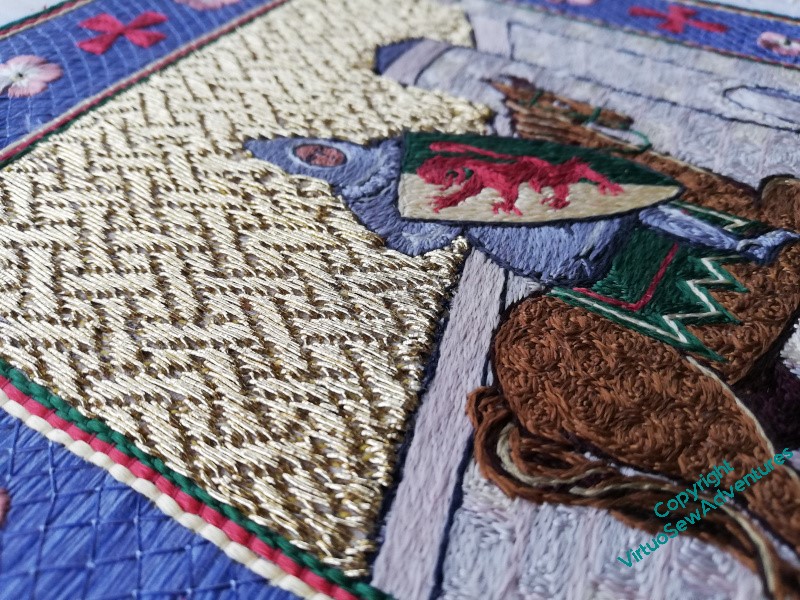
I was greatly relieved that the various oddities around the edges seem not to be drawling attention to themselves!
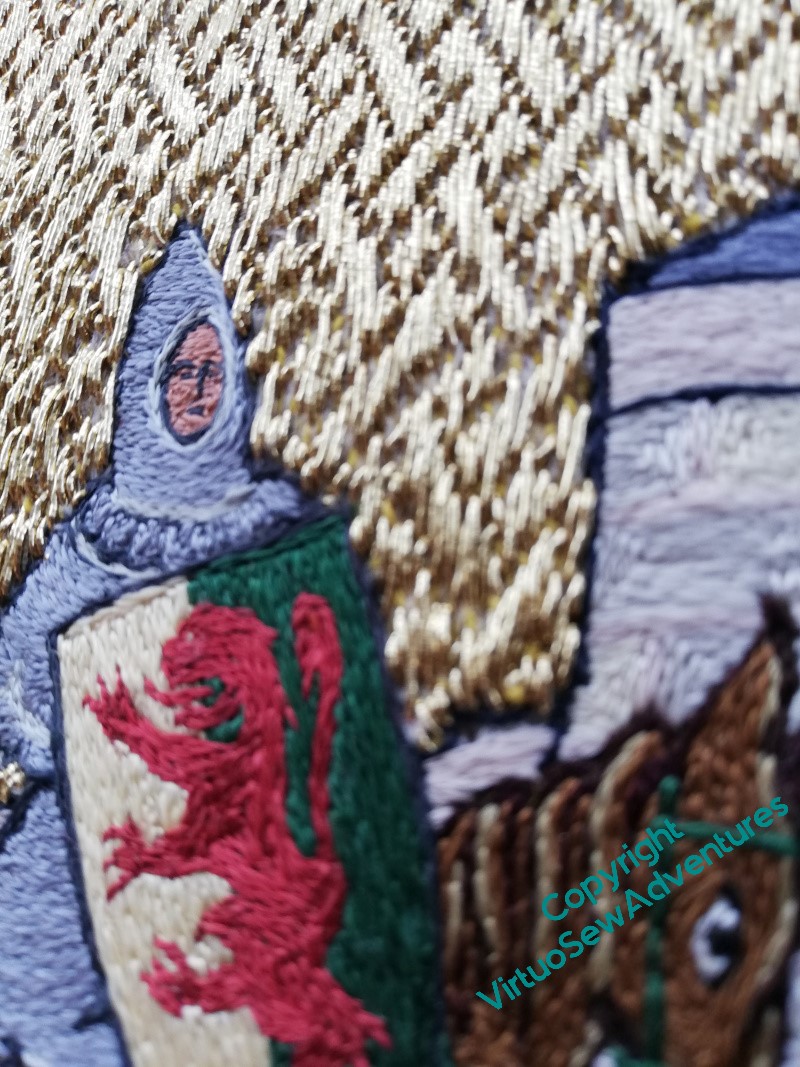
The lion rampant isn’t completely successful in terms of the details of stitch direction, I think, but I couldn’t see a better way to do it, and since when I put a picture on social media, someone was able to type their guess of the blazon (heraldic description) into a search engine and have “William Marshall, first Earl of Pembroke” pop up immediately, I think I’m just going to let well alone!
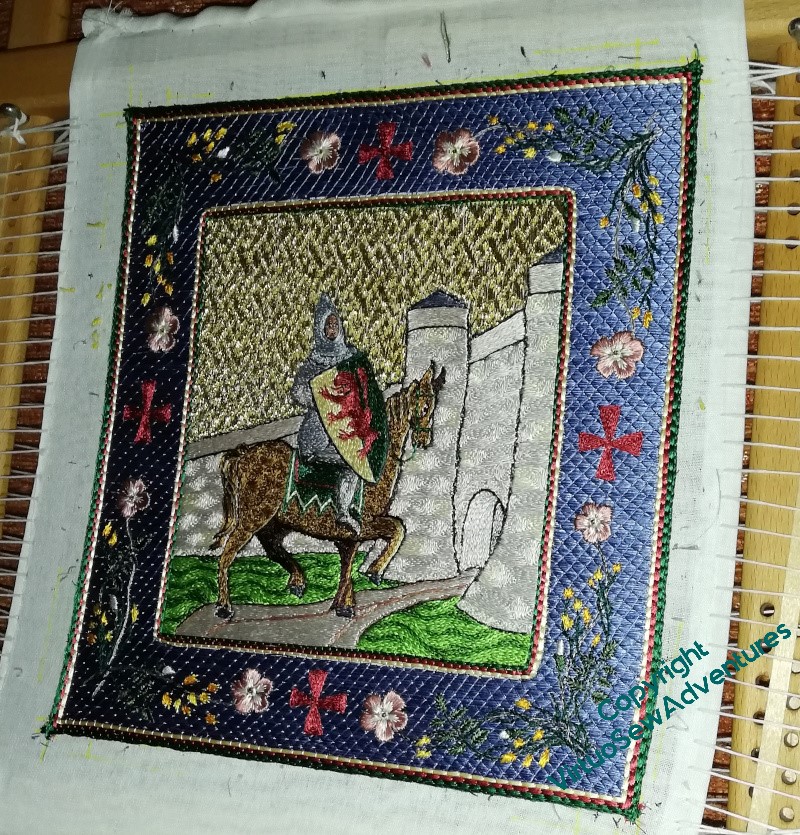
The points of light are couching stitches on the trellis couching. The flash doesn’t show up the stems in the border as well, but it does wonderful things for the stitch direction on the stonework and the dapples on the horse (Mars, we called him in the end, didn’t we?).
More progress on the corner borders
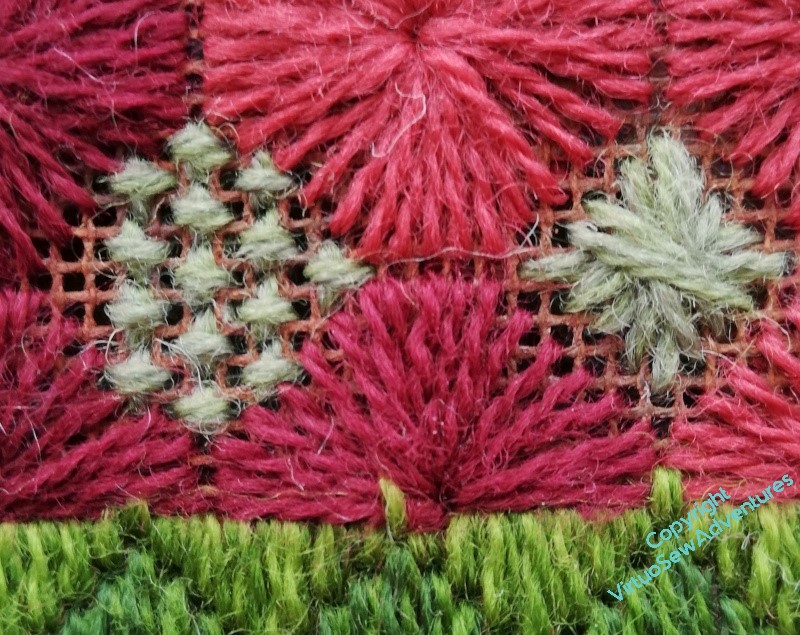
I wondered, once I’d done the large squared daisies and recovered from the experience of the one which kept going wrong, whether I should use Diagonal Rhodes Stitch again, or do something else, so here I was experimenting with a sort of fill pattern using upright cross stitch.
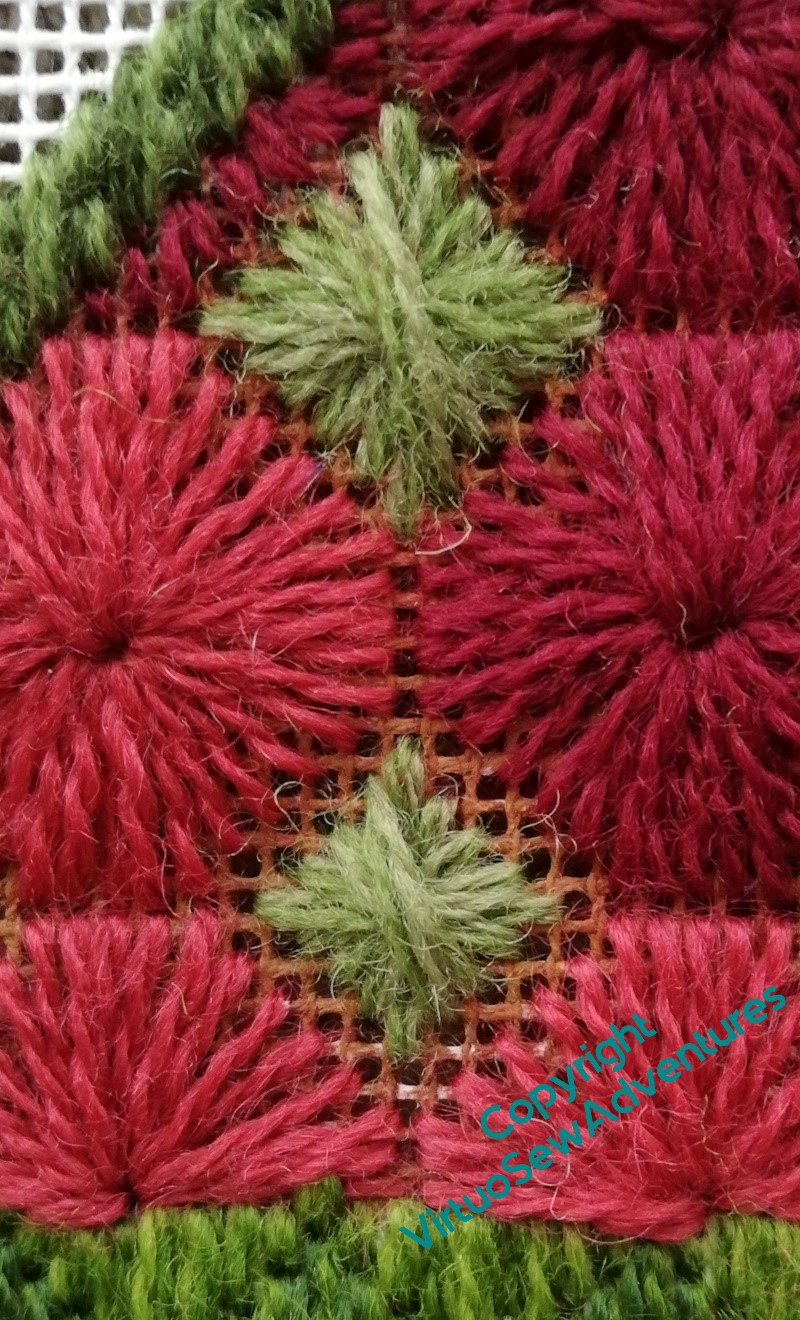
And no, both the thread (too pale) and the stitch pattern (somehow too incoherent, which is an odd thing for such a regimented stitch to look). Rhodes Stitch it is, then.
Ah, but what size of Rhodes Stitch?
The larger one, I decided in the end. This isn’t to be a cushion for leaning on, and although the “boss” created by the larger Rhodes Stitch had very long floats, it created a really lovely contrast with all those stitches going down in the middle of the Squared Daisies.
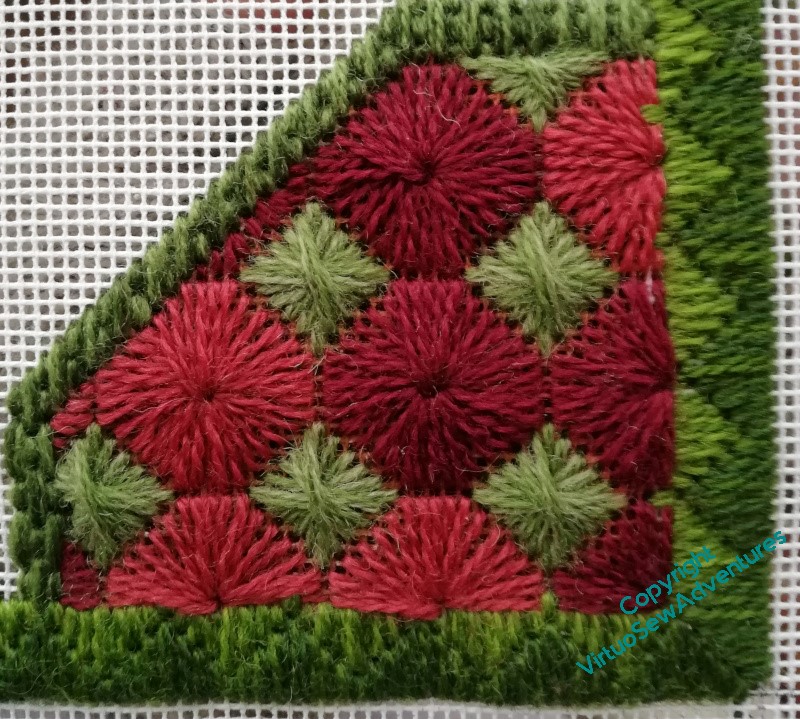
As you see here.
Now it’s done, I really like the look of this pairing. I think Jo Ippolito Christenson backstitches between her stitches, which I’m not going to do. I think this is a good enough recollection of the inspiration as it is, while staying true to itself as a piece of canvaswork.
Getting back to the Parterre
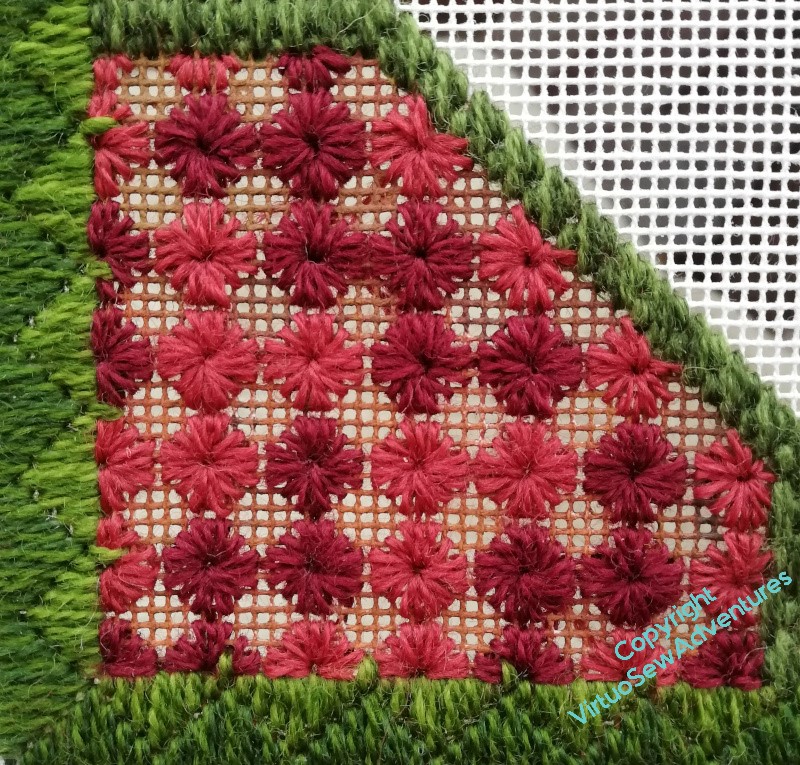
We last saw the Parterre in December, when I’d found a very pretty stitch (Squared Daisies) which was very trying to work, because it involved a lot of stitches going into the same hole.
As I was up to my eyes in exasperation with Amarna and William Marshall at the time, I set the parterre to one side so as to have fewer moments of fury and despair. Now that Amarna is in a totally different stage of effort and William is on the home straight, I’m returning to it, with a quieter mind and greater regularity of effort.
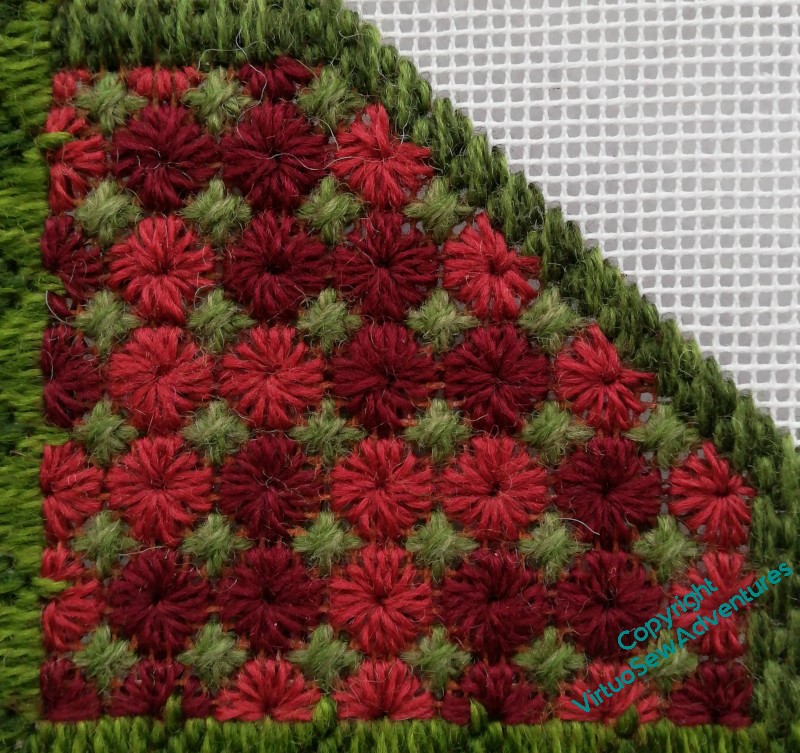
With the very cheering result that you see here. In no time, so it seemed, I’d finished the two panels in small squared daisies, and moved on to infilling them with Diamond Rhodes Stitch. You’ll see that the Daisies are worked in two different shades of red, not quite regularly alternating. The thread is a single strand of Paterna.
For the Diamond Rhodes Stitch, I decided to use a single colour. It’s two strands of Appleton Crewel wool, which is about the weight of the single strand Paterna, and it’s allowed me to soften the colour slightly by using two different shades in the needle.
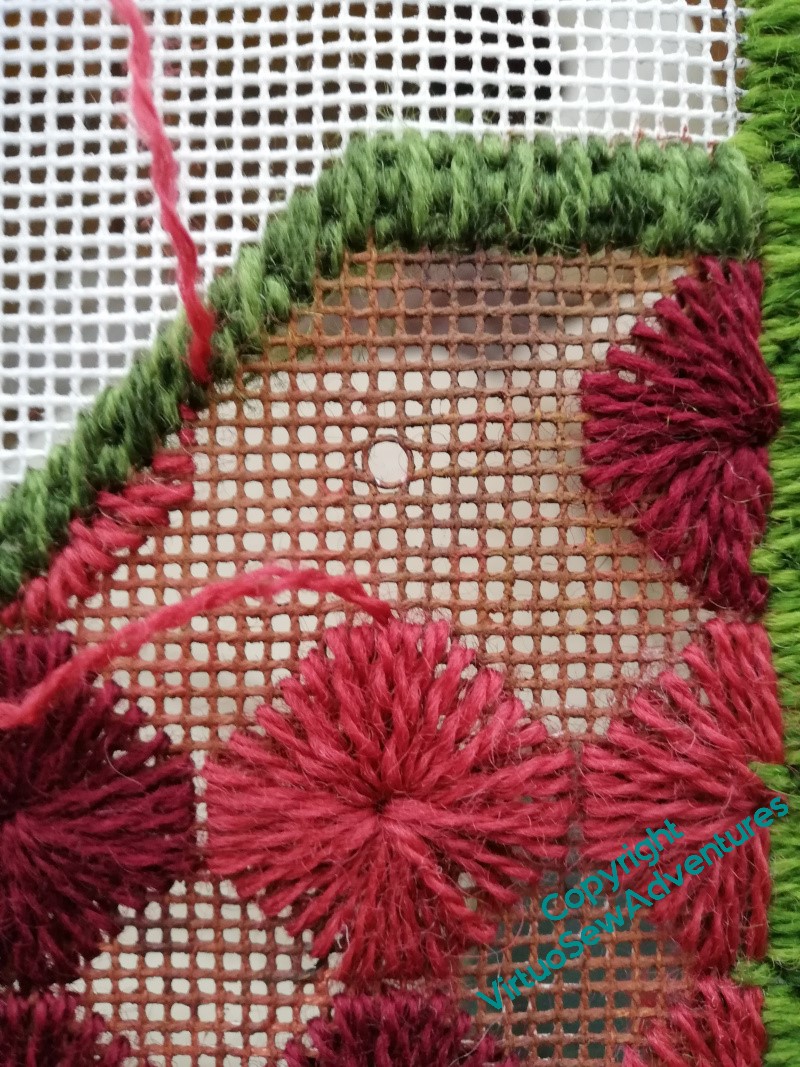
And then I moved on to the Super Large Squared Daisies, and, as it turned out, some repeated doing and undoing on one particular one, because I had misplaced the central hole.
Howl and Growl!
And do you know what is really infuriating?
It only went wrong in this particular case. All the others were fine.
Finishing William The Marshall
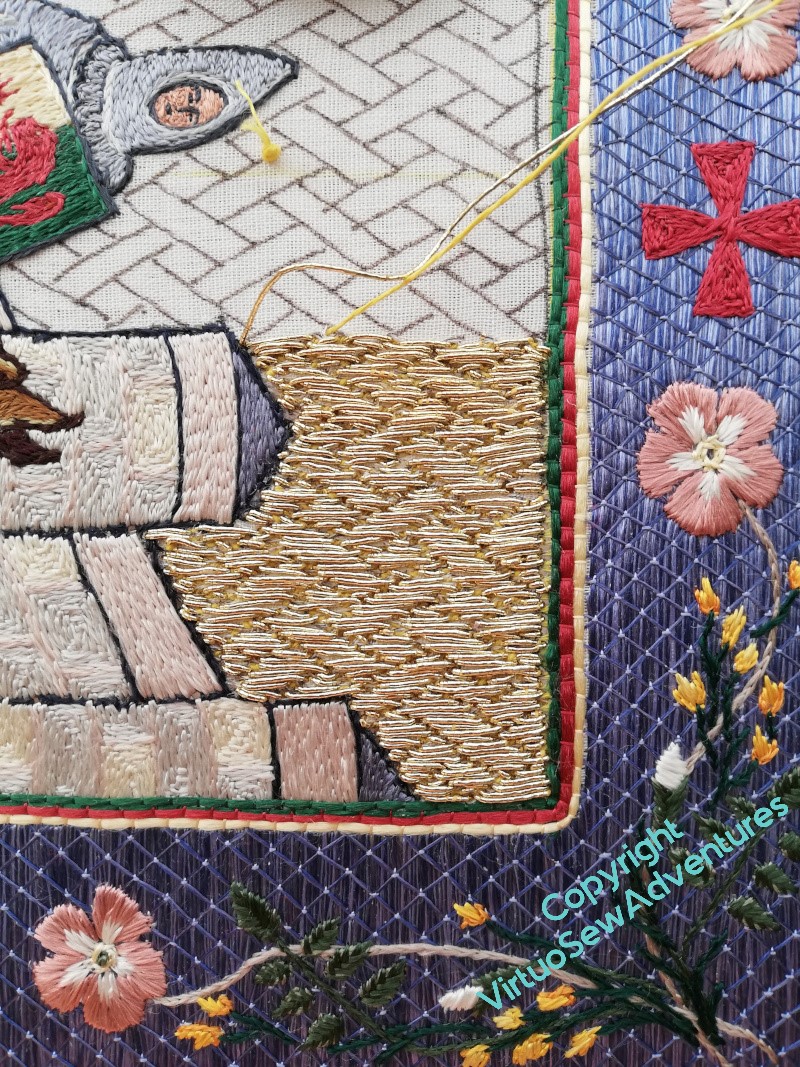
When we left William, I had just embarked on the underside couching, not without some trepidation, I have to say!
I stuck closely – one might say, religiously – to the advice about working underside couching that Tanya Bentham gives in her book about Opus Anglicanum. That is to say, no more than about half an hour at a time, no more than three sessions a day. In fact I think Tanya says 45 minutes, but I rapidly learnt that I lost focus and precision about the 33 minute mark, and two sessions were very much better for me than three.
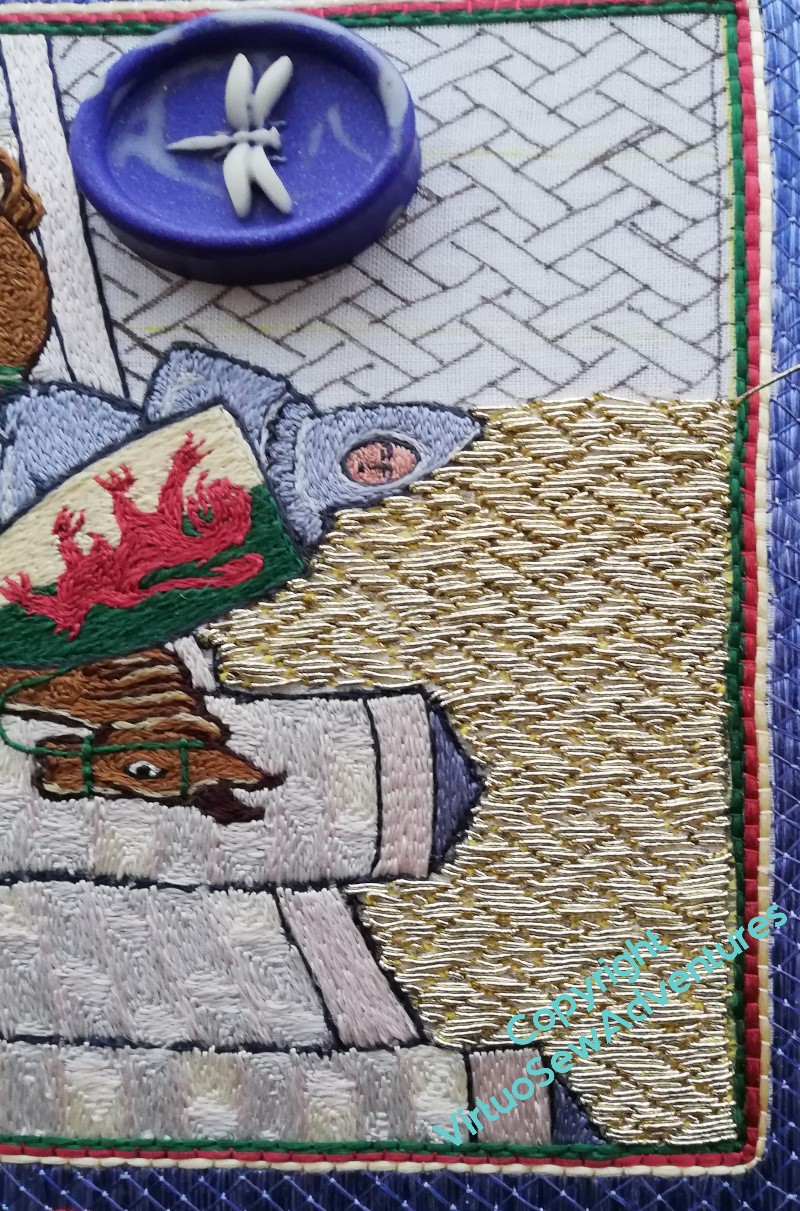
If you click on any of these pictures to expand them, (they should open in a separate window) you will certainly see some of the infelicities in my workings here – scraggly bits of fabric showing, unevennesses in the pattern, all sorts of misadventures. There were even a couple of points where the fabric, doubled though it was, gave way at points, necessitating all manner of ingenuity. I suspect that my tension was adrift, as I have a definite tendency to pull too tight on my stitches, especially if I’m concentrating on the unfamiliar.
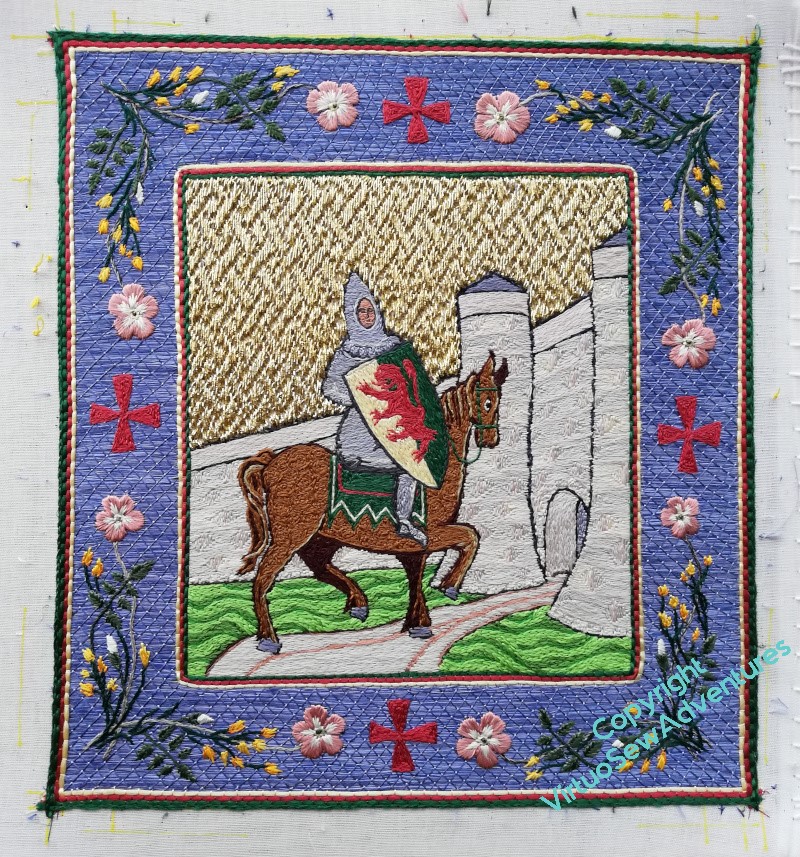
However, judge for yourselves whether I shouldn’t be pretty pleased with myself…
I do, of course, have to work out how I’m going to mount him, and on what, and it may be that in the end the lines of red, yellow, and green framing the border will need to be redone in some fashion. I like them as an idea, but as I move on to Aethelflaed, Rahere, and the Lady Julian, how much of a unity do I want to retain, and how on earth would I embody it?