Stella’s Birds – A few false starts
As anyone who follows my adventures will know, I always expect to improvise and have any number of false starts.
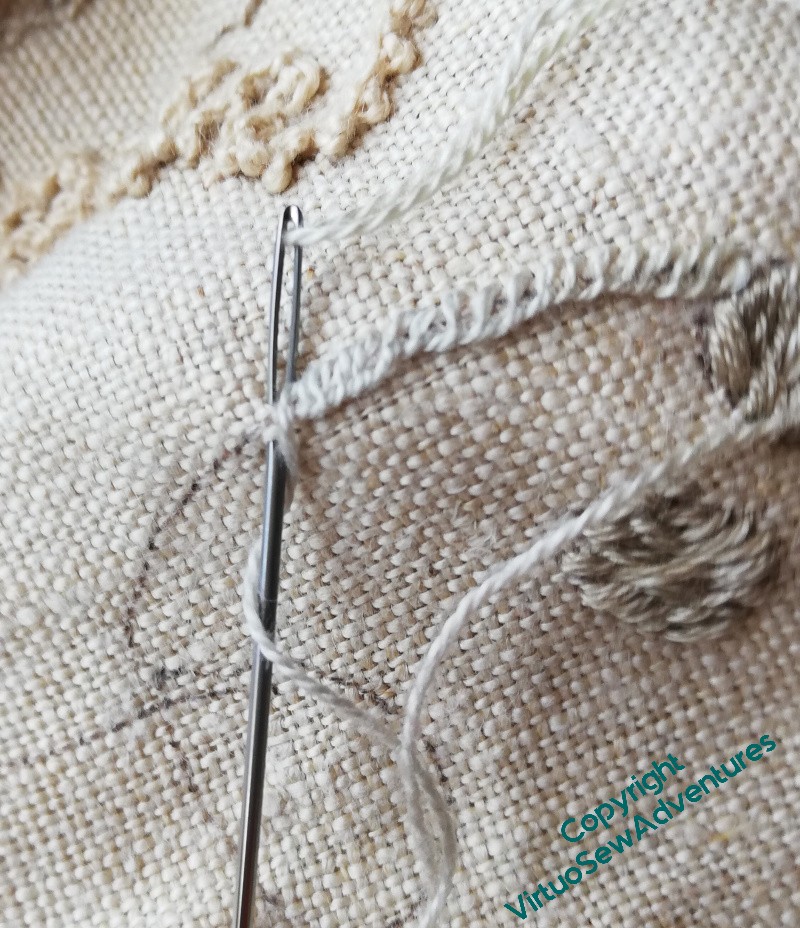
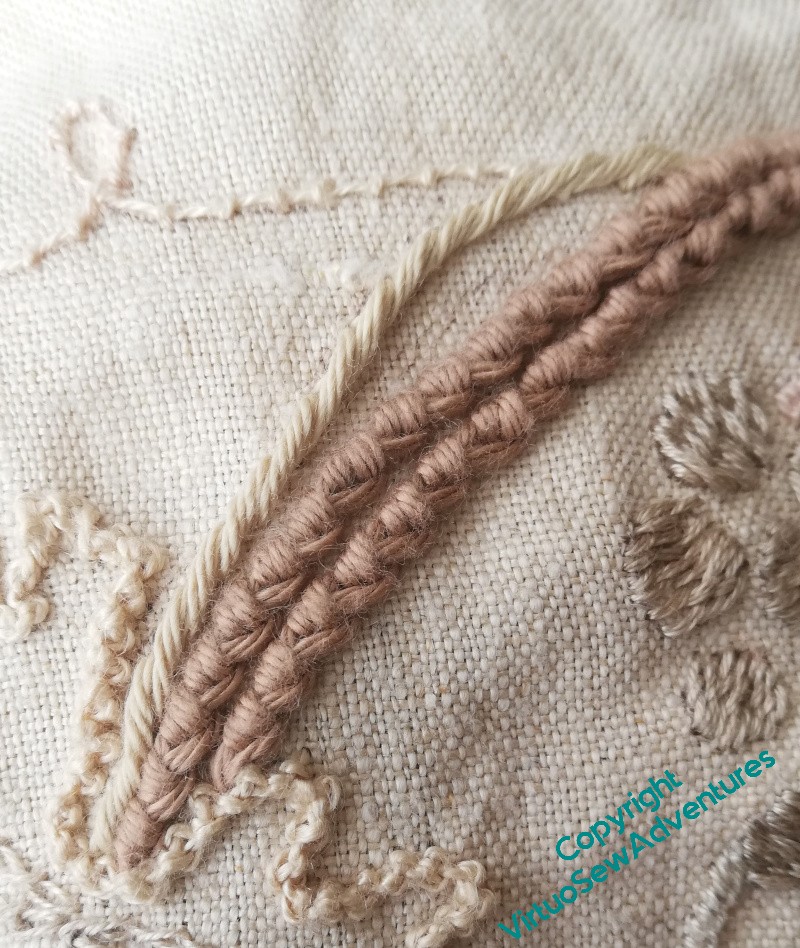
This is Cording Stitch, which is a classic Mountmellick work stitch, so I wanted to include it. I enjoyed stitching it, but once the whole design was stitched, I had Reservations.
I stared for a while, and then decided that it wasn’t working in the context I was using it, somehow it looked too stiff, and the thread didn’t seem like the right colour.
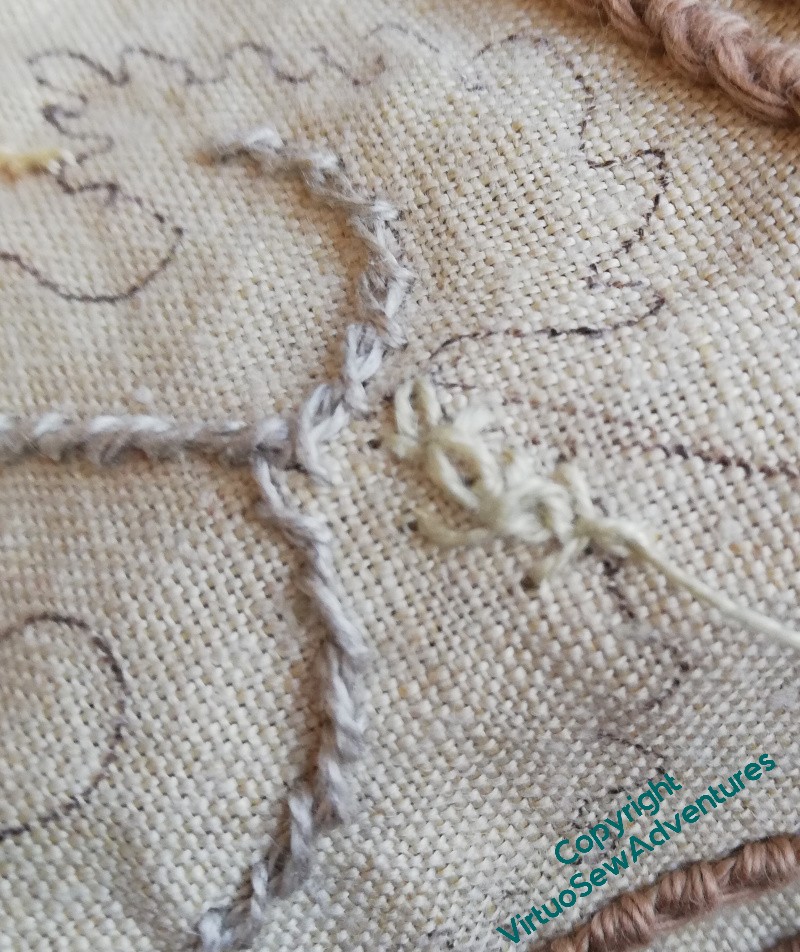
Another false start was when I started the second vine leaf. I was planning originally to have a riot of different stitches across the whole design. I was happy with the first one, in Palestrina Knot Stitch, but I thought I’d try something else.
Wheatear Stitch is a pretty stitch, and it fits well within the textural theme of the design, but it’s too broad – however hard I tried – to deal with all the wiggles around the edge of the vine leaves. After some thought, I realised that keeping some consistency in the “background” – the branches, the leaves, the tendrils – would enable the birds to shine.
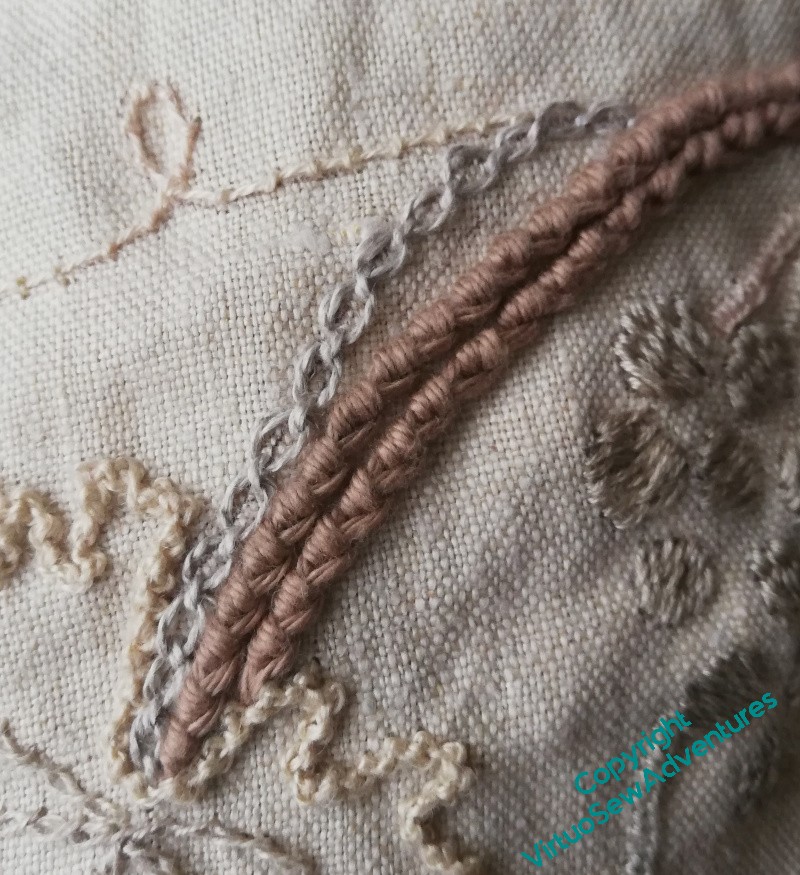
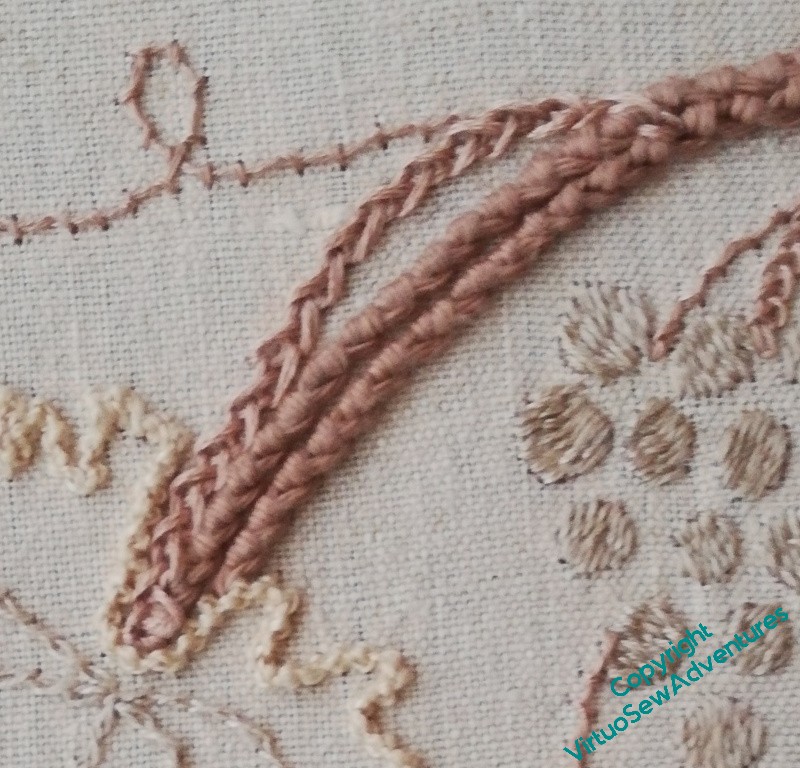
That insight helped me with the tendrils and the stems for the vine leaves, When I was first stitching them, I used different stitches, and different threads, and somehow the piece wasn’t hanging together. When I found a stranded cotton that matched the colour I used for the branches, and used that for the tendrils, and for the stems of the leaves and the grapes, that worked better.
The tendrils are now all in Coral Stitch, and the stems are a Feather Stitch variation. I’ve not been able to track it down, but it’s created a loose and pretty plaited effect that I’m very pleased with!

That plaited stitch is interesting. (A step-by-step how-to post would be nice.) You are right that some continuity of colour and/or stitch for the “boring” bits allows more focus of interest on the main subjects. Too much variety is sometimes as big a problem as too little.
In my opinion, it is not always the choice of stitch but the thickness of the thread that causes problems. Linear stitches, worked with a thick thread, can look so heavy, whereas a thinner thread produces a less dominating look.
I love Wheatear Stitch, but agree, it IS, and SHOULD BE, wide and loses its charm if we try to make it too slim and narrow.
Always good to see the lovely variety of stitches you use – and your false starts and how you remedie them!
You do have many false starts but you get there in the end.
I do admire your commitment to the integrity of the design in that you don’t shy away from unpicking and reworking until it feels/looks/tells you it’s right. It’s so tempting sometimes to let it go because you can’t face redoing it yet again, but this just proves that frustrating as it can feel, your determination pays dividends! (By the way, I’d picked the feather stitch variation as the one that felt right before I read that it was your final choice!)